From The Imaginative Conservative
By Louis Markos
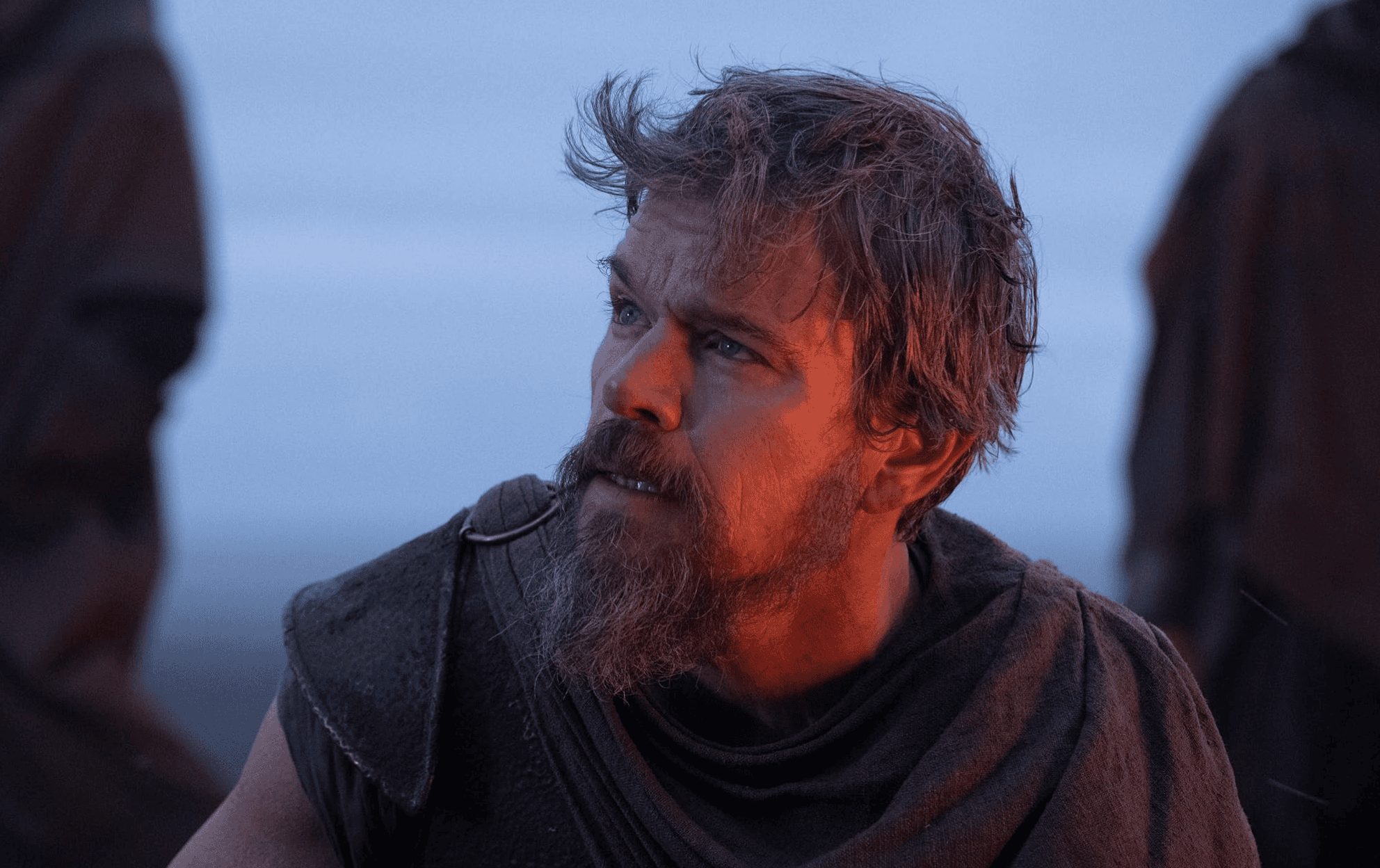 As an English professor who has taught the Odyssey every semester for the last 35 years, along with a dozen or so film classes on Hitchcock, Capra, musicals, Hollywood studios, and film classics, I awaited the release of Christopher Nolan’s Odyssey with great anticipation. Overall, I was impressed by the film and by Nolan’s fresh take on the epic, but it could have been much better, not on Homeric grounds but on the grounds Nolan set for himself. At the heart of the film lies a persuasive thesis that blends themes from Homer’s epic with the darker, more tragic vision of Aeschylus’ Oresteia trilogy and the aching sense of loss that pervades Virgil’s Aeneid.
The Odyssey revolves around xenia, the sacred relationship between guest and host that is guarded by Zeus himself (Zeus Xenos, the Guest God) and that brings catastrophe to those who violate it. When a stranger comes to the door of a Homeric Greek or Trojan, he is duty-bound to take him in, feed him, and clothe him before even asking his name. In return, the guest is to tell his story honestly, not steal from his host, and not overstay his welcome. If all goes well, the host will allow the stranger to leave with a gift, and the two will depart as guest-friends for life.
The Trojan War is sparked by a breach of xenia, when Paris, after being entertained in the home of Menelaus, leaves with his host’s wife, Helen. The suitors in Ithaca are, like Paris, bad guests who eat Penelope out of house and home and violate her maids, leading to their just execution. Odysseus’s men are bad guests when they eat the Cattle of the Sun and perish for it. Odysseus’s journey home is impeded by bad hosts (the Lotos Eaters, the Cyclops, the Lestrygonians, Circe, and Calypso) and aided by good ones (Aeolus, the Phaeacians). Telemachus is a good host in Ithaca and a good guest in the homes of Nestor and Menelaus, both of whom are model hosts.
While the Odyssey does not treat the Trojan Horse as a violation of xenia, it is treated as such in Aeschylus’ trilogy, which increases and darkens the ruse by connecting it thematically to a series of taboo crimes. Agamemnon’s father kills his nieces and nephews and feeds them to his brother; Agamemnon sacrifices his daughter to allow his fleet to sail to Troy; Agamemnon’s wife, Clytemnestra, sister of Helen, kills him when he returns from Troy; their son, Orestes, kills her and her lover to avenge his father. Homer, though he knows this version, transforms the subplot of Agamemnon into a film noir melodrama like Double Indemnity or The Postman Always Rings Twice. He leaves out the cannibalism, the sacrificing of the daughter, and the killing of husband by wife and mother by son. Instead, Clytemnestra is seduced by a man who kills her husband when he returns home, only to be killed by the husband’s son several years later.
Nolan adopts Aeschylus’ take on the war and its aftermath, referencing Agamemnon’s sacrifice of his daughter, the treachery of the Trojan Horse, and the descent into taboo violations of xenia that stands, historically, at the crux of the collapse of the golden Mycenean Bronze Age of Agamemnon, Menelaus, Nestor, Achilles, and Odysseus and the start of the Dark Ages during which Greece lost her written language, her monumental architecture, and her high culture. Nolan’s decision to establish a cause/effect relationship between the two is an effective one that neither violates history nor Homer and that segues well with Aeschylus and his fellow Athenian tragedians, Sophocles (Electra, Philoctetes) and Euripides (Trojan Women, Iphigenia at Aulis). It also makes historical sense of the Sea People, who appeared at the dawn of the Dark Ages.
To strengthen the power and reach of his thesis, Nolan conflates Homeric xenia with the Golden Rule of Jesus (do unto others as you would have them do unto you) to come up with what he calls Zeus’s Law. By constructing for his film a cross-cultural moral code (what C.S. Lewis dubbed the Tao) that connects the best of Greco-Roman ethical thinking with the Judeo-Christian teachings of Christ and the Church, Nolan transforms Homer’s time-and-place specific epic into a universal human morality play of what will happen to any culture when the deep, essential, unwritten laws of good and evil are breached.
Then, to clarify and give narrative shape to his dramatization of this breach, Nolan borrows a detail from Book II of the Aeneid, in which Virgil recounts—in flashback from the mouth of his hero—the fall of Troy. It is Virgil, not Homer, who tells the tale of the treacherous Sinon, who convinces the Trojans that the Horse is a sacred object and that if they take it into their city, it will bring them blessings from the gods. For his teachery, Dante puts Sinon in the eighth circle of hell with the falsifiers and handcuffs him to Potiphar’s wife, who pretended to be victimized by Joseph, when she, in fact, was the victimizer (Genesis 39).
Importing Sinon from Aeneid is a stroke of genius on Nolan’s part, for it increases the treachery of the Trojan Horse and its violation of Zeus’ law, making it the perfect initiating action to bring about the fall of the Bronze Age. It also draws in from Virgil the sense of a beautiful and heroic civilization (Troy) being lost, accompanied by a dim hope of promise (that Aeneas will lay the foundation for the greater Rome to come). Nolan conveys with great cinematic power Virgilian loss while hinting at hope when he has Odysseus sail off with Penelope at the end of the film to finish his expiation for his crimes and those of his crumbling civilization.
Sadly, though the Sinon subplot offers much potential, Nolan squanders it by not following Virgil. In the film, Sinon accuses Odysseus when the two meet in Hades of deceiving him and causing his death. But, in the film, Sinon is mortally wounded before he lies about the Horse. He is not killed because of his treachery. Worse yet, he emerges from the film as a fool for not figuring out on his own that Odysseus and his men are hiding in the Horse.
Had Nolan followed Aeneid II, he would have cemented his thesis in a consistent and powerful way. According to Virgil, Sinon runs to the Trojans for sanctuary, falsely claiming that Odysseus (Ulysses in Latin) tried to sacrifice him. When the Trojans, whom Virgil depicts as innocent and somewhat naïve, take pity on him and grant him sanctuary, Sinon says he no longer has any duty to help the Greeks and the devious, false-hearted Ulysses. To thank them for their hospitality to him, Sinon tells them that Ulysses hoped they would burn the Horse and thus bring down the wrath of the gods, but if they take it into Troy instead, they will please the gods.
What makes this scene so effective is that the deceiver Sinon speaks words of deception that were put in his mouth by Ulysses himself. Had Nolan filmed the scene this way, there would be no doubt in the viewer’s mind that the fall of the Bronze Age can be traced from this act of complex treachery. We would then know that Odysseus is a deceiver at heart and an unrepentant violator of Zeus’s law who needs to be chastened. I am not opposed to Nolan’s concept of Odysseus as suffering from PTSD. The problem is that we don’t see him do anything particularly heinous in the film. He is neither boastful nor bloodthirsty.
We never see or experience the cause of Odysseus’s PTSD. We don’t see Odysseus gloat over his cleverness or counsel Sinon in deceit. When the gates are opened to let in a dark, terrifying Agamemnon and his army, Odysseus steps aside and does not take part in the carnage. Indeed, in the farewell scene between Odysseus and Penelope that Nolan adds to the epic, we see he is opposed to the war before he even arrives at Troy, and that he does not seek personal glory or harbor a cruel, disproportionate vendetta against the city of Troy or its people.
And that leads to the deepest flaw in an otherwise well-conceived and well-shot film: its weak and inconsistent characterization of Odysseus. Let me begin by acknowledging that Nolan is perfectly in his rights to alter Odysseus’s archetypal associations. Few figures in literature have undergone such a sea change, from Homer’s heroic soldier who only wants to go home, to a Machiavellian villain in the Greek tragedies and Virgil, to Dante’s evil counselor, who yet has the courage to take a final voyage into the unknown, to Tennyson’s Victorian explorer with a fearless wanderlust and an indomitable spirit.
Nolan’s Odysseus, though well-acted by Matt Damon, lacks the power and intensity of any of these incarnations. He feels guilty and is willing to expiate his crimes; however, because we do not see the crimes, he comes across merely as dull and indecisive. And the major reason for that is Nolan’s failed reworking of the pivotal scene in the cave of the Cyclops Polyphemus, probably the best-known episode from ancient Greek literature.
I am not opposed on literary grounds to Nolan altering Odysseus’s adventures to enhance the cinematic experience of his audience and adapt a medium of words into a medium of images. His novel take on Circe’s transformation of Odysseus’s men into swine is truly eerie and memorable. His re-orchestrating of the scene with the Lestrygonians, trapping Odysseus’s men in moving trees rather than a closed harbor is masterful. His reimagining of Odysseus’s trip to Hades captures the nightmarish elements of Homer in a fresh way. His handling of the Sirens makes use of a well-written inner monologue and leaves the viewer to imagine the song that no sailor can resist. His conflation of Calypso, the Lotos Eaters, and the Phaeacians effectivity condenses an episodic narrative into a tightly-constructed plot.
All these changes are defensible, but not the cave of the Cyclops. Had Nolan followed Homer, he would have both clinched his thesis and shown us the dark side of Odysseus that merits his guilt and PTSD. In Homer, but not in Nolan, Odysseus is a bad guest, after the manner of the suitors in Ithaca, when he enters the cave. He helps himself to the food and encourages his men to do the same. Then, when his men beg him to leave, he refuses. Why? Because he wants to remain in hopes that the host will give him a big gift. Although xenia encourages the giving of gifts from host to guest, only a bad guest would enter a home in search of a gift. It is this breach of xenia, and not the Trojan Horse, that causes Odysseus to suffer so greatly.
But that is not all that Nolan misses. In the cave, we see both Odysseus’s arrogance and his cleverness. He is on his own in the cave, with no help from Athena or Hermes. Worse yet, he finds out that Polyphemus does not fear Zeus, the very god who punishes breaches in xenia. If Odysseus is to survive, he must rely upon his wits, an aspect of the hero that survives in all his various incarnations, but which Nolan ejects. (Since we don’t see Odysseus planning the Trojan Horse, we have no real sense that it was his cleverness that ended the Trojan War.) Without his cleverness, Odysseus is simply not Odysseus! I cannot fathom what possessed Nolan to leave out Odysseus’s famous play on words, in which he convinces the Cyclops that his name is “nobody,” a trick that bears fruit when the blinded cannibal cries out to his follow Cyclopes that his eye has been put out by “nobody,” and, of course, receives only ridicule. We also don’t see the clever ploy Odysseus uses to get his men out of the cave by tying them under the sheep, whose heads Polyphemus strokes before letting them out to feed.
Odysseus, the breacher of xenia and the trickster par excellence, is then robbed of a third essential aspect of his nature: his propensity to boast about his accomplishments. Odysseus and his men would have escaped the island without provoking the wrath of Poseidon, god of the sea and father of Polyphemus, had Odysseus not called out to the Cyclops and arrogantly revealed his name. When he does that, Polyphemus is empowered to level a curse on him, a curse that sets in motion all the suffering that Odysseus and his men encounter on the voyage home to Ithaca. Nolan’s rendering of the scene is terrifying and effective, but it fails to provide Odysseus with the necessary characterization to make him interesting and to help viewers understand why he remains one of the most beloved, and controversial, figures in all literature. In any case, nothing in Odysseus’s words or actions in the film justifies the confidence his men put in him.
Still, Nolan is to be commended for bringing so much of the Odyssey to cinematic life and for reminding us who live in the twenty-first century that our civilization is as tenuous as that of the ancient Myceneans. If we do not heed Zeus’s law, we too may find ourselves plunged into another Dark Age. We may also find, as Nolan’s Odysseus discovers, that he and his fellow soldiers are the very Sea People that they have been warned will bring about their downfall.
As the comic strip Pogo cautioned us long ago: “We have met the enemy and he is us.”
__________
The featured image is courtesy of IMDb.

No comments:
Post a Comment
Comments are subject to deletion if they are not germane. I have no problem with a bit of colourful language, but blasphemy or depraved profanity will not be allowed. Attacks on the Catholic Faith will not be tolerated. Comments will be deleted that are republican (Yanks! Note the lower case 'r'!), attacks on the legitimacy of Pope Leo XIV as the Vicar of Christ, the legitimacy of the House of Windsor or of the claims of the Elder Line of the House of France, or attacks on the legitimacy of any of the currently ruling Houses of Europe.