Chesterton may have been the most perspicacious observer of human life in the 20th century. At least, if he's not, he's in the top tier of the greatest.
From The Imaginative Conservative
By Bradley J. Birzer, PhD
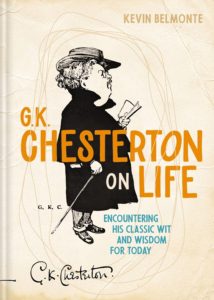
Kevin Belmonte’s glorious “G.K. Chesterton on Life” is a beautifully edited and compiled book, which looks at Chesterton’s character and personality, as well as his views on philosophy, nature, poetry, wit, London, words, proverbs, Modernity, literature, hearth and home, and, finally, Christmas. It is a delight of epicurean proportions.
G.K. Chesterton on Life: Encountering His Classic Wit and Wisdom for Today (208 pages, Thomas Nelson, 2026)
 One of my favorite, current writers is the extraordinary and prolific Kevin Belmonte. He’s a professional writer with more than thirty books to his credit. Perhaps most famous and best-known for his biography of William Wilberforce (the basis for the movie, Amazing Grace; he has also consulted for the BBC and PBS), Belmonte has also written extensively on evangelist D.L. Moody, C.H. Spurgeon, William Borden, the truth of miracles, and, my favorite, G.K. Chesterton. For TIC regulars, we might very well think of him as the Joseph Pearce of the Protestant world, and absent some of Joe’s more colorful past. Belmonte is also deeply rooted in New England culture and lives in beautiful Maine. Over the last decade or so, I must admit, Belmonte has also become a close friend—not only one of my closest friends on social media but in real, tangible, active life as well! He has also become well-known, most recently, as the lyricist for the Christian guitarist, Phil Keaggy. Indeed, they have a new album soon to appear. Finally, he’s one of the nicest guys imaginable, immensely loyal and quite capable of some of the best conversation known to man.
His most recent book, though, is the subject of this post, G.K. Chesterton on Life. Sadly, Belmonte’s expert commentary appears only sporadically throughout the book. Rather, it is a beautifully edited and compiled book, which looks at Chesterton’s character and personality, as well as his views on philosophy, nature, poetry, wit, London, words, proverbs, Modernity, literature, hearth and home, and, finally, Christmas. Each section contains what is nothing less than a “Portable and Quotable Chesterton.” Belmonte, who knows Chesterton intimately as well as being a man of impeccable taste, brilliantly brings the best of Chesterton to the reader. Even the book—compact in size, but with a beautiful hardcover, and multicolored pages and fonts—is a delight of epicurean proportions. Thomas Nelson, the publisher, is to be commended for producing this little book with heft.
For those who might not know, G.K. Chesterton (1874-1936) was one of the single finest Christian Humanists of the past two hundred and fifty years, comparable, in his own way, to Edmund Burke before him and C.S. Lewis after him. He was a big man and a man of immense wit, a lover of paradox and nuance. He had fascinating views on everything from economics to King Alfred to Christianity to myth to the Virgin Mary. Famously, he converted to Catholicism from Anglicanism and became, after Lewis and John Paul II, the greatest Christian apologist of his age. A poet, a novelist, and an essayist, there is little that Chesterton didn’t contemplate, digest, consider, and elucidate.
Even his man’s economics were fascinating. Neither a collectivist nor a radical individualist, Chesterton advocated what became known as Distributism, an anti-Marxian attempt to offer more and more property to families rather than collectivizing that property in society. Several Christian humanists, inspired by Chesterton, tried to create a Catholic colony at Ditchling, based on his economic principles.
Arguably, Chesterton’s most famous work was either Everlasting Man or Orthodoxy. In the former, he persuasively claimed that all men, by their very natures, crave myth and story.
As a matter of fact the Catholic Church has taken over the uproarious success the whole of this popular business of giving people local legends and lighter ceremonial movements. In so far as all this sort of paganism was innocent and in touch with nature, there is not reason why it should not be patronized by patron saints as much as by pagan gods. And in any case there are degrees of seriousness in the most natural make-believe. There is all the difference between fancying there are fairies in the wood, which often only means fancying a certain wood as fit for fairies, and really frightening ourselves until we walk a mile rather than pass a house we have told ourselves is haunted. Behind all these things is the fact that beauty and terror are very real things and related to a real spiritual world; and to touch them at all, even in doubt or fancy, is to stir the deep things of the soul.
Christianity, as such, was the first institution, therefore, to reconcile pagan stories with Greek rationality. These were the twin rivers that allowed a flourishing on the Tiber.
But in reality the rivers of mythology and philosophy run parallel and do not mingle till they meet in the sea of Christendom. Simple secularists still talk as if the Church had introduced a sort of schism between reason and religion. The truth is that the Church was actually the first thing that ever tried to combine reason and religion. There had never before been any such union of the priests and the philosophers. Mythology, then, sought God through the imagination; or sought truth by means of beauty…. But the imagination has its own laws and therefore its own triumphs, which neither logicians nor men of science can understand. . . . Imagination has its own laws and triumphs; and a tremendous power began to clothe its images, whether images in the mind or in the mud, whether in the bamboo of the South Sea Islands or the marble of the mountains of Hellas.
Chesterton’s greatest work, at least to my mind, is the utterly profound epic poem, Ballad of the White Horse. In it, Chesterton tells the story of the first English king, Alfred, in his attempt to unify the disparate Christians—old Romans, Celtic tribes, and Anglo-Saxons—to hold their own against the invading Danish heathen Vikings. The world, Chesterton poetically asserts, had ended long ago, with all of us living in some kind of Judgment Day. Alfred, a devout Christian, fights and fights, but fails to make headway against the Vikings. Frustrated, the forlorn king walks to the river and in a private moment rages at God. How could God forsake him when he is fighting for the Church, for the light of the Logos? In response, the Blessed Virgin Mary appears.
Out of the mouth of the Mother of God
Like a little word go I
For I go gather Christian men from sunken paving, ford and fen,
To die in battle, God knows when,
By God, but I know why
And this is the word of Mary
The word of the world’s desire
“No more of comfort shall ye get
Save that the sky grows darker yet
And the sea rises higher.”
Then silence sank.
Chesterton’s meaning could not be more clear. The battle is ours, but the war belongs to God. We have never been guaranteed victory, but we’ve been given the weapons to fight and the command to do so. The rest is in God’s hands, and we—little words made in the image of The Word—must do what we are called to do. We wage war fiercely, no matter the cost. Chesterton gorgeously ends the poem by noting that we in the twentieth century will miss the day when our enemies were men. For in the twentieth century, they will eat words and have ink on their hands; they will be like bureaucrats who devour and crush. Then, there will be no glorious battle of Christian vs. heathen, but man against the conformist abyss.
And, this brings me back to Belmonte’s glorious G.K. Chesterton on Life: Encountering His Classic Wit and Wisdom for Today. This fine book should be on the shelf of every Imaginative Conservative. It is a delight, and it will warrant reading, day in and day out, for many years to come.
All thanks to Belmonte!

No comments:
Post a Comment
Comments are subject to deletion if they are not germane. I have no problem with a bit of colourful language, but blasphemy or depraved profanity will not be allowed. Attacks on the Catholic Faith will not be tolerated. Comments will be deleted that are republican (Yanks! Note the lower case 'r'!), attacks on the legitimacy of Pope Leo XIV as the Vicar of Christ, the legitimacy of the House of Windsor or of the claims of the Elder Line of the House of France, or attacks on the legitimacy of any of the currently ruling Houses of Europe.