"Catholics did not invent wine. But what they did with it — liturgically, theologically, and in the cellars of a thousand monasteries — changed it forever."

From Aleteia
By Daniel Esparza
Catholics did not invent wine. But what they did with it — liturgically, theologically, and in the cellars of a thousand monasteries — changed it forever.Wine is older than Christianity by several thousand years. The evidence of winemaking in the Caucasus region dates to at least 6,000 BC. The ancient Egyptians, Greeks, and Romans all had sophisticated wine cultures long before the first Christian was baptized. What the Catholic tradition did with wine is a different and more interesting story than invention. It begins at a wedding.
Cana
The first miracle in the Gospel of John takes place at a wedding feast in Cana of Galilee, where the wine has run out. Mary notices and brings the problem to her son. Jesus tells the servants to fill six stone jars with water — jars used for ritual purification, each holding 20 to 30 gallons — and the water becomes wine. When the steward of the feast tastes it, he calls the bridegroom over: "You have kept the good wine until now." Not wine that would do, but the best wine, saved for last. Whatever the miracle at Cana means, it establishes from the beginning that the Christian relationship to wine is neither reluctant nor merely instrumental. It is generous, even lavish.
Then, on the night before his death, Jesus takes a cup of wine, gives thanks, and says: "This is my blood of the covenant, which is poured out for many." From that moment, wine is no longer a cultural artifact or a beverage. It is, in the Catholic understanding, the matter of the central act of Christian worship. Without wine, there is no Mass.

The monastic cellar
This liturgical necessity had practical consequences that shaped the history of European agriculture. Wherever Christianity spread, viticulture followed — not only because wine was needed for the Eucharist, but because monastic communities took seriously the Benedictine injunction that monks should earn their keep by the work of their hands. Viticulture required knowledge accumulated over generations, careful attention to soil and climate, and patience measured in years. Monasteries provided the perfect conditions under which that knowledge could be developed and preserved: stability, literacy, land, and time.
From the 12th century onward, Benedictine and Cistercian monasteries across France became custodians of Roman-era winemaking knowledge at a time when wars were devastating much of Europe. The Cistercians in Burgundy began the systematic study of the relationship between soil, climate, and grape quality that eventually produced the concept of the terroir—now fundamental to the understanding of fine wine. The Clos de Vougeot, a walled Burgundy vineyard still producing some of the world's most sought-after Pinot Noir, was created by the Cistercians in the 12th century. They built the wall themselves.
St. Martin of Tours — the 4th-century Roman soldier turned bishop — is still considered the spiritual father of French wine, credited with spreading viticulture through the Loire Valley and beyond. His monastery at Marmoutier became one of the most important winemaking centers in early medieval France.

Dom Pérignon
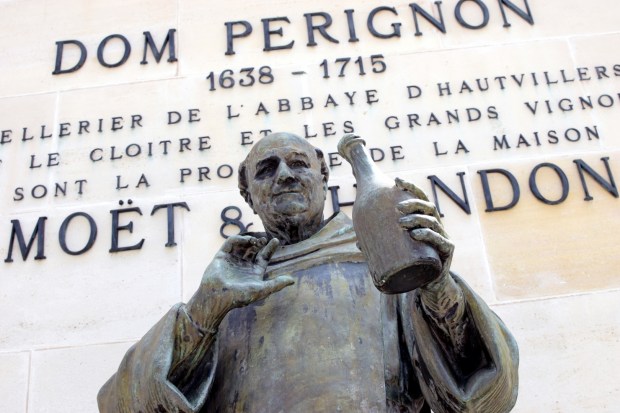
The story reaches its most famous episode in the cellars of the Abbey of Hautvillers, in the hills above Épernay in the Champagne region of northeastern France. In 1668, a Benedictine monk named Pierre Pérignon arrived as cellar master, responsible for the abbey's wine production and its considerable debts. The region at the time produced low-end wines the French court largely ignored, preferring the robust reds of Burgundy and Bordeaux.
Dom Pérignon — "Dom" being the title reserved for Benedictine monks in France — spent 47 years at Hautvillers working on two problems: how to make a clear white wine of consistent quality, and how to control the secondary fermentation that was causing bottles to explode in the cellars. His solutions were systematic: he pioneered blending grapes from different vineyards to harmonize their qualities, and experimented with cork stoppers imported from Spain to contain the pressure of sparkling wine without shattering the bottle.
The famous story — that he tasted his first sparkling wine and cried out "Come quickly, I am tasting the stars!" — is almost certainly apocryphal. What is certain is that Dom Pérignon was not the direct inventor of Champagne as we know it today, but that he made it possible, establishing the methods of blending and fermentation that gave the Champagne region its reputation. By the time he died in 1715, the abbey had doubled its vineyard holdings. He is buried in the abbey church at Hautvillers, and wine enthusiasts still make the pilgrimage to pay their respects. His successor and disciple, Dom Thierry Ruinart, continued his work; his nephew founded the oldest existing Champagne house in 1729, which still bears the family name.
After the cellar
The French Revolution dissolved most of the monasteries that had been the vehicle of this tradition, and the vineyards passed into secular hands — while retaining the viticultural knowledge the monks had spent centuries developing. The Italian version of this story runs through Franciacorta, the sparkling wine region northwest of Milan whose very name — franca corta, or tax-free court — refers to the Cluniac monasteries established there in the 11th century. The finest Franciacorta today is still produced by monastic communities, including the Servite Friars at the Convent of Annunciata in Rovato.
Wine remains, in the Catholic tradition, more than a beverage — the matter of a sacrament, the gift first given at a wedding, the blood poured out at the Last Supper. The monks who spent centuries perfecting its production were not primarily interested in making a luxury product. They were maintaining, with the attention that sacred things deserve, something they understood to be holy. That the results happened to be among the finest wines in the history of human civilization is no coincidence at all.


No comments:
Post a Comment
Comments are subject to deletion if they are not germane. I have no problem with a bit of colourful language, but blasphemy or depraved profanity will not be allowed. Attacks on the Catholic Faith will not be tolerated. Comments will be deleted that are republican (Yanks! Note the lower case 'r'!), attacks on the legitimacy of Pope Leo XIV as the Vicar of Christ, the legitimacy of the House of Windsor or of the claims of the Elder Line of the House of France, or attacks on the legitimacy of any of the currently ruling Houses of Europe.