30 October 2026

Bishop Challoner's Meditations ~ October 31st

ON THE FOUR CARDINAL VIRTUES

Consider first, that there are four moral virtues which are called cardinal; because they are, as it were, hinges upon which the whole life of a Christian must constantly move, if he would be good for anything. These are prudence, justice, fortitude, and temperance, which the wise man tells us, (Wisdom viii. 7,) are all taught by divine wisdom, and are such things as men can have nothing more profitable in life. All other moral virtues have a necessary dependence on these four; they all fall to the ground without them. Every virtue must be prudent and discreet in all it takes in hand, otherwise it degenerates into vice. Every virtue must be stout and valiant, firm and constant, in adhering to what is right, and opposing what is wrong. And every virtue must be sober and temperate, lest it exceeds the bounds of due moderation prescribed by right reason and religion. But, oh! what treasures of virtues do they possess that have acquired these four principal ones! These will effectually arm them against all vices.

Consider 2ndly, that Christian prudence is a virtue which teaches us in all things what is good and what is evil; what is right and what is wrong; and what ought to be done, and what ought to be left undone, in all the occurrences of life. 'Tis a virtue that directs all our words and actions in such a manner as that we neither decline out of the way, or offend ourselves, nor give occasion to others to offend; but ever setting before our eyes our great business and last end, makes always a proper choice of the means that are to bring us to this great end, and apply them accordingly. 'Tis a virtue that directs all other virtues; combining them all by the royal middle way of our great king, that they may not go aside by excess or defect, either to the right hand or to the left. The offices of this great virtue are to design and consult well, to judge right, and to direct well the execution, of what has been rightly concerted and judged to be proper. In all which it is helped, indeed, by the remembrance of things past, by the understanding of things present, by the forecasting of things to come, by reasoning, attention, caution, and circumspection; but all this with dependence on divine grace, and not on one's own industry, and with a continual application to our Lord, by frequent and fervent prayer for his light and assistance, without which our prudence will avail us nothing.

Consider 3rdly, the offices of the other three cardinal virtues and the excellence of them. Justice tenders to every one his due, and wrongs no one. It renders to every one his due, and wrongs no one. It teaches how to restrain every thought, every desire, every act of the will, every judgment, every word, every action, and every omission too, that any ways tend to injure one's neighbour, or that do not rightly square with that great principle of morality, 'Do as thou wouldst be done by.' And with regard to God, (who has the most undoubted right, by all manner of titles, to our whole being, and to all our service,) it obliges us, before all things, to dedicate our whole hearts and souls to him by worship and love. Then fortitude arms the soul with invincible courage in her warfare against her spiritual enemies, and gives her strength and constancy to enable her to overcome all fear or dread of any of those evils which she may be exposed to in her mortal pilgrimage for doing her duty, and resolution to suffer everything rather than to sin. Lastly, temperance restrains all immoderation in eating or drinking, with all other excesses of our passions or lusts, and all that any ways carry us out of the due bounds prescribed either by right reason and the law of nature, or by the precepts of God, or by them that have their authority from him, in the employment or functions of any of our senses, whether the exterior or interior. See, my soul, how admirable are all these virtues! Oh! there is not a day, there is scarce an hour of thy mortal life, in which thou dost not stand in need of them all.

Conclude to esteem and desire, love and seek, all these blessed virtues. O spare no pains to acquire them - they are richly worth all thy labour. But ever remember whose gifts they are, and that they must come to thee by fervent prayer. All thy labour, without this, will be labour in vain.

31 October, Antonio, Cardinal Bacci: Meditations For Each Day


Motives of Humility

1. Humility is the most necessary and the most difficult of the virtues. It is the most necessary because it is the foundation of the entire Christian edifice of spiritual perfection. No stable structure can be built without a firm foundation.


This virtue is also necessary because God gives His grace only to the humble, and without His grace we can gain no supernatural merit. “God resists the proud but gives grace to the humble.” (James 4:6) Humility is, moreover, the most difficult of the virtues. It is hard to renounce one's possessions and give them away to the poor in accordance with the evangelical counsel. It is harder to renounce one's wayward instincts and passions. It is even harder, however, to renounce one's own ego with all its immoderate desires. Nevertheless, this is what Christian humility demands of us. We must deny ourselves and acknowledge our nothingness. We must recognise that it is folly to glory in things which do not belong to us, but are merely gifts from God.

It is necessary to practise the virtue of humility continually if we are to become humble. For this purpose it is useful to meditate on the motives which should inspire us to humble ourselves both before God and before men. Our sins constitute one of these motives. All that we are and all that we have in the physical and in the supernatural order are gifts from our Creator and Redeemer, but sin belongs to us alone.

It is we ourselves who are responsible for sin, because in direct opposition to His will we abused the faculties which God gave us. This is surely a reason for humiliating ourselves; sin, which is an offence against God and is our spiritual ruination, is the only thing which we can claim as properly belonging to us. Unfortunately, we have committed innumerable sins in thought, word, deed, and omission; alone and in public, by day and by night, as children and as adults; against the commandments of God, against the precepts of the Church, and against the obligations of our state in life. Our whole existence has been marred by offences and acts of ingratitude against God, our greatest Benefactor.

2. Another motive for humility is our deficiency in virtue. We have received many gifts from God, but what use have we made of them? We have received gifts of nature and of grace, good inspirations, good example, and precious time and opportunity for doing good. On those occasions when the voice of God spoke most clearly in our hearts, we made good resolutions and promised to abandon sin and to walk with greater fervour in the way of perfection. Unfortunately, however, we continue to lag behind. This is a new motive for humbling ourselves and for beseeching from God the gift of perseverance.

3. Finally, there is the transient nature of mortal life. One illness is enough to carry us to the grave, there to rot and to be eaten by worms. It is sufficient for the capillary vessel of the brain to be burst in order to render us incapable of forming a single thought or of uttering a single word. We imagine that we are very important, whereas in fact we are insignificant before God and before the mighty universe. Let us do our best, therefore, to be humble. If we can become as little children, God will be pleased with us and will make us members of His kingdom. “Unless you turn and become like little children, you will not enter into the kingdom of heaven.” (Mt. 18:3)

Byzantine Saints: Bishop Theodore Romzha

Byzantine Saints: Apostle Epίmakhos of Alexandria

Byzantine Saints: Holy Apostles Stakhys, Apellēs, Amplίas, Urban, and Nárcissus of the 70 and Others with Them

From an Orthodox source.

Eastern Rite ~ Feasts of 31 October AM 7534

Today is the Feasts of the Holy Apostles Stakhys, Apellēs, Amplίas, Urban, and Nárcissus of the 70 and Others with Them, of the Holy Martyr Epίmakhos & of the Blessed Hieromartyr 
Theodore Romzha.
✠✠✠✠✠
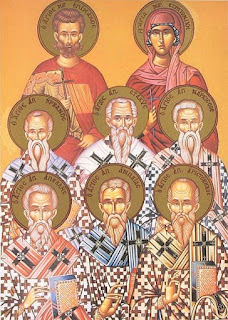
Saint Stachys, one of the Seventy Apostles, was ordained as Bishop of Byzantium by Saint Andrew (November 30). He founded a church at Argyropolis, and many people gathered there to hear him preach. He was a good shepherd to his flock, zealously proclaiming the Gospel of Christ, converting many to the true Faith, and laboring tirelessly for their salvation for sixteen years. He departed to the Lord in peace.

Saints Amplίas and Urban were also made Bishops by Saint Andrew. Amplίas was the Bishop of Diopolis, and Urban was the Bishop of Macedonia. They also suffered martyrdom because they were destroying the pagan idols.

Saint Nárcissus was appointed as Bishop of Athens by the Apostle Philip. He was tortured and put to death by the idol-worshippers because of his zeal in proclaiming the truth of the Gospel.

Saint Apellēs was the Bishop of Herakleia, and he brought many to the Christian Faith.

Saint Aristóboulos, one of the Seventy Apostles, was the brother of Saint Barnabas (June 11) and proclaimed the Gospel in Britain, where he died in peace. He is also commemorated on March 16, but on March 15 in Greek usage.

Troparion — Tone 5

(Podoben: “Come, let us worship the Word...“)
Let us acclaim Stachys, Apellēs, Amplίas, Urban, Nárcissus, and Aristóboulos as a six-stringed harp of the Spirit, / singing of God's marvellous gifts to mankind. / Together, as divine Apostles, / they ask that grace may be granted to our souls

Kontakion — Tone 8

(Podoben: “As the first fruits of our nature...“)
Fittingly, let us praise those sacred treasures of the All-Holy Spirit and rays of the Sun of Glory, / the wise Apostles Apellēs, Urban, Aristóboulos, Amplίas, Nárcissus, and Stakhys, / who received grace from our God.
✠✠✠✠✠

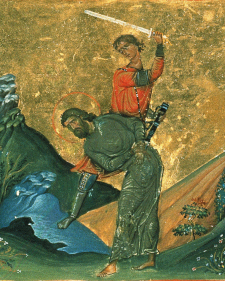
The Holy Martyr Epίmakhos of Alexandria was a native of Egypt. For a long time, he lived in seclusion on Mount Pēlousium. When he learned that Christians were being persecuted in Alexandria, Saint Epίmakhos entered the city and destroyed some pagan idols, declaring that he too was a Christian. Apellianos, the eparch of Alexandria, ordered him to sacrifice to the idols, and when the Saint refused to do this, he commanded that he be tortured.

Among those who witnessed his suffering was a woman who was blind in one eye. A drop of the Martyr's blood fell into her eye and she received her sight. Thus, the woman came to believe in Christ. After enduring many fierce torments, the Saint was beheaded with a sword.

The Holy Martyr Epίmakhos is also commemorated on March 11 (the transfer of his relics).

Troparion — Tone 4

Your holy martyr Epίmakhos, O Lord, / through his suffering has received an incorruptible crown from You, our God. / For having Your strength, he laid low his adversaries, / and shattered the powerless boldness of demons. / Through his intercessions, save our souls.

Kontakion — Tone 3

(Podoben: “Today the Virgin...”)
Of your own accord you went to contend for the true Faith, O Epίmakhos, / and courageously you cried out to the impious: / "I have come to strive in a contest for the truth, / and to destroy the idols of perdition." / And when you were beheaded, you received a crown of righteousness.
✠✠✠✠✠


1.
 Bishop Theodore G. Romzha was born of humble parentage on April 14, 1911 in Velikij Bychkiv, in the heart of the colorful district of Maramorosh, Subcarpathian Ruthenia. He was a pious and gifted young boy, and his only ambition was to become a priest.

He received his secondary education at the gymnasium (high school) in Chust. Due to his friendly disposition and scholastic achievements he became one of the most popular students. His popularity increased even more when he proved himself as an all-around athlete, excelling in soccer. At his graduation, he took everybody by surprise when he announced his intention of becoming a priest. He was sent to Rome for his priestly formation.

He lived at the German-Hungarian College in Rome for the first two years and then, in 1932, he moved to the Russian Pontifical Seminary, known as the “Russicum,” in order to prepare himself for missionary work in Soviet Russia. It was indeed a providential step, since in the “Russicum” he was expected to study communist atheism and its ideology. Thus, unwittingly, he prepared himself for the Soviet occupation of his native land. He was ordained to the priesthood in Rome on Christmas Day, December 25, 1936.

In the summer of the following year he came home to celebrate his “first” Liturgy with the intention of returning to finish his doctoral dissertation. But instead of returning to Rome, he was drafted into military service and sent to protect his country against the German invasion. To his friend in Rome he confided : ” I am going to the front with a deep conviction of doing the will of God. Therefore, I do not fear what will happen to me.”

2. Those were turbulent days in Europe. Even after Father Romzha’s discharge from the army in August 1938, the danger of approaching war remained. For this reason Bishop Alexander Stojka (1932-1943) did not permit him to leave the country, but appointed him to a forgotten parish of Berezovo, Maramorosh District. The young priest Romzha became a poor pastor among poor people. There were times when he could afford only one meal a day while trying to help his needy parishioners. But he did not complain. On the contrary, he was always ready to help. To his curious friend in Rome he wrote: “I live here as a pauper and yet I feel happy and satisfied.”

Father Romzha was a good and dedicated priest. He taught his parishioners not only to know their Faith but also to live it. The parishioners once again became proud of their small church. They could never forget him. He was their best pastor ever. In March 1939, the Hungarians once more occupied Subcarpathian Ruthenia by force. Great political and ecclesiastical changes followed. Bishop Stojka was forced by the Hungarian government to reorganize even the Seminary Staff. Thus, in the fall of 1939 Father Romzha was appointed Spiritual Director and Professor of Philosophy at the Eparchial Seminary in Uzhorod.

One of his students later recalled: “He was strict and demanding as a Professor, but as a Spiritual Director he was fatherly and kind. He knew how to inspire us and to bring out the best in us. Staying in close contact with us, his students, he was able to transplant into our hearts the main features of his strong priestly character. His dedication, genuine piety and generosity of heart.”

3. Even at the Seminary Father Romzha found some time for pastoral work by helping in the neighboring parishes. He enjoyed conducting missions and retreats for young students. Every penny he earned he generously distributed to the poor. To the mentioned friend in Rome he wrote: “I am living very unpretentiously, and yet my pockets are always empty. But I am not discouraged, since I am working not for the money but to please God.”

Bishop Stojka greatly appreciated the dedicated work of Father Romzha, and in 1942 obtained for him the papal dignity of Monsignor. But even then he remained a humble and dedicated priest, inspiring and winning the admiration and respect of all those who met him.

On May 31, 1943, during the critical time of the war, Bishop Alexander Stojka suddenly died. In view of the uncertainties of the time, the Holy See appointed Bishop Nicholas Dudash, OSBM of Hajdudorog as the temporary administrator of the Mukachevo Eparchy. While the Soviet army was rapidly approaching the Carpathian Mountains, the Holy See promptly appointed Msgr. Theodore G. Romzha to succeed Bishop Dudash as the Apostolic Administrator of Mukachevo. His episcopal ordination took place in Uzhorod, September 24, 1944. A month later, the entire territory of the Mukachevo Eparchy was occupied by the Red Army.

Bishop Romzha was informed that Subcarpathian Ruthenia will be again incorporated into post-war Czechoslovakia as an autonomous province. However, it soon became evident that the Soviets would not relinquish this politically strategic region. Consequently, on June 29, 1945, Subcarpathian Ruthenia was officially incorporated into the Soviet Ukraine. Thus the young and inexperienced Bishop Romzha found himself and his flock under Soviet atheistic rule.

4. At the beginning, Bishop Romzha tried not to antagonize the Soviet authorities, although some abusive and violent actions committed by the Soviet soldiers against the clergy were reported to him. But when the Soviet authorities started to expel the priests from their parishes at random and confiscate the church property, he was forced to protest against such abuses.

The Soviets had a ready answer: “Since the attitude of the Vatican is hostile toward the Soviet Union, the Soviet government cannot tolerate within its borders the Greek Catholic Church, loyal to the Vatican. Therefore, there is only one solution for you. You must recognize and submit to the jurisdiction of the Patriarch of Moscow.”  Bishop Romzha immediately replied : “I will rather die than betray my Church!” This signalled the open persecution of the Greek Catholic Church in Subcarpathia.

In the fall of 1945 Patriarch Alexis of Moscow appointed Bishop Nestor Sydoruk of Umany to head the Orthodox Eparchy of Mukachevo. Nestor was hailed by the Soviet press as the only legally appointed bishop, and received full support from the Soviet authorities. Intimidation, violent removal and imprisonment of leading Greek Catholic priests and faithful followed. It became clear that Bishop Nestor was appointed to liquidate the Greek Catholic Eparchy of Mukachevo.

Bishop Romzha decided to fight. As the Good Shepherd, he was ready to lay down his own life for his sheep. Although the Soviet authorities confiscated his car, he travelled long distance by horse and buggy, just to reassure his faithful and to encourage them to persevere until death, saying, ” They are taking from us our own priests and churches, but they will never be able to take away our faith from us.

5. During his extensive visitations Bishop Romzha tried to sustain the faith of the weak, to reassure the wavering, and to plead with those intimidated: “Faith is our greatest treasure on this earth. To preserve our faith we must even be ready to lay down our life. If we must die, then let us die as true martyrs, defending our faith. One thing is sure that we never will abandon our faith nor betray our Church.”

The faithful, supported by dedicated clergy, responded enthusiastically. They stood united behind their fearless Shepherd. Even some Orthodox parishes, seeing the violence and injustice perpetrated by the Soviets, asked Bishop Romzha to accept them back into the Catholic fold.

During these days of violence and open persecution Bishop Romzha offered his prayers and sufferings for the perseverance of his clergy and the faithful. He was sustained by his unshakable confidence in God’s Providence, and down deep in his courageous heart he vividly felt the protection of the Blessed Mother. There was no power that could shake up his loyalty to the Holy See. In his mind there was only “one, holy, catholic and apostolic Church,” established by our Lord on the rock of Peter and headed by His Vicar on the earth, the Pope of Rome. For this truth Bishop Romzha was ready to sacrifice his own life.

6. The Soviets were unable to intimidate Bishop Romzha. Therefore, they decided to liquidate him. First they staged a highway accident. The horse drawn carriage in which Bishop was returning home from the rededication of the church in Lavki, near Mukachevo, was rammed by a military truck. Bishop Romzha was badly injured, but he survived the attempted murder. The passersby took him to the hospital in Mukachevo. In a few days he began to regain his strength. Then suddenly, early on the morning of November 1, 1947, he was found dead. The night before Bishop Romzha’s death, the director of the hospital and a strange nurse, who promptly disappeared the next day, were seen entering Bishop’s room about midnight. They poisoned him! The Soviet authorities announced that Bishop Romzha died from injuries suffered in his highway accident, but the people knew better. They knew that their intrepid Shepherd was mercilessly killed for refusing to join the Orthodox Church.

Troparion - Tone 4

My father, my father! The chariots of Israel and its horsemen! Up on a cart as up on his bishop's throne, Theodore has been carried beyond the sanctuary veil. Let fall, O father, your mantle of pray'r, and beseech Christ to save our souls.

Kontakion - Tone 4

Though the godless poured poison into your veins, your heart still beats with love for Christ, O Bishop Theodore, martyred father, who now raise your prayer before the Throne of God.

IN LUMINE FIDEI: 31 OCTOBER – VIGIL OF ALL SAINTS ( ALL HALLOWS EVE)


IN LUMINE FIDEI: 31 OCTOBER – VIGIL OF ALL SAINTS (ALL HALLOWS EVE):   Dom Prosper Guéranger: Let us prepare our souls for the graces Heaven is about to shower upon the Earth in return for its homage. Tomor...

31 October, The Chesterton Calendar

OCTOBER 31st
HALLOW E'EN

If we ever get the English back on to the English land they will become again a religious people, if all goes well, a superstitious people. The absence from modern life of both the higher and the lower forms of faith is largely due to a divorce from nature and the trees and clouds. If we have no more turnip ghosts it is chiefly from the lack of turnips.

'Heretics.'

31 October, The Holy Rule of St Benedict, Patriarch of Western Monasticism


CHAPTER XXIV. What the measure of excommunication should be

1 Mar. 1 July. 31 Oct.

The measure of excommunication or chastisement should be meted out according to the gravity of the offence, the estimation of which shall be left to the judgment of the Abbot. If any brother be found guilty of lighter faults, let him be excluded from the common table. And this shall be the rule for one so deprived: he shall intone neither Psalm nor antiphon in the Oratory, nor shall he read a lesson, until he have made satisfaction. Let him take his meals alone, after those of the brethren so that if, for example, the brethren eat at the sixth hour, let him eat at the ninth: if they eat at the ninth, let him eat in the evening, until by proper satisfaction he obtain pardon.

1 November, The Roman Martyrology


K
aléndis Novémbris Luna vicésima prima. Anno Dómini 2026
November 1st 2026, the 21st day of the Moon,
The morrow is the Feast of All the Saints. This famous feast was instituted to be held every year throughout the whole city of Rome, in honour of the Blessed Virgin Mary, Mother of God, and of all the holy martyrs, by Pope Boniface IV, after he had consecrated to Christian worship the temple called the Pantheon or Temple of all the gods. And the same festival was afterwards being kept in diverse ways in diverse churches, when Gregory IV decreed that it should be solemnly observed for ever throughout the universal Church upon the first day of November, in honour of all the Saints.
Upon the same 1st day of November, were born into the better life:
In Persia, under King Sapor, the holy martyrs John the Bishop and James the Priest.
At Terracina, in Campania, (in the reign of the Emperor Diocletian,) the holy Deacon Caesarius, who suffered many days in prison, and was afterwards put into a sack, along with the holy Priest Julian, and cast into the sea.
At Dijon, the holy Priest Benignus, who was sent into Gaul to preach the Gospel by blessed Polycarp, under the Emperor Marcus Aurelius. He was put to many most grievous torments by the judge Terence, who commanded at last that his neck should be struck with an iron bar and a lance thrust through his body.
At Damascus, suffered the holy martyrs Caesarius, Dacius, and five others.
Upon the same day, the holy handmaiden Mary, who was accused of Christianity, under the Emperor Hadrian. She was grievously lashed, racked, and torn with hooks, and so suffered martyrdom.
At Tarsus, under the Emperor Maximian, holy Cyrenia and Juliana.
(At Clermont,) in Auvergne, holy Austremonius, the first Bishop of that see.
At Paris, (in the fifth century,) deceased the holy Marcellus, Bishop (of that see.)
At Bayeux, in the time of Childebert, King of the Franks, holy Vigor, Bishop (of that see.)
At Angers, holy Lucinius, Bishop of that city, a man of reverend holiness.
At Tivoli, the holy Monk Severinus.
In the Gatinais, (in the fourth century,) the holy Confessor Maturin.
℣. And elsewhere many other holy martyrs, confessors, and holy virgins.
℟. Thanks be to God.

Meme of the Moment

Today is the 166th anniversary of her birth.

Traditional Catholic Evening Prayers in English | October


Traditional Catholic evening devotional prayers to close your day with your mind, heart, tongue, and soul on our Lord! The month of October is dedicated to the Most Holy Rosary of the Blessed Virgin Mary. Begin and end each day with prayer and make a sincere commitment this month to pray the Rosary every day! This video is a compilation of many traditional evening prayers Catholics say, and should not be considered a replacement for those who have an obligation to pray the Divine Office evening prayers.

Compline

From St Thomas Aquinas Seminary. You may follow the Office at Divinum Officium.

Byzantine Saints: Martyr Eutropia of Alexandria

Bld Angelus of Acri: Butler's Lives of the Saints

Stations of the Cross According to St Francis of Assisi


From the Apostolic Penitentiary:

A plenary indulgence is granted to those who piously make the Way of the Cross. The gaining of the indulgence is regulated by the following rules:

1. Must be done before stations of the cross legitimately erected.

2. 14 stations are required. Although it is customary for the icons to represent pictures or images, 14 simple crosses will suffice.

3. The common practice consists of fourteen pious readings to which some vocal prayers are added.. However, nothing more is required than a pious meditation on the Passion and Death of the Lord, which need not be a particular consideration of the individual mysteries of the stations.

4. A movement from one station to the next is required. But if the stations are made publicly and it is not possible for everyone taking part to go from station to station, it suffices if at least the one conducting the exercise goes from station to station, the others remaining in their places.

5. Those who are "impeded" can gain the same indulgence if they spend at least one half and hour in pious reading and meditation on the Passion and Death of our Lord Jesus Christ.

Vespers of Friday in Pentecostide

From the Canons Regular of the New Jerusalem. You may follow the Office at Divinum Officium.

Summa Contra Gentiles, Book III: XXX That Man’s Happiness Does Not Consist in Wealth

From Contemplating History


Saint Thomas Aquinas (1225 – 7 March 1274), was a Doctor of the Church, Philosopher, Theologian, Jurist, Dominican Friar, and Priest. Known as Doctor Angelicus "Angelic Doctor," and the Doctor Communis "Universal Doctor" his writings serve as a defense and proof of the validity of Christ's authority over all. The Summa contra Gentiles (also known as Liber de veritate catholicae fidei contra errores infidelium, "Book on the truth of the Catholic faith against the errors of the unbelievers"). The Summa contra Gentiles consists of four books. The structure of Saint Thomas's work is designed to proceed from general philosophical arguments for monotheism, to which Muslims and Jews are likely to consent even within their own respective religious traditions, before progressing to the discussion of specifically Christian doctrine.
Book III discusses providence and the human condition, that is good and evil acts, human fate and intellect and the relation of created beings to the creator. Whether you are a history enthusiast, a student of religion, or simply curious about the impact of the Roman Catholic Church on the world, this playlist is designed to provide an informative and engaging journey through its captivating past. Subscribe to the Contemplating History channel for more educational content and immerse yourself in the rich tapestry of history.

Is AI Sentient? Why Some Tech Experts Are Trying to Convince the Catholic Church

From EWTN


Pope Leo XIV is urging vigilance, not alarm, over artificial intelligence. Some tech experts believe AI agents may be showing signs of sentience or self-awareness, an idea rejected by the vast majority of mainstream computer scientists and cognitive researchers. Oz Sultan, CEO of the Sultan Interactive Group, joins to discuss why the AI industry is spending so much time and money trying to win over the Catholic Church and other religious groups, why the Catholic Church is of special interest to them, and how a declaration of AI sentience could impact the industry. He also discusses Pope Leo XIV's recent encyclical, which refutes much of what the tech industry is seeking.

The Holy Rosary

Friday, the Sorrowful Mysteries, in Latin with Cardinal Burke.

Saint Louis IX, King of France: Wisdom and Justice

From Real Crusades History


J Stephen Roberts presents a reading from Jean of Joinville's Life of Saint Louis IX of France. Joinville and Villehardouin: Chronicles of the Crusades (Penguin, 1963), p. 176-79.

Being and Metaphysics

With Fr Thomas Joseph White, OP, DPhil (Oxon), STL, Rector Magnificus of the Pontifical University of Saint Thomas Aquinas in Rome.

Where Are You Going, Humanity? The Church’s Answer in 5 Points

The International Theological Commission’s document points out tht the benefits of technology will only be for the rich. No poor people need apply.

From Aleteia

By Daniel Esparza

The International Theological Commission’s major document on transhumanism and posthumanism is the most ambitious Catholic statement on the future of the human person in decades.

On March 4, 2026, the International Theological Commission published Quo Vadis, Humanitas? — “Where are you going, humanity?” — a 164-paragraph document on Christian anthropology in the face of transhumanism, posthumanism, and artificial intelligence. The work of a special sub-commission chaired by Father Javier Prades López and approved unanimously in forma specifica by the Commission’s plenary in 2025, it was authorized for publication by Pope Leo XIV and then served as one of the principal theological foundations of his encyclical Magnifica Humanitas, published in May.

The document takes its title from the ancient question — Quo vadis? — and applies it to humanity as a whole at a moment when, as the Commission writes, “reflection on the human being seems to go beyond the human, questioning the specificity of human nature itself.” It is a sustained, detailed, and at times technically demanding engagement with one of the most consequential questions of the century: What happens to the human person when technology begins to redefine what it means to be one?

Here are its five central claims.

1. Technology is not the enemy — but it carries ambivalence from the start

The document is careful not to position Christianity against technological development. “The recent acceleration of technological development and scientific progress has reawakened our wonder at humanity’s great potential,” it opens. The Commission acknowledges that technological progress has “greatly improved the possibilities for medical intervention and so of public health,” and that science and technology “correspond to a true vocation that comes from God.”

But every tool humanity has ever made carries within it what the document calls a fundamental ambivalence. Drawing on Benedict XVI's warning in Caritas in Veritate, it notes that “when human beings give in to a purely functional view of technology, they may see it as a tool for unconditional freedom, allowing them to disregard the limitations inherent in life and in things, dreaming of an absolute autonomy that authorizes them to create or recreate themselves.” The problem is not technology but the ideology that sometimes accompanies it — the claim that what technology can do, it should do, and that human nature is merely another material to be enhanced, optimized, and eventually transcended.

2. Transhumanism and posthumanism are named — and carefully distinguished

The document provides what is probably the most detailed analysis of transhumanism and posthumanism produced by a Vatican commission. It distinguishes the two carefully.

Transhumanism — the belief that science and technology can and should overcome the biological limitations of the human condition, including aging and death — “can be interpreted as the existential expression of a presumption that is both naive and arrogant.” Its horizon is individual immortality, achieved through technology, in what the document calls “the utopian scope of its quest for immanent immortality.”

Posthumanism, in its strict sense, goes further: it “criticizes traditional humanism, questioning the specificity of human beings and the existence of a ‘human form’ that, as such, deserves to be preserved.” It deconstructs the human subject entirely, making “the boundary between humans and machines completely fluid.” The document reads this as “an existential expression of escapism, which starts from a radical devaluation of the human.”

Both, it argues, are expressions of an ancient temptation — described by Pope Francis as a form of neo-Gnosticism — that seeks to free the human person from dependence on body, cosmos, community, and history. “These ways of thinking presume to liberate the human person from the body and from the material universe […] a reality deprived of meaning, foreign to the fundamental identity of the person, and easily manipulated by human interests.”

3. The body is not a problem to be solved

Against the transhumanist tendency to treat the body as biological material to be modified, enhanced, and eventually transcended, the document offers a sustained theological defense of corporeality as constitutive of human identity. “The human body shares in the dignity of ‘the image of God.’ […] It is in the body that each person recognizes himself or herself as generated by others.”

This becomes pointed when the Commission addresses what it calls the “cult of the body” — the contradictory cultural phenomenon in which the ideal body is obsessively pursued while the actual body is not truly loved. “One desires a perfect body, while dreaming of escaping from one’s own concrete body and its limitations.” Biotechnology, pharmacology, and cosmetic surgery increasingly enable people to treat their bodies as objects to be modified rather than gifts to be received. The document argues that this represents a failure not of technology but of anthropology: “it is no longer necessary to accept one’s own body in order to realise one’s identity. It can be transformed according to the tastes of the moment.”

The Commission also addresses disability in a section. “Disability should be explored […] as a manifestation of those dimensions of finitude and contingency that should be seen and experienced not merely as something negative in regard to the formation of identity. In fact, the condition of disability keeps personal identity firmly anchored to given bodily-spiritual reality […] In the context of the whole person and his or her history, disability can also be an opportunity for good, wisdom and beauty.”

4. Human identity is a gift and a task — not a self-construction project

At the center of the document is a sustained reflection on human identity — a category the Commission notes has “not been explicitly explored in previous documents” of the ITC, but which has become unavoidable given that contemporary technological development now “seems to allow interventions on human nature that were unthinkable until recently, to the point of encouraging the claim of individuals and societies to absolute self-determination.”

The document’s answer to the claim of absolute self-determination is precise: Human identity is simultaneously a gift that precedes us and a task entrusted to our freedom. “Being a human person, with infinite dignity, is not something we have constructed or acquired, but is the result of a free gift that precedes us. And it is not a gift that we simply received in the past, but something that exists for ever as a gift in every circumstance of our existence, becoming a non-transferable task.”

This is the document’s deepest point, and it connects directly to its engagement with Magnifica Humanitas. The transhumanist project of self-creation — of making oneself according to one’s own design — is a misunderstanding of what the self actually is. “One cannot desire anything, not even happiness, unless one discovers that one is authorised to desire oneself unconditionally by virtue of a given recognition: ‘Our dignity is bestowed upon us by God; it is neither claimed nor deserved.’”

The Commission draws on the Jesuit concept of magis — not more in the quantitative sense, but more fully oneself — to describe the authentic path of human development: not the dream of transcending human nature, but the slower, more demanding project of going deeply enough into the particular gift one has received that something genuinely new emerges. “Each of us is an original and unrepeatable being, called to make a unique contribution.”

5. The poor will bear the cost

The document’s conclusion returns to a note that runs beneath the entire text: the consequences of transhumanist and posthumanist ideology will not be evenly distributed. “These risks will be even greater for the weakest and most defenceless, that is, for those who count for nothing because they are of no use to the workings of the more powerful. They run the risk of becoming waste material, ‘collateral damage’, swept away without mercy.”

The technological gap between those who can afford enhancement and those who cannot threatens to produce what the document calls “a separation between a superior form of humanity, equipped with tools that empower it to the point of immortality, and a primitive, pre-technological humanity ultimately doomed for extinction.” The challenge to the poor is not incidental to the document’s argument — it is its conclusion, placed at the end as both a warning and an ethical criterion. Any theology of the human person that does not begin from the most vulnerable is not a theology of the human person.

The relationship to Magnifica Humanitas

Quo Vadis, Humanitas? was approved in 2025, authorized for publication in February 2026, and released in March. Magnifica Humanitas was published on May 15, 2026 — the 135th anniversary of Rerum Novarum. As the National Catholic Bioethics Center noted, the encyclical “continues a recent trend in highlighting the serious dangers of transhumanism and posthumanism” that the ITC document had laid out in theological detail. The two texts are in direct conversation: the ITC document provides the anthropological foundations; the encyclical applies them to the specific questions of artificial intelligence, labor, and the governance of technology in the public sphere.

Together, they constitute the most sustained Catholic engagement with the question of the human future since Gaudium et Spes — the 1965 conciliar constitution whose 60th anniversary provided the occasion for Quo Vadis, Humanitas? to be written. The question the document opens with — “Where are you going, humanity?” — is one it does not pretend to answer definitively. It does, however, insist that the answer cannot be left to the algorithms.

The Synodal Church Is Officially Teaching Paganism for World Youth Day

Bishop Barron Calls Out a Cardinal for Rejecting the Great Commission


Cardinal Vesco publicly said the Church is not here to work for the conversion of sinners. Bishop Robert Barron was perplexed and outraged by this statement even though he endorses the Synodal religion.

King Needs To Travel: How Fast and How Far Could He Go on Horseback? (We Test It Out)

From Modern History TV 


Modern History TV, with Jason Kingsley, CBE, the Modern Knight, explores the physical realities of medieval travel by testing horse speeds over measured distances. Using historical data from Edward I and Edward III, the experiment simulates both a casual court journey and a rapid emergency ride to understand the endurance required for long-distance horseback travel.

How fast could a Medieval King travel when he really needed to? We look at the evidence and try it out to see if the old documents are correct.

Traditional Catholic Morning Prayers in English | October


Traditional Catholic morning prayers to lay a strong foundation for the rest of your day! The month of October is dedicated to the Most Holy Rosary of the Blessed Virgin Mary. I hope these prayers increase your devotion to Our Lady of the Rosary this month, to help us meditate on the events in the life of Christ and draw us closer to her Divine Son, Jesus Christ. Begin each day with morning prayer!
This video is a compilation of many traditional evening prayers Catholics say, and should not be considered a replacement for those who have an obligation to pray the Divine Office morning prayers.

The First Thing Catholics Should Do When Someone Dies (It's Not What You Think)

From Totus Catholica


The phone rings in the middle of the night. Someone you love has just died. What should Catholics do when someone dies? In those first hours, grief can leave us reaching for arrangements before we find words to pray. But the person we love has not stopped existing, and the body before us is not something to discard. Our faith calls us to care for both, with tenderness and hope in the resurrection. I trace that care from ancient Israel's reverence for the dead to Joseph of Arimathea and Nicodemus at the tomb of Jesus, then into the prayer of the early Church. Why pray for someone after judgment? What can a priest do when death has already occurred? And why have a Mass offered for the departed? Together, we will walk through the first twenty-four hours without treating grief as a checklist or prayer as a second chance at salvation. If you are mourning, be gentle with yourself. Let this be an invitation to call your parish, pray for the soul you love, and entrust them to Christ through the Holy Sacrifice of the Mass. In this video: • What Catholics should do in the first twenty-four hours after a death • Jewish burial customs and their fulfilment at Christ's tomb • Calling a priest, praying the Rosary, and arranging a Mass • Why Catholics pray for the dead after judgment ⏱ CHAPTERS 0:00 What Catholics Should Do After Death 1:30 Particular Judgment and the Soul 2:37 Jewish Burial Customs and Jesus 4:19 Praying for the Dead: Biblical Roots 5:50 Call a Priest: Catholic Last Rites 7:19 Prayers, Mass, and Reverence for the Body 8:48 Is Praying for the Dead Biblical? 📖 SCRIPTURE REFERENCED Deuteronomy 21:23: burial and the dignity of the body. 2 Maccabees 12:46: prayer and atonement for the dead. 1 Corinthians 6:19: the body as a temple of the Holy Spirit. Hebrews 9:27: death followed by judgment. 1 Corinthians 3:15: saved, but as through fire. ⛪ FROM THE CHURCH FATHERS & THE CATECHISM Tertullian (2nd-3rd centuries): offerings for the departed. Saint Cyril of Jerusalem (4th century): benefit of prayer at the altar. Saint John Chrysostom (4th-5th centuries): helping and commemorating the dead. Catechism 1022: particular judgment; 1032: prayer and Mass for the dead; 2300: reverent care of the body. 📜 SOURCES & FURTHER READING Order of Christian Funerals: prayers after death. Book of Tobit: burying the dead as an act of mercy. 🔗 EXPLORE MORE 🌍 Website: https://totuscatholica.org/ Rosary Guide: https://totuscatholica.org/rosary ✉️ Contact: https://totuscatholica.org/contact 🔍 Examination of Conscience: https://catholicexaminationofconscien... 📚 Free eBooks: https://buymeacoffee.com/totuscatholi... 👥 Become a Totus Insider: https://buymeacoffee.com/totuscatholi...