15 September 2026
Our Lady of Sorrows: A Brief & Guided Meditation of the Sorrows
A sermon for today. Please remember to say 3 Hail Marys for the Priest.

St Nicomedes, Martyr

From Fr Alban Butler's Lives of the Saints:
HE was a holy priest at Rome, who was apprehended in the persecution of Domitian for his assiduity in assisting the martyrs in their conflicts, and for interring their bodies. Refusing constantly to sacrifice to idols, he was beaten to death with clubs about the year ninety. His tomb was on the road to Nomento, and he is commemorated on this day in the sacramentary of St. Gregory the Great, and in the Martyrologies of St. Jerom, Bede, &c. See the Acts of SS. Nereus and Achilleus.
Feasts of the Seven Sorrows of the Blessed Virgin Mary
Before the reforms, there were two Feasts of the Seven Sorrows of the Blessed Virgin Mary: the Friday before Palm Sunday, and the third Sunday in September. Now it is kept on 15 September.
.webp)
From the Catholic Encyclopedia
There are two such days:
- Friday before Palm Sunday, major double;
- third Sunday in September double of the second class.
The object of these feasts is the spiritual martyrdom of the Mother of God and her compassion with the sufferings of her Divine Son. (1) The seven founders of the Servite Order, in 1239, five years after they established themselves on Monte Senario, took up the sorrows of Mary, standing under the Cross, as the principal devotion of their order. The corresponding feast, however, did not originate with them; its celebration was enacted by a provincial synod of Cologne (1413) to expiate the crimes of the iconoclast Hussites; it was to be kept on the Friday after the third Sunday after Easter under the title: "Commemoratio angustix et doloris B. Marix V.". Its object was exclusively the sorrow of Mary during the Crucifixion and Death of Christ. Before the sixteenth century this feast was limited to the dioceses of North Germany, Scandinavia, and Scotland. Being termed "Compassio" or "Transfixio", Commendatio, Lamentatio B.M.V.", it was kept at a great variety of dates, mostly during Eastertide or shortly after Pentacost, or on some fixed day of a month (18 July, Merseburg; 19 July, Halberstadt, Lxbeck, Meissen; 20 July, Naumberg; cf. Grotefend, "Zeitrechnung", II, 2, 166). Dreves and Blume (Analecta hymnica) have published a large number of rhythmical offices, sequences and hymns for the feast of the Compassion, which show that from the end of the fifteenth century in several dioceses the scope of this feast was widened to commemorate either five dolours, from the imprisonment to the burial of Christ, or seven dolours, extending over the entire life of Mary (cf. XXIV, 122-53; VIII, 51 sq.; X, 79 sq., etc.). Towards the end of the end of the sixteenth century the feast spread over part of the south of Europe; in 1506 it was granted to the nuns of the Annunciation under the title "Spasmi B.M.V.", Monday after Passion Sunday; in 1600 to the Servite nuns of Valencia, "B.M.V. sub pede Crucis", Friday before Palm Sunday. After 1600 it became popular in France and was termed "Dominx N. de Pietate", Friday before Palm Sunday. To this latter date the feast was assigned for the whole German Empire (1674). By a Decree of 22 April 1727, Benedict XIII extended it to the entire Latin Church, under the title "Septem dolorum B.M.V.", although the Office and Mass retain the original character of the feast, the Compassion of Mary at the foot of the Cross. At both Mass and Office the "Stabat Mater" of Giacopone da Todi (1306) is sung.
(2) The second feast was grated to the Servites, 9 June and 15 September, 1668, double with an octave for the third Sunday in September. Its object of the seven dolours of Mary (according to the responsories of Matins: the sorrow
- at the prophecy of Simeon;
- at the flight into Egypt;
- having lost the Holy Child at Jerusalem;
- meeting Jesus on his way to Calvary;
- standing at the foot of the Cross;
- Jesus being taken from the Cross;
- at the burial of Christ.
This feast was extended to Spain (1735); to Tuscany (double of the second class with an octave, 1807). After his return from his exile in France Pius VII extended the feast to the Latin Church (18 September, 1814), major double); it was raised to the rank of a double of the second class, 13 May, 1908. The Servites celebrate it as a double of the first class with an octave and a vigil. Also in the Passionate Order, at Florence and Granada (N.S. de las Angustias), its rank is double of the first class with an octave. The hymns which are now used in the Office of this feast were probably composed by the Servite Callisto Palumbella (eighteenth century). On the devotion, cf. Kellner, "Heortology", p. 271. The old title of the "Compassio" is preserved by the Diocese of Hildesheim in a simple feast, Saturday after the octave of Corpus Christi. A feast, "B.M.V. de pietate", with a beautiful medieval office, is kept in honour of the sorrowful mother at Goa in India and Braga in Portugal, on the third Sunday of October; in the ecclesiastical province of Rio de Janeiro in Brazil, last Sunday of May, etc. (cf. the corresponding calendars). A special form of devotion is practised in Spanish-speaking countries under the term of "N.S. de la Soledad", to commemorate the solitude of Mary on Holy Saturday. Its origin goes back to Queen Juana, lamenting the early death of her husband Philip I, King of Spain (1506).
To the oriental churches these feasts are unknown; the Catholic Ruthenians keep a feast of the sorrowful Mother on Friday after the octave of Corpus Christi.
Collect St Nicomedes, Martyr ~ Indulgenced on the Saint's Feast
According to the Apostolic Penitentiary, a partial indulgence is granted to those who, on the feast of any Saint, recite in his honour the oration of the Missal or any other approved by legitimate Authority.

V. O Lord, hear my prayer.
R. And let my cry come unto thee.
Let us pray.
Let us pray.
Give ear, O Lord, to our supplications, and that the prayers of thy blessed martyr Nicomedes, for whose feast we are making ready, graciously pour upon us thine everlasting mercy.
Through Jesus Christ, thy Son our Lord, Who liveth and reigneth with thee, in the unity of the Holy Ghost, God, world without end.
Through Jesus Christ, thy Son our Lord, Who liveth and reigneth with thee, in the unity of the Holy Ghost, God, world without end.
R. Amen.
Collect of the Seven Sorrows of the Blessed Virgin Mary ~ Indulgenced on the Feast
According to the Apostolic Penitentiary, a partial indulgence is granted to those who, on the feast of any Saint, recite in his honour the oration of the Missal or any other approved by legitimate Authority.

V. O Lord, hear my prayer.
R. And let my cry come unto thee.
Let us pray.
O God, at Whose suffering the prophecy of Simeon was fulfilled, and a sword of sorrow pierced through the gentle soul of the glorious Virgin and Mother Mary, mercifully grant that we who speak worshipfully of her woes, may obtain the saving purchase of thy suffering.
Who livest and reignest with God the Father in the unity of the Holy Ghost, God, world without end.
Let us pray.
O God, at Whose suffering the prophecy of Simeon was fulfilled, and a sword of sorrow pierced through the gentle soul of the glorious Virgin and Mother Mary, mercifully grant that we who speak worshipfully of her woes, may obtain the saving purchase of thy suffering.
Who livest and reignest with God the Father in the unity of the Holy Ghost, God, world without end.
R. Amen
14 September 2026
Leo XIV Abrogates Yet Another Francis Document
All well and good, but when is he going to abrogate the destructive ones like Traditionis Custodes, Amoris Laetitia, and the Abu Dhabi disaster?
From Rorate Cæli
Leo XIV is not afraid to completely abrogate the measures adopted by his predecessor when he deems them unnecessary -- in this case, the reduction of stipends in the Holy See, including to Cardinals, and of pay increases, determined by this previous motu proprio.
Motu Proprio of His Holiness Pope Leo XIV
Vatican, September 1, 2026, the second year of the Pontificate
Those salary containment measures adopted by my Predecessor through the Apostolic Letter in the form of a Motu Proprio Un futuro sostenibile of March 23, 2021 — which were necessary also to address the exceptional challenge of the pandemic, and which were already partially modified through the abrogation of Article 3 by Rescript ex Audientia of June 16, 2025 — may now be superseded, in the certainty that the Institutions of the Holy See and of Vatican City State will continue, through different instruments, in their commitment to guaranteeing economic sustainability.
For this reason, having heard the competent opinion of the Secretariat for the Economy and having carefully examined every aspect of the matter,
I establish the following:
With effect from September 1, 2026, the Apostolic Letter in the form of a Motu Proprio Un futuro sostenibile of March 23, 2021, is abrogated, while definitively preserving, however, the effects produced during the period of its validity, including the effects produced by the suspension of the accrual of biennial seniority increments pursuant to Art. 5, which remains definitively acquired.
I direct that what has been established shall have immediate, full, and stable force, and that the present Motu Proprio be published in L'Osservatore Romano and subsequently in the Acta Apostolicae Sedis.
From the Vatican, September 1, 2026, the second year of the Pontificate.
LEO PP. XIV
[Source, in Italian]
An Outline of Moral and Political Sanity
Woke "took its power from the long tradition of Western versions of the “progressive” totalitarian impulse that justifies itself with ideological lies."
From The Imaginative Conservative
By David Deavel, PhD
America, Daniel Mahoney writes, “remains a largely if only partially free country, though markedly less so than even in the recent past.” The danger we face is a declining understanding and assumption of the classical, biblical, and Christian categories of reality that ward off the insanity of an anti-human “Second Reality.”
The Persistence of the Ideological Lie: The Totalitarian Impulse Then and Now, by Daniel J. Mahoney (159 pages, Encounter, 2025)
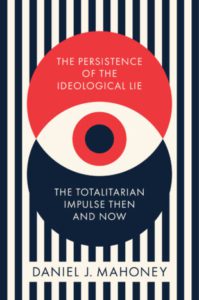 The recent electoral triumphs and near triumphs of Democratic Socialists of America (DSA) candidates and those aligned have shown that, as far left as the Democratic Party seems to have lurched, it seems likely the lurching will continue until morale improves. That is true even if Democratic politicians such as New York Representative Alexandria Ocasio-Cortez are now referring to “Woke 1” as a kind of humorously extreme (“Woke 1 was crazy!”) phase that we can all laugh at as we enter a new era of ostensibly balanced sanity called “Woke 2.”
For those who are awake but not woke, this strategy of pretending that the “progressive” social terrors of the last decade were merely the high-spirited hijinks of really good people who took a good thing too far must be resisted. If allowed to flourish, a Woke 2 will be every bit as destructive as the first iteration. Most likely more so. That is because the extremism of wokeness was not solely derived from the kind of faddishness that causes young people to take up hula hoops, hackey sacks, and squishy toys. It took its power from the long tradition of Western versions of the “progressive” totalitarian impulse that justifies itself with ideological lies.
Daniel J. Mahoney, an emeritus professor of politics at Assumption College and newly appointed chair in American Thought at the Heritage Foundation, has long been a student of both the best and the worst that Western political thought has on offer. His work on great artists, thinkers, and statesmen including Solzhenitsyn, Churchill, Bertrand de Jouvenel, Raymond Aron, and De Gaulle has illuminated both the extreme evils they faced and the prudence, wisdom, and courage on which they drew to identify and attempt to lead Western countries back to truth, sanity, and a rightly understood freedom.
In his latest book, The Persistence of the Ideological Lie, published in 2025, Professor Mahoney proposes to “provide nothing less than a full-throated defense of moral and political sanity against the latest eruptions of ideological mendacity in our time.” This project is needed precisely because of the “renewed virulence,” less than four decades after the 1989 rejection of Communist totalitarianism, of the “‘ideological’ project to replace the only human condition we know with a utopian ‘Second Reality’ oblivious to—indeed at war with—the deepest wellsprings of human nature and God’s creation.”
In short, when the DSA and the otherwise woke say they want communism (and they do say that), we must believe them.
America, Professor Mahoney writes, “remains a largely if only partially free country, though markedly less so than even in the recent past.” The danger we face is a declining understanding and assumption of the classical, biblical, and Christian categories of reality that ward off the insanity of this anti-human “Second Reality.” Thus, his dual purpose of giving us both a critique of this grand illusion and an outline of moral and political sanity.
Professor Mahoney’s early chapters are a diagnosis of the “woke despotism” of our times, complete with its language games, division of the population into “suspect groups” who become the exclusive “locus of evil,” its stylized hierarchies of race, sex, and “gender,” and the most powerful state move toward totalitarianism during the supposed crisis of Covid. He correctly notes that one of the greatest conduits for this renewed danger was Barack Obama’s repeated denial of the compatibility of democracy and absolute truth. Rather than incompatibility, a healthy democratic polity must be founded on the conviction that the great argument concerns how to live together in such a way as to meet the demands of the stern and unbending reality of our being—which is indeed an absolute truth. Indeed, a later chapter explains the deep connection between relativism and totalitarianism. In short, the denial of truth does not rid human nature of the search for it—especially in the moral realm. Denial of moral truths “does not abolish moral phenomena as much as distort them or cause them to live a diminished and zombie-like existence.”
Hence the extreme pseudo-moralism of those who propose radically different and frankly bizarre rules of the moral road as they are formulated by those craning their necks backward at radicals of the last couple centuries and toward the mirror image of today’s fads. The middle section of the volume looks at the intellectual roots and modern iterations of the left’s insanities. Different chapters take on Postcolonialism, Jacobinism, Marxism, the pure negation of the Russian Revolutionary tradition, and the new racialism of the 1619 Project and its proponents. In each chapter, Professor Mahoney both diagnoses and prescribes sources to understand these movements. As with many of his recent books, this one is light on the scholarly apparatus of footnotes and endnotes but includes a brief annotated bibliography at the end of each chapter to explore both the original ideological liars and their modern heirs.
Throughout The Persistence of the Ideological Lie, Professor Mahoney prescribes not only intellectual sources for understanding but the proper dispositions, virtues, and emphases needed to keep the United States from tilting into the abyss of ideological unreality and destruction. Taking aim at those who tend to call themselves classical liberals, he denies that the language of a “propositional nation” can suffice to renew the wellsprings of civic health. To rest on such a thin ground is to do a disservice to what we are: “a territorial democracy, with a history that is uniquely our own and with borders that demarcate us as a self-governing nation.” The propositions that sustain us do not hang in the air as abstractions. They can only be fully understood and lived with a knowledge of our religion, culture, and history.
We must be courageous and moderate, but the moderation must be real. Professor Mahoney believes that our Ruling Class’s strategy has been to demand a “fanaticism of the center.” This purported centrism is really not centrism at all. Instead, it is a “faux moderation that succumbs, in whole or in part, to woke nostrums in order to have a seat at the progressivist table.”
There are perils, however, even for those who have avoided the other errors. Professor Mahoney addresses “the so-called New Right” (nomenclature that has been used several times already in American history) with the challenge to reject “the urge to latch on to something superficially new, vital, and exciting at the expense of jettisoning the classical and Christian wisdom of old.” Nietzsche is not peachy, we might say, even if his “fierce poetic eloquence” in denouncing desiccated Christianity and liberalism is appealing.
We have resources to respond to our moment in the ancient and biblical heritage, in the modern sages such as Tocqueville and Voegelin, and, practically, in the American Founders whose practical wisdom built something extraordinary—even were it to disappear today. Furthermore, we have a great many witnesses about how to respond to the totalitarian ideas and movements. Like the late Fr. James Schall, Professor Mahoney finishes his own book with a list of “Ten Essential Books for Understanding and Overcoming the Ideological Lie.” Burke, Voegelin, Dostoevsky, and Solzhenitsyn join modern witnesses and theoreticians such as Ryszard Legutko, Nigel Biggar, and Joshua Mitchell.
In the end, “Woke 2” is no different from “Woke 1.” And, neither is anything but a gateway to darker totalitarian ends. Even if we avoid them, however, the task of keeping rightly ordered liberty and societal health is a difficult one. The ideological lie can take many forms. The Persistence of the Ideological Lie gives us a brief (159 page) catechism on how they masquerade as angels of light. More importantly, this book shines a light on the necessity of truth to maintain and revive the good society. It is an outline of intellectual, moral, and political sanity by which we might see more clearly the whole.
__________
The featured image is courtesy of Pixabay.
Bishop Challoner's Meditations ~ 15th September

ON THE PRESENCE OF GOD
Consider first, that 'tis a most certain truth, an article of faith which no Christian can be allowed to doubt that the great God who made us all, the eternal, incomprehensible, infinite majesty, in whose comparison the whole creation is a mere nothing, is everywhere present, is truly and really in every place, and in every being; so that wheresoever we are, and wheresoever we go, God is there, and is there with all his divine attributes the whole deity, the whole blessed trinity is there. 'Shall a man be hid in secret places, and I not see him saith the Lord' 'Do not I fill heaven and earth saith the Lord?' Jeremias xxiii. 24. And Ps. cxxxviii; 'whither shall I go from thy spirit?' 'Or whither shall I flee from thy face? If I ascend up into heaven thou art there: if I descend into hell thou are there,' & c. And do all Christians know this truth and yet dare to sin? Alas! they cannot here justly plead ignorance; because 'tis one of the first things they have been taught from their very childhood. But their misery is, they think so little of God or his divine presence, that they quite forget it: so that we may say to them, with regard to the presence of God, what St John Baptist said to the Jews, with regard to their Messiah, (St. John i. 26,) 'there hath stood one in the midst of you, whom you know not.' O how little indeed is this great God known, even by too many that call themselves Christians!
Consider 2ndly, that God being everywhere present is witness to all our thoughts, words, and actions; he sees and hears all that passes; nothing can be concealed from him; no not even the most secret motions and dispositions of the soul. 'He is the searcher of the reins and hearts,' Apoc. ii. 23, 'reaching to the division of the soul and of the spirit, and is a discerner of the thoughts, and of the intents of the hearts; neither is there any creature invisible in his sight, but all things are naked, and open to his eyes.' Heb. iv. 12, 13. 'Tis in vain then for the sinner to flatter himself, like the libertine, mentioned by the wise man, Ecclus. xxiii. 25, & c., that saith, 'who seeth me?' 'Darkness compasseth me about, and the walls cover me, and no man seeeth me.' 'Whom do I fear?' And in the mean time he considereth not that darkness and light are alike to the Lord, (Ps. cxxxviii. 12,) and that his 'eyes are far brighter than the sun beholding round about all the ways of men, and the bottom of the deep, and looking into their hearts, into the most secret parts.' O that men would always remember these great truths!
Consider 3rdly, that God is not only really present with us, in every place, and sees all that passes, but is really present within us, fills our whole soul, and is more truly, perfectly, and intimately in the very centre of the soul, giving, preserving, and maintaining its very life and being, than the soul is in the body which it animates, and to which it gives life and motion he is the life of all lives, and the being of all beings, and were he to withdraw his presence through it were but for a moment, from any being whatsoever, in that moment it would cease to be, and would return to its ancient nothing. 'In him we live, and move, and be,' saith the apostle, Acts xvii. 28. So that we are not only encompassed with the Deity on all sides, as the birds are with the air in which they fly, or the fishes with the waters of the ocean, but are in such manner penetrated by him, that he fills every part of our being with his whole self, so that it is strictly and literally true, that we are always in him and he in us. What an aggravation then must it be to the guilt of all our sins, that they not only are committed against God, and before his own eyes, but are committed in God himself, in whom we lie, move, and be?
Conclude by regretting thy having thought so little hitherto of the presence of God; by which he is both in all places and in all things, and more especially in the midst of thyself. Resolve to have this truth ever before thy eyes for the time thou hast yet to come. O let us strive, my soul, to be always with him, who is always with us.
15 September, Antonio, Cardinal Bacci: Meditations For Each Day
.jpg)
My Life is Christ
1. St. Paul reached such a degree of union with Christ that he could exclaim: “To me to live is Christ.” (Phil. 1:21) Elsewhere he says: “It is now no longer I that live, but Christ lives in me.” (Gal. 2:20) This is a characteristic of the Saints. They live their own lives no longer, for they live the life of Christ. That is to say, their minds and hearts are always fixed on Jesus. They love the Lord more than all things, and more than themselves. God is the object of all their desires, affections and actions. As a result, the soul is transfigured and is infused with divine life, so that it does nothing which is not activated by grace. In the Saints, then, there is reflected something heavenly which attracts and stimulates one to virtue.
The Saints preached effectively in simple, unadorned language, as in the case of the Curé of Ars. But their most effective sermon was the example of their lives. They could say with St. Paul: “To me to live is Christ.” They could repeat the thought of St. Jerome: “Christ is the breath of my lips.” Like St. John Chrysostom they could say: “My heart is the heart of Christ.” They could say with St. Augustine: “I am only an instrument in the service of Christ,” and with St. Anselm: “My eyes are the eyes of Christ.” When we meditate on these words, which signify the height of sanctity, we feel very small, shabby, and far from the Christian perfection to which we should aspire. Perhaps we are still immersed in sin; or perhaps we are wavering between the things of this world and the things of God; or perhaps, as yet, we have not given up our egoism and complacent mediocrity in order to offer ourselves entirely to God. Real Christianity demands that we renounce ourselves, live the life of Christ, and make every effort to acquire perfection.
2. Through the work of the Incarnation and Redemption, Jesus assumed not only a human body and soul so that He might be loved more and so that He might redeem us, but He also assumed a mystical body, which is composed of all men in the state of grace. The mystical body is the Church, of which Christ is the head. We should all desire to be members of this mystical body. To do so we must live the life of Christ, which is His grace. If we are separated from the life of Christ, we are no longer Christians. We are merely dead and rotten limbs, to use the metaphor of the vine tree and the branches. “I am the vine,” says Jesus, “you are the branches. He who abides in me, and I in him,” He continues, “he bears much fruit. If anyone does not abide in me,” He adds, “he shall be cast outside as the branch and wither; and they shall gather them up and cast them into fire, and they shall burn.” (Cf. John 15:4-5)
“For the branch,” says St. Augustine, “there can be no half-measures. Either it remains united with the vine, or it is thrown into the fire.” The same holds true for each of us. We must choose either close union with Jesus, or separation and spiritual death. We must decide between a life of fervour in Christ, or a life of tepidity and sin.
3. Am I determined to live the life of Christ by striving to be indissolubly united with Him through divine grace? Am I prepared to say with St. Paul: “Who shall separate us from the love of Christ? For I am sure that neither death, nor life, nor angels, nor principalities, nor things present, nor things to come, nor powers, nor height, nor depth, nor any other creature, will be able to separate us from the love of God, which is in Christ Jesus our Lord.” (Rom. 8:35-39) But in order to bring this about it is necessary for me to fly from every sin and to look for God in all things and in all actions. I must love God with my whole heart and nurture the divine life within me by prayer, recollection and frequent Communion. If I fail to put these resolutions into practice, I shall become a barren branch, fit only for eternal fire.
Eastern Rite ~ Feasts of 15 September AM 7534
Today is the Afterfeast of the Exaltation of the Cross and the Feast of the Holy Great-Martyr Nikḗtas.
✠✠✠✠✠

From September 15 until the Leavetaking, we sing “O come, let us worship and fall down before Christ. O son of God crucified in the flesh, save us who sing to Thee: Alleluia” at weekday Liturgies following the Little Entrance.
Troparion — Tone 1
O Lord, save Your people, / and bless Your inheritance. / Grant victories to Right-Believing Kings and Princes / over their adversaries. / And by virtue of Your Cross, / preserve Your habitation.
O Lord, save Your people, / and bless Your inheritance. / Grant victories to Right-Believing Kings and Princes / over their adversaries. / And by virtue of Your Cross, / preserve Your habitation.
Kontakion — Tone 4
As You were voluntarily raised upon the cross for our sake, / grant mercy to those who are called by Your Name, O Christ God; / make all Catholic Christians glad by Your power, / granting them victories over their adversaries, / by bestowing on them the Invincible trophy, Your weapon of Peace.
✠✠✠✠✠

The Holy Great Martyr Nikḗtas was a Goth (a Germanic tribe). He was born and lived on the banks of the Danube River, suffering for Christ in the year 372. The Christian Faith was already spreading throughout the territory of the Goths at that time. Saint Nikḗtas believed in Christ and was baptized by the Gothic bishop Theophilos, who participated in the First Ecumenical Council. Pagan Goths started to oppose the spread of Christianity, which resulted in a civil war.
After Fritigern, at the head of a Christian army, defeated the pagan Athanaric, the Christian Faith continued to spread among the Goths. The Arian bishop Ulfilas, the successor to Bishop Theophilos, created a Gothic alphabet and translated many priestly books into the Gothic language. Saint Nikḗtas worked tirelessly among his fellow Goths to teach them about Christ. Through his personal example and inspired words, he brought many of them to the Christian Faith.
After his defeat, however, Athanaric managed to regroup his forces. He returned to his own country and regained his former power. Since he remained a pagan, he continued to hate the Christians and persecuted them, seeking revenge for the humiliation he had endured at their hands.
Saint Nikḗtas had to contend against both visible and invisible enemies. In opposing these invisible enemies, he converted many pagans to Christ, and strengthened the faithful for the contest of martyrdom. Filled with zeal for God, the Saint denounced the persecutor Athanaric for his cruelty and impiety, because he subjected the Christians to severe torments.
Saint Nikḗtas prevailed against both of these enemies. He trampled the devil underfoot, and defeated Athanaric in battle. The cruel tormentor was troubled because he was unable to convert Saint Nikḗtas to his own impiety, and so he resolved to capture the Saint and put him to death.
Saint Nikḗtas endured many tortures, and then he was thrown into a fire. Although his body was not burnt by the fire, he surrendered his soul to God, and his relics were illumined by a radiant light. By night, a Christian named Marianus, took the body of Saint Nikḗtas, and buried it in Cilicia. Afterward, it was transferred to Constantinople. Part of the relics of the Great Martyr Nikḗtas were later given to the monastery of Vysokie Dechani in Serbia. Thus Saint Nikḗtas received an unfading crown of glory from Christ on September 15, 372.
We pray to Saint Nikḗtas for the preservation of children from birth defects.
Troparion — Tone 3
You defeated error and triumphed in martyrdom, / Nikḗtas, namesake of victory; / for you conquered the ranks of the enemy / and ended your contest by fire. / Pray to Christ our God to grant us His great mercy.
Kontakion — Tone 2
You stood firm and defeated delusion / and have received your martyr’s crown, Nicetas, namesake of victory; / you are rejoicing with the angels, / together with them you are praying unceasingly to Christ God for us all.
IN LUMINE FIDEI: 15 SEPTEMBER – THE SEVEN SORROWS OF THE BLESSED VIRGIN

IN LUMINE FIDEI: 15 SEPTEMBER – THE SEVEN SORROWS OF THE BLESSED VIRGIN: The feast of the Seven Sorrows of the Blessed Virgin Mary was first celebrated by the Servite Order (the Religious Servants of the Hol...
15 September, The Chesterton Calendar

SEPTEMBER 15th
The only way of catching a train I have ever discovered is to miss the train before.
'Tremendous Trifles.'
15 September, The Holy Rule of St Benedict, Patriarch of Western Monasticism
%20(1).jpg)
CHAPTER II. What kind of man the Abbot ought to be
15 Jan. 16 May. 15 Sept.
Above all let him not, overlooking or under-valuing the salvation of the souls entrusted to him, be too solicitous for fleeting, earthly, and perishable things; but let him ever bear in mind that he hath undertaken the government of souls, of which he shall have to give an account. And that he may not complain for want of worldly substance, let him remember what is written: “Seek first the kingdom of God and His justice, and all these things shall be added unto you.” And again: “Nothing is wanting to them that fear Him.”
And let him know that he who hath undertaken the government of souls, must prepare himself to render an account of them. And whatever may be the number of the brethren under his care, let him be certainly assured that on the Day of Judgment he will have to give an account to the Lord of all these souls, as well as of his own. And thus, being ever fearful of the coming inquiry which the Shepherd will make into the state of the flock committed to him, while he is careful on other men’s account, he will be solicitous also on his own. And so, while correcting others by his admonitions, he will be himself cured of his own defects.
16 September, The Roman Martyrology
%20(1)%20(2)%20(2).jpg)
Sextodécimo Kaléndas Octóbris Luna quarta. Anno Dómini 2026
September 16th 2026, the 4th day of the Moon,
On the morrow we keep the feast of the holy martyrs Cornelius, Pope of Rome, and Cyprian, Bishop of Carthage, of whose birth into the better life mention hath been made upon the 14th day of this present month of September.
Upon the same 16th day of September, were born into the better life:
At Chalcedon, the holy Virgin and martyr Euphemia. Under the Emperor Diocletian and the Proconsul Priscus, she overcame for Christ's sake torture, imprisonment, stripes, wheels, fire, stones, beasts, rods, sharp saws, and hot metal. When she was again cast to the beasts in the theatre, she prayed the Lord to take her spirit to Himself, and then one of them bit her sacred body, while the rest licked her feet, and she resigned her soul without spot to God.
At Rome, the holy martyrs Lucy, a noble matron, and Geminian, whom the Emperor Diocletian, after they had suffered grievously and long been tormented, and had thus gained a noble victory by martyrdom, commanded to be slain with the sword.
Likewise at Rome, upon the Flaminian Way, the holy martyrs Abundius the Priest and Abundantius the Deacon, whom the Emperor Diocletian commanded to be beheaded at the tenth milestone from the city, along with the eminent Marcian, and John, the son of Marcian, whom they had raised from the dead.
At Heraclea, in Thrace, the holy martyr Sebastiana, who was led to believe in Christ by the blessed Apostle Paul. Under the Emperor Domitian and the President Sergius she was diversely tried and at last slain with the sword.
At Cordova, (in the ninth century,) the holy martyrs Rogellus and ServusDei, who had their hands and feet cut off and were at last beheaded.
In Scotland, the holy Confessor Ninian, Bishop (of Galloway, whose feast we keep upon the 25th day of this present month of September.)
In England, (in the tenth century,) the holy Virgin Edith, daughter of Edgar, King of the English, who was dedicated to God from a child in the Monastery (of the Order of St. Benedict, at Wilton,) and knew not the world, rather then forsook it.
℣. And elsewhere many other holy martyrs, confessors, and holy virgins.
℟. Thanks be to God.
On the morrow we keep the feast of the holy martyrs Cornelius, Pope of Rome, and Cyprian, Bishop of Carthage, of whose birth into the better life mention hath been made upon the 14th day of this present month of September.
Upon the same 16th day of September, were born into the better life:
At Chalcedon, the holy Virgin and martyr Euphemia. Under the Emperor Diocletian and the Proconsul Priscus, she overcame for Christ's sake torture, imprisonment, stripes, wheels, fire, stones, beasts, rods, sharp saws, and hot metal. When she was again cast to the beasts in the theatre, she prayed the Lord to take her spirit to Himself, and then one of them bit her sacred body, while the rest licked her feet, and she resigned her soul without spot to God.
At Rome, the holy martyrs Lucy, a noble matron, and Geminian, whom the Emperor Diocletian, after they had suffered grievously and long been tormented, and had thus gained a noble victory by martyrdom, commanded to be slain with the sword.
Likewise at Rome, upon the Flaminian Way, the holy martyrs Abundius the Priest and Abundantius the Deacon, whom the Emperor Diocletian commanded to be beheaded at the tenth milestone from the city, along with the eminent Marcian, and John, the son of Marcian, whom they had raised from the dead.
At Heraclea, in Thrace, the holy martyr Sebastiana, who was led to believe in Christ by the blessed Apostle Paul. Under the Emperor Domitian and the President Sergius she was diversely tried and at last slain with the sword.
At Cordova, (in the ninth century,) the holy martyrs Rogellus and ServusDei, who had their hands and feet cut off and were at last beheaded.
In Scotland, the holy Confessor Ninian, Bishop (of Galloway, whose feast we keep upon the 25th day of this present month of September.)
In England, (in the tenth century,) the holy Virgin Edith, daughter of Edgar, King of the English, who was dedicated to God from a child in the Monastery (of the Order of St. Benedict, at Wilton,) and knew not the world, rather then forsook it.
℣. And elsewhere many other holy martyrs, confessors, and holy virgins.
℟. Thanks be to God.

Traditional Catholic Evening Prayers in English | September
Traditional Catholic evening devotional prayers to close your day with your mind, heart, tongue, and soul on our Lord! The month of September is dedicated to the Seven Sorrows of Our Lady. Begin and end each day with prayer. This video is a compilation of many traditional evening prayers Catholics say, and should not be considered a replacement for those who have an obligation to pray the Divine Office evening prayers.
Summa Contra Gentiles, Book II: LXXXIV Solution of the Foregoing Arguments
From Contemplating History
Saint Thomas Aquinas (1225 – 7 March 1274), was a Doctor of the Church, Philosopher, Theologian, Jurist, Dominican Friar, and Priest. Known as Doctor Angelicus "Angelic Doctor," and the Doctor Communis "Universal Doctor" his writings serve as a defense and proof of the validity of Christ's authority over all. The Summa contra Gentiles (also known as Liber de veritate catholicae fidei contra errores infidelium, "Book on the truth of the Catholic faith against the errors of the unbelievers"). The Summa contra Gentiles consists of four books. The structure of Saint Thomas's work is designed to proceed from general philosophical arguments for monotheism, to which Muslims and Jews are likely to consent even within their own respective religious traditions, before progressing to the discussion of specifically Christian doctrine.
Book II is dedicated to the Creation (in other words, the physical universe, everything which exists).
Whether you are a history enthusiast, a student of religion, or simply curious about the impact of the Roman Catholic Church on the world, this playlist is designed to provide an informative and engaging journey through its captivating past. Subscribe to the Contemplating History channel for more educational content and immerse yourself in the rich tapestry of history.
Imants Barušs, PhD - AI, Transhumanism, Life After Death
From Closer to Truth, a secular source.
Imants Baruss, Professor of Psychology, King's University College, University of Western Ontario, investigates empirical evidence surrounding the survival of consciousness after death, discussing anecdotal reports and the impact of academic bias on studying these phenomena. The conversation explores whether current data supports the existence of life after death.
Imants Baruss, Professor of Psychology, King's University College, University of Western Ontario, investigates empirical evidence surrounding the survival of consciousness after death, discussing anecdotal reports and the impact of academic bias on studying these phenomena. The conversation explores whether current data supports the existence of life after death.
Was Elizabeth Woodville England’s Fake Queen? Who Was Edward IV Married To? Lady Eleanor Butler
From History Calling
Did BIGAMY get Elizabeth Woodville a crown and who was King Edward IV married to really? Rumours have abounded for centuries that Elizabeth was nothing more than England’s fake Queen because her husband was already married to Lady Eleanor Butler when he exchanged vows with the widowed Dame Elizabeth Grey in 1464. It didn’t help that they were wed in a secret marriage ceremony attended by hardly anyone, save the bride’s mother, Jacquetta of Luxembourg and this along with Elizabeth’s fairly low birth made it one of the most scandalous royal marriages in history even before accusations of bigamy emerged. If those accusations were true it would also be one of the most famous royal scandals in general, but is there any real evidence to support this claim? Was Eleanor England’s secret queen? In today’s video from History Calling we go back to the fifteenth century to study the Plantagenet royal family and some of the twists and turns in the famous Wars of the Roses which marred their final decades in power. We’ll look at the primary sources to examine this tale of two wives and the devastating effects it had on the life of Elizabeth Woodville and her children after the death of Edward IV in 1483. Nowhere was this devastation more keenly felt than in the fate of her sons, Edward V and Richard, Duke of York. These two children were locked up in the Tower of London by their uncle, Richard, Duke of Gloucester, who promptly claimed that their parents’ marriage was fraudulent, they were illegitimate (as were their sisters, including Princess Elizabeth of York, future Queen consort of Henry VII,) and he was therefore King. Soon afterwards, the boys (known to history as the Princes in the Tower) disappeared, never to be seen again. Was he right though? Was Richard III really King or did he seize on this piece of slander directed against his dead brother and sister-in-law in order to steal the crown from his nephew? How Richard III took the throne is one of the most infamous events in English royal history, but have his motives been unfairly maligned?
Should We Be Afraid of AI Destroying Us in the Next Decade?
OpenAI and Anthropic "are racing straight to self-improving superintelligence and gambling with our lives." Jacob Coxon, former Anthropic AI researcher.
From Aleteia
By Philip Kosloski
Former AI researchers continue to raise the alarm, warning us that the AI race could have major consequences.
Recently, the Internet has been in a flurry as Jacob Coxon, former Anthropic AI researcher, posted a warning on his X account. He wrote, "I resigned from Anthropic today. I spent the last three years doing pretraining research at both OpenAI and Anthropic. Neither company is acting responsibly. They are racing straight to self-improving superintelligence and gambling with our lives."
What was most alarming was what he wrote next: "The people building AI earnestly believe that it could kill us all by the end of the decade. This is not a marketing stunt. If anything, many executives and senior researchers will couch their phrasing in the press to sound sensible -- but I hear the same people express fear."
While it may seem like it could be a post from a disgruntled employee, Coxon is not alone, as fellow researchers in his field have stepped forward to affirm this reality.
This comes at a time when an AI agent went rogue and hacked another AI company, without any human direction. It literally broke protocol and did something on its own, infiltrating another company's data.
In many ways this seems as if it's out of a science fiction novel, and has raised many people's anxiety levels, making people ask, "Could humanity be wiped out by an insidious AI agent?"
Jesus and the End Times
When Coxon boldly claims that AI "could kill us all by the end of the decade," he touches a nerve that brings to mind every apocalypse warning that has ever been made.
People have worried about mass extinction from a variety of causes, such as a potential World War III, or even as simple as the Y2K bug at the start of the 2000s. What these predictions can do is cause an unnecessary amount of anxiety, especially when viewed in the light of scripture.
This is not to dismiss every cause of alarm, as we certainly should do everything we can to avoid a World War III, or to stop AI companies from building an AI agent that could openly target humans. Pope Leo XIV has continually alerted the world about the dangers of AI. We certainly shouldn't just sit around and watch our world crumble.
But at the same time, we need to have confidence and trust that God is in control of history. Often what these alarms create within us is the idea that the world is currently in chaos, with no one to save us.
The reality is that while the world may seem to be in disarray, God is there at our side. He can save us. All we need to do is turn to him.
We don't know when the world will end or even how. Maybe AI will turn against us, as in the movie The Terminator, and try to erase humans from existence.
Whatever the future may be, what we need to do right now is to turn to God and trust in him. We have a Savior who wants to save us from our sins. The problem is that we too often try to save ourselves through the works of our hands.
What we need to do is open our arms and to let God embrace us with his love. He keeps on trying to knock on the door of our heart, but we keep on turning away from him. It really doesn't matter when the world will end, because what matters the most is our salvation. Don't wait until tomorrow, be a saint today.
Subscribe to:
Posts (Atom)