31 January 2023
St John Bosco, Confessor
Today's Holy Mass from Corpus Christi Church, Tynong, VIC, AU. You may follow the Mass @ Divinum Officium.

Paul VI: Refounder of Catholicism
A look at how Paul essentially created a new Church on the ruins of what had been that had little or nothing to do with what had gone before.
From One Peter Five
By John Byron Kuhner
Religion Department Academics of a certain sort love to scandalize undergraduates by telling them that Jesus is a marginal figure in Church history; the real founder of the religion, they whisper, was Paul. In fact, they persist, the religion should really be called Paulianity.
From the standpoint of Roman Catholicism, there is some truth to the claim.
The Mass as Roman Catholics celebrate it today received its form under Paul. Paul changed the formula of consecration during the Mass, as well as the rites of baptism, marriage, confession, extreme unction (anointing of the sick), and burial. He entirely restructured ordination, banishing the seven-step structure Holy Orders had once known. To the governing apparatus of the Church, Paul gave the definitive power structure it enjoys today. Very nearly every religious community in the Church altered its formation, daily life, habit, governance, bylaws, and prayer life in response to Paul’s demands for change. Church thinking changed as well, with wave after wave of innovative theological ideas ushered in by Paul. In almost every respect, Church life can be described dualistically: either Prepaulian or Postpaulian.
I speak, of course, of Paul VI, Giovanni Battista Montini, who died in 1978 after a remarkably consequential fifteen year pontificate – one of the four or five most consequential pontificates in the history of the Church. Despite this fact, and even despite Paul’s recent canonization, he remains remarkably understudied. Any other pontiff of comparable transformative power would have been called “the Great” long ago. But real deep engagement with Paul’s pontificate has suffered from multiple causes. For one thing, Paul’s extraordinarily unappealing public persona has smothered interest in him: scholars work from some form of passion, and the seemingly joyless (the Italians said Paolo sesto Paolo mesto, “Paul the Sixth Paul the Sad”) pope has not generated it. Paul was also the archetypal bureaucrat; the transformations of his pontificate came mostly via committee, and in response to the Second Vatican Council. They have been variously assigned to the pope, the members of the committees, the faithful themselves, or the Holy Spirit.
2023 marks sixty years since the beginning of Paul VI’s pontificate, and the time has come for sober judgement and assessment. The changes Paul VI decreed have come under increasing criticism, due largely to the fact that the Postpaulian Church has been so obviously diminished in the West. One key fact has clearly emerged: Paul’s implementation of the Second Vatican Council, which had decreed things like “no innovation should be undertaken unless the good of the Church genuinely and certainly requires it,” was not in accord with Conciliar decisions themselves.
Paul undertook a systematic program of innovation covering every detail of Church behavior, from how often a priest should kiss the altar during Mass to whether or not Carmelite nuns can live according to the rule of St. Teresa of Avila (Paul didn’t think they could, a decision which is still being contested). Paul’s changes to the liturgy, since they affect the daily life of the faithful so much, are the obvious ones: where the Council had decided to keep Latin, Paul jettisoned it; where the Council decreed keeping “the treasury of sacred music,” Paul consigned it to oblivion; where the Council had said nothing at all about building new altars, communion in the hand, or versus populum masses, they all became Catholic practice during Paul’s pontificate – in at least one instance, however, directly contrary to his wishes.
The best place to start with a serious engagement with the legacy of Paul VI is with Yves Chiron’s short biography, Paul VI: The Divided Pope (Angelico Press, translated from the French by James Walther, which a forward by Henry Sire).
Chiron, a Frenchman, has written voluminously on Catholic topics, from Benedict XV to Fatima to Padre Pio, always, it seems, on the general principle that there is value in a more disciplined, scholarly approach to the Catholic heritage of the twentieth century. He is known as a traditionalist, though this is evident more in his choice of material than in anything else; he does not write polemically. His biography of the Pontiff is worthwhile for three main reasons.
For one, it is really the only short, objective biography available in English; the best treatment of Paul’s pontificate, Peter Hebblethwaite’s, is three times as long and most assuredly a defense of Paul rather than pure biography; other short treatments are avowedly hagiographic or were written before his pontificate had concluded.
Secondly, Chiron has unusual depth in the French sources related to Paul’s pontificate, and it is undoubtedly French Catholicism which influenced Paul most (Jacques Maritain, Henri de Lubac, Jean Danielou, and others; when Paul came to the United Nations, he spoke in his fluent French). Wladimir d’Ormesson, a French diplomat in Rome, furnishes Chiron with useful official assessments of the young Montini. Chiron also personally interviewed Paul’s close friend, the philosopher Jean Guitton (who published Dialogues avec Paul VI during the pope’s lifetime), and he was able to use Guitton’s inside knowledge to structure much of his account of Paul’s life. Guitton’s ultimate assessment closes the book: “Paul VI did not have the makings of a pope. He did not have that which is characteristic of a pope: resolve, the strength of resolve.”
Thirdly, Chiron – who has also contributed a valuable biography of Annibale Bugnini, the Vatican official most responsible for the liturgical reform – understands the Vatican bureaucracy and how it works (that is to say, he understands it as well as anyone can, which is somewhat limited). What we need most is an understanding of how the decrees of the Second Vatican Council were turned into Church policy – a topic Chiron takes an interest in, and writes about. Take, for example, Chiron’s account of the generally unknown controversy about Latin in seminaries:
On January 25th, 1966, the Congregation for Seminaries and Universities published an instruction that Latin was to be retained in the seminaries for the celebration of Mass and for the recitation of the Breviary. Cardinal Lercaro, responsible for the liturgical reform then in progress, complained to the pope, as did several French bishops. Among them was Cardinal Villot, then archbishop of Lyon [the future Cardinal Secretary of State, and an extremely important prelate]. When he met with the pope the following February 22nd, he shared their concerns. He received a reassuring response, as a confidant testifies [Antoine Wenger, who write a biography of Villot]: “Paul VI could not disavow the Congregation for Seminaries and Universities. He said simply that the instruction was not imperative, but only indicative.” In the French seminaries, Latin was very soon to disappear from the liturgical offices.
Not imperative, but only indicative! And soon past tense. A very similar story appears in the memoirs of Archbishop Rembert Weakland, who as primate of the Benedictines led the resistance against the Conciliar decree, backed by Paul VI’s motu proprio Sacrificium Laudis, keeping Latin in monasteries. Chiron never mentions this, but he accurately describes the Vatican of this era as “a three-player game,” which the Pope, the Curial Committees and Congregations, and the Bishops and Abbots played against each other.
One of the easy conclusions that can be drawn from Chiron’s biography is that the Mass as celebrated today should truly be considered not the work of the Second Vatican Council but truly the work of Paul VI. It is postconciliar rather than conciliar. This confirms what Joseph Ratzinger said of the Novus Ordo Mass, “I can say this was not what the Council Fathers intended.” Chiron provides ample documentation of Paul’s interest in a vernacular liturgy, such as this from 1947:
Monsignor Montini expressed the opinion that one day the celebration of the whole “didactic part” (according to his expression) of the Mass in the language of the people should arrive. I remarked that it might well require a hundred years for that evolution. “No,” he replied, “an evolution that previously might have required a century can nowadays be realized in twenty years.”
He quotes the conclusion of Aime-Georges Martimort: “Nothing was decided, much less promulgated, without Paul VI being aware of it. He received the plans, which he annotated with his own hand, making his preferences clear and sometimes also his demands or refusals.” That the Mass is a papal rather than a conciliar creation does not make it any less valid for Catholics, of course; but it does make it clear that discussions of it should be separated from discussions of the Council. And whereas Paul permitted resistance from clerics of a modernizing tendency, even to his own decrees, Chiron is able to document his forceful crackdown on the use of older form of the Mass. He was capable of resolve against Tradition more than resolve against experimentation.
Chiron is interested in Paul’s legacy, and spends far less time evaluating him as a man. Paul’s strange romantic melancholy, his odd comparisons of himself to Hamlet, for instance, and Don Quixote; the tortured self-reflections he imposed on his audiences; the bizarre will he wrote (“I close my eyes upon this dolorous, dramatic, and magnificent world”) – Chiron has no room for such concerns, in a short biography of a man continually involved in important Vatican affairs from before Mussolini to the brink of the Reagan administration.
Similarly he spends no time on Paul’s deep and apparently sincere appreciation of many of the great saints, about whom he wrote convincingly and intelligently, or on the personal simplicity and humility which deeply affected many who worked for him and convinced them that he was truly a saint. Chiron’s omission of these details – and many others, for his was a busy pontificate, with change in every quarter of the Church, and controversies and dramas in nearly every one – points to the need for a complete, factual biography of Paul, as a means of understanding his immense shaping role on the Church of today. Many people have done important groundwork for such a biographical effort, Chiron foremost among them. The time is ripe.
In the meantime, we can use Chiron’s biography to draw further lessons. He focuses on what can justly be described as Paul’s career, legacy, and leadership. Much of this legacy is undoubtedly negative – Paul’s poor leadership undeniably ushered the Church into a state of crisis, a constant hemorrhaging of believers which shows no signs of letting up. In Paul we can see an ideological blindness to methods that are actually effective, a commitment to taking risks without any plan for assessing failure, and an organizational tendency to produce rules and then only selectively and rarely enforce them. We will take this up in our next essay, as a way of engaging with Paul VI on the occasion of the sixtieth anniversary of his accession. Picking up a copy of Chiron’s biography would be an excellent way to prepare for it: it is the least we can do to note the massive influence of St. Paul VI on the Church today.
MCC Brussels: Why Cancelling European History is a Bad Idea
'A strong Europe starts with proud Europeans, ...'
Of course, a strong Europe is the last thing the globalist elite wants. It would delay the installation of their planned One World Government.
Of course, a strong Europe is the last thing the globalist elite wants. It would delay the installation of their planned One World Government.
From The European Conservative
By Tamás Orbán
European history must stop dwelling on sins and start focusing on achievements again. A strong Europe starts with proud Europeans, according to the MCC’s panel discussion in Brussels.
History is not just a collection of names, dates, and facts. History—or rather, how we decide to look at it—deeply defines who we are and how we navigate the world, individually and as nations as well. But what happens if we let our collective historical narratives be downgraded to a catalog of horrors, as European schools (and Western ones, in general) have seemingly allowed it to? Are we ready to sacrifice objective historical knowledge for the sake of spreading arbitrary moral lessons about the present? And it is not only knowledge that we risk failing to pass on to new generations, but the very essence of national identities, which would weaken Europe as a whole as well.
The Mathias Corvinus Collegium’s recent event in Brussels shed light on the dire consequences of the left’s attempts at cancelling European history. The panel discussion took place on Wednesday and featured Dr. Joanna Williams (founder of the British think tank Cieo, author of How Woke Won, Women vs Feminism, and her recent paper, “The Politicisation of History Teaching in the EU: Exploiting the past to promote the imperative of social engineering”). During this discussion, Dr. Williams was accompanied by Thibaud Gibelin, visiting fellow at the MCC, and Professor Werner J. Patzelt, the think tank’s research director. Moderating the panel was MCC’s executive director, Professor Frank Füredi.
“Of our rich national legacies, what should we pass on to our children?” asked Füredi in his opening speech. The question might have been a simple one a few decades ago, but it is certainly not today. European history education appears to have lost its sense of clear purpose and has been undergoing a profound transformation for some time now.
Sins without Achievements
The main observation in Dr. Williams’ report is that European history teaching has adopted the broader post-war cultural context that everything that happened in the past is bad. According to her, the Council of Europe played a “terrible role” in leading the charge in this regard. From 1952 onward, the Council started reviewing history textbooks to root out bias and prejudice, to promote objectivity and democracy, and to combat general misinformation. Noble goals that undoubtedly had positive effects too. Nonetheless, the process also opened the door to a downward spiral of deepening identity crisis at the core of Europe.
Williams identified five common trends this transformation of history teaching gave birth to. The first trend can also be observed in a broader educational pattern: knowledge has been replaced by skills. While an arguably good strategy in other fields, not necessarily in history. Instead of becoming familiar with objective information about the past and being encouraged to think critically, children are being taught the “correct ways that they should feel about the past.”
The second trend Williams identified is that the “starting point” of history has changed. Whereas a couple of decades ago, history was seen as things that happened thirty years ago or more. Now everything that happened yesterday can become the subject of history class. The new starting point of history is the present, the question that drives history is what is important today, and every historical event that is being discussed is cherry-picked to support the ‘correct’ way of thinking about the era we live in.
The third trend is a consequence of the ‘cherry picking’ approach to history: children no longer appear to have a sense of the overall chronology of historical events. According to Williams, they are being taught isolated stories to justify present political positions without presenting the connections between them. But without historical evolution, there is neither social development nor a sense of achievement stemming from it.
The fourth, and one of the most worrisome trends, is that history no longer puts the emphasis on nations, but on identity groups—usually categorised as oppressed and oppressors. This facilitates polarised thinking and fractures communities rather than unifying them.
Finally, Dr. Williams’ fifth and most important observation was that education puts the emphasis on sins rather than achievements. This happens because of the present centrism outlined above and “shows what we, as a society, worry about: sovereigntism, nationalism, white supremacy. So we dwell on sins,” said Williams. She pointed out that children need to learn about slavery and genocides, but they also need a broader context to situate them alongside achievements and positive things.
“My main concern is what children are not getting from history: objectivity, critical thinking, and a sense of belonging,” Dr. Williams said. And when these are missing, identity groups are quick to fill the vacuum. However, it also works the other way around. “To me,” said Williams, “the one thing that transcends identity politics is the nation and national identity.”
Strong Nations Make a Strong Europe
Picking up the thread, Professor Patzelt summarised the three most important duties of responsible history teaching. History, if taught the correct way, facilitates social cohesion for each subsequent generation. It is, as he called it, an invaluable “bonding capital,” providing a sense of belonging and a strong national identity. Second, history is also a tool for teaching morality—that is, if we do not substitute objectivity with ideology—and guiding young people to become responsible members of society. And third, history teaching (that focuses on the achievements of the nation-state) helps the integration of newcomers and the managing of pluralistic democracies. “The nation-state is the only structure in which we have been able to create a well-functioning democracy”, Patzelt reminded the audience.
What should European history be then? After all, Europe is a patchwork of dozens of nations, each with its own historical background and no obvious structure to connect them into a single narrative. “The pseudo-solution” to this conundrum, according to Patzelt, is precisely what we see being taught in schools today. European history is simply the history of the European Union. This narrative, however, is shallow and lacks proper context. “A better solution is to turn to culture,” he said. Identifying the greatest achievements of European culture and focusing on our shared heritage—Greek philosophy, Roman law, Renaissance art, Enlightenment values—can create a flourishing European identity, but only if we recognize and appreciate our differences as well. Strong national and European identities do not exclude but strengthen each other. And the key word for preserving both is ‘pride’. Being proud of belonging to our nations and being proud of belonging to Europe. “If we want to maintain the wonderful achievement the European Union is, we need European citizens who are proud to be European. This is what European history should be.”
A World of Permanent Critique
Sharing his experience with the French educational system, Thibaud Gibelin offered little optimism about the future of history education in his country. “The education system in France is in free fall,” he said. “What is under attack is the very idea of the French nation as a source of pride.” According to him, the recent trends in academia that seek the continuous reconstruction of historical narratives contributed greatly to the general decline of national pride. “Nothing is sacred anymore, we question everything. History is not something that we regard as true, but something to be placed under constant scrutiny. We built up a world of permanent critique.”
Closing the panel, Füredi summarised the night with a couple of keen observations. “There is a tendency to read history backwards,” he said, “where we project the present onto the past to conserve the future. For lack of a better academic word, that’s called bullshit. [Audience laughs.] But what comes out of this that’s crucially important is that the idea of the ‘good old days’ has been replaced by the ‘bad old days.’ For a stronger and healthier Europe, therefore, it is the duty of all of us to educate the young ones about our shared historical achievements and make them proud again to be European.
Favorite Royal Images: A Touching Moment
I've no idea who they are. I'd thought possibly HM Queen Margrethe of Denmark, but HRH Prince Henrik was an inch taller than Her Majesty.
From The Mad Monarchist (28 August 2012)
 |
| It's the little things... |
Bishop Challoner's Meditations - January 31st
%20(1)%20(1)%20(1)%20(1)%20(2)%20(1)%20(1)%20(1)%20(1)%20(1)%20(1)%20(2)%20(1)%20(1)%20(2).jpeg)
ON THE JUDGMENTS OF GOD UPON MORTAL SIN
Consider first, that besides all the sad effects of mortal sin already mentioned, which are more than sufficient to demonstrate how heinous this worst of evils is in the sight of God, there still remains divers other convincing arguments of the hatred God bears to it, from the manifold judgments he has of old, and daily executes upon them who are guilty of it; and will continue to execute to the end of the world, and even to all eternity. Witness, of old, the judgment of the deluge, which in punishment of the general corruption of all flesh, swept off at once all the sinners of the earth, and hurried them down to hell. Witness the judgment of fire from heaven, on Sodom and the neighbouring cities; witness the many judgments on the rebel Israelites in the wilderness, particularly that remarkable one of the earth opening and swallowing up alive Kore, and his companions; and the fire from the Lord destroying in an instant fourteen thousand seven hundred of their abettors, Num. xvi. Witness, in every age of the world, millions that have been hurried away when they least expected it, by violent or untimely death in punishment of their crying sins; besides many instances of flourishing cities yea, and of whole nations too, destroyed by wars, pestilences, famines, earthquakes, &c., all brought upon them by their sins. O great God! who shall not fear thy almighty wrath, which always looks towards wilful sinners? Who shall not fear the dreadful evil of mortal sin, which thus provokes thy avenging justice.
Consider 2ndly, that though these visible judgments of God upon impenitent sinners, by which they are snatched away before their time by unprovided death, in the midst of their sins, be both very common, and very terrible; yet there is another kind of more secret judgments, which he daily executes upon thousands which is far more dreadful damnation. And that is, when in punishment of their abuse of grace and obstinacy in sin, he gives them up at length to a reprobate sense, and to a blindness and hardness of heart; so that they have now no more fear or thought of God or his judgments, or any concern at all for their souls, or for eternity. Now this is indeed the broad road to final impenitence, and is, in its consequences, the very worst of all God's judgments. It was thus he did by the Jews, according to the prediction of the royal prophet, Ps lxviii, 'Letting their eyes be darkened, that they should not see, and bowing down their back always - adding iniquity upon their iniquity,' &c., viz., by withdrawing his lights and his graces from them, and so giving them up to their own wicked inclinations; and thus he daily does with thousands of habitual sinners, in punishment of their slighting and resisting his repeated calls, Proverbs i. 24, &c., suffering them to go on in their wretched ways, and to add daily sin upon sin (without ever thinking of repentance), and consequently hell upon hell; which proves in the long run a far more dreadful judgment upon them than if, upon their first sin, the earth had opened and swallowed them down alive into hell.
Consider 3rdly, the judgments of God upon mortal sin, in the eternal duration of the torments of hell. O, sinners, go down, now whilst you are alive, into that bottomless pit and take a serious view of the rigour of God's justice there, of that worm that never dies, of that fire that never is extinguished, of that everlasting rage and despair, and of all that complication of the worst of evils that is to be found in that woeful dungeon, and then tell me what you think of the hatred God must bear to every mortal sin, when he, who is infinitely good and infinitely just, and cannot punish any one beyond what he richly deserves, condemns every soul that dies under any such guilt, to all this extremity of misery for all eternity. Surely the dismal prospect of this scene of woe must suffice to convince you of the enormity of mortal sin. But if anything be here wanting to full conviction, turn your eyes upon Jesus Christ the Son of God, and see how he was treated by the justice of his Father for our sins, which he had taken upon himself to expiate; see him agonizing in the garden, and sweating blood, under their enormous weight; see the multitude and variety of torments he endures for them, till his expiring upon a cruel and disgraceful cross; and how, notwithstanding the infinite dignity of his person, the divine justice would admit of nothing less than all these sufferings of his own Son for the expiation of any one mortal sin; and I am persuaded that the sight of a God, crucified for sin, must more effectually demonstrate to you the hatred God bears to this monstrous evil than the sight of hell itself, with all its dreadful and everlasting torments.
Conclude by giving thanks to God for having spared thee so long in thy sins, and resolving now to labour in earnest to avert, by a serious and speedy conversion, those judgments, which thou mayest have reason to apprehend are actually hanging over thy head for thy sins.
31 January, Antonio, Cardinal Bacci: Meditations For Each Day
%20(1)%20(1).jpg)
1. “Blessed are the peacemakers,” Our Lord says, “for they shall be called children of God.” (Mt. 5:9)
All those who are in the state of grace, and therefore living on the supernatural plane, are the adopted sons of God and sharers in His divine nature, (Cf. 2 Peter 1:4) which they will enjoy one day in the Beatific Vision. Our Saviour, however, refers to those who love peace as being in a special way the sons of God. Why is this? St. Augustine offers the real explanation. (Cf. De Serm. Domini, lib. I, Cap. 2) God is perfect peace and harmony. In Him there is no conflict. His being and His activity are identical. He is perfect unity and simplicity, eternal and unaffected by the limitations of space and time. Now, the son should be a living image of the father. Those who reflect, although necessarily in a limited way, this peace, harmony and serene activity in their own personality, deserve to be called in a special way the sons of God. They are the true lovers of peace.
2. How can one achieve this calmness of approach and manner of behaviour? We can consult St. Augustine again. (Ibid.) It is particularly necessary that the faculties and movements of our lower nature should be under control and subjects to right reason. It is reason which should govern us. It should guide us constantly and exercise complete control over all those parts of our nature which are common to men and animals. It is disastrous if the desires of the flesh rebel against the spirit, and worse still if they gain the upper hand. Then there can be no more peace of heart. There is no longer that reflection of the divine harmony which the grace of God had bestowed on us. There is only slavery, the slavery which takes away liberty and peace. It is very necessary, therefore, that “that part of man which is the highest and most perfect should rule without opposition the remaining parts which are common to men and animals; but in its turn this supreme faculty, that is, the intellect or reason, should be subject to God Almighty.” (Ibid.)
It is clear from these words that peace in us is the result of two kinds of necessary obedience, the obedience to right reason of the lower faculties, and the obedience of right reason to God, our Creator.
“This is the peace which God gives on earth to men of good will; this is the most perfect wisdom.” (Ibid.)
3. Peace is especially opposed to sentiments of anger and hatred against our brothers. It commands us to love and help them. Hatred is the heritage of Cain, because God says that “he who does not love abides in death. Everyone who hates his brother is a murderer. And you know that no murderer has eternal life abiding in him.” (I John 3:15) A man who hates his brother may not actually kill him, but he is guilty of murdering him in his heart. As a result he loses peace of soul, because, as St. Augustine points out (Sermon 82), by hating somebody you create disorder in yourself and destroy that divine harmony which was the gift of divine grace and charity.
If we wish to preserve interior peace, we must cast out from our hearts every vestige of hatred for our neighbour and entertain love, understanding and forgiveness for all. By loving our enemies we place ourselves above them by an act of true Christian nobility. We imitate Jesus, Who forgave His executioners and prayed for them from the Cross. A fit of anger is like a moment of madness. It is a great misfortune for anyone to yield to it. He speaks and acts like a man who has lost his reason and allows himself to be carried away by blind passion. When the moment of insanity is over, he will be ashamed of himself and of all that he has said and done.
It is necessary to be masters of ourselves and of our feelings. Never speak or act until anger has subsided within you. By persevering in co-operation with the grace of God, preserve that inward calmness which is a reflection of the peace of God.
Eastern Rite -Feasts of 31 January AM 7531
Today is the Feast of the Holy Wonderworkers and Unmercenaries Cyrus and John, and those with them.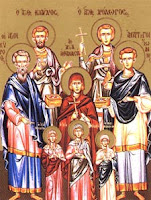
Saint Cyrus was a noted physician in the city of Alexandria, where he had been born and raised. He was a Christian and he treated the sick without charge, not only curing their bodily afflictions but also healing their spiritual infirmities. He would say, “Whoever wishes to avoid being ill should refrain from sin, for sin is often the cause of bodily illness.” Preaching the Gospel, the holy physician converted many pagans to Christ. During the persecution by Diocletian (284-305), Saint Cyrus withdrew into Arabia, where he became a monk. He continued to heal people by his prayer, having received from God the gift to heal every sickness.
In the city of Edessa at this time lived the soldier John, a pious Christian. When the persecution started, he went to Jerusalem and there he heard about Saint Cyrus. He began to search for him, going first to Alexandria and then to Arabia. When Saint John finally found Saint Cyrus, he remained with him and became his faithful follower.
They learned of the arrest of the Christian woman Athanasia and her three young daughters. Theoctiste was fifteen; Theodota was thirteen, and Eudoxia was eleven. Saints Cyrus and John hastened to the prison to help them. They were concerned that faced with torture, the women might renounce Christ.
Saints Cyrus and John gave them the courage to endure what lay before them. Learning of this, the ruler of the city arrested Saints Cyrus and John, and seeing their steadfast and fearless confession of faith in Christ, he brought Athanasia and her daughters to witness their torture. The tyrant did not refrain from any form of torture against the holy martyrs. The women were not frightened by the sufferings of Saints Cyrus and John but courageously continued to confess Christ. They were flogged and then beheaded, receiving their crowns of martyrdom.
At the same place, they executed the Holy Unmercenaries Cyrus and John. Christians buried their bodies in the church of the holy Evangelist Mark. In the fifth century, the relics of Saints Cyrus and John were transferred from Canopis to Manuphin. Later on, their relics were transferred to Rome, and from there to Munchen (Munich) (another account is located under June 28).
Saints Cyrus and John are invoked by those who have difficulty in sleeping.
Troparion — Tone 5
You have given us the miracles of Your martyrs, Cyrus and John, / as an invincible rampart; / through their prayers, frustrate the plans of the heathens, / and strengthen the faith of Catholic Christians, / for You alone are good and love mankind.
Kontakion — Tone 3
(Podoben: “Today the Virgin...”)
Having received the gift of miracles through divine grace, O saints, / you work wonders in the world unceasingly. / You remove all of our passions through your invisible surgery, / divinely-wise Cyrus and glorious John, / for you are truly divine physicians.
✠✠✠✠✠
Saint Cyrus was a noted physician in the city of Alexandria, where he had been born and raised. He was a Christian and he treated the sick without charge, not only curing their bodily afflictions but also healing their spiritual infirmities. He would say, “Whoever wishes to avoid being ill should refrain from sin, for sin is often the cause of bodily illness.” Preaching the Gospel, the holy physician converted many pagans to Christ. During the persecution by Diocletian (284-305), Saint Cyrus withdrew into Arabia, where he became a monk. He continued to heal people by his prayer, having received from God the gift to heal every sickness.
In the city of Edessa at this time lived the soldier John, a pious Christian. When the persecution started, he went to Jerusalem and there he heard about Saint Cyrus. He began to search for him, going first to Alexandria and then to Arabia. When Saint John finally found Saint Cyrus, he remained with him and became his faithful follower.
They learned of the arrest of the Christian woman Athanasia and her three young daughters. Theoctiste was fifteen; Theodota was thirteen, and Eudoxia was eleven. Saints Cyrus and John hastened to the prison to help them. They were concerned that faced with torture, the women might renounce Christ.
Saints Cyrus and John gave them the courage to endure what lay before them. Learning of this, the ruler of the city arrested Saints Cyrus and John, and seeing their steadfast and fearless confession of faith in Christ, he brought Athanasia and her daughters to witness their torture. The tyrant did not refrain from any form of torture against the holy martyrs. The women were not frightened by the sufferings of Saints Cyrus and John but courageously continued to confess Christ. They were flogged and then beheaded, receiving their crowns of martyrdom.
At the same place, they executed the Holy Unmercenaries Cyrus and John. Christians buried their bodies in the church of the holy Evangelist Mark. In the fifth century, the relics of Saints Cyrus and John were transferred from Canopis to Manuphin. Later on, their relics were transferred to Rome, and from there to Munchen (Munich) (another account is located under June 28).
Saints Cyrus and John are invoked by those who have difficulty in sleeping.
Troparion — Tone 5
You have given us the miracles of Your martyrs, Cyrus and John, / as an invincible rampart; / through their prayers, frustrate the plans of the heathens, / and strengthen the faith of Catholic Christians, / for You alone are good and love mankind.
Kontakion — Tone 3
(Podoben: “Today the Virgin...”)
Having received the gift of miracles through divine grace, O saints, / you work wonders in the world unceasingly. / You remove all of our passions through your invisible surgery, / divinely-wise Cyrus and glorious John, / for you are truly divine physicians.
IN LUMINE FIDEI: 31 JANUARY – SAINT JOHN BOSCO (Confessor)

IN LUMINE FIDEI: 31 JANUARY – SAINT JOHN BOSCO (Confessor): John Bosco was born in 1815 in Becchi, Italy, to the farmhands Francesco Bosco and Margherita Occhiena. Francesco died when John was tw...
31 January, The Chesterton Calendar
%20(1)%20(1)%20(1)%20(2)%20(1)%20(1)%20(1)%20(1)%20(1)%20(1)%20(1)%20(1)%20(2).jpg)
JANUARY 31st
The 'Iliad' is only great because all life is a battle, the 'Odyssey' because all life is a journey, the Book of Job because all life is a riddle.
The Defendant.'
31 January, The Holy Rule of St Benedict, Patriarch of Western Monasticism
%20(1)%20(1)%20(2).jpg)
CHAPTER VII. Of Humility
31 Jan. 1 June. 1 Oct.
The third degree of humility is, that a man for the love of God submit himself to his superior in all obedience; imitating the Lord, of Whom the apostle saith: “He was made obedient even unto death.”
1 February, The Roman Martyrology
%20(1)%20(1)%20(1)%20(2)%20(1)%20(1)%20(1)%20(1)%20(1)%20(1)%20(2)%20(1)%20(1)%20(2).jpg)
Kaléndis Februárii Luna décima Anno Dómini 2023
February 1st 2023, the 10th day of the Moon, were born into the better life:
The holy martyr Ignatius, who ruled the church of Antioch as the third Bishop of that See in succession to the blessed Apostle Peter.
In the persecution under the Emperor Trajan he was condemned to be killed by wild beasts, and was sent to Rome in chains by command of the emperor. There, in the presence of the Senate, he was first put to most grievous torments and then thrown to lions, the which throttled him with their teeth, and so he was made Christ's offering, (in the year 107.)
At Smyrna, the holy martyr Pionius. He was a Priest who had written much controversial matter on behalf of the Christian faith. After suffering a foul imprisonment, during the which he strengthened many brethren by his exhortations to the enduring of martyrdom, he was put to many tortures and nailed upon a pyre, where he obtained a blessed end by being burnt for Christ's sake. And with him suffered fifteen others, (in the year 251.)
At Ravenna, holy Severus, (in the year 389,) Bishop of that city, to the which place he was chosen, on account of his extraordinary merits, through a miraculous sign in the form of a dove.
At Tron, in Gaul, (in the fifth century,) holy Paul, Bishop of that see, whose life shone with grace, and the preciousness of whose death is attested by miracles.
Upon the same day, holy Ephrem, Deacon of the church of Edessa, who after much work for the faith of Christ fell asleep in the Lord, eminent for holiness and teaching, in the time of the Emperor Valens, (in the year 378.)
In Ireland, (in the year 523,) the holy Virgin Brigid. At the moment that she bowed down her head to receive the hallowed veil, she chanced to touch the wooden steps of the altar with her hand, and in witness to her virginity the dry wood at once became green.
At Florence, in Tuscany, the blessed Virgin Veridiana, recluse, of the Order of Vallombrosa, (Castel Florentin, 1242.)
V. And elsewhere many other holy martyrs, confessors, and holy virgins.
R. Thanks be to God.
30 January 2023
France Oberving 9-Year Novena to St. Joan of Arc, All Invited To Join
I will be adding an intention that the organisers haven't, the restoration of the man St Joan called the 'Lieutenant of Christ', the King of France.
In recent years the historically Catholic nation of France has fallen into a crisis of faith. With a high rate of reported anti-Chrisitian incidents and consistent bids for secularization in the government – including a bid to enshrine a constitutional right to abortion – the situation only became exacerbated when Notre Dame caught fire and burned in April of 2019. Now, the French faithful are rallying around the Maid of Orleans for a time of renewal.
At the tail end of 2022, a group of about a dozen faithful in communion with the bishops launched a 9-year novena to St. Joan of Arc. With the goal of renewing the nation’s vocation as the “eldest daughter of the Church,” France will offer prayers for St. Joan’s intercession until the sixth centennial anniversary of her death in 2031, and they’re inviting Catholics around the world to join them.
Each of the nine years will focus on another aspect of St. Joan’s faithful witness, aspects of which are shared by the French Catholic identity. In the first year France will honor St. Joan’s “availability and obedience to the will of God.”
According to the novena’s official website, all that is required to take part is to sign up for a monthly newsletter – this will send texts for contemplation and prayer – as well as practicing daily prayer.
The supplied prayer reads:
Subsequent years will continue to explore themes based on the life and deeds of St. Joan. The faithful will meditate on the topics of caution (2024), courage (2025), hope (2026), patriotism (2027), charity and justice (2028), practice of the sacraments (2029), purity (2030), and patience (2031).
In an interview with Famille Chrétienne, novena spokesperson Thibaud Collin explained that he was struck with the idea while reading a biography of St. Joan to his daughter. When he realized that St. Joan died in 1431, he recalled the years-long novena in Poland which took place from 1958 to 1966, known as the Great Novena. He said:
Click here to sign up for the newsletter and join the 9-year novena to St. Joan of Arc today.
From Aleteia
By J-P Mauro
The 9-year novena to the patron saint of France will end on the sixth centennial anniversary of her death in 2031.At the tail end of 2022, a group of about a dozen faithful in communion with the bishops launched a 9-year novena to St. Joan of Arc. With the goal of renewing the nation’s vocation as the “eldest daughter of the Church,” France will offer prayers for St. Joan’s intercession until the sixth centennial anniversary of her death in 2031, and they’re inviting Catholics around the world to join them.
Each of the nine years will focus on another aspect of St. Joan’s faithful witness, aspects of which are shared by the French Catholic identity. In the first year France will honor St. Joan’s “availability and obedience to the will of God.”
According to the novena’s official website, all that is required to take part is to sign up for a monthly newsletter – this will send texts for contemplation and prayer – as well as practicing daily prayer.
The supplied prayer reads:
Sainte Jeanne
Like you, we want to be faithful to the promises of our baptism;
Guide us.
We want to discern the will of God to accomplish it;
enlighten us.
We desire to follow the banner of Christ to extend his reign over our life, our country and the Church;
Get ahead of us.
We beg you for the salvation of our country and our souls;
pray for us.
Subsequent years will continue to explore themes based on the life and deeds of St. Joan. The faithful will meditate on the topics of caution (2024), courage (2025), hope (2026), patriotism (2027), charity and justice (2028), practice of the sacraments (2029), purity (2030), and patience (2031).
In an interview with Famille Chrétienne, novena spokesperson Thibaud Collin explained that he was struck with the idea while reading a biography of St. Joan to his daughter. When he realized that St. Joan died in 1431, he recalled the years-long novena in Poland which took place from 1958 to 1966, known as the Great Novena. He said:
“We saw the fruits of this in the following years: Solidarnosc, St. John Paul II, etc. Given the state of our country, of the world, and of the Church, I have the very simple intuition that prayer and fasting can have very concrete effects in our society.”
Click here to sign up for the newsletter and join the 9-year novena to St. Joan of Arc today.
What is Philosophy?
Video Number One in Crash Course Philosophy, with Hank Green.
Today Hank begins to teach you about Philosophy by discussing the historical origins of philosophy in ancient Greece, and its three main divisions: metaphysics, epistemology, and value theory. He will also introduce logic, and how you’re going to use it to understand and critically evaluate a whole host of different worldviews throughout this course. And also, hopefully, the rest of your life.
Will The Catholic Faith Disappear from The Earth? │Gerhard Cardinal Müller
Not unless Christ lied!!!
Apologia Pro Marcel Lefebvre - Vol. III - Correspondence
%20(1)%20(1)%20(2)%20(1)%20(1)%20(1)%20(1)%20(1)%20(1)%20(2)%20(1).jpg)
7 April 1982
Your Excellency,
I would like to inform you without delay that I have been able to give a preliminary account of our discussion of 27 March last to the Holy Father. He was kind enough to express his satisfaction with it, and decided that the results obtained on the occasion of this meeting should be examined jointly by a small group of Cardinals of my choice gathered around me. When I have obtained their opinions, I shall be in a position to inform the Sovereign Pontiff in more detail. He will then give instructions as to what is to follow.
So as to have a secure base from which to work, it seems to be to be necessary to set down in writing points taken from the letter of the late Cardinal Seper dated 20 October 1980, which could serve towards a declaration.
- Mgr. Lefebvre declares his support for the teachings of the Second Vatican Council "understood in the light of the whole of holy Tradition and on the basis of the unvarying Magisterium of the Church" (cf. John Paul II, Allocution to the Sacred College, 5 November 1979. A.A.S. LXXI (1979/II) p. 1452). This adherence takes into account the theological qualification given by the Council itself (Note made during the 125th General Congregation, 16 November 1964).
- Mgr. Lefebvre accepts the legitimacy of the liturgical reforms requested by the Second Vatican Council. He recognizes that, when applied in conformity to the Missal and other liturgical books promulgated by the Holy See that they are neither heretical nor invalid, for all that he has considerable reservations about the way in which the reforms have actually been put into practice.
- ) In so far as pastoral ministry and works are concerned, Mgr. Lefebvre agrees to conform to the norms of Canon Law, especially in so far as ordinations, confirmations, pontifical ceremonies, the establishment of Religious Institutions, the training of clergy and apostolic activity in the dioceses are concerned. He will eventually accept the appointment of a Pontifical Delegate charged with studying with him the means of regularizing his own position as well as that of the members of the Society of St. Pius X.
- Finally, Mgr. Lefebvre regrets those of his words and deeds which have displeased the Holy See.
I would be grateful if you could let me have your comments as soon as possible, should you be of the opinion that the above four points do not render the content of our recent conversation exactly.
Meanwhile, Your Excellency, I ask you to accept, with the assurance of my prayers, my brotherly and devoted best wishes.
Joseph Card. Ratzinger
**************
Mgr. Lefebvre's Reply to Cardinal Ratzinger
21 April 1982
Your Eminence,
I have received your letter of 7 April. I have studied it with great interest, and willingly recognize that the declaration which you put forward is very close to that which I believe it would be possible to sign.
The first point in particular presents no more problems as soon as "tradition" and the "rule of theological interpretation" become the norms that enlighten our judgment of the conciliar texts.
The second point would be more appropriately expressed as follows:
"Mgr. Lefebvre signed the conciliar Decree on the Liturgy, so accepting the possibility of reform. He has never affirmed that the texts of the new liturgical books in their original Latin versions were heretical or invalid in themselves, but he believes that the reform of the Liturgy as implemented necessitates grave reservations, as Cardinals Ottaviani and Bacci rightly stated."
The third point, which aims to place the Society and my work in a regular position with regard to Canon Law, is subject to acceptance by the Holy See of the requests put forward in my letters to the Holy Father and to Cardinal Seper in the course of the past two years. Might it not be put in the following way:
"Mgr. Lefebvre wishes that an Apostolic Delegate should be appointed, and should make a Visitation; when the Delegate has seen the work of the Society and its associated bodies, he could, in agreement with the Society, propose a project for the regularization of the Society and of its activities."
The fourth point really could be expressed in slightly modified terms:
"Mgr. Lefebvre regrets those of his words and deeds which may have displeased the Holy See."
I consider it indispensable that subjoined to the declaration or in some other document there should be indicated the intentions of the Holy See concerning what would be granted in respect of the Liturgy and of recognition of the Society.
In the hope that these explanatory details will enable Your Eminence to propose a definitive text, I ask you to take note of my feelings of respect and heartfelt devotion in Christo et Maria.
+ Marvel Lefebvre
**************
27 May 1982
Letter of Mgr. Lefebvre to Cardinal Ratzinger
Your Eminence,
Upon my return from a journey to the U.S.A. and Canada, I am anxious to inform you that on learning at Winnipeg in Canada of the deplorable affair of Father Fernandez-Krohn1 at Fatima, I immediately made a public declaration on Canadian national television, deploring this act of madness committed by a priest whom I had ordained.
I accompanied this statement with some information about this violent tempered priest, who, alas! has caused us many problems. He left us a year after his ordination, opposing the Society's loyalty to the Pope. He repented, and we took him back out of pity, with the intention of making him more tractable to reason, but he refused to take up his responsibilities vis-a-vis the Society and began once more to behave in a violent fashion towards myself and my brethren.
We had resolved to distance ourselves from him for good when he perpetrated this demented act which is truly a source of grief to all the members of the Society.
To the best of my knowledge, this information has not yet crossed the Atlantic. I hope, however, that the Apostolic Delegate to Canada will have passed it to Rome.
Your Eminence, please tell the Holy Father once again of our filial respect, and accept my expressions of respect and devotion in Jesus and Mary.
+ Marvel Lefebvre
****************
Reply of Cardinal Ratzinger
23 June 1982
Your Excellency,
I thank you for your letter of 27 May last, and am anxious to inform you that I have not failed to pass it on to the Holy Father. Besides, the position that you took in Canada was already known in Rome.
I am grateful to you for the sentiments which you expressed on the occasion of the unfortunate events at Fatima. Do permit me, this notwithstanding, a personal afterthought. It is quite clear that you are in no way personally responsible for the sacrilegious attempt upon the Holy Father's life perpetrated by Father Fernandez‑Krohn. However, the fact that you agreed to ordain him priest gives rise to questions about the rigorousness of the criteria as to worthiness applied in his case. In a more general sense, are you sufficiently concerned to restrain and combat what must be called the fanaticism of certain members of the Society of St. Pius X? Reports recently reached me of a sad example of this, a sermon preached by one of them at Wurzburg on the occasion of his first Mass; this showed feelings falling little short of hatred for the legitimate Pastor of the diocese.
Please accept, Your Excellency, my feelings of fraternal respect and devotion in Our Lord.
Joseph Card. Ratzinger
************
Letter of Cardinal Ratzinger to Mgr. Lefebvre
23 June 1982
Your Excellency,
I have received your letter of 21 April last, and I thank you for it. Please excuse my delay in replying: as I said earlier, I was first obliged to consult a group of Cardinals of my choice, then to consult the Holy Father frequently. You know how busy he has been for the last few weeks.
Following these discussions, I am now informing you of our conclusions, and the thoughts which I have had about our meeting in March and our subsequent correspondence,
according to the four points foreseen for some future declaration, as put forward in your letter.
1. The first point‑concerning adhesion to the teachings of Vatican II‑ no longer seems to present any difficulties on either side. Naturally, this implies that the Council, understood in this way, will no longer be the object of polemical attacks by yourself, as Cardinal Seper asked of you in his letter of 26 October 1981.
2. In the matter of the second point, first of all it is too restrictive to mention acceptance of the possibility of a reform. The Constitution Sacrosanctum Concilium decided upon a reform of the liturgy and set out the general and particular norms, often in a highly detailed way.
Secondly, we do not think it possible to accept the way in which you limit your acceptance to the Latin text only. Indeed, the Apostolic See cannot accept the suspicion that most Masses and Sacraments legitimately celebrated in the Church in the vernacular and according to approved translations, could be invalid. Accordingly we think it necessary to return to the formula as before: "applied in conformity to the Missal and other liturgical books promulgated by the Holy See."
Besides, given that you are said to be the author of a text according to which: "the new Masses are not only incapable of fulfilling our Sunday obligation, but are such that we must apply to them the canonical rules which the Church customarily applies to communicatio in sacris with Orthodox Churches and Protestant sects." (in Cor Unum - internal liaisory Bulletin for members of the Society of St. Pius X, November 1979), we consider that the projected declaration should contain a formula which distances itself clearly from such a statement.
As to an expression of your reservations concerning the concrete realization of the liturgical reforms, we think it preferable that this should not figure in an official declaration. You could add it as a footnote, on your own responsibility, and, of course, in a moderate form, previously approved by the Holy See.
3. The opening part of the third point, left out of the latest draft proposed by yourself, is absolutely indispensable. On this issue, allow me to express my astonishment, my sorrow even, at the way in which you pursue your visits and activities in various countries and dioceses, as was recently the case in Canada and will be soon in Venice‑not to forget the grave and ever present question of ordinations to the priesthood. All this can but render more arduous the path to reconciliation.
The second part, retained by yourself, which concerns the Pontifical Delegate, presents no special difficulty. It will, however, be necessary to examine and to elaborate the details of this mission, notably with regard to the members of the Society of St. Pius X, whose willingness to commit themselves to an undertaking such as yours will have to be proved.
4. The formula which you retain for the fourth point involves a considerable softening of it, which could nevertheless be accepted in a spirit of magnanimity. However, many bishops have been severely hurt by your actions in their dioceses; I could give many important instances. It is accordingly necessary that this last point should include them in some way in the expression of regrets, at the very least in a general manner, as follows, for example: "words and deeds which may have displeased the Holy See and troubled common order in the Church as established by Canon Law."
You ask, furthermore, that as an addendum to the Declaration, or in another document, there should be indicated the intentions of the Holy See concerning the Liturgy and the Society of St. Pius X. That is a question of which careful note has been taken. In the present state of affairs, I can make you no detailed promises; but I am anxious to assure you that, on this subject, I am in continual contact with the Holy Father.
In closing, I thank you in advance for the attention that you will doubtless give the contents of this letter, and the reflection which you will devote to it in the presence of Our Lord and of the Virgin Mary. Equally, I assure you of my complete preparedness to meet you again at a date that you suggest, bearing in mind that I shall be absent from Rome from 3 July to 6 September next.
Please allow me to express, together with the assurance of my prayers, Your Excellency, my feelings of fraternal respect and devotion.
Joseph Card. Ratzinger
1. A priest of the Society ordained by Mgr. Lefebvre who attempted to assassinate Pope John Paul 11 at Fatima.
Cardinal McElroy’s Attack on Church Teachings on Sexuality Is a Pastoral Disaster
More on McElroy's plans on queering the Church. Remember, Abp Gómez, a Catholic, was passed over for a Red Hat to give it to McElroy.
From the National Catholic Register
By Fr Raymond J. de Souza
COMMENTARY: Jettisoning the distinction between ‘orientation and activity’ means the end of chastity as a virtue to be strived for — or implies that ‘the LBGT community’ is not capable of chastity and should therefore be preached a lesser gospel.
That a cardinal wishes to change the Church’s teaching on the morality of same-sex sexual acts is not new. But there is a new one advocating just that, and one of the newest in the college at that.
Cardinal Jean-Claude Hollerich, created a cardinal by Pope Francis in 2019 and appointed relator general of the synodal process on synodality for a synodal Church, has been advocating for such a change because the “sociological-scientific foundation of this teaching is no longer correct.”
Now Cardinal Robert McElroy, bishop of San Diego and created a cardinal by Pope Francis just last August, has joined Cardinal Hollerich with a wide-ranging essay in America magazine this week. Cardinal McElroy argues that the synodal process on synodality for a synodal Church is an opportune time to revisit — and revise — some doctrines of the Church. Among those are the question of priestly ordination for women, but his main focus was on “radical inclusion of L.G.B.T. people.”
There has been much reaction and more will certainly follow. Here I would just draw attention to one aspect of Cardinal McElroy’s pastoral approach: the abolition of chastity.
Cardinal McElroy, in his discussion of Holy Communion, objects to traditional Catholic teaching that “all sexual actions outside of marriage are so gravely evil that they constitute objectively an action that can sever a believer’s relationship with God” — mortal sin, in usual parlance.
“This objection should be faced head on,” he writes, and so he does:
The distinction between orientation and activity cannot be the principal focus for such a pastoral embrace because it inevitably suggests dividing the L.G.B.T. community into those who refrain from sexual activity and those who do not. Rather, the dignity of every person as a child of God struggling in this world, and the loving outreach of God, must be the heart, soul, face and substance of the church’s stance and pastoral action.
In traditional pastoral practice the two ought to go together, affirming the dignity of every person while also advising that sinful acts be avoided.
Cardinal McElroy’s argument, that “the distinction between orientation and activity” cannot be a “principal focus” undermines a great deal more than he allows. Indeed, as a confessor he would know how crucial the distinction is. A penitent who mentions an involuntary desire for adulterous relations but resists the temptation is not only not guilty of a sin, but is practicing virtue. A penitent who entertains such desires but does not act upon them is guilty of a sin, though likely not a grave one. And the penitent who engages in adultery is guilty of a mortal sin.
That distinction may not be the “principal focus” — the principal focus is always God’s love and mercy — but the distinction is pastorally essential.
There are any number of sexual sins — pornography, masturbation and fornication being the most common — where the distinction between an orientation, a disposition, a desire, a habit and a particular act, is absolutely fundamental.
I don’t know how pre-Cana classes are run in San Diego, but presumably cohabitation and fornication are addressed. The “distinction between orientation and activity” does not apply only to homosexuality.
Heterosexual engaged couples are certainly oriented toward conjugal union, but actual conjugal union is sinful before marriage. I would concur that this ought not be the “principal focus” of marriage preparation, but it can hardly be set aside for fear of “dividing” the pre-Cana classes into those who are striving for chastity and those who are not.
Jettisoning the distinction between “orientation and activity” in sexual matters means the end of chastity as a virtue to be strived for. Or, at the very least, implies a view that “the L.B.G.T. community” is not capable of chastity and should therefore be preached a lesser gospel.
A final note about Cardinal McElroy himself. His creation as a cardinal last August was noteworthy. Archbishop José Gómez of Los Angeles — head of the largest diocese in the United States, then president of the USCCB, an immigrant from Mexico himself who is a champion of immigrants — was passed over in favor of the bishop of San Diego.
For a pope whose favored phrase is the santo pueblo fiel de Dios — the holy, faithful people of God — passing over a Latino prelate for a McElroy was curious. On the very day that Cardinal McElroy’s essay was published, the Holy Father gave an interview in which he denounced the German “synodal path” as “elitist.”
It would seem that something similar could be said about Cardinal McElroy’s desire to use the synodal process on synodality for a synodal Church to abolish chastity. And there is no American prelate more elite than Cardinal McElroy — degrees from Harvard, Stanford, Berkeley and the Gregorian, the Jesuit university in Rome.
When McElroy was created a cardinal in San Diego, some wondered if it might be a repeat of what Pope Francis did when he created Joseph Tobin a cardinal while still archbishop of Indianapolis. Soon after Cardinal Tobin was transferred to Newark. Might the new cardinal in San Diego soon be on his way to Washington or back to Harvard, as archbishop of Boston?
It may be that Cardinal McElroy has his sights set beyond that. Was the essay on “radical inclusion” an application to be transferred to Germany instead?
A Road to Nowhere
In keeping with Francis's plans to destroy the Church, his new Cardinal, McElroy, calls for 'queering' the Church & changing infallible doctrine.
From The Catholic Thing
By Stephen P. White
Cardinal Robert McElroy of San Diego has penned a lengthy reflection (available here) on how the synodal process might address the exclusion of certain categories of people. The essay covers a lot of ground, but the bulk of it is concerned with the questions of how to address, “the exclusion of divorced and remarried and L.G.B.T. Catholics, particularly on the issue of participation in the Eucharist.”
Reading the essay, I couldn’t help but think of H. Richard Niebuhr’s famous line: “A God without wrath brought man without sin into a kingdom without judgment through the ministrations of a Christ without a cross.” Which is to say: this was in no way an edifying document.
Where to begin?
While pastoral in tone, the essay deals almost entirely in abstractions. Concrete acts by particular moral agents simply don’t register. Exclusion is treated not as a consequence of sin, but as something inflicted upon sinners by the Church. Sin is not what divides us; the Church’s hang-ups about sin do.
So we read, for example, “[T]he exclusion of men and women because of their marital status or their sexual orientation/activity is pre-eminently a pastoral question, not a doctrinal one.”
The Church has gone to great lengths to insist that no one is excluded from receiving the Eucharist because of sexual orientation, which Cardinal McElroy surely knows. But even as he attempts to collapse the distinction between sinner and sin, McElroy draws a bright line between the moral life and our relationship with God, just as he does between pastoral and doctrinal matters. He writes:
The heart of Christian discipleship is a relationship with God the Father, Son and Spirit rooted in the life, death and resurrection of Jesus Christ. The church has a hierarchy of truths that flow from this fundamental kerygma. Sexual activity, while profound, does not lie at the heart of this hierarchy. Yet in pastoral practice we have placed it at the very center of our structures of exclusion from the Eucharist. This should change.
It is true that sexual morality is not at the heart of the hierarchy of truths of the faith in precisely the limited sense that no moral teaching of the Church is at the heart.
Of course, the reason God gives us the moral law is precisely to guide us toward those actions and habits that bring us closer to Him and to our neighbor, and to avoid those actions that impede, damage, and destroy those same relationships.
This is why Jesus says, “If you love me, you will keep my commandments.” And why, shortly before equating lust with adultery, he gave his disciples this warning:
Whoever breaks one of the least of these commandments and teaches others to do so will be called least in the kingdom of heaven. But whoever obeys and teaches these commandments will be called greatest in the kingdom of heaven. I tell you, unless your righteousness surpasses that of the scribes and Pharisees, you will not enter into the kingdom of heaven.
The actual words of the Scripture stand in jarring contrast to the disjointed view of doctrine and pastoral concerns, as Cardinal McElroy presents them. Curiously, the essay’s only reference to Scripture, such as it is, is to the title of a Synod document which is taken from Isaiah: “Enlarge the Space of Your Tent.” Not incidentally, Scripture scholars say this really refers, not to “inclusion,” but the territorial expansion of Israel, i.e., conquest.
For his part, the Cardinal is concerned that the Church places too much emphasis today on sexual morality. Were it not for the utter collapse of marriage in the West, the malformation and perversion of a whole generation of young people through pornography, the daily reminders that our gnostic culture promotes a view of the human person which renders the body meaningless and the Incarnation incoherent, and the Church’s own decades of failure to adequately address sexual abuse, he might have a point.
Cardinal McElroy has often expressed concern about polarization in the Church and has long been a critic of various notions of individual autonomy that mark American culture. Yet when it comes to reception of the Eucharist, that most inextricably communal reality in Christian life, McElroy stakes out a maximalist view of individual conscience: “While Catholic teaching must play a critical role in the decision making of believers, it is conscience that has the privileged place. Categorical exclusions undermine that privilege precisely because they cannot encompass the inner conversation between women and men and their God.”
As I’ve written before, nowhere is the individualist strain in American Catholicism more manifest than in the ubiquitous belief that reception of the Holy Eucharist is a private matter rather than a fundamentally ecclesial reality. Here we see it from Cardinal McElroy in its starkest form.
So diminished is the ecclesial dimension of the Eucharist in favor of private conscience, that one could easily miss McElroy’s call for open communion: “[T]he church must embrace a eucharistic theology that effectively invites all of the baptized to the table of the Lord. . .”
Unsurprisingly, the very thing Christ died to save us from – sin – barely registers in the Cardinal’s essay. Nor do we read anything about that beautiful Sacrament by which Christ offers us a remedy for even the gravest of sins. In some 3,000 words on the pastoral urgency for inclusion, the Sacrament of Reconciliation is not mentioned even once.
Sin, mercy, conversion, redemption: all these dissolve into flaccid platitudes about inclusion, listening, dialogue. Behind this fog of abstractions and platitudes, the fundamental drama of salvation – the very substance of the Good News – is obscured.
What we’re left with is a vision of Christian life which lacks any hint of the freshness of the Gospel. If that’s the path the synod takes, it will be a path to nowhere. And all of us, not least those in the difficult pastoral circumstances Cardinal McElroy is so genuinely and admirably concerned about, will be the worse for it.
From The Catholic Thing
By Stephen P. White
Cardinal Robert McElroy of San Diego has penned a lengthy reflection (available here) on how the synodal process might address the exclusion of certain categories of people. The essay covers a lot of ground, but the bulk of it is concerned with the questions of how to address, “the exclusion of divorced and remarried and L.G.B.T. Catholics, particularly on the issue of participation in the Eucharist.”
Reading the essay, I couldn’t help but think of H. Richard Niebuhr’s famous line: “A God without wrath brought man without sin into a kingdom without judgment through the ministrations of a Christ without a cross.” Which is to say: this was in no way an edifying document.
Where to begin?
While pastoral in tone, the essay deals almost entirely in abstractions. Concrete acts by particular moral agents simply don’t register. Exclusion is treated not as a consequence of sin, but as something inflicted upon sinners by the Church. Sin is not what divides us; the Church’s hang-ups about sin do.
So we read, for example, “[T]he exclusion of men and women because of their marital status or their sexual orientation/activity is pre-eminently a pastoral question, not a doctrinal one.”
The Church has gone to great lengths to insist that no one is excluded from receiving the Eucharist because of sexual orientation, which Cardinal McElroy surely knows. But even as he attempts to collapse the distinction between sinner and sin, McElroy draws a bright line between the moral life and our relationship with God, just as he does between pastoral and doctrinal matters. He writes:
The heart of Christian discipleship is a relationship with God the Father, Son and Spirit rooted in the life, death and resurrection of Jesus Christ. The church has a hierarchy of truths that flow from this fundamental kerygma. Sexual activity, while profound, does not lie at the heart of this hierarchy. Yet in pastoral practice we have placed it at the very center of our structures of exclusion from the Eucharist. This should change.
It is true that sexual morality is not at the heart of the hierarchy of truths of the faith in precisely the limited sense that no moral teaching of the Church is at the heart.
Of course, the reason God gives us the moral law is precisely to guide us toward those actions and habits that bring us closer to Him and to our neighbor, and to avoid those actions that impede, damage, and destroy those same relationships.
This is why Jesus says, “If you love me, you will keep my commandments.” And why, shortly before equating lust with adultery, he gave his disciples this warning:
Whoever breaks one of the least of these commandments and teaches others to do so will be called least in the kingdom of heaven. But whoever obeys and teaches these commandments will be called greatest in the kingdom of heaven. I tell you, unless your righteousness surpasses that of the scribes and Pharisees, you will not enter into the kingdom of heaven.
The actual words of the Scripture stand in jarring contrast to the disjointed view of doctrine and pastoral concerns, as Cardinal McElroy presents them. Curiously, the essay’s only reference to Scripture, such as it is, is to the title of a Synod document which is taken from Isaiah: “Enlarge the Space of Your Tent.” Not incidentally, Scripture scholars say this really refers, not to “inclusion,” but the territorial expansion of Israel, i.e., conquest.
For his part, the Cardinal is concerned that the Church places too much emphasis today on sexual morality. Were it not for the utter collapse of marriage in the West, the malformation and perversion of a whole generation of young people through pornography, the daily reminders that our gnostic culture promotes a view of the human person which renders the body meaningless and the Incarnation incoherent, and the Church’s own decades of failure to adequately address sexual abuse, he might have a point.
Cardinal McElroy has often expressed concern about polarization in the Church and has long been a critic of various notions of individual autonomy that mark American culture. Yet when it comes to reception of the Eucharist, that most inextricably communal reality in Christian life, McElroy stakes out a maximalist view of individual conscience: “While Catholic teaching must play a critical role in the decision making of believers, it is conscience that has the privileged place. Categorical exclusions undermine that privilege precisely because they cannot encompass the inner conversation between women and men and their God.”
As I’ve written before, nowhere is the individualist strain in American Catholicism more manifest than in the ubiquitous belief that reception of the Holy Eucharist is a private matter rather than a fundamentally ecclesial reality. Here we see it from Cardinal McElroy in its starkest form.
So diminished is the ecclesial dimension of the Eucharist in favor of private conscience, that one could easily miss McElroy’s call for open communion: “[T]he church must embrace a eucharistic theology that effectively invites all of the baptized to the table of the Lord. . .”
Unsurprisingly, the very thing Christ died to save us from – sin – barely registers in the Cardinal’s essay. Nor do we read anything about that beautiful Sacrament by which Christ offers us a remedy for even the gravest of sins. In some 3,000 words on the pastoral urgency for inclusion, the Sacrament of Reconciliation is not mentioned even once.
Sin, mercy, conversion, redemption: all these dissolve into flaccid platitudes about inclusion, listening, dialogue. Behind this fog of abstractions and platitudes, the fundamental drama of salvation – the very substance of the Good News – is obscured.
What we’re left with is a vision of Christian life which lacks any hint of the freshness of the Gospel. If that’s the path the synod takes, it will be a path to nowhere. And all of us, not least those in the difficult pastoral circumstances Cardinal McElroy is so genuinely and admirably concerned about, will be the worse for it.
Subscribe to:
Posts (Atom)