01 February 2024

The Art of Dress – A Survey of Principles

Miss Kalinowska continues her series on proper dress with a new essay. Again, it's aimed mostly at women but can be profitably read by either sex.

From One Peter Five

By Anna Kalinowska (Her preferred title is “Miss.” Please never call her “Ms.”!)

Other articles in this series:

The Art of Dress – Two Schools of Thought
The Art of Dress – Problems with Normalcy
The Art of Dress – Learning from the Valiant Woman

The Art of Dress - What Nuns Can Teach Us

In 1925, professors of home economics Harriet and Vetta Goldstein published a textbook called Art in Every Day Life. The book and its three subsequent editions soon become a key reference for virtually all other textbooks on dress of the time and ended up influencing generations of American homemakers.[1]

The sisters began the book with an introduction to “good taste” in their distinctly simple prose:

It has been said that good taste is doing unconsciously the right thing, at the right time, in the right way. Unfortunately, very few people are born with this rare gift, but it is comforting to know that with study one can consciously apply the principles, until the wished for time is reached when the right thing is done unconsciously.[2]

They then presented their formulation of art principles: Harmony, Proportion, Balance, Rhythm, and Emphasis. In subsequent chapters, they covered topics as varied as hat selection, to interior design, to city planning—their principles applied to all.[3]

With occasional references to “the Greeks” and Japanese prints as their authorities, the Goldsteins took for granted in their students a desire for beauty and a willingness to bow to universal principles.[4]      Commenting, for instance, on textural harmony, it was enough to say:

In dress we sometimes see textures as inharmonious as gold-lace hats worn with coarse wool sweaters, and strings of pearls with rough wool dresses. The gold-lace hat and pearls are related, and are harmonious in texture with such fabrics as satin, velvet, and fine furs. The wool sweater and the wool dress have textures which would be in harmony with each other and with felt, rough straw, or similar textures.[5]

This clear guidance contrasts drastically from that found in the digital maelstrom of today’s fashion commentary, which seems to value comfort above all and which treats aesthetic value—whatever it asserts that is—only as a means to shock or seduce.

The Goldstein sisters’ challenge to their students to bring beauty to every sphere of life, and their candid avowal that one must follow rules to do so successfully contribute to making their book seem rigid and irrelevant to most intelligentsia today. And yet, among the general population, there are many who, marveling at the beauty of Grace Kelly’s wedding dress, or their own great grandmother’s attire in a faded family photo, begin to suspect that to reclaim some portion of what they admire, it might just be worthwhile to study something with more backbone than the latest vapid fashion blog.

I will now present a brief survey of the Goldsteins’ work regarding the art of dress to show how it might guide us today. I write particularly for women who, struggling to dress modestly, have run up against inevitable frumpiness; who wonder wistfully why even their poorest ancestors looked so much better than they; and who wish to make of dress something more than a dreary duty; in short, who believe that dress can and should be a source of great joy.

Harmony

When people think of harmony, their thoughts likely go first to music. But taken in the broader sense, harmony is merely the successful arrangement of things, be they musical notes, buildings, or bracelets; harmony and disharmony occur in all realms of art.

The Goldsteins described harmony as, “the art principle which produces an impression of unity through the selection and arrangement of consistent objects and ideas.”[6] They described harmonious objects and ideas as having “family resemblances” and “friendly” relationships with one another, and broke harmony into four sub-categories: shape, texture, idea, and color.[7]

Shape Harmony

Regarding shape harmony in dress, they wrote:

Since a dress design in itself is not considered as a complete unit, but as something to be worn on a human figure, its lines should suggest some relationship to the lines of the figure. This means that its outline will follow the form closely enough to have something in common with it, yet not so closely as to appear immodest or to be uncomfortable.[8]

One finds here a refreshingly balanced perspective of the “shape” question so often considered only from the view of how much ought to be hidden. A human wears the clothes; therefore, it is proper and logical to show some suggestion of the human shape rather than to obscure it completely in the name of modesty. In warning against the other extreme, that is overly clingy clothing, the Goldsteins assume their readers not only know what modesty is but also desire it. Not prone to philosophizing or preaching, perhaps they found the admonishment to ease of motion an easier one to support. Besides, in their day, stretch fabrics had not yet made second-skin leggings and tank tops a possibility, so anyone looking for ease of motion would have necessarily worn looser fitting clothing. In the section on emphasis, I will further discuss the problems with overly clingy clothing.

To further understand shape harmony, consider the photos below:

Lack of Shape Harmony

Although this ensemble succeeds in decently covering the wearer, it shows very little shape harmony. The baggy untucked polo shirt obscures the figure beneath. The skirt fails to fall gracefully over the hips and instead seems to hang midair in a stiff wad. The shoes do not allow the figure to “taper” at the feet, but rather, stand out like two heavy blobs. This ensemble, though less than ideal, could be greatly improved simply by tucking in the shirt (assuming the skirt sits at the natural waist) and exchanging the sneakers for light flats or sandals.

Successful shape harmony

This dress also succeeds in decently covering the wearer, but this time, shows successful shape harmony too. The bodice, though fitted, does not cling. Its seam at the natural waist harmonizes perfectly with the wearer beneath. The ordered gathers of the skirt fall gracefully over the hips, at once concealing and revealing the beauty of the figure. It is worth noting too, that the gentle puffs at the shoulders provide ease of motion remarkable for a fabric (a cotton linen blend) with no stretch. The length of the sleeves and their narrowing width down to the elbow harmonizes better with the arm of the wearer than the untapered quarter-length sleeves of the standard polo shirt above.

Textural Harmony

On harmony of textures, the Goldsteins unlock a great secret to artistic success: namely, that materials exist in roughly three textural families—coarse, fine, and transitional—and that to achieve harmony in a design, all materials used must originate (or seem to originate) from the same family. For instance, the common durability and weight of denim, rough wool, and leathers such as rawhide makes them siblings. Just as one expects to see the brothers and sisters of a family together, so it appears natural for related materials to comprise an ensemble of clothing. In the realm of fine materials, the similar luster of pearls and satin makes them like two radiant sisters, and one could call fine lace their cheerful cousin. Straw and light fabrics such as muslin and linen share a common summer airiness. And so on. It is beyond the scope of this survey to determine what generates family relationships of materials—are they only a human association, or something metaphysical? Here it suffices to repeat the Goldsteins’ simple statement:

So many schemes just miss being successful because the person who planned them did not recognize that textures which are very coarse have nothing in common with those which are very fine.[9]

Ironically, most adherents of “mainstream” fashion accidentally achieve textural harmony simply because they never attempt anything beyond the most informal level of dress. Their T-shirts, yoga pants, and running shoes, all fall in the same family of textures. This perpetual informality of the so-called “athleisure” style presents its own set of problems.

However, among devout Catholics who sometimes try to dress with formality one often sees instances of these texture schemes that “just miss.” For instance, the woman who pairs a light chiffon dress with a boxy unisex windbreaker. The utilitarian “sport” fabric and masculine shape of the one has nothing in common with the light fabric and femininity of the other. Nor do the shock-absorbing foam soles and neon mesh of sneakers have anything in common with a light cotton sundress. And, perhaps the most ubiquitous and well-meant blunder of all: fine lace chapel veils have nothing in common with denim. Although most lace seen today is made of nylon and produced by machines (and therefore inexpensive), lace as a fabric family still enjoys an aura of great formality, even regality. Historically lace was considered a precious fabric and counted as part of a kingdom’s treasure. It will always clash with utility fabrics. Nor does it correct matters in the least to tie the chapel veil around the head “dew rag” style as one sometimes sees.

To further understand textural harmony, consider the photos below:

Lack of Texture Harmony: Fine texture of lace does not harmonize with casual polo, denim, and running shoes.

Successful Texture Harmony: Fine texture of lace harmonizes with chiffon blouse, formal cut of blazer and skirt, and graceful shoes.

In the Goldsteins’ day, occurrences of disharmony were still largely the result of innocent artistic blunders and limitations in resources, as is the case among devout Catholics today.

But in contemporary mainstream fashion, we see highly trained designers purposely generating ridiculous combinations such as combat boots paired with evening gowns or jeans with patent leather heels, and flaunting them before all the world. The forces which drive contemporary fashion come from a philosophy which dislikes beauty and therefore have no use for harmony. They call their creations “edgy,” “fierce,” or “tough,” but these are meaningless labels used simply to glamorize ugliness.[10]

Idea Harmony

Art in Every Day Life introduces the important concept of idea harmony. “It is not enough that sizes, shapes, colors, and textures should have something in common,” the Goldsteins write, “but there must be harmony in the ideas which are presented together.”[11]

An ensemble of clothing may convey many ideas: the age of the wearer, the wearer’s state in life, the wearer’s present occupation, the time of year, etc. The more the ideas conveyed by an ensemble harmonize with one another, their wearer, and their surroundings, the more beauty the ensemble can achieve.

The light summer fabrics and brilliant colors (or dazzling whites) historically worn by those in tropical climates harmonize perfectly with their surroundings. They seem to have grown out of their surroundings as a harmonious synthesis of nature’s inspiration and human craft. On the other hand, the rich earth tones or warm jewel tones of fabrics historically used in colder climates harmonize well with the quiet sobriety of winter’s ethos. A dress of flounces and polka dots clashes with the venerable dignity on an elderly woman but harmonizes well with the playful spirit of a child. Conversely, black lace and dark heavy fabrics harmonize far better with a matron than a little girl. Formal clothing cut in more restrictive styles and made of fine fabrics does not harmonize with occupations such as hiking or farming which suggest ease of motion and a kind of pragmatic kinship with the elements. On the other hand, the garb of hiking and farming does not harmonize with ceremonies of high splendor such as liturgies, which point to things high above the mundane. These greatest occasions of life demand formal clothing in order to harmonize with the decorum and majesty of the prevailing atmosphere which has momentarily set aside life’s various labors to bask in the divine.

One of the most common disharmonies found in the dress of devout Catholics comes from the disregard for seasonal dress. Velvet appears in July and hibiscus prints in January. The many devout women who amass collections of maxi skirts, those long polyester tubes of striped or figured polyester, seem not to realize that the flimsy fabric and invariably garish summer prints will never look well with Eskimo boots.

Admittedly, wool and other winter-weight fabrics have become nearly impossible to obtain. Year-round, one can hardly find anything but thin, stretch polyester in loud prints. Nevertheless, the fact remains that the clash of ideas—summer and winter—creates disharmony. It is worth noting too that the change of seasons and the movements of the natural world in general have a profound impact on man’s spirit. Dressing with a true consciousness of the seasons is a fundamental way to counteract forces which, through technology, seek to disconnect man from the natural world and the image of God therein.

To further understand idea harmony, consider the photos below:

Inharmonious ideas: This skirt’s thin fabric and nautical stripes lend themselves to summer, whereas the tall suede boots clearly belong in the autumn or winter. (It may be asked whether one should ever wear a flimsy unflattering skirt such as this one, but that is a topic for another article…)

Inharmonious Ideas: Adding a bulky winter coat does not help matters…

Successful Idea Harmony: here, the same boots as shown above harmonize with a wool skirt and autumnal color palette.

This hunter green jacket and heavy wool skirt convey an autumnal idea that harmonizes well with the boots.

Before concluding this discussion of idea harmony, one crucial point must be made. Although, harmony with one’s surroundings can very often result in great beauty, in the post-modern world, one usually must draw a line of distinction as a kind of aesthetical pale that divides ordered beauty from the disordered chaos which surrounds us. For instance, a woman who must work every day in a brutalist office building must not strive to harmonize with this ugliness. She must recognize that the architecture, furniture, and likely the dress of all those around her flows from an ideology which has rejected harmony and beauty. By dressing beautifully, she will be a light in the darkness.

Color Harmony

The fact that the Goldstein sisters devoted two full chapters to an in-depth treatment of color theory in itself speaks of their conservative approach to art. “In order to understand color and use it beautifully,” they wrote, “it is necessary to learn enough color theory to understand color language and to know why one should choose certain colors rather than others.”[12] They then go on to present both the Prang and Munsell color systems.

While it is beyond my scope to retrace their steps here, for dress, it is safe to say that the rules of traditional color theory apply with the interesting additional challenge that the human person represents not a blank white canvas but a complete work of art already. When dressing, one must consider how the colors of man’s art (dress) play with those of God’s art (the human complexion).

To further understand color harmony, consider the photos below:

Adequate Color Harmony: Camel brown and black look moderately well together…

This ensemble possesses colors which are not inharmonious. Camel brown is light enough to pair with black without resulting in the discord one usually finds in black and brown combinations.

However, with some knowledge of color theory, one may see that camel brown is really a shade of orange; a quick glance at the color wheel and one sees that to complement orange, one must use blue. The trick is finding a blue with the same value (lightness or darkness) and intensity (level of neutrality). Here a navy blue suffices.

Better Color Harmony: Knowledge of color theory will help to improve the beauty of an ensemble.

This is the classic navy blue and brown combination often exhibited by men who wear navy blue suits with brown shoes and belts. The human eye delights in this pairing. There are many other successful color schemes which one may easily determine with some knowledge of color theory.

Proportion

Many Thomists will view proportion and harmony as overlapping if not synonymous principles. The Goldsteins themselves wrote that proportion is “the Law of Relationships,” a definition hardly distinguishable from their words on harmony. But as the sisters continue unfurling their elegant prose, one soon sees that what they mean by proportion is a more specialized treatment of shape harmony.[13]

The Goldsteins’ treatment of proportion stems from a simple understanding of the human mind’s tendency to assess rapidly and subsequently dismiss monotonous patterns such as the spacing on a picket fence, but to linger on unusual patterns such as a gate or archway. Their example par excellence from which they build their entire pedagogy of proportion is the Greek Parthenon and its proportions of roughly two-to-three.

The Goldsteins dismiss one-to-one ratios such as those seen in the drop-waist frocks of the flappers as “mechanical,” “uninteresting,” and “commonplace.”[14] They provide detailed analysis of human proportions as measured by head-lengths, and point out that women ought to remember that “fashion figures” are often drawn as nine, ten, or eleven heads in height, when the average woman is only seven and a half heads tall. The sisters remind their students that harmonious proportions in dress must always begin with an understanding of the proportions and size of each individual. For instance, a broad woman ought to avoid wide horizontal stripes, as they will tend to make her appear overly broad and distract from her other features. A very petite woman ought to avoid oversized prints. Flowers ought never be bigger than the wearer’s own head!

To further understand the principle of Proportion, consider the photos below:
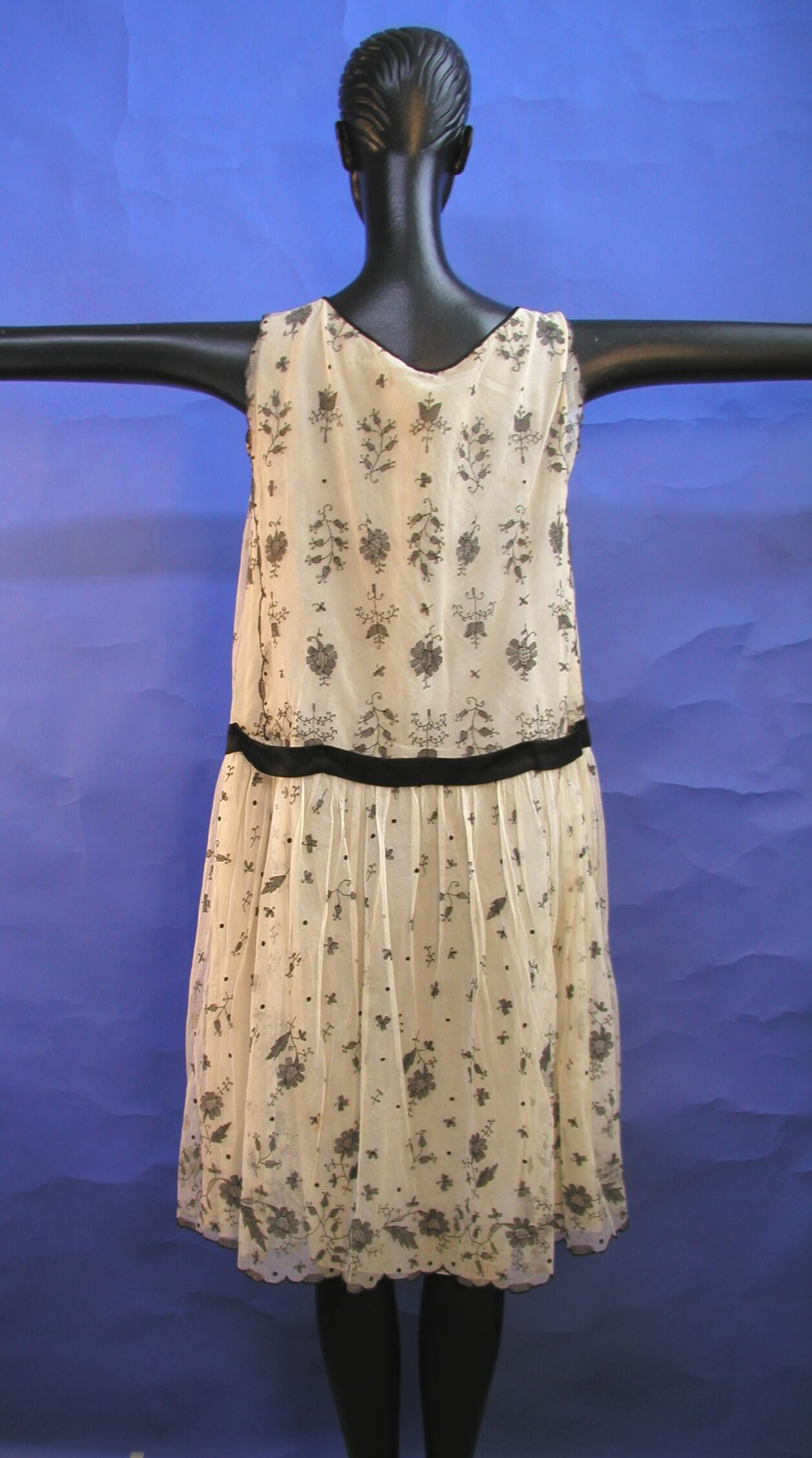
Ugly Proportion: the Goldsteins particularly warned against waist lines that divided the figure in half.

Beautiful Proportion: the waist line here divides the dress into a roughly 2:3 ratio pleasing to the eye.

Although the Goldsteins spoke often of the “normal” and “average” figures with regard to height, and provided much practical guidance for dressing the “stout” figure, they never mention dress of the pregnant woman.[15] This can be attributed to the times in which they wrote.

However, given their focus on health and ease of motion, one can well imagine the Goldsteins took the pregnant figure in stride. To the woman of “Large waist and Hips,” they recommend building out the shoulders, keeping the center of interest at the face, wearing skirts long to add height, and selecting hats of slightly larger than average size.[16]

Successful harmony and proportion for the pregnant woman. Photo courtesy of Erin Werner.

The model in the image above is thirty-eight weeks pregnant. The structure and detailed stitching of her velvet jacket lend width to her shoulders and her fur hat echoes the black of her dress while drawing the eye to her face. This is not an attempt to hide pregnancy, but rather, a way of dressing which protects the mother’s sense of modesty and helps the viewer see the mother as a whole person. Where her pregnancy draws much attention to her body, simple techniques of dress can help draw the eye back to her face, the window of her soul.

Balance

The Goldsteins defined balance as a restful effect obtained by grouping shapes and colors around a center in a way that creates equality of attractions on each side of that center. They wrote,

One does not enjoy watching a woman in the street if she is wearing a wide hat and large furs, with a short tight skirt and French heels; she looks so top-heavy that it seems as if the next gust of wind would blow her over.[17]

They then launch into a practical overview of how weights (sizes and colors) must balance a work of art across right and left and top and bottom. The Goldsteins used Pinturicchio’s Music as an example of “Formal Balance” which occurs in symmetrical compositions:

Formal Balance: Pinturicchio’s Music

And they used Puvis de Chavannes’ Saint Genevieve Watching Over Paris to illustrate for their students, “Informal Balance” where the composition is not symmetrical, but balanced by skilled spacing of objects and varied depths of color.

Informal Balance: Pierre Puvis de Chavannes’ St. Genevieve Watching over Paris

One can achieve formal balance in dress more easily than informal balance because the human figure lends itself so well to symmetry: the figure has two arms, so two sleeves make good sense. The figure has width at the bust and at the hips, so flares in the fabric at both places balance each other perfectly.

A lady may achieve informal balance with such “tricks” as a corsage on her right shoulder and a large bracelet on her left hand or a scarf hung over her right side and a hat tilted to the left, but seeking more prominent asymmetry usually ends in failure.

Modern designers often discard symmetry without any attempt at achieving beauty through informal balance. They make one-shoulder dresses or jagged skirt hems that hang ridiculously longer on one side without any element on the other side of the composition to restore balance. One recent example is the wedding gown of Rajwa Alseif which was largely symmetrical except for a neckline which veered sharply toward her right shoulder. Not only did the neckline create a harsh, ugly shape, the bride had nothing on her left side to balance it. Instead of marveling at the beauty of the bride’s overall dress, one gets stuck pondering the question why she had to have a slanting pizza slice cut out of her neckline.

The most common violation of balance seen among devout Catholics is the use of heavy shoes paired with skirts that hit right at mid-calf making the figure bottom heavy.

While this cloddish style is of course unintentional among those of faith, it is celebrated by the destructive forces of popular culture which drive mainstream fashion into ever greater ugliness:

Imbalance: bottom heaviness caused by bulky shoes of contrasting color. Of course, here there are many, many other issues besides…

Contrast the above example with the ensemble below which shows perfect balance and feminine grace:

Successful balance

Rhythm

The Goldstein sisters defined rhythm as the “easy, connected path along which the eye may travel in any arrangement of lines, colors, objects, or lights and darks.”[18] In order to possess true rhythm, a work of art must allow the eyes this “ease” of movement which provides a sense of rest. Aquinas tells us that happiness is “rest in a good attained” (I-II q4 a1). The good attained from rhythm is the same as the good attained from any of the art principles, namely, the beauty of form. In other words, rhythm takes its part in bringing to bear the form (or the truth) through movement. Meaningless lines, chaotic patterns, and inharmonious combinations of textures and colors lack rhythm.

To further understand the principle of Rhythm, consider the photos below:

Lack of rhythm

The figure above shows an ensemble lacking rhythm. The eye does not rest but rather throbs in the repetition of thin light and dark stripes over such a large area, and the arrangement of these stripes in a large zigzag do not bring to bear a beautiful form, but seem at odds with the wearer’s form, as if she had been slashed to pieces and reassembled incorrectly. The clashing yellow T-shirt creating yet another meaningless line at the hips only adds to the overall effect of chaos, and the straps of the sandals bring in another unrelated scheme.

Successful rhythm

This figure, on the other hand, shows lines that form an orderly pattern over the wearer’s legs. The use of horizontal lines adds interest, but the predominant motion is vertical, which highlights the upright posture of the human form. The color palette is more complex than that in the figure which lacks rhythm, and yet the eye moves from one color to the next easily, as one moves from one word to the next in a well-metered poem.

Emphasis

The Goldsteins define Emphasis as “the art principle by which the eye is carried first to the most important thing in any arrangement, and from that point to every other detail in the order of importance.” The sisters highlight the importance of simplicity in a design, of having a clear center of interest which may or may not have secondary points of interest around it. “The eye and the mind do not enjoy a haphazard collection of shapes and colors,” they state.[19] And lest their students mistake this tenet as a call to empty monotony, the Goldsteins present Huber Jan Van Eyck’s Adoration of the Lamb as a composition far from minimalistic, but possessing an unmistakable center and logical secondary points of interest:

Successful emphasis

To help their students bring about successful emphasis in their own compositions, the Goldsteins exhorted them to carefully consider the following questions:

  • What to emphasize.
  • How to emphasize.
  • How much to emphasize.
  • Where to place emphasis.[20]

They then discuss each of these questions at length and provide insights on grouping of elements, contrasting lights and darks, ornamentation, judging the correct ratio of background space, and the use of unusual or unexpected lines, shapes, sizes, and colors. Emphasis, in comparison to the other art principles, demands subtle artistic judgement. Where the other principles seem almost binary—e.g. one achieves harmony or disharmony, balance or imbalance, and so on—emphasis exists on a more gradual scale and has the added complexity that one may very successfully emphasize the wrong thing.

Modern clothing designers have become masters of the principle of emphasis, but they choose to emphasize what ought actually to be veiled. Deep V-necks, “window shirts,” and “cold shoulder shirts” draw the eye to cleavage or reveal patches of flesh with the sole purpose of drawing the mind to the idea of still more naked flesh. Great slits in the skirts of evening gowns point like arrows at the body beneath as if to apologize to the lusting viewer for such a troublesome excess of fabric. All but the baggiest women’s blue jeans are designed to draw the eyes to the wearer’s buttocks.[21] And finally, yoga pants and clinging T-shirts adhere to every curve like the casing of a sausage, making the human within appear like only so much meat.

The “window shirt” draws eyes away from the face.

The Goldstein sisters had a different approach to emphasis. They wrote, “In the well-organized plan for a costume the face will be the chief center of interest; the most successful design is that which will lead the eye to the face through the choice and arrangement of all the colors and lines that go to make up a dress design.”[22] And elsewhere, “Here the person is the chief center of interest, and the clothes are the background.”[23] This, however, does not mean that clothing must be bland or have no points of interest of its own. The sisters explain how Bronzino’s Portrait of Lucrezia Panciatchi centers the viewer’s interest on her face by way of an ornate neckline echoed at her waist with a jeweled belt. The eyes then fall to her beautiful hands which are emphasized both by the contrast of dark fabric and light flesh and the delicate ruffles of her cuffs. Her exposed neck and hands do not distract from her face, but rather complement it, and she sits before the viewer as a truly whole person:[24]

Emphasis that is successful both from a moral and artistic standpoint.

In dress, there exist many possible secondary points of interest, but in general, any feature not overtly sexual may add to the beauty of the whole without leading to lust. For instance, a woman may show the beauty of her collar bones with a neckline cut just a little beneath them; this, rather than drawing the eye down in the way of a deep V-neck, draws the eye back up to the face by framing it. Or, a woman may wear an ornamented belt that divides her figure in pleasing proportion without revealing every curve.

The photo below shows a contemporary example of an ensemble where the neckline (highlighted by pearls) and the waist (highlighted by a sash) add interest, but exist only as parts of the whole and will emphasize rather than distract from the wearer’s face.

Morally and artistically successful emphasis.

In Conclusion

Writing in the wake of World War I, the Goldsteins would have noticed early signs of cultural decay all around them, yet their book betrays no alarm. For better or worse, they did not fill their pages with laments and admonishments, only with calm common-place instruction. Nor did they consider the application of art principles an act of restoration but merely an act of “good taste.” Though they admitted that dressing well requires study and care, they never went so far as to say that it requires courage and perseverance.

But for us today, the art principles call for a more intentional and whole-hearted adoption. Whereas in the Goldsteins’ day, art principles acted as guidelines to help consumers make selections in the market’s plethora of readily available options, they now act as beacons in a cultural wasteland where options are few and far between.

Nevertheless, causes for hope abound. For one thing, the principles themselves are as simple as ever; merely by thinking about them as she selects her daily clothing, a woman will begin to discover how she might improve her dress. She need not transform her entire wardrobe overnight; it is enough to begin with just one ensemble. For another thing, the increase of small online boutiques and resources for seamstresses has allowed woman to break free from the tyranny of the shopping mall and superstore’s limited offerings. And finally, readers will find that the beauty they achieve as they apply the art principles becomes a real source of nourishment to themselves and those around them. This nourishment will help them continue on with the quest to still more beauty. By practicing dress as a joyful art rather than a dreary duty, they show the world a view of higher things, of the life of the soul, and even of Heaven itself.

Five Ways to Begin Applying the Art Principles Now

  • Begin with Solemn Mass. Consider the clothing you usually wear to Solemn Mass and start by perfecting just one ensemble. Do the elements harmonize with the shape of your body? Your age? Personality? The color of your skin and hair? Do the elements bear a family relationship with each other? Are there elements of denim or rustic leather that could be replaced with something more suitable for a solemn liturgy? (One question that can often help: would I wear this to a wedding?) Do the ensemble’s rhythms provide rest to the eyes? Would a hat or graceful shawl improve the ensemble’s balance? Does the ensemble emphasize that which should be veiled? Would a belt, sash, or necklace add an interesting secondary point of emphasis?
  • Enjoy dress every day. Even if one dresses for messy housework or errands, one can still enjoy practicing the art principles. An old baggy dress from a thrift store can receive new shape with the use of a belt. A festive cotton scarf that harmonizes with skirt and blouse can hold back hair. Aprons of all shapes and sizes can take much of the risk out of working in “nicer” clothing. Few tasks besides mucking stalls and painting rooms are so messy that even a full-body apron will not suffice to protect one’s ensemble.
  • Opt for quality over quantity. Rather than filling your closet with scores of polyester dresses of a generic one-size-fits-most design, save your funds to buy one dress or skirt of cotton, linen, or wool from an online vendor such as eShakti or XiaoLizi which provide customization options to suit your size, shape, and personal taste.
  • Be patient. It took you time (probably years) to build your current wardrobe. Do not try to overturn it in one day. Work with what you have as best you can and be selective with new purchases.
  • Remember for Whom you dress. The whole point of dressing beautifully is to draw your mind and heart to God. If ever the difficulty of practicing the art of dress begins to discourage you, remember to offer your efforts to Christ Who clothes the lilies of the field.


With the exception of the photo from Erin Werner, all other photos not linked to their public domain source are courtesy of Cameron McCarty and private property of Anna Kalinowska.

(c) 2023 Anna Kalinowska. All Rights Reserved.

[1] Linda Przybyszewski, The Lost Art of Dress. (New York, New York: Basic Books a member of Perseus Books Group, 2014) 17 – 18.

[2] Harriet and Vetta Goldstein, Art in Every Day Life. (New York, New York: The MacMillan Company, 2030) 3.

[3] Ibid. 5.

[4] The Lost Art of Dress, 65-66 and 53 and Art in Every Day Life chapter 4.

[5] Art in Every Day Life, 49.

[6] Ibid. 21.

[7] Ibid. 21 – 56.

[8] Ibid. 36 – 37.

[9] Ibid. 48.

[10] Alexis Frawley and Jessica Glass, “Edgy Style: Fierce Fashion Tips to Level-Up Your Looks” Stitch Fix, 14 June 2022.

[11] Art in Every Day Life, 49.

[12] Ibid, 184.

[13] Ibid, 57.

[14] Ibid, 59 and 66.

[15] Ibid, 302.

[16] Ibid, 279.

[17] Ibid, 83.

[18] Art in Every Day Life, 115.

[19] Ibid, 141.

[20] Ibid.

[21] Stacy London, “Stylist Stacy London Says Skinny Jeans Will Never Die—Here’s Why” Rachel Ray Show, 2021. In this video tutorial on denim selection, stylist Stacy London, tells viewers, “The most important thing to know about denim is that if it doesn’t make your butt look good, you’re wearing the wrong shape.”

[22] Art in Every Day Life, 167.

[23] Ibid, 164.

[24] Ibid, 169.


The Life of St Ignatius of Antioch


From the Golden Legend of Bld Jacobus Voragine, translated by William Caxton (ca 1483)

HERE FOLLOWETH THE LIFE OF ST. IGNATIUS, BISHOP

St. Ignatius was disciple of St. John Evangelist, and was bishop of Antioch. And after that, as some say, he sent a letter unto our Lady or an epistle in this wise: Unto Mary the Virgin, that bare Jesu Christ in her body, I, humble Ignatius, her servant, send greeting, I, that am yet a novice in the faith and disciple to Jesu Christ and to John thy dear friend, desire to have of thee some comfort and consolation of some good enseignment and teaching. For of Jesus thy Son I have heard say many marvels, of which I am enjoyed to hear only of thee, which hast been always in his company. Thou knowest well the secret desires of him, thou hast been plainly informed, and they that be yet young in the faith with me trust much to be endoctrined of thee, and informed in their creance and belief: Lady, God salute thee.

And to this letter answered the glorious Virgin Mary in this manner:
Ignatius, good disciple of Jesus and his special friend, the humble handmaid of Jesu Christ sendeth to thee greeting. I do thee to wit that all that John hath said to thee of Jesu Christ and all that thou hast learned of him is true doctrine and thing certain. Go alway in good creance, and believe and keep firmly the promise of thy Christian faith, and do thy works according to the same. I shall come with St. John for to visit thee and other Christian men with thee. Hold thee always well in the faith and in good works, and let no persecution ne adversity that thou shalt suffer move thee from thy faith ne from thy creance, but have solace and affiance in Jesu Christ thy Saviour.
This was the answer of his letter.

THE MARTYRDOM OF ST. IGNATIUS

St. Ignatius was a man right well learned, and the third bishop after St. Peter the apostle of the church of Antioch, and much desired to be a martyr for the faith of Jesu Christ. It happed that Trajan, which was emperor of Rome, passed by Antioch, to whom Ignatius showed to him and blamed of this, that he persecuted Christian men, wherefor the emperor did him to be taken and put in irons, and in that wise by ten knights to be led to Rome. There he was presented tofore the emperor and all the senators of Rome, and was constrained by promises, by menaces, and by torments, many and great an horrible, for to adore the idols. St. Ignatius showed to them clearly that their gods had been thieves, ribalds, and men of abominable and evil life, and that they were damned in hell, and that they had been in great error in this, that of so cursed men they made their gods and worshipped devils, and had forsaken God which had made and created all the world, and his blessed Son which in human nature had redeemed and saved the world.

Finably, after this, that he had been tormented by fire, and by beating and prison, the emperor did send for the Romans in a place and there did do set St. Ignatius, and did do bring thither two lions for to devour him. But he had never dread for death ne for other torments, of which he had suffered many, but was always comforted for to die for the love of Jesu Christ. And he said at the last: I am wheat of Jesu Christ, which ought to be grounden between the teeth of these beasts, by which I may be pure bread for to be presented to my Lord.

And anon the lions came and strangled him without tearing of his flesh, or anything hurting it, wherefor Trajan had great marvel and departed from the place.

THE MIRACLE OF HIS HEART

It is read that St. Ignatius in all his torments and all the pains of martyrdom that he suffered, that his tongue never ceased to name the name of Jesus, and when they that tormented him demanded him wherefore he named this name so oft, he answered: Know ye for certain that I have in my heart this name written, and therefore I may not leave to name this name oft.

And because hereof, when he was dead, they that heard these words opened his body and drew out his heart and cut it open, and they found within the name of Jesus written with fair letters of gold, for which miracle many received the faith of Jesu Christ.

ST. BERNARD’S REMARKS ON ST. IGNATIUS

Of this saint saith St. Bernard upon the psalm, Qui habitat [Psalm 15]: St. Ignatius, martyr of God glorious, is of great merit, which was minister to the disciple that Jesus so much loved, and in his epistles, the which he sent to the glorious Virgin Mary, he saluted her as mother that had borne Jesu Christ and she resaluted him again, in sign that he was a person of great honour, of great dignity, and of great authority. The body of whom was honorably buried of Christian men, to the worship of Jesu Christ which is blessed in secula seculorum. Amen.

St Ignatius of Antioch, Bishop & Martyr

Today's Holy Mass from Corpus Christi Church, Tynong, VIC, AU. You may follow the Mass at Divinum Officium.

St Ignatius of Antioch, Bishop & Martyr ~ Dom Prosper Guéranger

Thursday of Septuagesima Week ~ Dom Prosper Guéranger

St Ignatius of Antioch, Bishop & Martyr


From Dom Prosper GuĂ©ranger's The Liturgical Year

Two days more, and the happy season of Christmas will be over! This is the vigil of its termination, and lo! there comes to gladden us one of the grandest Martyrs of the year — Ignatius surnamed the Theophorus, (Greek for: “he that carries God” or “he that is carried of God”) Bishop of Antioch. A venerable tradition tells us, that this old man, who so generously confessed the faith before Trajan, was the child whom Jesus took into his arms, and showed to his Disciples as a model of that simplicity, which we must all have, if we would enter into the kingdom of heaven. Today he appears before us, standing near the Crib, in which this same Jesus gives us his own divine lessons of humility and simplicity.

But, in this the Court of our Emmanuel, Ignatius stands near to Peter, the Feast of whose Chair we kept a few days since; for the Prince of the Apostles made him his second successor in his first See of Antioch. From so honoured a position Ignatius derived that courage, which made him resist a powerful Emperor even to his face, defy the wild beasts of the amphitheatre, and triumph by a glorious martyrdom. As it were to show the supremacy of the See of Rome, Divine Providence willed that he, with his chains upon him, should go to see Peter, (Galatians 1:18) and finish his course in the Holy City, and thus mingle his blood with that of the Apostles. Rome would have been imperfect without the glory of Ignatius’ martyrdom, which is the pride of her Coliseum, rich as it is with the blood of so many thousands of Martyrs.

Ignatius’ character is impetuosity of love for his God. He has but one fear — it is, that the prayers of the Romans will stay the lions from devouring him, and his desire of being united to Christ be thus denied him. Let us admire this superhuman fortitude, which shows itself thus suddenly amidst the pagan world, and let us acknowledge, that so ardent a love of God, and so vehement a longing to possess him, could only have come from the accomplishment of the Mysteries of our Redemption, which showed man how much God loved him. The Crib of Bethlehem, even had there never been the Sacrifice of Calvary, would, of itself, been sufficient to convince us of all this. God comes down from heaven for the sake of his creature, man; he himself becomes Man, nay, a Child, and is laid in a manger! Such miracles of love would have sufficed to save the guilty world;
how, then, shall they not have power to prompt men to give their whole heart to their loving God? And would it be too much, if we made a sacrifice of our very lives to repay our Jesus for only that much of his love, which he showed us by being Born among us?

The Church gives us, in the Lessons of to-day’s Office, the brief account of our Saint given by St. Jerome in his Book On Ecclesiastical Writers. The holy Doctor has inserted a few sentences from the Martyr’s admirable Epistle, written to the Faithful of Rome. We would have gladly offered the whole of this Epistle to our readers, had it not been for want of space. But the passages quoted by St. Jerome are some of the finest.

Ignatius was the third Bishop of the Church of Antioch, St. Peter the Apostle being the first. During the persecution under Trajan, he was condemned to be devoured by wild beasts, and was sent in chains to Rome. During this voyage, which was made by sea, he had to stop at Smyrna, where Polycarp, the disciple of St. John, was Bishop. From this city, he wrote several Epistles; one to the Ephesians, a second to the Magnesians, a third to the Trallians, a fourth to the Romans. When he had left Smyrna, he addressed an Epistle to the Philadelphians and Smyrneans, and one to, Polycarp himself, recommending to him his Church of Antioch. It is in this last named Letter, that he quotes from the Gospel, which I have lately translated, a passage bearing testimony to the person of our Lord Jesus Christ.

I cannot pass by this mention of so great a man, without citing a few sentences from the Epistle, which he wrote to the Romans. “From Syria,” he says, “even unto Rome, I am fighting with wild beasts, both by sea and land, both night and day, for I am fastened to ten leopards, I mean, to the soldiers who have care of me. When I show them a kindness, they grow more brutal. Their injuries are my instruction, but I am not thereby justified. I long for the wild beasts, that are prepared for me, which I heartily wish may rush upon me, and torture me, and devour me, and not be afraid to touch me, as has happened with other Martyrs. Nay, if they refuse to approach me, I will make them come on, I will rush upon them, that so they may devour me. Pardon me, my little children: I know what is for my own welfare.

“Now do I begin to be a disciple of Christ, and care for nothing in this world, that so I may find Jesus. Let fire, or the cross, or wild beasts, or the breaking of my bones, or the cutting me to pieces, or the shattering of my whole body, yea, all the tortures of the devil — let them all come upon me, only let me enjoy my God.” When he was sentenced to be devoured by wild beasts, and heard the roaring of the lions, his impatience to suffer made him exclaim: “I am the wheat of Christ — let me be ground by the teeth of wild beasts, that I may become the pure bread.” He suffered in the eleventh year of Trajan’s reign. His Relics are at Antioch, in the Cemetery outside the Daphne Gate.

We find the following stanzas in the Mengea of the Greek Church, for the feast of St. Ignatius.

Thou wast called to be the successor of him who is the Prince of Theologians, thou didst follow in their footsteps. Thy rising was in the East, but thou wast manifested in the West, and there, Ignatius, full of wisdom! thou didst shine with the splendour of thy heavenly preachings. Thou didst, indeed, depart from this world, but thou wast taken up to God, wearing on thy soul the rich crown of grace.

Resplendent, as the sun, with the rays of the Holy Ghost, thou didst sweetly illumine the ends of the earth with the brilliancy of thy combat, and the maxims of piety breathed forth so warmly and so truly in thy writings. Thus didst thou, most blessed one! make thyself bread to the Master who, in his ceaseless love, feeds all created things.

O Ignatius! thou that carriest God! by cherishing Christ, thy Love, in thy breast, thou didst give thy blood for him, thus receiving the perfection of the sacrifice of the Gospel of Christ. Hereby, thou wast the wheat of the divine Husbandman; and being ground by the teeth of lions, thou wast made his bread most sweet. O blessed Combatant! pray to him for us.

Most saintly Ignatius! thy soul was firm as is the adamant; for thou didst say to thy Beloved Jesus, with an insatiable longing: “It is not material fire that burns within me — it is the voice of Him, who is the living Water, saying within my breast, Come to the Father!” Therefore, being inflamed by the Holy Spirit, thou didst urge on the lions to take thee quickly from this world, and carry thee to Christ, the object of all thy desires. Oh! pray to him, that he save our souls.

All thy desires were satisfied, glorious Martyr! Thou hast died for Jesus — thou art with Jesus. Rome’s sons and daughters filled the Coliseum; their savage joy made it tremble with their cheers as they saw thee mangled by the lions. It was the hour thou hadst prayed for — thy sacrifice for Him, who had sacrificed himself for thee, is over, and thy
soul is buried in his divine embrace! Generous and impetuous lover of Christ! thou wast ambitious to pay thy debt to the Crucified — the death of suffering. It seemed to thee, that thou hadst no right to his kingdom, until thou hadst repaid his Passion by some cruel tortures endured for Him. O worthy companion of Stephen, Sebastian, Vincent, and
Agnes! how rich and verdant is the Palm thou holdest over thy Jesus Crib! Canst thou look upon us, weak Christian cowards, and not pity us? Pray for us that we may at least be faithful to our Lord, when we are persecuted by the temptations of the world, the flesh, and the devil; that we may, at least, give our hearts to his service, if we are not
to be permitted to give our bodies to be tortured for his name. Thou wast chosen, when a little child, as the model of the simplicity which our Saviour was teaching to his Disciples, and this innocence never left thee: — ask for us from Him, who is the King of Little Children, that one of the graces of the Christmas we have been keeping, may be this holy
Simplicity of heart.

Successor of Peter in the See of Antioch! pray for the Churches of thy Patriarchate, that they may return to the true Faith and Catholic unity. Intercede for the holy City of Rome, which thou didst water with thy blood, and which is now in possession of thy sacred Relics, that were saved from the lions’ jaws. Watch over the maintenance of ecclesiastical
discipline and order, of which thou hast left such admirable rules in thy Epistles; and obtain for the Church, that all the members of her hierarchy may be united in the bonds of duty and love, that thus she may be beautiful in the strength of her unity, and terrible to the enemies of God, as an army set in array. (Song of Solomon 6:3)

Thursday of Septuagesima Week


From Dom Prosper GuĂ©ranger's The Liturgical Year

Forgiveness is promised; but atonement must be made. Divine justice must be satisfied, and future generations be taught that sin can never pass unpunished. Eve is the guiltier of the two, and her sentence follows that of the serpent. Destined by God to aid man in peopling the earth with happy and faithful children, formed by this God out of man’s own substance “flesh of his flesh, and bone of his bones,” woman was to be on an equality with man. But sin has subverted this order, and God’s sentence is this: conjugal union, notwithstanding the humiliation of concupiscence now brought upon it, is to be, as before, holy and sacred; but it is to be inferior in dignity, before both God and man, to the state of virginity, which disdains the ambitions of the flesh.

Secondly, woman shall be mother still, as she would have been in the state of innocence; but her honor shall be a burden. Moreover, she shall give birth to her children amidst cruel pains, and sometimes even death must be the consequence of her infant’s coming into the world. The sin of Eve shall thus be memorialized at every birth, and nature shall violently resist the first claims of him whom sin has made her unwelcome lord.

Lastly, she who was at first created to enjoy equality of honor with man is now to forfeit her independence. Man is to be her superior, and she must obey him. For long ages, this obedience will be no better than slavery; and this degradation shall continue till that Virgin comes, whom the world shall have expected for four thousand years, and whose humility shall crush the serpent’s head. She shall restore her sex to its rightful position, and give to Christian woman that influence of gentle persuasiveness which is compatible with the duty imposed upon her by divine justice, and which can never be remitted: the duty of submission.

IN DOMINICA TYROPHAGI

O Lord! King of all ages! who didst create me by thy love; I have been injured by the envy of the crafty serpent, and have provoked thee, my Savior, to anger: but despise me not, O God! Call me back to thee.

Alas! my bright robe has been changed into this garb of shame. I bewail my ruin, O Savior, and to thee do I cry with confidence: My good God! Despise me not, but call me back to thee.

How, my soul, couldst thou, that wast made the lord of serpents and beasts, treat the soul-slaying serpent with familiarity, and use thine enemy as a trusty counselor? Bewail, my wretched soul, thy fatal error!

(To thee do we sing, O Mary, full of divine grace! Hail bright tabernacle of the Incarnation! O fount of mercy, hope of them that are in despair, enlighten me that am dishonored by the dark clouds of my passions.)

Ignatius of Antioch: Faith of Our Fathers

A sermon for today's Saint. Please, remember to say 3 Hail Marys for the priest.

St Sigebert II, French King of Austrasia, Confessor


From Fr Alban Butler's Lives of the Saints

DAGOBERT I., king of France, led for some time a very dissolute life, but was touched by an extraordinary grace upon the birth of his son Sigebert, and from that time was entirely converted to God. Bagnetrude, our saint’s mother, is only styled the concubine of Dagobert, though he was publicly married to her. The father desiring to have his son baptized by the most holy prelate of his dominions, recalled St. Amand, bishop of Maestricht, whom he had banished for his zeal in reproving his vices, fell at his feet at Clichi, near Paris, to ask his pardon, promised amendment, and by the advice of St. Owen and St. Eligius, then laymen in his court, engaged him to initiate his son in the sacrament of regeneration. The ceremony was performed with great pomp at Orleans, Charibert, king of part of Aquitain, and brother to Dagobert, being god-father. The young prince’s education was intrusted by the father to the blessed Pepin of Landen, mayor of his palace, who being forced by the envy of the nobility to withdraw for some time, carried Sigebert into the dominions of Charibert in Aquitain, where he enjoyed a considerable estate, the paternal patrimony of his wife the blessed Itta. Pepin remained there about three years; after which term he was recalled to the court of Dagobert, who declared his son Sigebert, though only three years old, in 633, king of Austrasia, and gave him for his ministers, St. Cunibert, archbishop of Cologne, and duke Adelgise, and committed the administration of the whole kingdom to Pepin, whom he always kept near his own person. Dagobert’s second son, Clovis II., was born in the following year, 634, and to him the father allotted for his inheritance all the western part of France, containing all Neustria and part of Burgundy. 1 Austrasia, or Eastern France, (in which sense Austria retains a like name in Germany,) at that time comprised Provence and Switzerland, (dismembered from the ancient kingdom of Burgundy,) the Albigeois, Auvergne, Quercy, the Cevennes, Champagne, Lorraine, Upper Picardy, the archbishopric of Triers, and other states reaching to the borders of Friesland; Alsace, the Palatinate, Thuringia, Franconia, Bavaria, Suabia, and the country which lay betwixt the Lower Rhine and Old Saxony. Dagobert died in 638, and was buried at the abbey of St. Denys, of which he was the munificent founder. According to the settlement which he had made, he was succeeded in Austrasia by St. Sigebert, and in the rest of France by his youngest son Clovis II. Pepin of Landen, who had been mayor of the palace to the father, discharged the same office to his death under St. Sigebert, and not content to approve himself a faithful minister, and true father to the prince, he formed him from the cradle to all heroic Christian virtues. By his prudence, virtue, and valour, St. Sigebert in his youth was beloved and respected by his subjects, and feared by all his enemies. Pepin dying in 640, the virtuous king appointed his son Grimoald mayor of his palace. He reigned in perfect intelligence with his brother, of which we have few examples among the Merovingian kings whenever the French monarchy was divided. The Thuringians revolting, he reduced them to their duty; and this is the only war in which he was engaged. The love of peace disposed his heart to be a fit temple of the Holy Ghost, whom he invited into his soul by assiduous prayer, and the exercise of all Christian virtues. His patrimony he employed in relieving the necessitous, and in building or endowing monasteries, churches, and hospitals. He founded twelve monasteries, the four principal of which were Cougnon, now a priory, not far from Bouillon; Stavelo and Malmedi, two miles from each other, and St. Martin’s, near Metz. St. Remaclus brought from Solignac the rule of St. Columban, which king Sigebert in his charter to Cougnon calls the rule of the ancient fathers. This that holy abbot established first at Cougnon, and afterwards at Malmedi and Stavelo. A life filled with good works, and devoted all to God, can never be called short. God was pleased to call this good king from the miseries of this world to the recompense of his labours on the 1st of February, in the year 656, the eighteenth of his reign, and the twenty-fifth of his age. 2 He was interred in the abbey of St. Martin’s, near Metz, which he had built. His body was found incorrupt in 1063, and placed in a monument on the side of the high altar: and in 1170 it was enshrined in a silver case. The monastery of St. Martin’s, and all others in the suburbs, were demolished by Francis of Lorraine, duke of Guise, in 1552, when Charles V. laid siege to Metz. The relics of St. Sigebert are now deposited in the collegiate church of our Lady at Nancy. He is honoured among the saints in a great part of the dominions which he governed, and in the monasteries and churches which he founded. See Fredegarius and his continuator, Sigebert of Gemblours, in his life of this saint, with the learned remarks of Henschenius, p. 40. Also Calmet, Hist. de Lorraine, t. 1. p. 419. SchoĂ«pflin, Alsatia Illustrata, Colmariæ, an. 1751. Sect. 2. p. 742. 1

Note 1. Charibert, though he took the title of king, and resided at Toulouse, held his estates of his brother Dagobert, and by his gift. After Charibert’s death, Chilperic, his eldest son, was put to death by Dagobert; but his second son, Boggis, left a numerous posterity, which was only extinguished in Lewis d’Armagnac, duke of Nemeurs, slain at the battle of Cerignole, where he commanded for Lewis XII. against Gonzales de Cordova, surnamed The Great Captain, for the Catholic king Ferdinand in 1503, by which the French lost the kingdom of Naples. So long did the family of Clovis II. subsist. See Vaissette, Hist. de Languedoc. Henault, Abr. de l’Hist. de France, t. 1. p. 36. and 818. [back]
Note 2. St. Sigebert left his son Dagobert, about seven years old, under the care of Grimoald, mayor of his palace, who treacherously sent him into Ireland, and placed his own son Childebert on the throne. This usurper reigned seven months, as SchoĂ«pflin proves from the express testimony of Chronieon Brevissimum, and from circumstances mentioned by Fredegarius, against the mistake of the authors, l’Art de vĂ©rifier les Dates, p. 481, who say he only reigned seven days. By an insurrection of the people, Grimoald and his son were deposed, and both perished in prison; but Dagobert not being found, Clovis II. united Austrasia to his other dominions. Dagobert II., by the assistance of St. Wilfrid, afterwards archbishop of York, returned into France eighteen years after the death of his father, and recovered Alsace and some other provinces by the cession either of Childeric II., son of Clovis II., (then monarch of all France,) or of his brother Theodoric III., who succeeded him before the month of April, in 674: for the reign of Dagobert II. must be dated from the latter end of 673, with Henault, or from 674, with SchoĂ«pflin. The spirit of religion and piety, which he had learned in the school of afflictions, and under the great masters of a spiritual life, who then flourished among the Scots and Irish, was eminently the distinguishing part of his character. As he resided chiefly in Alsace, he filled that country, in the first place, with monuments of his devotion, being so liberal in founding and endowing monasteries and churches, that though his reign was only of six years, SchoĂ«pflin assures us the French church is not more indebted to any reign than to this, at least in those parts, (p. 740.) St. Wilfrid, bishop of York, had exceedingly promoted his return into France; and when that prelate was compelled to leave England, Dagobert entertained him with the most cordial affection, and, upon the death of St. Arbogastus, earnestly pressed him to accept of that see. St. Wilfrid declined that dignity, promising, however, to call upon this good king in his return from Rome, where he obtained a sentence of pope Agatho in his favour. But coming back into France, he found his royal friend cut off by a violent death. It is the general persuasion of the French historians, that the impious Ebroin, mayor of the palace to Theodoric III., king of Burgundy and Neustria, was the author of his death, with a view to seize his dominions. Dagobert was murdered by assassins at Stenay upon the Meuse, now the best town in the duchy of Bar in Lorraine. The people, however, chose Pepin and Martin dukes or governors of Austrasia, who defended their liberty against Ebroin. Martin was afterwards assassinated by the contrivance of Ebroin, and Ebroin by Ermenfrid: but Pepin, in 687, defeated Theodoric III. at Testry, took Paris, and the king himself; from which time, under the title of mayor, he enjoyed the supreme power in the French monarchy. The death of St. Dagobert happened in 679, on the 23rd of December, on which day he is commemorated in the Martyrology of Ado and others, and honoured as a martyr at Stenay, in the diocess of Verdun, ever since the eighth century. The church of Strasburg was much enriched by this prince, as may be seen in SchoĂ«pflin’s Alsatia Illustrata. The same author gives an account of some of the monasteries which were founded by this prince in those parts, (c. 11. s. 254. p. 736.) and shows from his charters that the palace where he chiefly resided was at Isenburg in Alsace. (Sect. 1. c. 10. s. 146. p. 693.) The year of the death of Dagobert II. is learned from the life of St. Wilfrid, who returned from Rome when St. Agatho sat in St. Peter’s chair. See on this holy king the lives of St. Wilfrid and St. Salaberga; also his charters; and, among the moderns, Dan. SchoĂ«pflin, professor of history and eloquence at Strasburg, in his Alsatia Illustrata, anno 1751. Sect. 2. c. 1. s. 3. p. 740. 743. and s. 1. c. 10. s. 146. p. 693. c. 11. s. 254. p. 736. Also Calmet. Hist. de Lorraine, t. 1. l. 10. n. 16. p. 432. The first edition of this work was given in 1728, in three volumes folio, but the second edition is so much enlarged as to fill six volumes folio. The reign of Dagobert II. escaped most of the French historians; which omission, and a false epoch of the beginning of the reign of Dagobert I. brought incredible confusion into the chronology and history of most of the Merovingian kings, which Adrian Valcis, Henschenius, Le Cointe, Pagi, Longuerue, and others, have taken great pains to clear up. [back]

St Ignatius, Bishop of Antioch, Martyr


From Fr Alban Butler's Lives of the Saints

ST. IGNATIUS, surnamed Theophorus, 1 a word implying a divine or heavenly person, was a zealous convert and an intimate disciple of St. John the Evangelist, as his acts assure us; also the apostles SS. Peter and Paul, who united their labours in planting the faith at Antioch. 2 It was by their direction that he succeeded Evodius in the government of that important see, as we are told by St. Chrysostom, 3 who represents him as a perfect model of virtue in that station, in which he continued upwards of forty years. During the persecution of Domitian, St. Ignatius defended his flock by prayer, fasting, and daily preaching the word of God. He rejoiced to see peace restored to the church on the death of that emperor, so far as this calm might be beneficial to those committed to his charge: but was apprehensive that he had not attained to the perfect love of Christ, nor the dignity of a true disciple, because he had not as yet been called to seal the truth of his religion with his blood, an honour he somewhat impatiently longed for. The peaceable reign of Nerva lasted only fifteen months. The governors of several provinces renewed the persecution under Trajan his successor; and it appears from Trajan’s letter to Pliny the younger, governor of Bithynia, that the Christians were ordered to be put to death, if accused; but it was forbidden to make any inquiry after them. That emperor sullied his clemency and bounty and his other pagan virtues, by incest with his sister, by an excessive vanity, which procured him the surname of Parietmus, (or dauber of every wall with the inscription of his name and actions,) and by blind superstition, which rendered him a persecutor of the true followers of virtue, out of a notion of gratitude to his imaginary deities, especially after his victories over the Daci and Scythians in 101 and 105. In the year 106, which was the ninth of his reign, he set out for the East on an expedition against the Parthians, and made his entry into Antioch on the 7th of January, 107, with the pomp of a triumph. His first concern was about the affair of religion and worship of the gods, and for this reason he resolved to compel the Christians either to acknowledge their divinity and sacrifice to them, or suffer death in case of refusal. 1

Ignatius, as a courageous soldier, being concerned only for his flock, willingly suffered himself to be taken, and carried before Trajan, who thus accosted him: “Who art thou, wicked demon, that durst transgress my commands, and persuade others to perish?” The saint answered: “No one calls Theophorus a wicked demon.” Trajan said: “Who is Theophorus?” Ignatius answered: “He who carrieth Christ in his breast.” Trajan replied: “And do not we seem to thee to bear the gods in our breasts, whom we have assisting us against our enemies?” Ignatius said: “You err in calling those gods who are no better than devils: for there is only one God, who made heaven and earth, and all things that are in them: and one Jesus Christ his only Son, into whose kingdom I earnestly desire to be admitted.” Trajan said: “Do not you mean him that was crucified under Pontius Pilate?” Ignatius answered: “The very same, who by his death has crucified with sin its author, who overcame the malice of the devils, and has enabled those, who bear him in their heart, to trample on them.” Trajan said: “Dost thou carry about Christ within thee?” Ignatius replied: “Yes; for it is written: I will dwell and walk in them?” 4 Then Trajan dictated the following sentence: “It is our will that Ignatius, who saith that he carrieth the crucified man within himself, be bound and conducted to Rome, to be devoured there by wild beasts, for the entertainment of the people.” The holy martyr hearing this sentence, cried out with joy: “I thank thee, O Lord, for vouchsafing to honour me with this token of perfect love for thee, and to be bound with chains of iron in imitation of thy apostle Paul, for thy sake.” Having said this, and prayed for the church and recommended it with tears to God, he joyfully put on the chains, and was hurried away by a savage troop of soldiers to be conveyed to Rome. His inflamed desire of laying down his life for Christ made him embrace his sufferings with great joy. 2

On his arrival at Selucia, a sea-port, about sixteen miles from Antioch, he was put on board a ship which was to coast the southern and western parts of Asia Minor. Why this route was pitched upon, consisting of so many windings, preferably to a more direct passage from Selucia to Rome, is not known; probably to render the terror of his punishment the more extensive, and of the greater force, to deter men from embracing and persevering in the faith: but providence seems to have ordained it for the comfort and edification of many churches. Several Christians of Antioch, taking a shorter way, got to Rome before him, where they waited his arrival. He was accompanied thither from Syria, by Reus, Philo a deacon, and Agathopodus, who seem to have written these acts of his martyrdom. He was guarded night and day, both by sea and land, by ten soldiers, whom he calls ten leopards, on account of their inhumanity and merciless usage: who, the kinder he was to them, were the more fierce and cruel to him. This voyage, however, gave him the opportunity of confirming in faith and piety the several churches he saw on his route; giving them the strictest caution against heresies and schism, and recommending to them an inviolable attachment to the tradition of the apostles. St. Chrysostom adds, that he taught them admirably to despise the present life, to love only the good things to come, and never to fear any temporal evils whatever. The faithful flocked from the several churches he came near, to see him, and to render him all the service in their power, hoping to receive benefit from the plenitude of his benediction. The cities of Asia besides, deputing to him their bishops and priests to express their veneration for him, sent also deputies in their name to bear him company the remainder of his journey; so that he says he had many churches with him. So great was his fervour and desire of suffering, that by the fatigues and length of the voyage, which was a very bad one, he appeared the stronger and more courageous. On their reaching Smyrna, he was suffered to go ashore, which he did with great joy to salute St. Polycarp, who had been his fellow-disciple, under St. John the Evangelist. Their conversation was upon topics suitable to their character, and St. Polycarp felicitated him on his chains and sufferings in so good a cause. At Smyrna he was met by deputies of several churches, who were sent to salute him. Those from Ephesus were Onesimus the bishop, Burrhus the deacon, Crocus, Euplus, and Fronto. From Magnesia in Lydia, Damas the bishop, Bassus and Apollo, priests, and Sotio deacon. From Tralles, also in Lydia, Polybius the bishop. From Smyrna St. Ignatius wrote four letters: in that to the church of Ephesus, he commands the bishop Onesimus and the piety and concord of the people, and their zeal against all heresies, and exhorts them to glorify God all manner of ways: to be subject, in unanimity, to their bishop and priests, to assemble as often as possible with them in public prayer, by which the power of Satan is weakened: to oppose only meekness to anger, humility to boasting, prayers to curses and reproaches, and to suffer all injuries without murmuring. He says, that because they are spiritual, and perform all they do in a spiritual manner, that all, even their ordinary actions, are spiritualized, because they do all in Jesus Christ. That he ought to have been admonished by them, but his charity would not suffer him to be silent: wherefore he prevents them, by admonishing first, that both might meet in the will of God. He bids them not be solicitous to speak, but to live well, and to edify others by their actions; and recommends himself and his widow-church of Antioch to their prayers. Himself he calls their outcast, yet declares that he is ready to be immolated for their sake, and says they were persons who had found mercy, but he a condemned man: they were strengthened in grace, but he straggling in the midst of dangers. He calls them fellow-travellers in the road to God, which is charity, and says they bore God and Christ in their breasts, and were his temples, embellished with all virtues, and that he exulted exceedingly for the honour of being made worthy to write to them, and rejoice in God with them: for setting a true value on the life to come, they loved nothing but God alone. Speaking of heretics, he says, that he who corrupts the faith for which Christ died, will go into unquenchable fire, and also he who heareth him. It is observed by him that God concealed from the devil three mysteries: the virginity of Mary, her bringing forth, and the death of the Lord: and he calls the Eucharist, the medicine of immortality, the antidote against death, by which we always live in Christ. “Remember me, as I pray that Jesus Christ be mindful of you. Pray for the church of Syria, from whence I am carried in chains to Rome, being the last of the faithful who are there—Farewell in God the Father, and in Jesus Christ our common hope.” The like instructions he repeats with a new and most moving turn of thought, in his letters to the churches of Magnesia, and of the Trallians, inculcates the greatest abhorrence of schism and heresy, and begs their prayers for himself and his church in Syria, of which he is not worthy to be called a member, being the last of them. 5 His fourth letter was written to the Christians of Rome. The saint knew the all-powerful efficacy of the prayers of the saints, and feared lest they should obtain of God his deliverance from death. He therefore besought St. Polycarp and others at Smyrna, to join their prayers with his, that the cruelty of the wild beasts might quickly rid the world of him, that he might be presented before Jesus Christ. With this view he wrote to the faithful at Rome, to beg that they would not endeavour to obtain of God that the beasts might spare him as they had several other martyrs; which might induce the people to release him, and so disappoint him of his crown. 3

The ardour of divine love which the saint breathes throughout this letter is as inflamed as the subject is extraordinary. In it he writes: “I fear your charity lest it prejudice me. For it is easy for you to do what you please; but it will be difficult for me to attain unto God if you spare me. I shall never have such an opportunity of enjoying God: nor can you, if ye shall now be silent, ever be entitled to the honour of a better work. For if ye be silent in my behalf, I shall be made partarker of God; but if ye love my body, I shall have my course to run again. Therefore, a greater kindness you cannot do me, than suffer me to be sacrificed unto God, whilst the altar is now ready: that so becoming a choir in love, in your hymns ye may give thanks to the Father by Jesus Christ, that God has vouchsafed to bring me, the bishop of Syria, from the East unto the West, to pass out of the world unto God, that I may rise again unto him. Ye have never envied any one. Ye have taught others. I desire therefore that you will firmly observe that which in your instructions you have prescribed to others. Only pray for me, that God would give me both inward and outward strength, that I may not only say, but do: that I may not only be called a Christian but be found one: for if I shall be found a Christian, I may then deservedly be called one; and be thought faithful, when I shall no longer appear to the world. Nothing is good that is seen. A Christian is not a work of opinion, but of greatness, when he is hated by the world. I write to the churches, and signify to them all, that I am willing to die for God, unless you hinder me. I beseech you that you show not an unseasonable good-will towards me. Suffer me to be the food of wild beasts, whereby I may attain unto God: I am the wheat of God, and I am to be ground by the teeth of the wild beasts, that I may be found the pure bread of Christ. Rather entice the beasts to my sepulchre, that they may leave nothing of my body, that, being dead, I may not be troublesome to any. Then shall I be a true disciple of Jesus Christ, when the world shall not see so much as my body. Pray to Christ for me, that in this I may become a sacrifice to God. I do not, as Peter and Paul, command you: they were apostles, I am an inconsiderable person: they were free, I am even yet a slave. But if I suffer I shall then become the freeman of Jesus Christ, and shall arise a freeman in him. Now I am in bonds for him, I learn to have no worldly or vain desires. From Syria even unto Rome I fight with wild beasts both by sea and land, both night and day, bound to ten leopards, that is, to a band of soldiers; who are the worse for kind treatment. But I am the more instructed by their injuries; yet I am not thereby justified. 6 I earnestly wish for the wild beasts that are prepared for me, which I heartily desire may soon despatch me; whom I will entice to devour me entirely and suddenly, and not serve me as they have done some whom they have been afraid to touch; but if they are unwilling to meddle with me, I will even compel them to it. 7 Pardon me this matter, I know what is good for me. Now I begin to be a disciple. So that I have no desire after anything visible or invisible, that I may attain to Jesus Christ. Let fire, or the cross, or the concourse of wild beasts, let cutting or tearing of the flesh, let breaking of bones and cutting off limbs, let the shattering in pieces of my whole body, and all the wicked torments of the devil come upon me, so that I may but attain to Jesus Christ. All the compass of the earth, and the kingdoms of this world will profit me nothing. It is better for me to die for the sake of Jesus Christ, than to rule unto the ends of the earth. Him I seek who died for us; Him I desire who rose again for us. He is my gain at hand. Pardon me, brethren: be not my hindrance in attaining to life, for Jesus Christ is the life of the faithful: whilst I desire to belong to God, do not ye yield me back to the world. Suffer me to partake of the pure light. When I shall be there, I shall be a man of God. Permit me to imitate the passion of Christ my God. If any one has him within himself, let him consider what I desire, and let him have compassion on me, as knowing how I am straitened. The prince of this world endeavours to snatch me away, and to change the desire with which I burn of being united to God. Let none of you who are present attempt to succour me. Be rather on my side, that is, on God’s. Entertain no desires of the world, having Jesus Christ in your mouths. Let no envy find place in your breasts. Even were I myself to entreat you when present, do not obey me; but rather believe what I now signify to you by letter. Though I am alive at the writing of this, yet my desire is to die. My love is crucified. The fire that is within me does not crave any water; but being alive and springing within, says: Come to the Father. I take no pleasure in the food of corruption, nor in the pleasure of this life. I desire the bread of God, which is the flesh of Jesus Christ, and for drink his blood, which is incorruptible charity. I desire to live no longer according to men; and this will be if you are willing. Be then willing, that you may be accepted by God. Pray for me that I may possess God. If I shall suffer, ye have loved me: If I shall be rejected, ye have hated me. Remember in your prayers the church of Syria, which now enjoys God for its shepherd instead of me. I am ashamed to be called of their number, for I am not worthy, being the last of them, and an abortive: but through mercy I have obtained that I shall be something, if I enjoy God.” The martyr gloried in his sufferings as in the highest honour, and regarded his chains as most precious jewels. His soul was raised above either the love or the fear of anything on earth, and as St. Chrysostom says, he could lay down his life with as much ease and willingness as another man could put off his clothes. He even wished every step of his journey to meet with the wild beasts; and though that death was most shocking and barbarous, and presented the most frightful ideas, sufficient to startle the firmest resolution; yet it was incapable of making the least impression upon his courageous soul. The perfect mortification of his affections appears from his heavenly meekness; and he expressed how perfectly he was dead to himself and the world, living only to God in his heart, by that admirable sentence: “My love is crucified.” 8 To signify, as he explains himself afterwards, that his appetites and desires were crucified to the world, and to all the lusts and pleasures of it. 4

The guards pressed the saint to leave Smyrna, that they might arrive at Rome before the shows were over. He rejoiced exceedingly at their hurry, desiring impatiently to enjoy God by martyrdom. They sailed to Troas, where he was informed that God had restored peace to his church at Antioch: which freed him from the anxiety he had been under, fearing lest there should be some weak ones in his flock. At Troas he wrote three other letters, one to the church of Philadelphia, and a second to the Smyrnæans, in which he calls the heretics who denied Christ to have assumed true flesh, and the Eucharist to be his flesh, wild beasts in human shape; and forbids all communication with them only allowing them to be prayed for, that they may be brought to repentance, which is very difficult. His last letter is addressed to St. Polycarp, whom he exhorts to labour for Christ without sparing himself; for the measure of his labour will be that of his reward. 9 The style of the martyr every where follows the impulses of a burning charity, rather than the rules of grammar, and his pen is never able to express the sublimity of his thoughts. In every word there is a fire and a beauty not to be paralleled: every thing is full of a deep sense. He every where breathes the most profound humility and contempt of himself as an abortive, and the last of men; a great zeal for the church, and abhorrence of schisms; the most ardent love of God and his neighbour, and tenderness for his own flock: begging the prayers of all the churches in its behalf to whom he wrote, and entreating of several that they would send an embassy to his church at Antioch, to comfort and exhort them. The seven epistles of this apostolic father, the same which were quoted by St. Irenæus, Origen, Eusebius, St. Athanasius, St. Chrysostom, Theodoret, Gildas, &c. are published genuine by Usher, Vossius, Cotelier, &c. and in English by archbishop Wake, in 1710. 5

St. Ignatius, not being allowed time to write to the other churches of Asia, commissioned St. Polycarp to do it for him. From Troas they sailed to Neapolis in Macedonia, and went thence to Philippi, from which place they crossed Macedonia and Epirus on foot; but took shipping again at Epidamnum in Dalmatia, and sailing by Rhegium and Puteoli were carried by a strong gale into the Roman port, the great station of the navy near Ostia, at the mouth of the Tiber, sixteen miles from Rome. He would gladly have landed at Puteoli, to have traced St. Paul’s steps, by going on foot from that place to Rome, but the wind rendered it impracticable. On landing, the authors of these acts, who were his companions, say they were seized with great grief, seeing they were soon to be separated from their dear master; but he rejoiced to find himself so near the end of his race. The soldiers hastened him on, because the public shows were drawing to an end. The faithful of Rome came out to meet him, rejoicing at the sight of him, but grieving that they were so soon to lose him by a barbarous death. They earnestly wished that he might be released at the request of the people. The martyr knew in spirit their thoughts, and said much more to them than he had done in his letter on the subject of true charity, conjuring them not to obstruct his going to the Lord. Then kneeling with all the brethren, he prayed to the Son of God for the Church, for the ceasing of the persecution, and for perpetual charity and unanimity among the faithful. He arrived at Rome the 20th of December, the last day of the public entertainments, and was presented to the prefect of the city, to whom the emperor’s letter was delivered at the same time. He was then hurried by the soldiers into the amphitheatre. The saint hearing the lions roar, cried out: “I am the wheat of the Lord; I must be ground by the teeth of these beasts to be made the pure bread of Christ.” Two fierce lions being set upon him, they instantly devoured him, leaving nothing of his body but the larger bones: thus his prayer was heard. “After having been present at this sorrowful spectacle,” say our authors, “which made us shed many tears, we spent the following night in our house in watching and prayer, begging of God to afford us some comfort by certifying us of his glory.” They relate, that their prayer was heard, and that several of them in their slumber saw him in great bliss. They are exact in setting down the day of his death, that they might assemble yearly thereon to honour his martyrdom. 10 They add, that his bones were taken up and carried to Antioch, and there laid in a chest as an inestimable treasure. St. Chrysostom says, his relics were carried in triumph on the shoulders of all the cities from Rome to Antioch. They were first laid in the cemetery without the Daphnitic gate, but in the reign of Theodosius the younger were translated thence with great pomp to a church in the city, which had been a temple of Fortune, but from this time bore his name, as Evagrius relates. 11 St. Chrysostom exhorts all people to visit them, assuring them they would receive thereby many advantages, spiritual and corporal, which he proves at length. 12 They are now at Rome, in the church of St. Clement, pope, whither they were brought about the time when Antioch fell into the hands of the Saracens in the reign of Heraclius, in 637. 13 The regular canons at Arouaise near Bapaume in Artois, the Benedictin monks at Liesse in Haynault, and some other churches, have obtained each some bone of this glorious martyr. 14 The Greeks keep his feast a holyday on the day of his death, the 20th of December. His martyrdom happened in 107. 6

The perfect spirit of humility, meekness, patience, charity, and all other Christian virtues, which the seven epistles of St. Ignatius breathe in every part, cannot fail deeply to affect all who attentively read them. Critics confess that they find in them a sublimity, an energy and beauty of thought and expression, which they cannot sufficiently admire. But the Christian is far more astonished at the saint’s perfect disengagement of heart from the world, the ardour of his love for God, and the earnestness of his desire of martyrdom. Every period in them is full of profound sense, which must be attentively meditated on before we can discover the divine sentiments of all virtues which are here expressed. Nor can we consider them without being inspired by some degree of the same, and being covered with confusion to find ourselves fall so far short of the humility and fervour of the primitive saints. Let us listen to the instructions which this true disciple of Christ gives in his letter to the Philadelphians, an abstract of his other six epistles being given above. He begins it by a strenuous recommendation of union with their bishop, priests, and deacons; and gives to their bishop (whom he does not name) great praises, especially for his humility and meekness, insomuch that he says his silence was more powerful than the vain discourses of others, and that conversing with an unchangeable serenity of mind, and in the sweetness of the living God, he was utterly a stranger to anger. He charges them to refrain from the pernicious weeds of heresy and schism, which are not planted by the Father, nor kept by Christ. “Whoever belong to God and Jesus Christ, these are with the bishop. If any one follows him who maketh a schism, he obtains not the inheritance of the kingdom of God. He who walks in the simplicity of obedience is not enslaved to his passion. Use one eucharist: for the flesh of the Lord Jesus Christ is one, and the cup is one in the unity of his blood. There is one altar, as there is one bishop, with the college of the priesthood and the deacons, my fellow-servants, that you may do all things according to God. My brethren, my heart is exceedingly dilated in the tender love which I bear you, and exulting beyond bounds, I render you secure and cautious: not I indeed, but Jesus Christ, in whom being bound, I fear the more for myself, being yet imperfect. But your prayer with God will make me perfect, that I may obtain the portion which his mercy assigns me.” Having cautioned them against adopting Jewish ceremonies, and against divisions and schisms, he mentions one that had lately happened among them, and speaks of a revelation which he had received of it as follows: “When I was amongst you, I cried out with a loud voice, with the voice of God, saying: Hearken to your bishop, and the priesthood, and the deacons. Some suspected that I said this from a foresight of the division which some afterwards made. But He for whom I am in chains is my witness, that I knew it not from man, but the Spirit declared it, saying: Do ye nothing without your bishop. Keep your body holy as the temple of God. Be lovers of unity; shun all divisions. Be ye imitators of Jesus Christ, as he is of the Father, I therefore did what lay in me, as one framed to maintain union. Where disagreement or anger is found, there God never dwells. But God forgives all penitents.” He charges them to send some person of honour from their church to congratulate with his church in Syria upon peace being restored to it, and calls him blessed who should be honoured with this commission. 7

Note 1. The accent placed on the penultima of [Greek], as the word is written in the saint’s acts, denotes it of an active signification, one that carrieth God; but of the passive, carried of God, if placed on the antepenultima. [back]
Note 2. St. Gregory tells us, (l. 4. ep. 37.) that he was a disciple of St. Peter. The Apostolic Constitutions add, also of St. Paul. (l. 7. c. 46.) We are assured by St. Chrysostom (Hom. in St. Ignat.) and Theodoret, (Dial. 1. p. 33.) that he was made bishop by the direction of the apostles, and by the imposition of their hands. St. Chrysostom says, that St. Peter appointed him bishop to govern the see of Antioch, when he quitted it himself; which seems also to be affirmed by Origen, (in Luc. Hom. 6.) St. Athanasius, (de Syn. p. 922.) Facundus, &c. Baronius thinks he was left by St. Peter, bishop of the Jewish converts, and became bishop also of the Gentiles in 68: for Eusebius (Hist. l. 3. c. 22. 36.) says, that St. Evodius succeeded St. Peter at Antioch; he adds in his chronicle, in the year 43, that he died in 68, and was succeeded by St. Ignatius. Some think there is a mistake in the chronicle of Eusebius, as to the year of the death of Evodius, and that this happened before the martyrdom of St. Peter, who appointed St. Ignatius his successor. See Cotelier, not. p. 299. Tillem. not. t. 2. p. 619. The Greek Menæa mentions Evodius on the 7th of September. [back]
Note 3. Hom. in St. Ignat. t. 2. p. 592. See also Theodoret, Dial. 1. p. 33. [back]
Note 4. 2 Cor. v. 16. [back]
Note 5. In his letter to the Magnesians, after saluting them, he says, he rejoices exceedingly in their charity and faith, and adds: “Having the honour to bear a name of divine dignity, on account of the chains which I carry, I sing the glory of the churches, and wish them the union of the flesh and spirit of Jesus Christ our perpetual life, of faith, and of charity, than which nothing is more excellent; and what is chiefest, of Jesus and the Father, in whom, hearing with patience, the whole power of the prince of this world, and escaping him, we shall possess God.” The saint much commends their bishop Damas, and exhorts them to yield him perfect obedience, notwithstanding his youth. Setting death before their eyes as near at hand to every one, he puts them in mind that we must bear the mark of Jesus Christ, (which is charity,) not that of the world. “If we are not ready to die, in imitation of his sufferings, his life is not in us,” says he—“I recommend to you that you do all things in the concord of God, the bishop presiding for God, the priests in the place of the college of the apostles, and my dearest deacons, to whom is the ministry of Jesus Christ, who was with the Father before all ages, and has appeared in the end. Therefore, following all the same conduct, respect one another, and let no one consider his neighbour according to the flesh; but ever love each other, in Jesus Christ. As the Lord did nothing without the Father, so neither do you any thing without the priests. Meeting together, have one prayer, one mind, one hope in charity, in holy joy.—All of you meet as in one church of God, as to one altar, as to one Jesus Christ, who proceeds from one Father, exists in one, and returns to him in Unity.” He cautions them against admitting the Jewish ceremonies, and against the errors of the Docetes. Then adds: “I shall enjoy you in all things if I am worthy. For though I am in chains, I am not to be compared to any one of you who enjoy your liberty. I know there is in you no pride: for you have Jesus Christ within you. And when I commend you, I know that you are more confounded, as it is written: The just man is his own accuser.” Prov. xviii. 18. He again tenderly exhorts them to concord, and to obedience to their bishop, and commends himself, that he may attain to God and his church, of which he is not worthy to be called one, to their prayers, adding: “I stand much in need of your united prayer and charity in God, that the church in Syria may deserve to be watered by your church.”
The epistle to the Trallians he begins thus: “I know that your sentiments are pure, your hearts inseparable in patience and meekness, which is not passing, but as it were natural; as I learn from your bishop Polybius who congratulated with me in my chains in Christ Jesus, in such manner that in him I beheld your whole multitude. Receiving through him your good will in God, I gloried, finding you to be, as I knew, imitators of God. As you are subject to the bishop as to Christ, you seem not to live according to men, but according to Jesus Christ.” He bids them respect the deacons (whom he calls the ministers of the mysteries of Jesus Christ) as the precept of Christ; the priests as the senate of God, and the bishop as representing God. “Without these the very name of a church is not given,” says he—“I know many things in God, but I measure myself, lest by glorying I perish. Now I have reason more to fear: nor must I listen to those who speak kindly to me; for they who speak to commend me, scourge me. I desire indeed to suffer: but I know not whether I am worthy.—Though I am in chains, and understand heavenly things, the ranks of angels and principalities, things visible and invisible; am I on this account a disciple? for many things are wanting to us that we be not separated from God. I conjure you, not I, but the charity of Jesus Christ, to use Christian food, and to refrain from foreign weed, which is heresy. Heretics join Jesus Christ with what is defiled, giving a deadly poison in a mixture of wine and honey, which they who take, drink with pleasure their own death without knowing it. Refrain from such; which you will do if you remain united to God, Jesus Christ, and the bishop and the precepts of the apostles. He who is within the altar is clean, but he who is without it, that is, without the bishop, priests, and deacons, is not clean.” He adds his usual exhortations to union, and begs their prayers for himself and his church, of which he is not worthy to be called one, being the last of them, and yet fighting in danger. “May my spirit sanctify you, not only now, but also when I shall enjoy God.” [back]
Note 6. 1 Cor. iv. 4. [back]
Note 7. Not that he would really excite the beasts to despatch him, without a special inspiration, because that would have been self-murder; but this expresses the courage and desire of his soul. [back]
Note 8. [Greek]. [back]
Note 9. See an account of these two last in the life of St. Polycarp. Orsi draws a proof in favour of the supremacy of the see of Rome, from the title which St. Ignatius gives it at the head of his epistle. In directing his other letters, and saluting other churches, he only writes: “To the blessed church which is at Ephesus:” [Greek] “at Magnesia near the Mæander: at Tralles: at Philadelphia: at Smyrna:” but in that to the Romans he changes his style, and addresses his letter: “To the beloved church which is enlightened, (by the will of Him who ordaineth all things which are according to the charity of Jesus Christ our God,) which presides in the country of the Romans, [Greek], worthy of God, most adorned, justly happy, most commended, fitly regulated and governed, most chaste, and presiding in charity, &c.” [back]
Note 10. According to the common opinion, St. Ignatius was crowned with martyrdom in the year 107. The Greek copies of a homily of the sixth age, on the False Prophets, among the works of St. Chrysostom, say on the 20th; but Bede, in his Martyrology, on the 17th of December. Antoni Pagi, convinced by the letter of Dr. Loyde, bishop of St. Asaph’s, places his martyrdom about the end of the year 116: for John Malalas of Antioch tells us the great earthquake, in which Dion Cassius mentions that Trajan narrowly escaped at Antioch, happened in that journey of Trajan in which he condemned St. Ignatius. Now Trajan marching to the Parthian war, arrived at Antioch on the 8th of January, in 113, the sixteenth year of his reign: and in his return from the East, above two years later, passed again through Antioch in 116, when this earthquake happened. St. Ignatius suffered at Rome towards the end of that year. Le Quien prefers this date, because it best agrees with the chronology of his successors to Theophilus. Oriens Christ. T. 2. p. 700. [back]
Note 11. Evagr. Hist. Eccl. l. 1. c. 16. Ed. Vales. [back]
Note 12. Or. in S. Ignat. t. 2. p. 600. Ed. Nov. [back]
Note 13. See Baron, Annal. ad an. 637, and Not. ad Martyr. Rom. ad 17 Dec. [back]
Note 14. See Henschenius, Feb. t. 1. p. 35. [back]

Collect of St Siegbert, King & Confessor ~ Indulgenced on the Saint's Feast (See Note)

According to the Apostolic Penitentiary, a partial indulgence is granted to those who on the feast of any Saint recite in his honour the oration of the Missal or any other approved by legitimate Authority.


V. O Lord, hear my prayer.
R. And let my cry come unto thee.
Let us pray.
O God, who by the preaching of Thy blessed servant Sigebert Thou didst cause the light of the Gospel to shine in Austrasia:
 Grant, we beseech Thee, that, having his life and labours in remembrance, we may show our thankfulness to Thee by following the example of his zeal and patience
Through Jesus Christ, Thy Son our Lord, Who liveth and reigneth with Thee, in the unity of the Holy Ghost, God, world without end.
R. Amen. 

Nota bene - St 
Sigebert is not celebrated on the Universal Calendar, but according to the Roman Martyrology, today is his Feast Day. The Collect is taken from the Common of Confessors. 

Collect of the St Ignatius of Antioch, Bishop & Martyr ~ Indulgenced on the Saint's Feast

According to the Apostolic Penitentiary, a partial indulgence is granted to those who on the feast of any Saint recite in his honour the oration of the Missal or any other approved by legitimate Authority.


V. O Lord, hear my prayer.
R. And let my cry come unto thee.
Let us pray.
Mercifully consider our weakness, O Almighty God, and whereas by the burden of our sins we are sore, let Ignatius your Martyr be mercifully pleased to deliver us from all things which may hurt our bodies, and from all evil thoughts which may defile our souls.
Through Jesus Christ, thy Son our Lord, Who liveth and reigneth with thee, in the unity of the Holy Ghost, God, world without end.
R. Amen. 

I would assume that this indulgence also attaches to the recitation of the Troparion and Kontakion of the Saint of the day in the Eastern Calendar which are in my Eastern Rite post at 00.06.