The Hon. Joseph Shaw, DPhil (Oxon), FRSA, is Chairman of the Latin Mass Society of England and Wales and President of Fœderatio Internationalis Una Voce.
From Rorate Cæli
The musings and meandering thoughts of a crotchety old man as he observes life in the world and in a small, rural town in South East Nebraska. I hope to help people get to Heaven by sharing prayers, meditations, the lives of the Saints, and news of Church happenings. My Pledge: Nulla dies sine linea ~ Not a day without a line.
The Hon. Joseph Shaw, DPhil (Oxon), FRSA, is Chairman of the Latin Mass Society of England and Wales and President of Fœderatio Internationalis Una Voce.
From Rorate Cæli
According to the Apostolic Penitentiary, a partial indulgence is granted to those who on the feast of any Saint recite in his honour the oration of the Missal or any other approved by legitimate Authority.
From First Things
By Thomas J. Paprocki, Bishop of Springfield, Illinois
Imagine if a cardinal of the Catholic Church were to publish an article in which he condemned “a theology of eucharistic coherence that multiplies barriers to the grace and gift of the eucharist” and stated that “unworthiness cannot be the prism of accompaniment for disciples of the God of grace and mercy.” Or what if a cardinal of the Catholic Church were to state publicly that homosexual acts are not sinful and same-sex unions should be blessed by the Church?
Until recently, it would be hard to imagine any successor of the apostles making such heterodox statements. Unfortunately, it is not uncommon today to hear Catholic leaders affirm unorthodox views that, not too long ago, would have been espoused only by heretics. “Heretic” and “heresy” are strong words, which contemporary ecclesiastical politeness has softened to gentler expressions such as “our separated brethren” or “the Christian faithful who are not in full communion with the Catholic Church.” But the reality is that those who are “separated” and “not in full communion” are separated and not in full communion because they reject essential truths of “the faith which was once for all delivered to the saints” (Jude 1:3). Thus, it is deeply troubling to consider the possibility that prelates holding the office of diocesan bishop in the Catholic Church may be separated or not in full communion because of heresy.
Yet both the cases mentioned above would in fact involve heresy, since heresy is defined as “the obstinate denial or obstinate doubt after the reception of baptism of some truth which is to be believed by divine and Catholic faith” (canon 751 of the Code of Canon Law). What, then, constitutes “some truth which is to be believed by divine and Catholic faith”?
According to canon 750,
A person must believe with divine and Catholic faith all those things contained in the word of God, written or handed on, that is, in the one deposit of faith entrusted to the Church, and at the same time proposed as divinely revealed either by the solemn magisterium of the Church or by its ordinary and universal magisterium which is manifested by the common adherence of the Christian faithful under the leadership of the sacred magisterium; therefore all are bound to avoid any doctrines whatsoever contrary to them.
In 1998, Pope John Paul II added a second paragraph to canon 750, which states,
Furthermore, each and every thing set forth definitively by the Magisterium of the Church regarding teaching on faith and morals must be firmly accepted and held; namely, those things required for the holy keeping and faithful exposition of the deposit of faith; therefore, anyone who rejects propositions which are to be held definitively sets himself against the teaching of the Catholic Church.
The Holy Father also amended canon 1371 of the Code of Canon Law, adding an appropriate reference to canon 750, so that it now reads: “The following are to be punished with a just penalty: a person who . . . teaches a doctrine condemned by the Roman Pontiff, or by an Ecumenical Council, or obstinately rejects the teachings mentioned in canon 750 § 2 or in canon 752 and, when warned by the Apostolic See or by the Ordinary, does not retract.”
Canon 752 says,
Although not an assent of faith, a religious submission of the intellect and will must be given to a doctrine which the Supreme Pontiff or the college of bishops declares concerning faith or morals when they exercise the authentic magisterium, even if they do not intend to proclaim it by a definitive act; therefore, the Christian faithful are to take care to avoid those things which do not agree with it.
In his apostolic letter Ad Tuendam Fidem, Pope John Paul II explained his reason for making these changes to canon law:
To protect the faith of the Catholic Church against errors arising from certain members of the Christian faithful . . . we, whose principal duty is to confirm the brethren in the faith (Lk 22:32), consider it absolutely necessary to add to the existing texts of the Code of Canon Law and the Code of Canons of the Eastern Churches, new norms which expressly impose the obligation of upholding truths proposed in a definitive way by the Magisterium of the Church, and which also establish related canonical sanctions.
Normally canonical sanctions require that either a judicial or administrative process be followed before a penalty can be imposed. However, it is important to note that canon 1364 says that “an apostate from the faith, a heretic, or a schismatic incurs a latae sententiae excommunication.” A latae sententiae excommunication is a sentence that is automatically incurred without any canonical process. While an automatic penalty without due process is unheard of in most judicial systems, canon law provides for such penalties, due to the distinctive character of spiritual offenses such as apostasy, heresy, and schism, since a person who espouses apostasy, heresy, or schism has de facto separated themselves ontologically—that is, in reality—from the communion of the Church. Thus heretics, apostates, and schismatics inflict the penalty of excommunication upon themselves.
Returning to the earlier examples cited, it is contrary to a “truth which is to be believed by divine and Catholic faith” to reject or condemn “a theology of eucharistic coherence that multiplies barriers to the grace and gift of the eucharist,” as if no such barriers existed. They do exist, and they are a matter of divine revelation. The truth about eucharistic coherence that must be believed by divine and Catholic faith was articulated by St. Paul in his First Letter to the Corinthians: “Whoever eats the bread or drinks the cup of the Lord in an unworthy manner will be guilty of profaning the body and blood of the Lord . . . For anyone who eats and drinks without discerning the body eats and drinks judgment upon himself” (1 Cor. 11:27–29). This has been the constant teaching of the Church for the past two thousand years. Thus, the Catechism of the Catholic Church states, “Anyone aware of having sinned mortally must not receive communion without having received absolution in the sacrament of penance.” A mortal sin is one which “destroys charity in the heart of man by a grave violation of God's law; it turns man away from God.”
With regard to the sinfulness of homosexual acts, the truth that must be believed with divine and Catholic faith is also stated clearly in the Catechism:
Basing itself on Sacred Scripture, which presents homosexual acts as acts of grave depravity, tradition has always declared that “homosexual acts are intrinsically disordered.” They are contrary to the natural law. They close the sexual act to the gift of life. They do not proceed from a genuine affective and sexual complementarity. Under no circumstances can they be approved.
Thus a cardinal of the Catholic Church, like any other Catholic who denies settled Catholic teaching, embraces heresy, the result of which is automatic excommunication from the Catholic Church.
In addition, a cleric can be punished with the penalties mentioned in canon 1336, such as prohibiting residence in a certain place or territory and removing “a power, office, function, right, privilege, faculty, favor, title, or insignia, even merely honorary.” Canon 1364 adds, “If contumacy of long duration or the gravity of scandal demands it, other penalties can be added, including dismissal from the clerical state.”
Canon 194 provides for removal from an ecclesiastical office by the law itself in the following cases:
1) a person who has lost the clerical state;
2) a person who has publicly defected from the Catholic faith or from the communion of the Church; and
3) a cleric who has attempted marriage even if only civilly.
However, canon 194 adds this restriction: “The removal . . . can be enforced only if it is established by the declaration of a competent authority.” Only the pope can remove a cardinal from office or dismiss him from the clerical state in the case of heresy or other grave crimes. If he does not do so, the unseemly prospect arises of a cardinal, excommunicated latae sententiae due to heresy, voting in a papal conclave.
We must pray that the Holy Spirit will not let this happen, and will inspire anyone who espouses heretical views to renounce them and seek reconciliation with our Lord and his Church.
Dewi Sant (St David) is the Patron of the Principality of Wales. As in Ireland with the shamrock on St Patrick's Day, the Welsh wear leeks and daffodils in honour of their Patron.
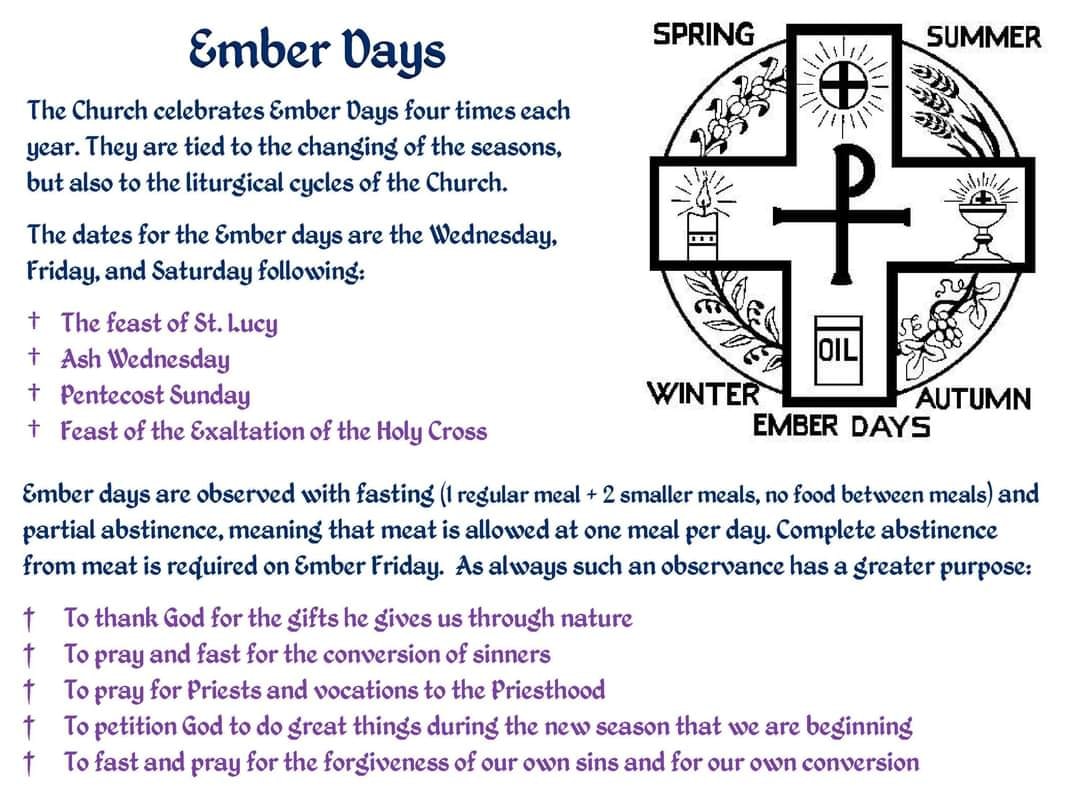
Today, Friday and Saturday are the Lenten Ember days. These days are traditionally observed with fast, partial abstinence (full on Friday, of course), and prayer.
Some information on the Ember Days-
Ecclesiastes 3:1-8:
All things have their season,
and in their times all things pass under heaven.
A time to be born and a time to die.
A time to plant, and a time to pluck up that which is planted.
A time to kill, and a time to heal.
A time to destroy, and a time to build.
A time to weep, and a time to laugh.
A time to mourn, and a time to dance.
A time to scatter stones, and a time to gather.
A time to embrace, and a time to be far from embraces.
A time to get, and a time to lose.
A time to keep, and a time to cast away.
A time to rend, and a time to sew.
A time to keep silence, and a time to speak.
A time of war, and a time of peace.
Four times a year, the Church sets aside three days to focus on God through His marvellous creation. These quarterly periods take place around the beginnings of the four natural seasons that "like some virgins dancing in a circle, succeed one another with the happiest harmony," as St. John Chrysostom wrote (see Readings below).
These four times are each kept on a successive Wednesday, Friday, and Saturday and are known as "Ember Days," or Quatuor Tempora, in Latin. The first of these four times comes in Winter, after the the Feast of St. Lucy; the second comes in Spring, the week after Ash Wednesday; the third comes in Summer, after Pentecost Sunday; and the last comes in Autumn, after Holy Cross Day Their dates can be remembered by this old mnemonic:
Sant Crux, Lucia, Cineres, Charismata Dia
Ut sit in angaria quarta sequens feria.
Which means:
Holy Cross, Lucy, Ash Wednesday, Pentecost,
are when the quarter holidays follow.
For non-Latinists, it might be easier to just remember "Lucy, Ashes, Dove, and Cross" -- or "Lenty, Penty, Crucy, Lucy."
These times are spent fasting and partially abstaining (voluntary since the new Code of Canon Law) in penance and with the intentions of thanking God for the gifts He gives us in nature and beseeching Him for the discipline to use them in moderation. The fasts, known as "Jejunia quatuor temporum," or "the fast of the four seasons," are rooted in Old Testament practices of fasting four times a year:
Zacharias 8:19:
Thus saith the Lord of hosts: The fast of the fourth month, and the fast of the fifth, and the fast of the seventh, and the fast of the tenth shall be to the house of Juda, joy, and gladness, and great solemnities: only love ye truth and peace.
Our Israelite ancestors once fasted weekly on Tuesdays and Thursdays, but Christians changed the fast days to Wednesdays (the day on which Christ was betrayed) and Fridays (the day on which He was crucified). The weekly two day fasts were later amended in the Roman Church to keeping only Fridays as penitential days, but during Embertides, the older, two-day fasts are restored. Saturdays (the day He was entombed) were added to these Ember times of fasting and are seen as a sort of culmination of the Ember Days: for example, on Ember Wednesdays, there is one lesson given during the Mass; on Fridays, there are none; and on Saturdays, there are four or five. Interestingly, the story of Sidrach, Misach, and Abdenago's escape from King Nabuchodonosor's fiery furnace with the help of an angel is commemorated on each Saturday of Embertides except that of Whit Embertide, and part of their beautiful hymn of praise follows (Daniel 3:52-56. See readings at the bottom of the page for this gorgeous hymn in its entirety).
In any case, the Dominican, Blessed Jacopo de Voragine (A.D. 1230-1298), Archbishop of Genoa, wrote a collection of the stories of the Saints known as "Legenda Aurea" (Golden Legend). This work gives eight quite interesting reasons to fast during Ember Days:
The fasting of the Quatretemps, called in English Ember days, the Pope Calixtus ordained them. And this fast is kept four times in the year, and for divers reasons.
For the first time, which is in March, is hot and moist. The second, in summer, is hot and dry. The third, in harvest, is cold and dry. The fourth in winter is cold and moist. Then let us fast in March which is printemps for to repress the heat of the flesh boiling, and to quench luxury or to temper it. In summer we ought to fast to the end that we chastise the burning and ardour of avarice. In harvest for to repress the drought of pride, and in winter for to chastise the coldness of untruth and of malice.
The second reason why we fast four times; for these fastings here begin in March in the first week of the Lent, to the end that vices wax dry in us, for they may not all be quenched; or because that we cast them away, and the boughs and herbs of virtues may grow in us. And in summer also, in the Whitsun week, for then cometh the Holy Ghost, and therefore we ought to be fervent and esprised in the love of the Holy Ghost. They be fasted also in September tofore Michaelmas, and these be the third fastings, because that in this time the fruits be gathered and we should render to God the fruits of good works. In December they be also, and they be the fourth fastings, and in this time the herbs die, and we ought to be mortified to the world.
The third reason is for to ensue the Jews. For the Jews fasted four times in the year, that is to wit, tofore Easter, tofore Whitsunside, tofore the setting of the tabernacle in the temple in September, and tofore the dedication of the temple in December.
The fourth reason is because the man is composed of four elements touching the body, and of three virtues or powers in his soul: that is to wit, the understanding, the will, and the mind. To this then that this fasting may attemper in us four times in the year, at each time we fast three days, to the end that the number of four may be reported to the body, and the number of three to the soul. These be the reasons of Master Beleth.
The fifth reason, as saith John Damascenus: in March and in printemps the blood groweth and augmenteth, and in summer coler, in September melancholy, and in winter phlegm. Then we fast in March for to attemper and depress the blood of concupiscence disordinate, for sanguine of his nature is full of fleshly concupiscence. In summer we fast because that coler should be lessened and refrained, of which cometh wrath. And then is he full naturally of ire. In harvest we fast for to refrain melancholy. The melancholious man naturally is cold, covetous and heavy. In winter we fast for to daunt and to make feeble the phlegm of lightness and forgetting, for such is he that is phlegmatic.
The sixth reason is for the printemps is likened to the air, the summer to fire, harvest to the earth, and the winter to water. Then we fast in March to the end that the air of pride be attempered to us. In summer the fire of concupiscence and of avarice. In September the earth of coldness and of the darkness of ignorance. In winter the water of lightness and inconstancy.
The seventh reason is because that March is reported to infancy, summer to youth, September to steadfast age and virtuous, and winter to ancienty or old age. We fast then in March that we may be in the infancy of innocency. In summer for to be young by virtue and constancy. In harvest that we may be ripe by attemperance. In winter that we may be ancient and old by prudence and honest life, or at least that we may be satisfied to God of that which in these four seasons we have offended him.
The eighth reason is of Master William of Auxerre. We fast, saith he, in these four times of the year to the end that we make amends for all that we have failed in all these four times, and they be done in three days each time, to the end that we satisfy in one day that which we have failed in a month; and that which is the fourth day, that is Wednesday, is the day in which our Lord was betrayed of Judas; and the Friday because our Lord was crucified; and the Saturday because he lay in the sepulchre, and the apostles were sore of heart and in great sorrow.
Now, in addition to the penitential fasting and alms-giving of this time, it is good to consider our stewardship of the earth, a responsibility God gave to us in the Garden of Eden, as recorded in Genesis 1:28-30:
God blessed them, saying: Increase and multiply, and fill the earth, and subdue it, and rule over the fishes of the sea, and the fowls of the air, and all living creatures that move upon the earth. And God said: Behold I have given you every herb bearing seed upon the earth, and all trees that have in themselves seed of their own kind, to be your meat: And to all beasts of the earth, and to every fowl of the air, and to all that move upon the earth, and wherein there is life, that they may have to feed upon.
The point is also beautifully made in the eighth Psalm:
O Lord our Lord, how admirable is thy name in the whole earth! For thy magnificence is elevated above the heavens. Out of the mouth of infants and of sucklings thou hast perfected praise, because of thy enemies, that thou mayst destroy the enemy and the avenger. For I will behold thy heavens, the works of thy fingers: the moon and the stars which thou hast founded.
What is man that thou art mindful of him? or the son of man that thou visitest him? Thou hast made him a little less than the angels, thou hast crowned him with glory and honour: And hast set him over the works of thy hands. Thou hast subjected all things under his feet, all sheep and oxen: moreover the beasts also of the fields. The birds of the air, and the fishes of the sea, that pass through the paths of the sea. O Lord our Lord, how admirable is thy name in all the earth!
Be mindful of your effects on our dear earth and don't allow people to "politicize" the issue of our stewardship of God's creation! But to be mindful of nature, it helps to actually see her first. Go outside and look! And praise God for all you see, hear, smell, feel, and taste as you allow His glorious works to touch your senses!
From The Imaginative Conservative
By Fr Dwight Longenecker
In his new book, Michael Warren Davis rescues the reactionaries. With a jaunty air and the panache of all the ridiculous warriors from Cyrano de Bergerac to Don Quixote, he stands up for all that is alternative, counter-cultural, strange, spare, and delightfully luddite.
I thought I was a fogey, but Michael Warren Davis, in his new book The Reactionary Mind: Why “Conservative” Isn’t Enough informs me that I am, in fact, a reactionary. I didn’t take to the term too happily because we all know that a reactionary is another name for a grump, a curmudgeon, an out-of-date, dyed-in-the-wool fuddy-duddy.
If the mainstream media and elite educators are to be believed, I am all of that and more: I am also privileged, racist, bigoted, misogynistic, homophobic, transphobic and just about everything-phobic. I’m also a snob, a religious hypocrite, a white supremacist, and a just plain nasty specimen of humanity.
But Mr. Davis rescues the reactionaries. With a jaunty air and the panache of all the ridiculous warriors from Cyrano de Bergerac to Don Quixote, he stands up for all that is alternative, counter-cultural, strange, spare, and delightfully luddite.
He pokes at progressives and punctures the pomposity of our contemporary assumptions and the pride of our techno-affluent power. He is for the virtues of an earlier time and the sanity of a simpler life. His book is a reminder that in a world of fugitives, the one who returns home will seem to be running away.
In his first ten chapters, he outlines the main traits of the reactionary: He is a man who marches to a different drum; he looks at facts, not propaganda, and assesses truth according to a higher standard than yesterday’s trends and tomorrow’s fashions. So the reactionary sympathizes with Savonarola, enthuses about the inquisition, doubts the assumptions of science, and questions the trickery of technology.
In other words, like Samson pulling down the pillars of the temple of Dagon, Michael Warren Davis pushes against the pillars of our modern, techno-political power structures. He resents our unthinking reliance on technology and refuses to “follow the science.” Instead, in the second part of his book he lays out an alternative path. He calls for a return to simplicity and prefaces his book with a winning quotation from Robert Frost, “Well, if I have to choose one or the other I choose to be a plain New Hampshire farmer.”
In Part Two, he sketches the outlines of a simpler life, beginning with ideas on a more humane economy that is centered on the home and family rather than the office and the marketplace. He endorses a retreat from the non-stop lies of the mass media and entertainment industries, encourages us to switch off the screens, step back from our love affair with technology, and pick up the “patient arts”: reading, writing poetry, learning an instrument, smoking a pipe, drinking tea, gardening. In “Musings of a Human Liberationist,” he takes healthy potshots at the idiocy of contemporary conservatism with its marriage to unrestrained consumerism and internationalism.
Finally, Mr. Davis makes an appeal for “The Strenuous Life.” “Men lost their health when they lost their meaningful work on the land, which also cost them their freedom and independence. Today they settle for little things like “fitness” and (God help us) “wellness.” Attacking the gym culture for producing fake masculinity—all muscles and fragile machismo—Mr. Davis calls for a return to the rugged individual like Teddy Roosevelt who loved the great outdoors and the fresh air that it offered. The reactionary should therefore combine the patient arts with boxing, hunting, fishing, hiking, and camping.
Mr. Davis’ book is s delightful rant against the idiotic modern world in which we find ourselves. It is observant, well-researched, suitably absurd, irreverent, and iconoclastically silly. Like that other great reactionary John Senior, Mr. Davis’ manifesto is in many ways unrealistic, romantic tosh. Not many of us can do a Thoreau and go live in the woods. We’re tied to our mortgages, our jobs, and yes, to our gym memberships, our Netflix, and our social media.
However, rants like Mr. Davis’ can inspire us to take small steps. All of us can read more and watch the screen less. All of us can get outside more, challenge the system, doubt the headlines, distrust the politicians, and try to accept that we will have enough just as soon as we realize that we have enough.
Furthermore, idealistic books like Mr. Davis’ often inspire movements that do change the world. John Senior, for example, wanted a boys boarding school where the lads would rise at five to milk the cows before going into chapel to sing lauds in Latin and then troop off to the dining hall for a hearty breakfast. He never founded such a school, but some of his students went to France and became Benedictine monks, then returned to Oklahoma years later and founded Clear Creek Monastery, which is now chock-full of young men who live pretty much the way John Senior dreamt. (The monastery is so successful that they’re planning to plant a priory in New Mexico.)
So who knows, Mr. Davis’ muscular conservatism may inspire an army of young men to get married, have lots of kids, go to church, choose country living, and raise hearty, red-cheeked children who know how not only to survive in the wasteland of modernity, but to thrive and build a better future.
From The Mad Monarchist (5 August 2012)
Consider first, that we must also examine the state of our souls as to hidden sins, as to such sins as we may be guilty of in others; for in these kinds, many are guilty of great disorders, while they flatter themselves that all goes well with them. Few indeed are ignorant of their carnal sins; though even in these sometimes persons deceive themselves, but very many take little or no notice of their spiritual sins, which are more interior; and though less infamous in the eyes of men, are more heinous in the sight of God; see then thou examine thyself thoroughly upon these heads; for spiritual sins are commonly very subtle, and not easily discerned, without a diligent search. Nay sometimes such as are the most guilty, will not believe themselves guilty of them. These spiritual sins are of one of these five kinds, viz,, pride, covetousness, envy, secret malice, and spiritual sloth. Look into them one by one, and if thy self love will suffer thee to be impartial in thy search, in all probability thou wilt find thyself more guilty than thou art aware of.
Consider 2ndly, in particular, how full thou art of thyself; how fond of every thing that flatters thee; how presumptuous of thy own sufficiency; how apt to compare thyself with others in thy thoughts, and to give thyself the preference; how apt to despise others; how unwilling to suffer any reproof or contradiction; how ready to swell with indignation upon every trifling opposition or contempt; how apt to break out into a storm upon every supposed affront; how much concerned at what the world will think or say of thy performances; how much more solicitous for thy worldly honour than for the glory of God. And what is all this but an unhappy pride, which is laying waste thy soul, and corrupting its very vitals, whilst thou art not sensible of it. See also, as to covetousness, whether the love of the mammon of the world does not reign in thy heart. Alas! the greatest miser does nor think himself covetous; but the tree is to be known by its fruit - such as an anxious care and a perpetual solicitude about the things of the world; and upon this account neglecting prayer and other spiritual duties, or being continually distracted in them; thinking more of thy money than of thy God; locking up thy heart in thy chest; losing thy peace upon every loss or disappointment; and a strange unwillingness to part with thy money, even when the honour of God, or thy neighbour's necessities call for it. See if nothing of this be thy case. See if thou art not more afraid of losing thy worldly substance than thy God. If so, thou art not in the way to heaven.
Consider 3rdly, as to the other spiritual sins, whether there be no person for whom thou hast a secret envy? No one whose praises, whose endowments, corporal or spiritual, whose virtues or performances, make thee uneasy, and gnaw thy soul, as if their advantages were a lessening to the honour, praise, and esteem which thou affectest. O how common is this mortal crime, and how many detractions and other evils does it produce! and yet how many take very little notice of it! Is it not thy case? Then as to secret malice, rancour, and hatred how dost thou stand affected? Look well into thyself; for here again we are too apt to deceive ourselves; but we must judge of the tree by its fruits, that is, by our way of thinking, speaking, and acting with relation to our supposed enemies. Now, there is so very wide a difference between the fruits of charity and those of malice, between love and hatred, that if we are sincere in our examination we cannot well be deceived therein. And as to spiritual sloth, which is a clog upon the soul, infinitely opposite to the love of God, to the spirit of prayer, to a due care in frequenting the sacraments and other duties; is not this also a most common evil, which frequently amounts to a mortal sin and yet how seldom do lukewarm souls take notice of it.
Conclude upon declaring an eternal war against all these vices, and particularly against that which thou hast reason to apprehend is thy predominant passion, that is to say, the chiefest and most dangerous of all thy enemies.
Catholic Action
1. Catholic action is the participation of the laity, or more correctly their co-operation, in the hierarchical apostolate of the Church. It is not really an innovation. It is as old as the Church herself, although it is only on account of the peculiar circumstances of our times that it has come to be organised in a special manner. From the beginning of Christianity, the laity of both sexes worked energetically alongside the Apostles for the expansion of the Kingdom of God. When St. Paul was writing to the Philippians he urged them to assist those Christian women who had done so much to spread the Gospel, as well as Clement and his other fellow-workers. "Help them, for they have toiled with me in the Gospel, as have Clement and the rest of my fellow-workers whose names are in the book of life." It is evident that even at that time there were laymen and women working in co-operation with the apostolic hierarchy. Every Christian, moreover, should feel the need to do this. Anyone who has the true faith and is on fire with the love of God and of his neighbour cannot but exert himself so that all men may reach the truth and live in accordance with it, that is, in accordance with the precepts of the Gospel. Anyone who is not motivated by this desire cannot claim to be a genuine and enthusiastic Christian.March 1st
ST. DAVID'S DAY
1 Mar. 1 July. 31 Oct.
The measure of excommunication or chastisement should be meted out according to the gravity of the offence, the estimation of which shall be left to the judgment of the Abbot. If any brother be found guilty of lighter faults, let him be excluded from the common table. And this shall be the rule for one so deprived: he shall intone neither Psalm nor antiphon in the Oratory, nor shall he read a lesson, until he have made satisfaction. Let him take his meals alone, after those of the brethren so that if, for example, the brethren eat at the sixth hour, let him eat at the ninth: if they eat at the ninth, let him eat in the evening, until by proper satisfaction he obtain pardon.