06 August 2019

What’sUp at the Fishwrap These Days?

I call it the National 'Catholic' Distorter.

From Fr Z's Blog

Meanwhile, what’s going on at the Fishwrap (aka National Sodomitic Reporter)?

As I write, this is the featured piece over there.

‘Queer Eye’ shows how grace works
When the U.S. bishops met this past June, Bishop Robert Barron, auxiliary of Los Angeles, drew some heavy pushback when he lifted up Canadian psychologist and social media personality Jordan Peterson as a model of how the church could be engaging with the culture, especially the religiously unaffiliated “nones.” Arguably, the pushback might have been worse had more bishops even heard of Peterson and his noxious broth of hyper-masculinity, anti-PC spite and cringeworthy flirtations with Christianity. [NB what things writer doesn’t like!  Masculinity… “straight” talk… thinking about Christianity.] But the real missed opportunity here was that Bishop Barron did not instead opt for a model of cultural dialogue closer to home, namely, the hit Netflix makeover show “Queer Eye,” which premiered its fourth season on July 19.  [No, you really did read that.]
While still probably an unknown quantity [Oh?] at least evinces a joy and a love for marginalized people as each episode finds the “Fab Five” — a makeover team of five gay men — coming into the life of a particularly stuck person and, over the course of a week, fostering transformation across the board in each team member’s areas of expertise — Karamo (culture), Jonathan (grooming), Antoni (food), Tan (fashion) and Bobby (design). Since arriving on Netflix in early 2018, the show — a reboot of an early 2000s series “Queer Eye for the Straight Guy” — has garnered a reputation for its intense human warmth and cathartic tears, both onscreen and in the homes of its viewers. [NB what things the write does like.] Others in religious media have called the work done on the show ministry [?!?] as much as makeover. But that’s underselling the dynamics unfolding before our eyes.  [Good grief.]
to most bishops, “Queer Eye”
[…]
For a Catholic who’s being honest, watching the Fab Five descend into an individual’s unique mess and dysfunction has an unmistakable Pope Francis feel to it.
[…]

Sorry, friends.  I know, I know.  You can’t unread that.

Blech.

But… this is what Fishwrap is all about.

The writer was from 2008-2016 an employee of the USCCB’s media office.

Surprising Convergences Between an Anti-Catholic Textook and the Liturgical Reform

Dr Kwasniewski points out the radically fundamental protestant nature of the destruction of the Liturgy.

From the New Liturgical Movement

By Dr Peter Kwasnieski


Luther points the way?
The claim that the liturgical reform under Paul VI was “Protestant” or “Protestantizing” is one that is both frequently made by its critics and strenuously resisted by its defenders. To some traditionalists, it is enough to point to the presence of Protestant observers at the Consilium; others find support in the striking admission of the pope’s close friend Jean Guitton, a well-respected philosopher, who stated:
The intention of Pope Paul VI with regard to what is commonly called the Mass, was to reform the Catholic liturgy in such a way that it should almost coincide with the Protestant liturgy… There was with Pope Paul VI an ecumenical intention to remove, or at least to correct, or to relax, what was too Catholic, in the traditional sense, in the Mass and, I repeat, to get the Catholic Mass closer to the Calvinist service.
But as Yves Chiron notes in his biography of Bugnini, the observers at the Consilium played a fairly minor role, taking the limelight only during discussions of the expanded lectionary; and one should not accept without scrutiny a man’s interpretation of his friend’s motives.

Nevertheless, it is impossible to deny the basic agreement between the historical vision of the liturgical reformers and that of the Protestant Reformers. Both regarded the post-Constantinian history of the Catholic Church as one of progressive darkening and pagan relapsation, a deviation from the pure, simple, authentic springtime of the early Christians who met in homes to “break bread” and remember Jesus, the wonder-working carpenter from Nazareth. This deviation reached its nadir in the Middle Ages, which then transmitted a superstitious cult to succeeding centuries, embellished along the way by the courtliness of the Baroque, until the clericalist dumb-show known as the Tridentine Mass achieved its frozen perfection. The fiery breath of the Pentecostal spirit melted this paradigm and replaced it with forms of worship more in tune with the living faith of Christians: first in the Reformation, then, much later, in the period of Vatican II and the sweeping reforms it ushered in.

There is practically no mainstream book on liturgy from about 1965 to about 1985 that does not express something like this viewpoint, with varying degrees of mockery for the past and confidence for the future of vernacular, accessible, lay-inclusive worship. It simply becomes the unquestioned summary of where the Church has been and where she is going.

Now, this is a Protestant account if ever there was one. A friend pointed out to me the following passage from a popular Protestant homeschooling textbook, World History and Cultures in Christian Perspective, published by Abeka:

The pagans who flooded the imperial church [after the Edict of Milan] inundated it with heathen beliefs, practices, and traditions. Public worship was described by Justin Martyr in the second century as a simple meeting of believers on the Lord’s Day to hear the Scriptures read and explained along with the singing of hymns, the offering of prayers, the celebrating of the Lord’s Supper, and the receiving of gifts.
       The influence of paganism began to change the worship service into elaborate rites and ceremonies with all the trappings of heathen temple worship. The presbyters now became sacerdotes who offered up the Lord’s body and blood as a sacrifice for the living and dead. Little by little, these errors and distortions grew and developed into the false teachings and practices of the medieval church. … Some devout followers even purchased and worshipped relics.…
       The demands of their religion led the people to regard Christ as a stern and merciless Judge rather than a compassionate and loving Savior. They sought to placate the Son’s wrath against their sins by praying to His mother, the Virgin Mary, and seeking her intercession. Because even Mary sometimes seemed unapproachable, they also prayed to the long-departed apostles and other saints (deceased Christians officially recognized by the Church as holy because of martyrdom, miracles, or other merits). But the Bible clearly teaches that there is only one mediator between God and man, Jesus Christ (1 Tim. 2:5).
We may wince and groan at this caricature of ancient Catholicism, but it is sobering to discover similar sentiments strewn throughout the books of Liturgical Movement authors writing in the twentieth century, paving the way for Sacrosanctum Concilium and the Pauline reform. In their different ways, Cardinal Ottaviani and Cardinal Bacci fifty years ago in their Short Critical Study, and Cardinal Ratzinger in his lecture at the Fontgombault conference of July 2001, recognized this powerful Protestantization of Catholic liturgical thinking. (Ratzinger noted that almost no academic theologian in Europe defends anymore the notion of the Mass as a true and proper sacrifice; even Catholics have come around to agreeing with Martin Luther.)

Ultimately, the Pauline liturgical reform rests on a Protestant understanding of Church history and liturgy. To accept it is to accept, to a greater or lesser extent, its foundation in the textbook Protestant vision of Catholicism as a history of obscurantism, mystification, ritualistic clericalism, and systematic exclusion from the liberties of the Gospel — in a word, a history of corruption.

The Dark Ages by Vladimir Manyukhin
Could we say that a recurrent problem within Protestants (admittedly I paint here with a broad brush) is that they do not place a positive value on the working of the Holy Spirit in history, over time? There seems to be no inherent weight to the witness of time, the sum total of the contingent, the course of development. Anything good about time or history is purely coincidental or extraneous. For example, in a certain year, say, 1780 or 1843 or 1921, there may be a camp revival somewhere, and that’s great as far as it goes, but it has nothing to do with the Christian religion as such. For Protestants, all dynamism takes place at the level of the individual man, inside the heart, where the Spirit moves; there is no relationship between the Spirit and a visible Church as a temporal/transtemporal whole.

The Catholic, on the other hand, sees the Faith as an historical, social, visible, incarnate reality, living a life that develops and unfolds, and that retains its earlier phases within itself while it grows beyond them. This is why the view John Henry Newman arrived at in his Essay on the Development of Christian Doctrine is so profoundly un-Protestant:
The following Essay is directed towards a solution of the difficulty which has been stated,—the difficulty, as far as it exists, which lies in the way of our using in controversy the testimony of our most natural informant concerning the doctrine and worship of Christianity, viz. the history of eighteen hundred years. The view on which it is written has at all times, perhaps, been implicitly adopted by theologians, and, I believe, has recently been illustrated by several distinguished writers of the continent, such as De Maistre and Möhler: viz. that the increase and expansion of the Christian Creed and Ritual, and the variations which have attended the process in the case of individual writers and Churches, are the necessary attendants on any philosophy or polity which takes possession of the intellect and heart, and has had any wide or extended dominion; that, from the nature of the human mind, time is necessary for the full comprehension and perfection of great ideas; and that the highest and most wonderful truths, though communicated to the world once for all by inspired teachers, could not be comprehended all at once by the recipients, but, as being received and transmitted by minds not inspired and through media which were human, have required only the longer time and deeper thought for their full elucidation. (Introduction, §21)
In fairness, we may assume that many or most of the Catholics involved in the liturgical reform would not have agreed with a purely Protestant view; but it can escape no one’s notice that their attitude is at best semi-Protestant, in the sense that they think and act on the basis of a profound skepticism about most of the history of the Church, from the middle of the first millennium to the end of the second millennium — the period from which they felt free to discard whatever features they deemed “corrupt” or “redundant” or “obscure” or “outmoded.”

In other words, their conception of faith is not the incarnational and pneumatological confidence in the unfolding of tradition that Catholics have always held, but, like Protestants looking for the stirring up of the heart in the revival tent meeting, they bring to bear a set of subjective criteria based on what they deem “effective” or “relevant.” In this way they have a basic stance of skepticism towards tradition that is incompatible with Catholicism.

Cardinal Journet quotes a passage from Soloviev that is remarkably pertinent:

How unreasonable is he who, seeing in the seed neither trunk nor branches, neither leaves nor flowers, and hence concluding that all the other parts are only applied later and artificially from the outside, and that the seed has not the force to issue forth these parts, totally denies that the tree will appear in the future, admitting only the existence of the single seed. Just as unreasonable is the person who denies the most complex forms or manifestations in which divine grace appears in the Church and wants absolutely to return to the form of the early Christian community. (Theology of the Church, 145)
It is only apparently paradoxical that antiquarianism and modernism go hand-in-hand. Cardinal Newman perceived this connection when he claimed that dogmatic Protestantism, which took as its justification the proclamation of the “original uncorrupted” Gospel, has a tendency, due to hermeneutical subjectivism, to degenerate into liberal Protestantism, which in turn tends to degenerate into ethical rationalism, agnostic naturalism, and atheistic secularism. In short, Protestantism has a way of self-destructing. Once one starts down this path, one will reach the end of it, short of a miraculous divine intervention. Hence, if the liturgical reform adopted the same mental framework toward historical and traditional Catholicism that dogmatic Protestantism did in the sixteenth century, it is only a matter of time before this newer version of Catholicism will enter its liberal mid-life, and move on from there to ethical, agnostic, and atheistic decrepitude.

In fact, a good case can be made that, like a time-lapse film of a tree losing its foliage in the fall, the Church (in the main) has already passed through the second phase and is well advanced in the final one. When a pope prioritizes environmental ethics, give interviews to atheist-communist journalists, and eviscerates Scripture of its supernatural sense, we are already looking at the Church of Latter-day Socinians. It took our separated brethren centuries to separate themselves from Christ as God, God as real, and, at last, man as man. Catholics, goaded by an inferiority complex, have done it in a matter of decades.

The Modernists against whom Popes Pius X and Pius XII battled had, of course, their own version of the “corruption claim.” For them, however, it was not the inadequacy of the medieval church, but the inadequacy of premodern Christianity as a whole, from the death of the last Apostle to the advent of the first paleontologist, that compelled a fundamental shift in understanding and practice. In response to a defrocked priest whom he calls “Fr. G.,” Teilhard de Chardin wrote on October 4, 1950:

Basically I consider — as you do — that the Church (like any living reality after a certain time) reaches a period of “mutation” or “necessary reformation” after two thousand years; it is unavoidable. Mankind is undergoing a mutation, how could Catholicism not do the same?
This mutation of Catholicism from its dogmatic-liturgical essence to a loosely-defined moral therapeutic deism in symbolic pantomime has happened, is happening, and will continue to happen, for as long as the Protestant distrust of incarnational ecclesiology and the Modernist skepticism of divine revelation and apostolic tradition continue to exercise their sway in the Vatican, the academies, the chanceries — and upon the altars of our parishes.

There is, however, a solution as obvious as it is simple: to embrace, once again, the fullness of Catholic tradition in its century-striding grandeur, doing away with the real corruption that threatens us: the faux ancien, crypto-Protestant, congenially modern papal rite of Paul VI.
The solution is at hand.

Good Science Gets Its Boots On

When the Shroud of Turin was 'debunked', I lost some of my faith. Oh, not in the Shroud, but in so-called 'science'.

From The American Catholic


On the Shroud.
It has been pointed out for years that radiocarbon dating doesn’t work that way– it’s supposed to be for stuff that has been stored away, not stuff that we KNOW has been handled, soaked at least once, and for heaven’s sake had cloth added to it.
Well, turns out that they hadn’t actually let anybody see the results of those tests.
Until now!
“Three laboratories performed a radiocarbon analysis of the Turin Shroud,” according to Casabianca. “The results, which were centralized by the British Museum and published in Nature in 1989, provided ‘conclusive evidence’ of the medieval origin of the artefact. However, the raw data were never released by the institutions,” he wrote.
In 2017, Casabianca submitted a Freedom of Information request to the British Museum and was allowed to see the data.
“Our statistical analysis shows that the 1988 carbon 14 dating was unreliable: the tested samples are obviously heterogeneous, and there is no guarantee that all these samples, taken from one end of the sheet, are representative of the whole fabric. It is therefore impossible to conclude that the shroud of Turin dates from the Middle Ages,” Casabianca explained in an interview with a website called L’Homme Nouveau.
Oh, if you’d like to look at the Shroud, there’s a site for that.

"Day With Mary" - 7 June 2014 - Our Lady at Pentecost

Fr. Giles speaks on Our Lady during the "Day With Mary" held at St. Emilie de Vialar Parish in Canning Vale, Western Australia on 7 June 2014.

Orwell the Prophet

As I've said when quoting him many times, one of my favourites!

From The American Catholic


In addition to this there is the horrible — the really disquieting — prevalence of cranks wherever Socialists are gathered together. One sometimes gets the impression that the mere words ‘Socialism’ and ‘Communism’ draw towards them with magnetic force every fruit-juice drinker, nudist, sandal-wearer, sex-maniac, Quaker, ‘Nature Cure’ quack, pacifist, and feminist in England.

George Orwell, The Road to Wigan Pier (1937)

The Orders of Society


Rest in Peace, Grandma and Dad!

On this day my beloved Grandmother, Pitronella Frederika (Nellie) Weismiller, nee Peterson (obit. 1973) would have been 143 years old. My stepfather, Marion Edward Spiller (obit. 1995), the only Dad I ever really knew and equally beloved, would have been 99. May they both rest in peace. They are gone but never forgotten! Minne Evigt! Memory Eternal!

Musings is Back (Sort Of)

Courtesy of the Dvoracek Memorial Library of Wilber, NE I have access to a full size computer. However, because of scheduling conflicts, I'll only be able to use it Tuesday thru Friday.

There will be far fewer posts than normal (which may be a relief to some of my readers!), and some of my regular posts will be missing or be delayed by days, but I'll do what I can.

Please pray that I can get a new computer at home soon.

01 August 2019

Farewell For Now

My computer has died. This is being laboriously typed on my tablet. Whilst I can type a short post, I don't know how to cut and paste, upload pictures, or any of much of what I normally do to produce 'Musings' on the tablet.

So, at least for the foreseeable future, this blog is on hiatus. I can be reached on Facebook on either my personal page or on the'Musings of an Old Curmudgeon' group page.

I am working on a longer post of explanation.

I'm sorry. I had promised' not a day without a line'. I managed over a year and a half.

The Catechism of the Summa - The Second Part: II. OF THE LAST END OR HAPPINESS OF MAN VIEWED IN ALL HIS ACTIONS (A)

II. OF THE LAST END OR HAPPINESS OF MAN VIEWED IN ALL HIS ACTIONS

(A)
Has man always an end in view when he acts?

Yes, man has always an end in view when he acts, that is when he acts as man and not as a machine, or by impulse, or by any reaction which is purely physical or instinctive (I. 1).

In the material world, is it only man that can act for an end?

Yes, only man in the material world can act for an end.

Does it then follow that all other beings in the material world act without an end?

No, it does not follow that all other beings in the material world act without an end; on the contrary, all beings act for an end that is very definite; but they are incapable of fixing an end for themselves; it is God who knows the end and who fixes it for them (I. 2).

All other beings then act in view of attaining some end which has been fixed for them by God?

Yes, all other beings act in view of attaining some end which has been fixed for them by God (I. 2).

Has not God also fixed for man the end for which he acts?

Yes.

What then is the difference between man when he acts and other creatures in the material world?

The difference is this, that man under the higher action of God and dependently upon this action, can fix for himself the end for which he acts; whereas other creatures of the material world put into execution blindly, naturally, or instinctively the end fixed to their action by God (I. 2).

What is the reason of this difference between man and other beings in the matter of actions?

The reason is because man is endowed with mind, whereas other creatures are not (I. 2).

Next - The Catechism of the Summa - The Second Part: II. OF THE LAST END OR HAPPINESS OF MAN VIEWED IN ALL HIS ACTIONS (B)

(This is no longer being shared from the Kindle edition. I'm now sharing from the  Jacques Maritain Center, at the University of Notre Dame.)

Feasts of Early August

From My Book of the Church's Year, By Enid M. Chadwick, [London:] Mowbrays, no date.


"Day With Mary" - 7 June 2014 - Why Corpus Christi?

Fr. Giles speaks on the Eucharist during the "Day With Mary" held at St. Emilie de Vialar Parish in Canning Vale, Western Australia on 7 June 2014.


Catechism of St Pius X - The Sacraments - The Sacrament of Penance - The Sacrament of Extreme Unction

The Sacrament of Extreme Unction 

1 Q. What is Extreme Unction?

A. Extreme Unction is a sacrament instituted for the spiritual as well as for the temporal comfort of the sick in danger of death.

2 Q. What are the effects of Extreme Unction?

A. The sacrament of Extreme Unction produces the following effects: (1) It increases sanctifying grace; (2) It remits venial sins, and also mortal sins which the sick person, if contrite, is unable to confess; (3) It takes away weakness and sloth which remain even After pardon has been obtained; (4) It gives strength to bear illness patiently, to withstand temptation and to die holily; (5) It aids in restoring us to health of body if it is for the good of the soul.

3 Q. When should Extreme Unction be received?

A. Extreme Unction should be received when the illness is dangerous, and after the sick person has received, if possible, the sacraments of Penance and the Blessed Eucharist; it is even well to receive it while he has the use of his senses, and has still some hope of recovery.

4 Q. Why is it well to receive Extreme Unction when the sick person has still the use of his senses, and has still some hope of recovery?

A. It is well to receive Extreme Unction while the sick person retains the use of his senses, and while there remains some hope of his recovery because: (1) He thus receives it with better dispositions, and is hence able to derive greater fruit from it; (2) This sacrament restores health of body (should it be for the good of the soul) by assisting the powers of nature; and hence it should not be deferred until recovery is despaired of.

5 Q. With what dispositions should the sacrament of Extreme Unction be received?

A. The principal dispositions for receiving Extreme Unction are: To be in the state of grace; to have confidence in the power of this sacrament and in the mercy of God and to be resigned to the will of the Lord.

6 Q. What should be the sick person's feelings on seeing the priest?

A. On seeing the priest, the sick person should feel thankful to God for having sent him; and should gladly receive the comforts of religion, which, if he is able, he should request himself.

Next - Catechism of St Pius X - The Sacraments - The Sacrament of Holy Orders

Pius X, Pope St.. Catholic Catechism of Saint Pius X (1908) (pp. 91-92). Kindle Edition.

Word of the Day: Kevelaer (Shrine)

Our Lady of Kevelaer
KEVELAER (shrine). Place of pilgrimage in North Germany, not far from the Dutch border. A Marian shrine where many disabled and sick children have been healed. In 1641 a trader on three successive nights heard a voice telling him, "Build a sanctuary in my honour here." Simultaneously his wife had an apparition of a lovely lady, and recalled an itinerant soldier selling a cheap paper picture of the Madonna. The soldier was found and the picture was bought, but because of the crowds it attracted to her small cottage she gave the picture to the village church. Repeatedly the blind, paralysed, deaf, and mute, especially children, who came to the church were cured and the word spread that the Blessed Virgin and her Son shown in the faded picture were the merciful ones. To accommodate the crowds, it was necessary to build a larger edifice, and a new statue made of stone but resembling the paper image replaced the old picture in importance. Pope Pius IX sent the stone from Rome for the new building and in 1892 the statue was solemnly crowned. Even during the war years in Germany, thousands came to this shrine, where both the new statue and the old faded picture are centres of devotion.

Remembering a Forgotten Poet

Mr Pearce remembers a great Catholic poet, now sadly forgotten to the point that even his grave is neglected.

From Faith & Culture 

By Joseph Pearce 
I fled Him, down the nights and down the days; I fled Him, down the arches of the years;I fled Him, down the labyrinthine ways Of my own mind ..
There was a time when the opening lines of Francis Thompson’s poem, “The Hound of Heaven”, would have been widely known. Today, as I discovered on a recent trip to England to film a documentary on Thompson, the poem and the poet are almost entirely forgotten. Nowhere was this crass disregard for one of England’s finest poets more evident than in the disgraceful neglect of the poet’s grave. The inscription on the tomb in the sprawling Catholic cemetery in Kensal Green had eroded to the point of illegibility. Ivy crawled creepily over the sarcophagus, covering the tomb in a blanket of oblivion, and, as if to add insult to the injury of neglect, another headstone had been placed so close to Thompson’s that it had eclipsed the poet’s epitaph. Having paid my respects at Thompson’s grave, I tried in vain to find the grave of another great Victorian poet, Lionel Johnson, whose resting place I knew to be only a matter of yards from Thompson’s. Such ignorance of fine art and such forgetfulness of a priceless heritage say more about the demise of England than they say about the neglected legacy that Thompson has bequeathed to a heedless nation.
In the light of such national amnesia, the film documentary on Thompson has become something of a crusade to make the poet and his work known to a new generation of cultured Christians on both sides of the Atlantic.
Francis Thompson was born in 1859 in Preston in Lancashire. Having failed in his efforts to train for the priesthood and then for the medical profession, he lived for a while in abject poverty in the squalor of post-Dickensian London. Homeless, penniless, addicted to laudanum, and sleeping on the streets, he befriended prostitutes at a time when the notorious Jack the Ripper was filling those same streets with terror. Such is the modern proclivity for conspiracy theories that the hapless poet has been listed among those suspected of being the world’s most mysterious serial killer. There are many reasons that Thompson could not have been the Ripper, not least of which are the innocent wisdom and religious serenity to be found in his poetry.
Thompson was saved from the streets by the charity of Wilfrid Meynell, editor of the magazine, Merry England, in which Meynell had published some of Thompson’s verse. At Meynell’s instigation, Thompson spent some time recovering his health and overcoming his drug addiction at Storrington Priory in Sussex, which was immortalized a few years later by Hilaire Belloc in his poem, “Courtesy”:
Of Courtesy, it is much less
Than Courage of Heart or Holiness,
Yet in my Walks it seems to me
That the Grace of God is in Courtesy.

On Monks I did in Storrington fall,
They took me straight into their Hall;
I saw Three Pictures on a wall,
And Courtesy was in them all ...
The recipient of the same courtesy that would so impress Belloc, Thompson recovered remarkably well at Storrington, writing some of his finest verse during his period of convalescence with the monks, including his most famous poem, the above-quoted “Hound of Heaven”. Although most revered as a poet, Thompson was also the author of “Finis Coronat Opus”, one of the finest short stories the present author has ever had the pleasure of reading. A cautionary tale in the Faustian mode, it tells of a poet who sells his soul to the devil and sacrifices his marriage on the altar of “art”. It was a stinging sideswipe against the rising aesthetic movement with its mantra of “art for art’s sake” and its desire to divorce beauty from morality. Here, as elsewhere and always, Thompson’s art was always at the service of the Good, the True and the Beautiful.
Francis Thompson died in 1907 at the tragically young age of forty-seven. He was eulogized memorably by G. K. Chesterton who described him as “the greatest poetic energy since Robert Browning”: “In Francis Thompson's poetry, as in the poetry of the universe, you can work infinitely out and out, but yet infinitely in and in. These two infinities are the mark of greatness; and he was a great poet.”
Returning to the vision of the neglected grave in Kensal Green cemetery, there seems no more appropriate tribute to Thompson’s life and death (and resurrection) than the closing lines of Chesterton’s famous poem, “The Rolling English Road”:
My friends, we will not go again or ape an ancient rage,
Or stretch the folly of our youth to be the shame of age,
But walk with clearer eyes and ears this path that wandereth,
And see undrugged in evening light the decent inn of death;
For there is good news yet to hear and fine things to be seen,
Before we go to Paradise by way of Kensal Green.
Reading these lines afresh, in the light of my visit to Thompson’s tomb in Kensal Green cemetery, I cannot but believe that Chesterton had Thompson in mind as he wrote these lines. Thompson’s youth was certainly full of folly and the reference to seeing things “undrugged” is surely an allusion to the laudanum addiction that Thompson, like Coleridge before him, had never managed to overcome.
The final words on this great but neglected poet do not belong to Chesterton, or even to Thompson himself. They belong to the God whom Chesterton and Thompson worshipped. At the end of “The Hound of Heaven”, it is Christ Himself who speaks to the Poet:
Alack, thou knowest not
How little worthy of any love thou art!
Whom wilt thou find to love ignoble thee,
Save Me, save only Me?
All which I took from thee I did but take,
Not for thy harms,
But just that thou might'st seek it in My arms.
All which thy child's mistake
Fancies as lost, I have stored for thee at home:
Rise, clasp My hand, and come!'

SAINT FRANCIS and the SULTAN: All About Conversion to Christ, Not Ecumenical Dialogue

I wonder what il Poverello thinks of Francis's choice of a Papal name?

From The Remnant 

By Alberto Carosa


cartoon
June 24th, 2019, marked the 800th anniversary of the day St. Francis met the Sultan of Egypt. The Italian Bishops Conference CEI news agency, SIR, acknowledged this in a March 1st, 2019 dispatch on the special stamp issued to commemorate the anniversary of such historical event.
Among the most recent commemoration initiatives, an exhibition with over 50 images focused on the anniversary was inaugurated on Friday, May 24, at the Sala Dono Doni of the Sacred Convent in Assisi. It will be open to the public till September 1.
sultan and francis picCommemoration of the meeting in 1219  took place in the area of Ras El-Bar, in that part of the city of Damietta where the river Nile flows into the Mediterranean
This encounter between St. Francis and the Egyptian sultan Melek Al Kamil, nephew of Saladin, is often described as a sort of archetypal model of interreligious dialogue and the celebration of this 800th anniversary took place in early March in Damietta and Cairo on the same vein, with the participation of national and local authorities, diplomats and top religious representatives including the Prefect of the Congregation for the Oriental Churches, Cardinal Leonardo Sandri, as personal special envoy of Pope Francis. The senior prelate celebrated the closing Pontifical Holy Mass in the Cathedral of St. Joseph, the seat of the Curia of the Province of the Friars Minor in the heart of the Egyptian capital (see HERE).
This meeting was recalled also by Pope Francis himself, during his recent trip to the United Arab Emirates last February and to Morocco in late March. “My pilgrimage followed in the footsteps of two Saints: Francis of Assisi and John Paul II”, he said again during his general audience on April 3rd, 2019.
“Eight hundred years ago Francis took the message of peace and fraternity to the Sultan al-Malik al Kamil”.
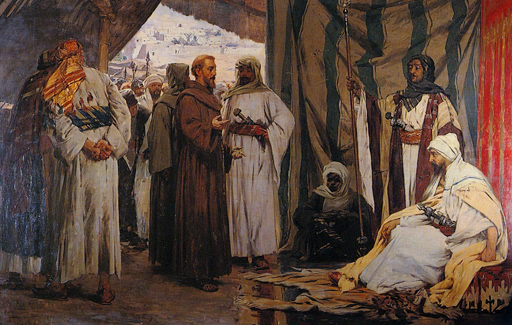
16 b mBut was it really what happened in the historic encounter 800 years ago?
The facts tell a different story, in the sense that this encounter was much more than that. For example, who knows that the presence of the Franciscans in the Holy Land came about and developed from this episode?
As a matter of fact, this year 2019 also marks the 800th year of Franciscan presence in the Holy Land, where in 2016 there were 259 religious coming from 40 countries.
This was explained in a conversation to a group of pilgrims in the Holy Land, of which the author of this article had the privilege of being part, by a nice Spanish religious, the Franciscan Father Artemio Vítores González, former superior of the Church of the Holy Saviour in the old city of Jerusalem and now guardian of the Franciscan convent of St. Catherine "ad nativitatem" of Bethlehem after nine years as vicar guardian of the Holy Land, where he has been present for 48 years and has seen eight wars and two intifadas.
Professor at the Biblicum of Jerusalem and author of many books on the Franciscan presence in the Holy Land, the father was informed of our visit and we had a chance for him to tell us something about the activity of the Franciscans in the Holy Land, who support the Latin Patriarchate of Jerusalem in the care of the pastoral needs of faithful and pilgrims. Whereas the Franciscans are mainly responsible for the holy places and their sanctuaries, the Patriarchate is entrusted with the care of parish and diocesan structures.
In addition to writing books, he held conferences over the course of 10 years to some 85,000 pilgrims, whose influx into the Holy Land has recently increased exponentially. Until a few years ago, he said, "I had two or three groups of Mexicans, but only last year I had 57".
All this is a sign of love and interest on the part of the pilgrims to meet with Christ through the holy places, the religious noted.
And it was love that prompted St. Francis to go to the Holy Land. As Father Artemio reminded us, Francis arrived in the Holy Land in 1219, and this 800th anniversary of his arrival follows up to another anniversary in 2017—that of the establishment of the province of the Holy Land by the general chapter of the Franciscan order in 1217.
"St. Francis’ love for Christ is so radical", explained the father, "that he wants everyone to fall in love with Christ, and everyone also includes Muslims". This is why the Franciscan venture in the Holy Land began with the encounter in 1219 in Alexandria between Saint Francis of Assisi and the Egyptian Sultan Melek Al Kamil, from whom he obtained, despite the ongoing Crusades, for the Franciscans to be granted access and protection in the Holy Land.
Therefore, "the origin of the Franciscan custody of the Holy Land, however incredible it may be, is a consequence of the friendship between a Christian and a Muslim".
Although on the occasion the sultan did not convert after the saint's preaching, however, this concession was also the result of Melek Al Kamil's great admiration for his guest, for two fundamental reasons:
-the incredible courage shown by the Saint, who for his faith in his God had put his life at stake, especially if one considers that, as Father Artemio recalls, there was at the time an edict of the sultan who rewarded Muslims with a highly valuable gold coin for every head of Christians delivered;
- St. Francis' refusal of gold and silver offered as a gift by the sultan as a sign of esteem and friendship, which strengthens his conviction that he was facing a truly extraordinary person.
In the end, what did the crusades achieve?" asks Father Artemio. "While San Francesco and his friars did much more, even though it was always difficult".
To get an idea of ​​these difficulties, he cites the title of a chapter in one of his books:
"The friars buried in the Holy Sepulcher", to indicate the enormous sacrifices, and at times a real physical martyrdom, to maintain the right to possession of the holy places. Specifically in the case of the Holy Sepulchre, where "for six centuries the friars were inside the Holy Sepulchre without being able to go out and had to be replaced every three months because they died, being unable to breathe air, only the smoke of candles".
So much so that when the emperor of Austria Franz Joseph came to visit in 1860, Father Artemio goes on, he exclaimed that not even the worst criminals in the prisons of his empire lived in those conditions.
Then fortunately the situation improved and the friars returned to see and breathe the air and the light of the day. We must never forget, continues Father Artemio, that when Saint Francis arrived in the Holy Land in 1219, there were no longer Christians there. For four centuries the only Christians there were the Franciscan friars, except for a few pilgrims from time to time and in any case without parishes and other structures.
Thus, if today we Christians can freely go on pilgrimage to the holy sites with all the immense spiritual benefits which go with it, a great deal of credit goes to St. Francis, whose mission was not motivated by ecumenical dialogue, but an evangelization drive so fruitful not only for the past 800 years but also for many more centuries to come.

1 August, Antonio, Cardinal Bacci: Meditations for Every Day

The Awareness of the Presence of God
1. The cultivation of a continual awareness of the presence of God is such a useful practice that many writers regard it as the fundamental principle of the spiritual life. As St. Alphonsus de' Liguori points out, it obliges us to do three things: (1) To preserve ourselves completely free from sin; (2) To practise virtue in every possible way, and (3) To seek a closer and more loving contact with God. (Al. Div. Servizio, III, 1, 3)

The realisation of the presence of God is a particularly good way of subduing our passions and conquering temptation. “If we were always aware of God's presence within us,” writes St. Thomas, “we should never, or hardly ever, sin.” (Opusc. 58, c. 2)
It is unlikely that a man who is committing sin adverts to the fact that God is watching him and could intervene to punish him at any moment. He has forgotten the presence of God, his Creator and Redeemer, Who has been so good to him and Who will one day be his judge. His mind has been darkened and his heart led astray by the deceptive pleasures of this world.
God is far from the sinner because the sinner ignores His inspirations and advice and has, in short, rejected Him. The unhappy man will never find peace in this world and is doomed to eternal unhappiness in the next.
“If we remained always in the presence of God,” wrote St. John Chrysostom, “we should neither conceive nor do anything evil.” (Homil. 8, ad Phil., 2.)
2. The presence of God, moreover, encourages us to do our best to acquire all the virtues. When He is always before our eyes we have no difficulty in recognising that He is the supreme Truth, Beauty, and Goodness.
Let us seek to please God, therefore, by obeying His commandments and inspirations. If we wish to be worthy of His presence, let us seek to adorn our souls with His grace, which is ours for the asking. Our awareness of God's presence should not be a passive state. It should enliven our faith and increase our love for Him.
Do we realise how poor and pitiful we are in the sight of God? Let us ask Him to make us holy. If we are troubled by temptations, let us ask Him for the strength to conquer them. If we are worn out by suffering, let us ask Him to help and console us.
3. If we remind ourselves constantly of the presence of God, we shall always be closely united to Him. Union with God should be the result of our love for Him, for it is an unfailing rule of love that it increases with the nearness of the beloved. If we live in the presence of God and contemplate Him as the perfection of beauty, truth and goodness, we shall be moved to love Him more and more. Our love, moreover, will generate in us the ardent desire of an even closer intimacy with Him.
This sacred union will bring us great peace and tranquility in all the vicissitudes of life, a serenity which will be reflected in our personality and in our conduct for the edification of our fellow-men.

IN LUMINE FIDEI: 1 AUGUST – THE SEVEN HOLY MACCABEES

IN LUMINE FIDEI: 1 AUGUST – THE SEVEN HOLY MACCABEES: At Antioch in Syria took place the martyrdom of the Seven Holy Maccabees, seven Jewish brothers who lived in Old Testament times. Acco...

IN LUMINE FIDEI: 1 AUGUST – THE CHAINS OF SAINT PETER

IN LUMINE FIDEI: 1 AUGUST – THE CHAINS OF SAINT PETER: During the reign of Theodosius the younger, his wife Eudoxia went to Jerusalem to fulfil a vow, and while she was there she was honoured...

1 August, A Chesterton Calendar

AUGUST 1st 

A man must be orthodox upon most things, or he will never even have time to preach his own heresy. 

‘George Bernard Shaw.’

Chesterton, G. K.. The G. K. Chesterton Collection [50 Books] (Kindle Locations 44684-44686). Catholic Way Publishing. Kindle Edition. 

2 August, The Roman Martyrology

Quarto Nonas Augústi Luna secunda Anno Domini 2019

August 2nd 2019, the 2nd day of the Moon, were born into the better life: 

At Nocera-dei-Pagani, [in Campania, Italy, in the year 1787,] holy Alphonsus Mary de Liguori, Bishop of Santa-Agata-de'-Goti, and Founder of the Congregation of the Most Holy Redeemer. Illustrious for the zeal for the salvation of souls shown both by his writings, his words, and his ensample. Pope Gregory XVI. enrolled his name with those of the Saints, and the Supreme Pontiff Pius IX. gave him the title of Doctor of the Church. 
At Rome, in the cemetery of Callistus, [in the year 257,] the holy Pope and martyr Stephen. He was celebrating Mass during the persecution under the Emperor Valerian, when the soldiers broke in. He finished his office before the altar without fear or trembling, and then was beheaded as he sat upon his throne. 
At Nice, in Bithynia, [in the fourth century,] the holy Theodota and her three sons, who were all burned [alive] in the fire together by the order of Neretius, Consular of Bithynia, after he had first caused the eldest son, whose name was Evodius, to be beaten with clubs for his faithful confession of Christ. 
In Africa, [in the year 211,] the holy martyr Rutilius. He had fled from one place to another in order to escape the persecution, and had sometimes bought himself out of danger, when he was unexpectedly arrested and brought before the President. He was long put to the torture, then given over to the fire, and so crowned with a noble testimony. 
At Padua, [in the second century,] the holy Maximus, Bishop of that city, who died a blessed death, famous for miracles. 
V. And elsewhere many other holy martyrs, confessors, and holy virgins.
R. Thanks be to God.

Memes of the Day


31 July 2019


Church Militant Headlines — July 31, 2019

Anti-Catholic to figure prominently in revamped (destroyed) John Paul II Pontifical Theological Institute, Stupich blames 'unfulfilled pledges' for missing $190M+.


A Bit of Monarchist Humour

H/T to a member of the Facebook group, Catholic Monarchist League.

Republicans: In order to preserve tradition and culture we need, ...

Monarchist: A King, a Queen, a royal bloodline and the Catholic Church

Republicans:


Apropos My Last Post

So, according to Francis, His Holiness Pope Leo XIII was teaching false doctrine?