Giving Anne Carson the Nobel Prize in Literature is a tragedy. This is not a celebration of literary excellence but its destruction. Indeed, the world now heaps praise upon her as she deconstructs ancient literature and dismantles the structures that give literary art its meaning and beauty.
 For many years now, the annual announcement of the Nobel Prize in Literature has been a celebration of the bizarre. Writers of one-sentence 400-page books, obscene narratives and nihilistic tales have dominated the field of those winning the world’s most prestigious prize for writing.
One might hope that this year would be different. Perhaps the august judges of the Swedish Academy might find someone who can write real stories about real people with a compelling message. How wonderful it would be if the works of this year’s winner would reflect the good, true and beautiful and not be obsessed with the contrary.
More of the Same
Alas, such good fortune was not to be. This year’s winner is the Canadian writer Anne Carson. She is known for her surrealism, intentional absurdity, and genre-bending narratives.
Like most postmodern prize winners, Anne Carson, 76, is largely unknown, except to a tiny niche of readers who believe they can decipher her work. Indeed, modern literature has long lost its universality and is now the domain for all things esoteric, subjective, and limited.
What makes this award perplexing is that Anne Carlson is considered an expert in classical literature. She knows what good literature is.
Yet she uses this knowledge to invite ancient characters to interact with her own. Her work is an absurd hodgepodge that defies every standard and questions every certainty.
Upside Down
Her works become timeless by turning time upside-down. Ancient figures meld with modern ones as she places them inside bizarre postmodern contexts. Sophicles’ Antigone and Ismene can be found discussing Hegel. She merges Helen of Troy with Marilyn Monroe. The young Hercules is involved in homosexual relationships. In another episode of Hercules’ life, she takes the side of the red monster he kills. Her “translations” of classical works are really distortions in which anything is possible.
The narrators in her stories are also upside-down. A cloud, a monster, or an imaginary character might tell the story. The storyteller might change mid-story. There is a lack of unity in her works as she flits from one subject to another. There are no rules in Ms. Carson’s ever-changing world.
Even the format of her works can be upside-down. Some of her writings reject the structural norm of being a book. Her work, Nox, for example, is printed as a single, continuous accordion-folded sheet of paper placed inside a box. Another is called Float, a collection of 22 individual booklets housed in a plastic case. They are to be shuffled and read at random.
Acclaimed by the Establishment
An example of her work is the absurd “poem” titled “Room in Brooklyn.” This minimalist piece of literature consists of four words: “This slow day moves.”
For such “works,” she is acclaimed. The more chaotic her style, the more popular she becomes with establishment academics and critics who do everything they can to find value in her ramblings.
She is described as brilliant, minimalist, and avant-garde. Her style is called delightfully absurd, surreal, and unconventional.
Indeed, this acclaim is far worse than the texts themselves because it creates the false notion that everyone sees value in four-word poetry and upside-down narratives.
No Reason to Celebrate
Giving Anne Carson the Nobel Prize in Literature is a tragedy. This is not a celebration of literary excellence but its destruction. Indeed, the world now heaps praise upon her as she deconstructs ancient literature and dismantles the structures that give literary art its meaning and beauty.
By questioning everything, works like Ms. Carson’s no longer construct a rational story. They turn stories, conventions, and morals into oppressive structures that must be overthrown. Literature becomes a brutal weapon to fragment, isolate, and shred those admirable shared stories that were once so well expressed with wonder and beauty.
Let the prize be given to writers who elevate people’s horizons toward that which is good, true, and beautiful. Would that literature might be freed from such mediocre and “delightfully absurd” authors that deprive it of its purpose. And free from those critics who acclaim such works as masterpieces.
__________
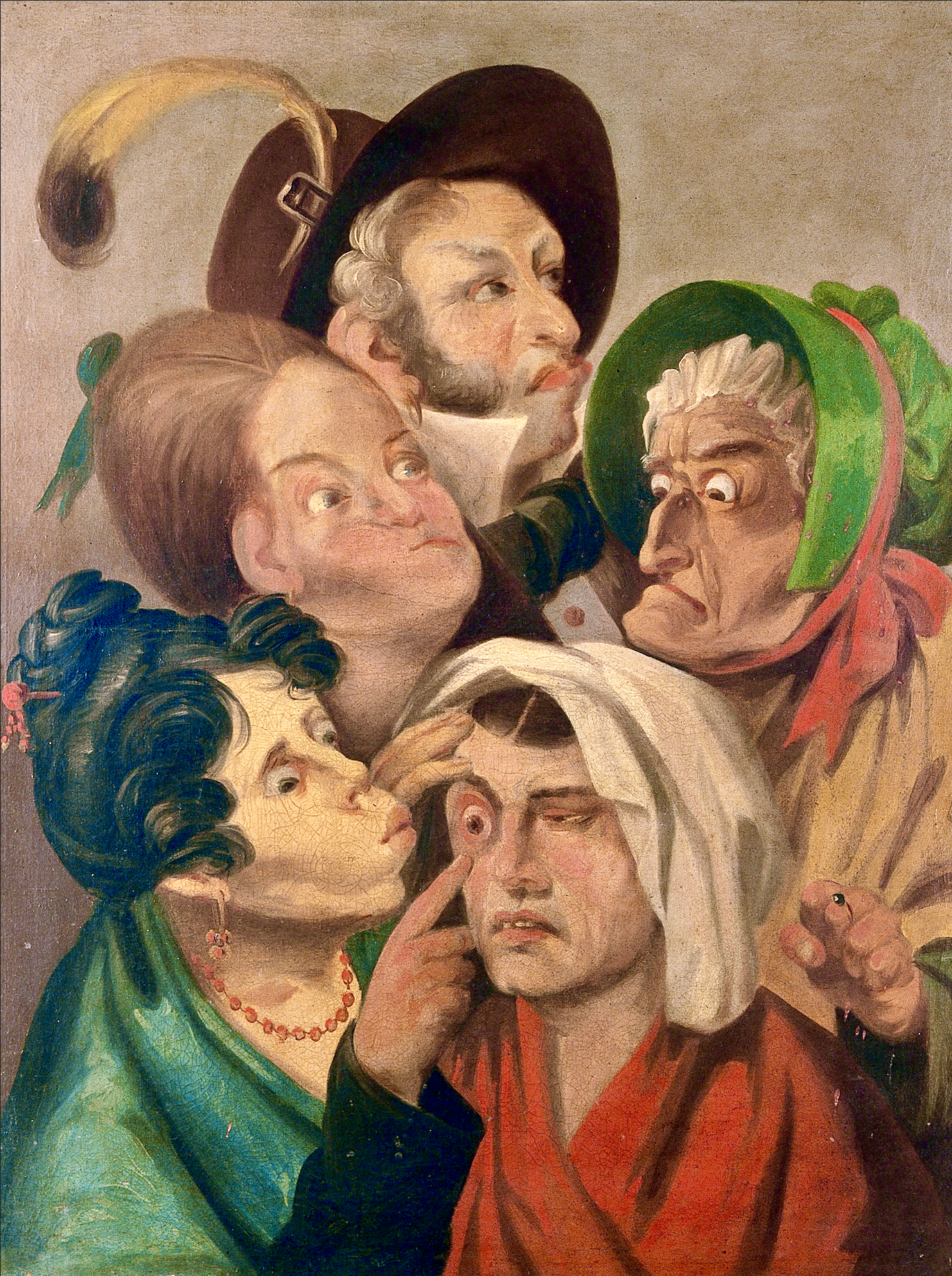
The featured image is “A bizarre physiognomical caricature with a figure pointing to another’s sore eye,” by a follower of Louis-Léopold Boilly (1761–1845). This file comes from the Wellcome Collection, a website operated by Wellcome Trust, a global charitable foundation based in the United Kingdom, and is licensed under the Creative Commons Attribution 4.0 International license, courtesy of Wikimedia Commons.

No comments:
Post a Comment
Comments are subject to deletion if they are not germane. I have no problem with a bit of colourful language, but blasphemy or depraved profanity will not be allowed. Attacks on the Catholic Faith will not be tolerated. Comments will be deleted that are republican (Yanks! Note the lower case 'r'!), attacks on the legitimacy of Pope Leo XIV as the Vicar of Christ, the legitimacy of the House of Windsor or of the claims of the Elder Line of the House of France, or attacks on the legitimacy of any of the currently ruling Houses of Europe.