A profound essay on why truth must be sought before we can have civility, bipartisanship, compromise, dialogue, or common ground.
From The Imaginative Conservative
By Gleaves Whitney
Today we hear well-meaning appeals for civility, bipartisanship, compromise, dialogue, and common ground. Admirable aspirations, these. But there is a proper order that is often lost in our civic workshops: The search for truth must begin before the quest for common ground.
 On a recent summer evening, a friend entertained several of us with nothing more than an ordinary deck of playing cards. One trick followed another. Cards vanished. They appeared where they could not possibly have been. Predictions proved uncannily accurate. Choices we believed were entirely our own had somehow been anticipated from the beginning. We laughed and applauded. We were dazzled and delighted.
What made the evening memorable was not merely the magician’s dexterity but the strange pleasure of being deceived. We knew we were being fooled. We just didn’t know how.
Walking home, I pondered a question: Who are the magicians of modern society? Not the stage performers, of course, but those individuals and institutions that possess the knowledge, tools, credentials, and influence to shape what millions of people believe about politics, economics, finance, technology, health, education, foreign affairs, and culture. Are we willing dupes?
Like every metaphor, the card-wielding magician has limits. Yet the card trickster can serve as a type who illuminates something unsettling about our age. Increasingly, the forces in public life are hidden behind systems so complex that ordinary citizens cannot easily inspect them. Algorithms determine what we see. Financial instruments influence markets few understand. Statistical models guide public policy. Artificial intelligence generates clear answers by mysterious methods. Advertising campaigns shape our collective subconscious in insidious ways. And scientific findings are condensed into headlines that few have the expertise or time to evaluate.
None of this necessarily involves conspiracy. Complexity alone produces distance between those who exercise influence and those who experience its consequences. But, given what we know about human nature, complexity also gives rise to temptations. We see it already in the ancient Sophists who were the rhetorical “magicians” of Ancient Greece. They well understood—long before computers, media conglomerates, or social media platforms existed—that whoever controls persuasion can gain power. Plato objected to the Sophists not because rhetoric was inherently evil but because rhetoric divorced from truth becomes manipulation.
That distinction is as relevant today as it was 2,500 years ago. Throughout the modern age, we have repeatedly witnessed sophisticated efforts by “magicians” to shape public perception while serving interests quite different from those publicly proclaimed. After World War II in the U.S., the tobacco industry’s campaign to cast doubt on mounting evidence linking smoking to disease remains one of the most abhorrent examples. Rather than directly disprove the scientific consensus, “experts” were bought off. They prostituted themselves and produced “scientific studies” that successfully manufactured uncertainty long enough to delay public action.
The private sector has hardly been alone in deploying an army of sophists and tricksters among us. The public sector has been just as bad. During the Vietnam War, Secretary of Defense Robert McNamara became famous for applying quantitative analysis and systems management to military strategy. Vietnam has sometimes been called the world’s first spreadsheet war. While numbers can illuminate reality, in the modern magicians’ hands they can also deftly obscure it. McNamara’s statisticians created the appearance of understanding and control while masking the deeper political, cultural, and human realities that prolonged a terrible war.
Then look at the politicians who repeatedly say how much they deplore inequality and care about the poor and working class. Yet these same pols tacitly support a system of credit and government spending that guarantees there will be structural inflation—always to the detriment of the people they claim to care about.
Look as well at the “public servants” who opine incessantly about the internal threats to our democracy—all the while ensuring that gerrymandering will rig elections to favor their candidate and their party. Their hypocrisy is the very antithesis of democracy, for there is no true contest of ideas and policies in these districts.
Business, politics, media, the academy—they all possess their own versions of the card trick. The magician as a type persists into the modern age because human nature has not changed. The perennial desire for wealth, influence, status, prestige, and power endures as it always has. The clothing may have changed, but the motivations have not. The illusionists of our age may not be wearing tuxedos. Rather, they are wearing lab coats, bespoke suits, university regalia, or Silicon Valley hoodies. Their props are not cards, rabbits, and silk scarves but algorithms, data sets, predictive models, fine print, branding campaigns, and carefully crafted narratives.
Perhaps we need a new word for the modern-day sophists among us, for those who exercise disproportionate influence through the combination of expertise, institutional authority, and persuasive power. Call them the magicopoly—not because they literally control everything, but because modern institutions and technology increasingly concentrate the ability to shape perception in relatively few hands.
No doubt, some of the magicopolists are honorable servants of the common good. Others are not. The challenge is to distinguish between them.
The problem is not experts or elites, per se. Every age has needed its elites. Civilization requires expertise. To recur to one of Plato’s frequent lines of thought, the physician knows more about medicine than the patient. Engineers understand bridges better than those who drive across them. Judges study law more deeply than jurors.
The problem begins when experts ask to be trusted without question—when they dazzle without transparency. While thriving civilizations require experts, they also require citizens capable of putting intelligent questions to the experts. Here Friedrich Nietzsche offers a useful allegory. In Thus Spoke Zarathustra, Nietzsche describes three transformations of the spirit of a culture. First comes the camel, a load-bearing beast of burden that carries forward the inherited traditions and accepted truths. Then comes the lion that refuses simply to accept what it has been told. The lion stops the camel in its tracks, challenging authorities and questioning convention. Finally comes the child who recovers the sense of wonder that originally inspired the culture and creates anew.
Whether or not one accepts Nietzsche’s philosophy, his lion performs an indispensable civic service. Every free society requires men and women willing to ask tough questions. How do we know a claim is true? Who benefits, who pays? What assumptions remain hidden? What evidence has been omitted? Where are the incentives? Where does the information we put into AI go? In other words, who are the magicians and what card tricks do they use?
These questions are not always expressions of cynicism. They often are exercises of responsible citizenship. Indeed, one of the greatest mistakes of our age is to confuse skepticism with nihilism. The lion need not deny truth. The lion is fierce because it doesn’t want to be fooled and seeks the truth. The distinction is important.
What do we do with the distinction? Again, Plato is helpful: The physician who confronts a malady should not compromise with disease. The engineer who discovers structural failure should not seek common ground with gravity. The historian who finds forged documents should not negotiate with falsehood.
There is another danger. Today we hear well-meaning appeals for civility, bipartisanship, compromise, dialogue, and common ground. Admirable aspirations, these. Every one of them is necessary to the survival of the republic. But there is a proper order that is often lost in our civic workshops. The search for truth must be paramount. Indeed, the search for truth must begin before the quest for common ground. And in that search we must discern who the magicians are, know what card tricks they use, and understand how their tricks work.
The Sophists taught persuasion. Socrates pursued truth. Every generation must decide which teacher it will follow. The digital age has not abolished this ancient contest. It has merely equipped both sides with more sophisticated tools. Artificial intelligence can enlighten or deceive; data can clarify or manipulate; media can inform or inflame; statistics can reveal or conceal; technology can magnify virtue or vice.
Ultimately, the deepest struggle is not technological but moral. The greatest illusion has never been a card trick. It has always been the temptation to believe that human beings can transcend their nature. And the irony is this: the people who make that argument are often the most ambitious, prideful, and greedy among us.
In the face of the magicopoly, our response is neither blind trust nor universal suspicion. It is discernment and understanding. These virtues require historical memory, philosophical clarity, moral courage, and intellectual humility. It asks us neither to worship experts nor to dismiss expertise. From Socrates onward, the willingness to ask how the trick is done does not make us cynics. It makes us citizens who love truth more than illusion, and liberty more than power.
_________
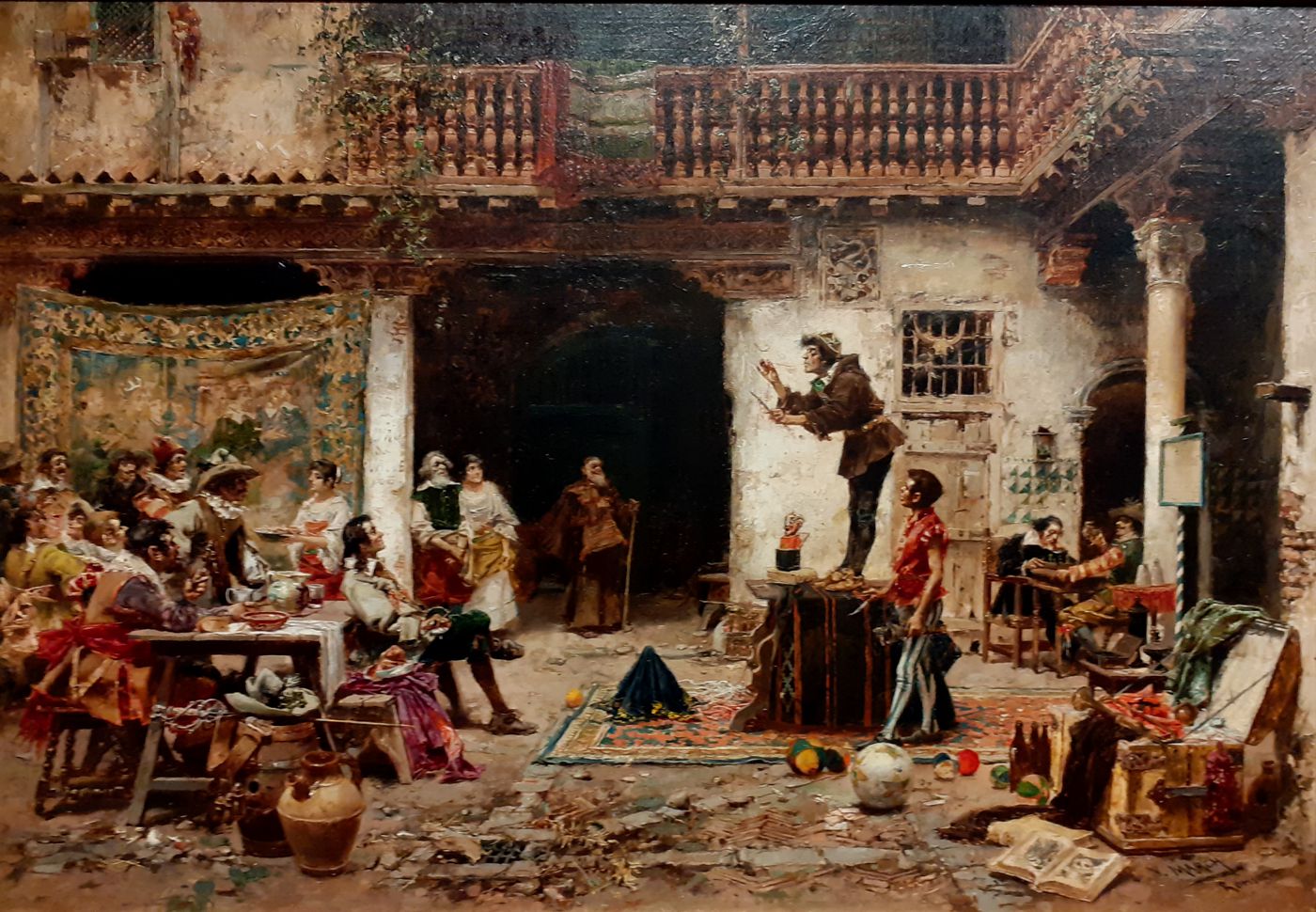
The featured image is “The Magician” (by 1927), by Vicente March, and is in the public domain, courtesy of Wikimedia Commons.

No comments:
Post a Comment
Comments are subject to deletion if they are not germane. I have no problem with a bit of colourful language, but blasphemy or depraved profanity will not be allowed. Attacks on the Catholic Faith will not be tolerated. Comments will be deleted that are republican (Yanks! Note the lower case 'r'!), attacks on the legitimacy of Pope Leo XIV as the Vicar of Christ, the legitimacy of the House of Windsor or of the claims of the Elder Line of the House of France, or attacks on the legitimacy of any of the currently ruling Houses of Europe.