.png)
From One Peter Five
By Caterina Lorenzo-Molo, PhD
When the metaphysical order of judgment is bypassed, reasoning collapses onto a Cartesian-style plane.
Articles addressing the Fraternity of the Society of St. Pius X (FSSPX) often fall into the following: 1) openly hostile and dismissive; or 2) defensive and apologetic. Very rarely, one encounters a critique that appears balanced—concedes that the SSPX may have a correct diagnosis of the crisis, criticizes anti-SSPX Catholics and defends the Society against unfair hostility, and even recommends sympathetic works written in their defense, such as Kennedy Hall’s book. When an author concedes significant ground to the SSPX position while still offering criticism, the expectation is that what follows will represent a fair and balanced engagement. For this reason, the article SSPX: Hope or Tragedy? seems to present itself as a thoughtful and even promising contribution. But we did say, “initially presents itself.” But is it truly a thoughtful and even promising contribution or is it more of the same?
What follows may appear abstract—but the issue is quite simple: Are we judging the truth of things, or the intentions of people?
We will simply state our thesis—for all the attempts to concede much of the SSPX diagnosis—thus appearing moderate and reasonable, the author essentially attacks the SSPX position, and by extension, the larger fight for the Catholic Church and the preservation of the Faith—by essentially asserting a suspicion (that the SSPX have a “modus operandi” of “boycotting” the Catholic Church)—hence, calling for an investigation of intention.
As a consequence, the debate is shifted away from metaphysical adjudication toward analysis of the attitudes and behavior of those raising objections—a displacement of judgment from object to subject.
For the non-metaphysically adept, this movement is persuasive precisely because it is gradual. The psychological and emotional appeal prepares the reader to accept that in certain circumstances, the faithful might attend the Novus Ordo when no other option exists. But as the discussion develops, the scope widens. A question that begins with the Society’s position on the Novus Ordo ends by raising the possibility of a deeper problem—one that invites scrutiny not of the argument, but of the intentions behind it—what the author asserts as a “modus operandi” and a “boycotting” of the Catholic Church.
In classical moral reasoning, however, judgment proceeds first from the object under consideration; the intentions of the agents involved are considered only afterward and cannot replace the evaluation of the object itself. Hence, the article introduces disorder into the process of judgment itself. The result is a messy and unproductive line of inquiry, which can be easily weaponized rhetorically—likely killing dissent on anything and everything Vatican II—expanding that Cartesian arcade, into a rhetorical pattern that eventually forecloses the question rather than resolving it. The result is the displacement already described—evaluating the claimant rather than the claim. But the central issue, that is the liturgical reform and the broader doctrinal framework from which it emerged, remains unadjudicated, as it has been for six decades. (By extension, this article also addresses the editor Mr. Flanders’s concerns, recently repeated last week.)
The Shift from Object to Subject
The practice of relocating judgment away from the object and toward actors is 60 years old. A 1976 exchange between Paul VI and Archbishop Marcel Lefebvre illustrates this. Rather than engaging the substantive doctrinal and liturgical concerns raised, Paul VI focused on the Archbishop’s “unbearable rebellion.” Judgment was relocated from the object (the content of Tradition and the reform) to the subject (the canonical and hierarchical status of the one raising the objection).
A similar pattern appears in John Paul II’s Veritatis Splendor (1993), which seems to reaffirm the primacy of the moral object: “The morality of the human act depends primarily and fundamentally on the ‘object’ rationally chosen by the deliberate will” (VS 78). It appears Thomistic. But earlier in the document (VS 71–73), there is an undeniable pivot where the framework is established in terms of the acting person and self-determination. Hence, the object is affirmed only at the level of formulation, but the interpretive framework has already been relocated to the subject. The question shifts from what the act is to what the act means for the subject. Personalist language replaces metaphysical precision. While Thomistic in terminology, John Paul reverses their function by relocating the order of analysis to a phenomenological-personalist framework.
Benedict XVI operates within the same shift. In Deus Caritas Est (2005), he redefines the starting point of moral theology—from Christianity to an encounter with a person. The mode of access to truth shifts from objectively specified reality to subjective relational experience. Hence, there is a shift from “define, judge, and apply” to “encounter, interpret, and accompany”—the predecessor to Pope Francis’s call for a Church of accompaniment.
This is extended further in Amoris Laetitia (par. 305). In situations objectively identified as sinful, the subject’s conditions—mitigating factors, circumstances, and discernment—can qualify the conclusion. The moral object no longer governs as it becomes a mere reference point within a broader process centered on the subject. Thus, the act of judgment is no longer specified primarily by conformity of intellect to reality, but conditioned by the interior state and circumstances of the subject—relocating the formal principle of judgment. Experimental discernment is then carried forward through accompaniment.
This can be seen in Dignitatis Humanae (par. 2-3), which marks a structural shift in the order of judgment, where the subject’s immunity from coercion becomes the prior condition under which this obligation to seek and adhere to truth can be fulfilled. Thus, the subject’s condition becomes a determining framework rather than a secondary consideration.
The Prelude: the Cartesian Shift in Reasoning
When the metaphysical order of judgment is bypassed, reasoning collapses onto a Cartesian-style plane where questions are treated methodologically rather than ontologically. Reality is then filtered through Kantian mediation instead of participation in being, and the resulting Hegelian dialectic produces endless thesis–antithesis cycles—noise that traps the debate in an entropic time loop (devolving situation) without resolution (see our discussion here). And sixty years have now passed as empirical confirmation of what the metaphysical analysis already contained in principle—and which Archbishop Marcel Lefebvre himself, though in different terms, repeatedly warned would follow.
We are not claiming direct intellectual influence but a structural homology—similar patterns of reasoning emerging at the level of form rather than through historical derivation.
Here we focus only on the Cartesian shift: from judging things to positioning actors within a framework. Classical Aristotelian–Thomistic reasoning proceeds differently as it begins with the nature of the thing (form and finality) and only afterward examines relations and circumstances. When this classical order is replaced by a framework-first method, debate shifts from judging the object itself to the managerial activity of positioning actors within a system. We might say, the former begins with man’s framework, while the latter begins with reality itself—and ultimately with God.
Unlike the Cartesian thinker, the Thomist stands on the ground of reality and can therefore see clearly what is not grounded in it. The Conciliar-Cartesian interlocutor, by contrast, expects the framework maintained and interpreted within its own terms, ignoring the greater reality that ought to govern that framework—as the Vatican itself has repeatedly stated (see here) that reopening the Council’s texts for correction is impossible—the Cartesian enclosure, we are referring to.
The Debate on the Cartesian Plane
Classical reasoning (Thomistic) begins with the nature of the thing itself, whereas modern thought (Cartesian), begins with the framework constructed by the thinking subject. It is the latter, which contemporary ecclesial debates since Vatican II have followed, beginning with actors and their attitudes within the Church. Thus the discussion has been displaced from the reform itself to people reacting to the reform—which explains the popularity of the implementation problem and the hermeneutic of continuity fix vs looking into structural problems with the texts themselves. And because the object changes, the method of solving problems also changes. From the classical solution, where problems are solved by judging according to the nature of things, the modern system has adopted the Cartesian method of repositioning or managing elements within a system. We see the resemblance between the latter and the popular “it’s an implementation problem” when it comes to Vatican II. Hence, problems are solved through dialogue, integration, and pastoral accommodation. As a result, metaphysical adjudication disappears and attention shifts to actors (vs objects)—their attitudes, intentions, and ecclesial alignment, particularly with the default framework that is Vatican II. As a corollary consequence, metaphysical adjudication is replaced by psychological readings and descriptions and pastoral management.
When judgment no longer begins with the nature of the thing, discourse tends to shift toward the management of actors, the interpretation of intentions, and the administration of institutional positions.
Conclusion: The Larger Underlying Problem
The article in question is persuasive precisely because the shift is incremental. Each step appears reasonable, and even modest. But the cumulative effect is that the original question disappears. What began as a dispute about the reform ends as an inquiry into intention—reflecting a broader pattern that emerged after the Council.
Since Vatican II, debate has increasingly operated within a framework that prioritizes the subject—its dignity, conditions, and experience—over the object and its specification. The order of judgment has been inverted.
Note: The article in question presents the SSPX’s pastoral cautions regarding diocesan parishes and other TLM communities as evidence of a “modus operandi.” But it does not acknowledge the doctrinal context in which those cautions arise—namely that many such communities operate under conditions that prohibit questioning the theological premises of Vatican II. Without this context, a prudential response to a doctrinal dispute is easily recast polemically as, “boycotting the Catholic Church.”
But something far more radical has occurred that would be disastrous not only for the SSPX but for the entire traditional movement, fighting to preserve both the Church and the Faith. It takes that shift from object to subject, unleashed at the Second Vatican Council, to a whole new level of intention-investigation that assumes the rhetoric and polemic of a witch-hunt with accusations such as “modus operandi” and “boycotting,” directed at a group, resisting the displacement of judgment. As Cardinal Fernández makes clear here, the Council’s texts “could not be corrected.” Since Vatican II, the SSPX has remained the largest and only organized group maintaining attachment to Peter while openly holding that doctrinal problems exist in the Council’s texts.
This is a move that can disarm sympathetic readers, who value charity, moderation, and ecclesial unity, appealing to the emotions of well-meaning Catholics who do not have the time to undertake the difficult task of metaphysical adjudication. After all, Catholics should be able to trust their hierarchy—and most especially the Holy Father—to have guarded and preserved the Faith without any taint of risk or probability of displacement. From a Thomistic perspective, judging intentions before examining the object is methodologically unsound—placing the cart before the horse.
Once that shift occurs, it could bring the unsuspecting traditional Catholic onto the same terrain of openly hostile critics—the Vatican II Cartesian enclosure, where the order of judgment has been reversed/ inverted—undermining and eroding the ground, and possibly neutralizing the very cause of confronting the normative and metaphysical questions. We can accurately predict this will become costlier than it has ever been as that single organized group (SSPX) that has remained steadfast in calling for this six-decade old problem to be addressed and dealt with (correctly) is being set to silence and it seems exiled to ‘excommunication’.
Postscript: Locating Recent Responses in the Order of Judgment
We encountered several recent articles on the SSPX question, which can be situated within the order of judgment described above.
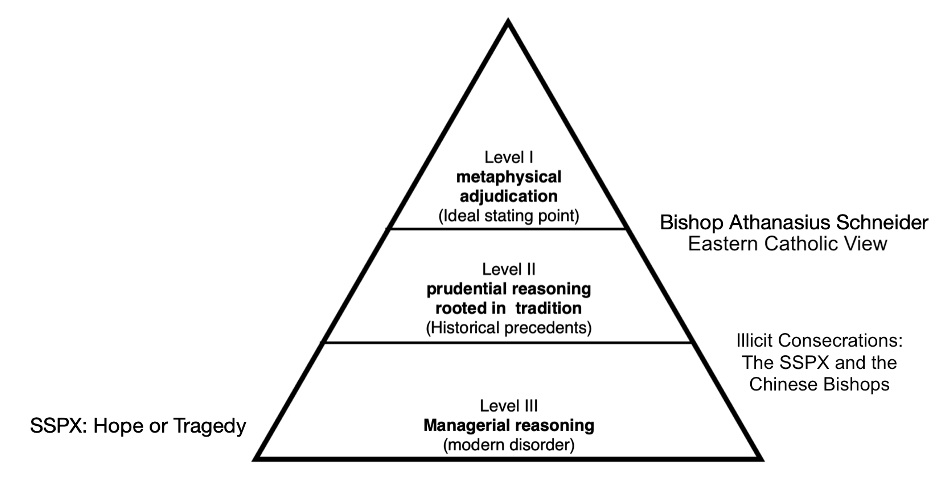
Bishop Athanasius Schneider’s recent appeal regarding the SSPX comes closest to acknowledging the deeper level at which the dispute must ultimately be resolved. While his intervention does not itself attempt a full metaphysical adjudication of the post-Conciliar reforms, it nevertheless explicitly resists reducing the controversy to juridical categories. By criticizing the tendency to elevate the canonical and legal as the supreme criterion and warning against equating disobedience with schism, His Lordship implicitly recognizes that the present debate has inverted the proper order of judgment—and that the question cannot be resolved simply by determining whether a canonical norm has been violated if the doctrinal and theological situation that gave rise to the act remains unexamined. Hence, his assessment of the proposed consecrations remains prudential and proceeds from at least an implicit recognition that a deeper theological question lies beneath the juridical conflict. We will add that the burden of proof and metaphysical adjudication lies with the post-Conciliar hierarchy, since it is they who continue to carry out the changes—a fact underscored even by the expression ‘Conciliar Church,’ a term first used from the Vatican side in the Benelli correspondence.
A second position, presented by an Eastern Catholic defending the reasonableness of the SSPX consecrations, proceeds through historical and canonical precedents. Although it does not begin at the metaphysical level, it avoids structural disorder because such reasoning remains implicitly grounded in the Church’s theological tradition. The argument therefore operates prudentially upon foundations that are ultimately metaphysical, even if not made explicit.
A third position, in “Illicit Consecrations: the SSPX and the Chinese Bishops,” introduces a moral distinction between the external act and the intention behind it. While this reflects a classical principle, the argument remains enclosed within the same canonical framework it assumes. The underlying premise of the SSPX position, a doctrinal crisis arising from Vatican II—is not addressed. As a result, the discussion remains confined to evaluating actors and intentions within a structure whose adequacy is itself in question.
Our figure below more clearly illustrates where these positions lie. His Lordship, Bishop Athanasius Schneider, stands closest to Level I insofar as he explicitly resists reducing the dispute to juridical categories and implicitly recognizes that a deeper theological adjudication must precede canonical judgment. The Eastern Catholic view is just slightly below, able to curb any structural problems (e.g. logical incoherence and instability)—because we might say, their position is latently metaphysical, meaning, their reasoning is prudential but latently grounded in the Church’s metaphysical and theological tradition. The article “Illicit Consecrations: The SSPX and the Chinese Bishops” lies just below the Eastern Catholic view. Although it attempts a form of moral reasoning grounded in classical principles—distinguishing the external act from the intention behind it—it remains enclosed within the existing canonical framework. It does not consider the new situation identified by the SSPX—a doctrinal crisis arising from Vatican II—as it assumes that canonical and juridical categories remain sufficient to adjudicate the matter. The very premise of the SSPX position, however, is that the crisis has placed the Church in circumstances where those categories alone cannot adequately resolve the dispute.
A Final Note
We will end with our summary of a recent response from the SSPX by Father Etienne Ginoux to Cardinal Robert Sarah, who cautioned against the consecrations, calling it an irreversible rupture within the Body of Christ. From one African to another, Fr. Ginoux gives the path to stopping the consecration of bishops: 1) “…we beg you to use your authority, your reputation, and your pen to convince the Holy Father to put an end to the doctrinal, moral, and liturgical crisis through which the Holy Church is passing”; 2) “Then the Society of Saint Pius X will no longer be compelled to ordain bishops without a papal mandate”; and 3) “Then there will be true unity and perfect communion in the Church of God: unity and communion in the faith.”
In other words, end the “doctrinal, moral, and liturgical crisis” in the Church. After sixty years, the structural misordering that has characterized post-Conciliar argumentation (now Conciliar-Synodal) is increasingly evident and yet the crisis it has perpetuated remains unresolved.

No comments:
Post a Comment
Comments are subject to deletion if they are not germane. I have no problem with a bit of colourful language, but blasphemy or depraved profanity will not be allowed. Attacks on the Catholic Faith will not be tolerated. Comments will be deleted that are republican (Yanks! Note the lower case 'r'!), attacks on the legitimacy of Pope Leo XIV as the Vicar of Christ, the legitimacy of the House of Windsor or of the claims of the Elder Line of the House of France, or attacks on the legitimacy of any of the currently ruling Houses of Europe.