From One Peter Five
By Mark Ingoglio
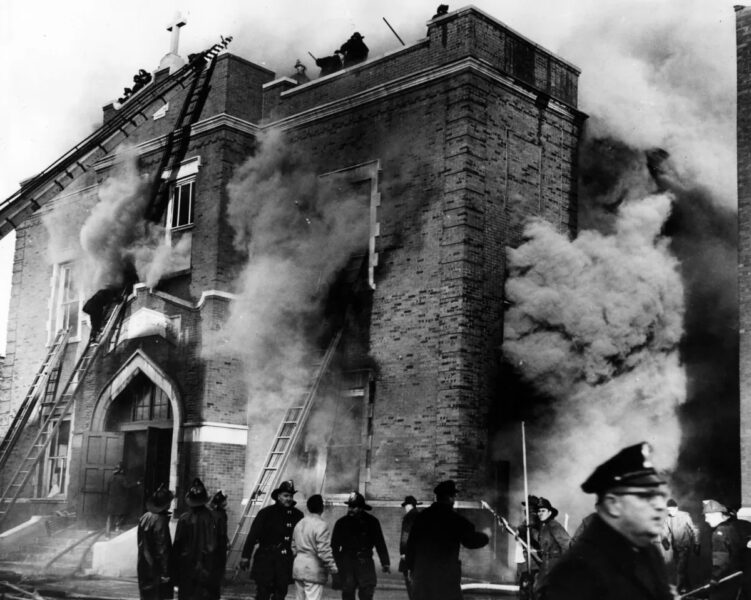
Little Robert Prevost turned three years old about two and a half months before Our Lady of the Angels Catholic School in Chicago’s Humboldt park, some ten miles away, burned and was then demolished. The fire began in a basement stairwell and went undetected for some time before it self-ventilated through a window. That, plus an open door, resulted in rapid fire spread. Ninety-two children died in that fire, along with three sisters whose actions to save them are well-documented. The enrollment of Our Lady of the Angels was about 1200 in the year 1958.
I follow the ongoing story of the SSPX as a traditional Catholic from the periphery. I have never assisted at Holy Mass at a chapel of the Society or sought it out for any other purpose. Since the previous pontiff granted its priests universal faculties to hear confessions, and moreso after the publication of Fr. Charles Murr’s book, Murder in the 33rd Degree, I think I have paid better attention… but I live my traditional Catholic life with the help of secular clergy and that of former Ecclesia Dei religious.
Even now, having promised myself on 8 May 2025 not to concern myself with what the Pope had for breakfast on any given day, I follow the latest installment of the Society’s story concerning the episcopal consecrations, but moreso to learn from select individuals on various sides rather than to offer an impassioned or inevitably-ignorant opinion of my own. It should go without saying, but it cannot be too often said, that prayer is always in order.
One of those select individuals wrote a letter to Pope Leo, and I listened to Tim Flanders read it in full on the OnePeterFive podcast. I was edified by much of what I heard from His Excellency, Bishop Schneider, particularly by his image of a fire chief requiring his firefighters to use or not use certain tools to extinguish a house on fire. On this one particular occasion, I am persuaded to think that I might have something worth contributing to the discussion now underway. Here is His Excellency’s parable:
But the situation in the life of the Church today can be illustrated with the following parable: A fire breaks out in a large house. The fire chief allows only the use of new firefighting equipment, even though it has been shown to be less effective than the old, proven tools. A group of firefighters defies this order and continues to use the tried-and-tested equipment—and indeed, the fire is contained in many places. Yet these firefighters are labelled disobedient and schismatic, and they are punished.
To extend the metaphor further: the fire chief permits only those firefighters who acknowledge the new equipment, follow the new firefighting rules, and obey the new firehouse regulations. But given the obvious scale of the fire, the desperate struggle against it, and the insufficiency of the official firefighting team, other helpers—despite the fire chief’s prohibition—selflessly intervene with skill, knowledge, and good intentions, ultimately contributing to the success of the fire chief’s efforts.
Faced with such rigid and incomprehensible behavior, two possible explanations present themselves: either the fire chief is denying the seriousness of the fire, much like in the French comedy Tout va très bien, Madame la Marquise!; or, in fact, the fire chief desires that large parts of the house burn, so that it may later be rebuilt according to a new design.
If the efforts of the firefighters referred to by Bishop Schneider were successful in their tasks (in a real world scenario), they would be praised as courageous, innovative professionals – as real heroes. If their efforts to save lives and preserve property failed, they would be called to appear at meetings and hearings at several levels of the chain of command. They might be called to testify in civil or criminal proceedings. Their decisions would be documented in an After-Action Report, which would be referenced in OSHA and NIOSH Reports and identified as the primary or contributing factors to the overall success or failure of the operation. These fire service members might be terminated from employment or removed as volunteers. They might be sued; the municipality might even be sued. If firefighters in that district were represented by a union, extensive involvement could be expected from leadership and from the membership in other locals.
After passions died down a bit – long after the general public moved on from the story and whether the efforts of those firefighters were successful or not – the decisions made and tools used would be discussed at fire academies and other small and large scale training venues. They would wind up being something additional to put in the new firefighter’s proverbial tool box, or serve as a cautionary tale. It might even become part of an industry standard.
***
In his “Editor’s Opinion” for Fire Engineering’s August 2018 issue, Chief Bobby Halton (RIP) wrote about those who do and do not have “skin in the game.” Relating a story about a phone call he received from a reporter inquiring about a recent fire, he expressed his frustration with those who, in spite of the professionalism and bravery exhibited by crews, were only interested to know, “how much time is it supposed to take to put water on the fire?” “High authoritarian modernists,” he called these people, interestingly enough.
His frustration was further increased when he discovered the motivation behind the reporter’s question, namely that, “a city official said it’s only supposed to take two minutes.”
That conscientious professionals “innovate, deviate and improvise” rational solutions for the problems before them – this simply does not occur to people who are focused on rules for rules’ sake. In defense of those firefighters who seem to have made a wrong decision, the Chief pointed out that, “We must honor the firefighter who, in context, made a decision they thought would be successful.” Chief Halton, a Catholic firefighter, died of occupational cancer a couple of years back; please remember him to God.
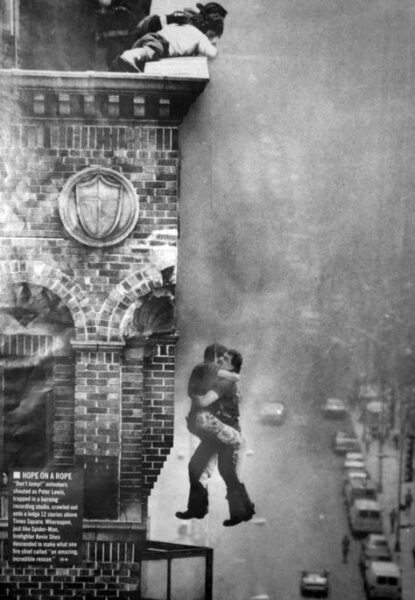
In sum, I think this fire service image is an apt metaphor, and Bishop Schneider’s letter gives us a lot to think about. I pray the Holy Father thinks about it, too. We don’t all have the same role to play in the advance or defense of the Truth, in the saving of life, in the preservation of property. It is obvious that the Church and Her institutions are on fire and that souls are at stake. So, finding and functioning each of us in our own role is the first important task! A willingness to support with fasting, prayer and almsdeeds those who have what seem to be more impactful roles is not out of the question.

No comments:
Post a Comment
Comments are subject to deletion if they are not germane. I have no problem with a bit of colourful language, but blasphemy or depraved profanity will not be allowed. Attacks on the Catholic Faith will not be tolerated. Comments will be deleted that are republican (Yanks! Note the lower case 'r'!), attacks on the legitimacy of Pope Leo XIV as the Vicar of Christ, the legitimacy of the House of Windsor or of the claims of the Elder Line of the House of France, or attacks on the legitimacy of any of the currently ruling Houses of Europe.