St George is honoured in both the East and the West today. Here is his story from both traditions.
From the East:
✠✠✠✠✠
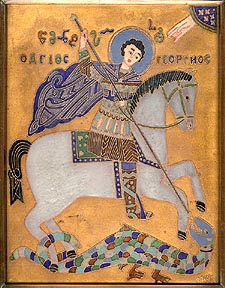
When he became a man, Saint George entered into the service of the Roman army. He was handsome, brave and valiant in battle, and he came to the notice of the emperor Diocletian (284-305) and joined the imperial guard with the rank of comites, or military commander.
The pagan emperor, who did much for the restoration of Roman might, was clearly concerned with the danger presented to pagan civilization by the triumph of the Crucified Saviour, and intensified his persecution against the Christians in the final years of his reign. Following the advice of the Senate at Nicomedia, Diocletian gave all his governors full freedom in their court proceedings against Christians, and he promised them his full support.
Saint George, when he heard the decision of the emperor, distributed all his wealth to the poor, freed his servants, and then appeared in the Senate. The brave soldier of Christ spoke out openly against the emperor’s designs. He confessed himself a Christian, and appealed to all to acknowledge Christ: “I am a servant of Christ, my God, and trusting in Him, I have come among you voluntarily, to bear witness concerning the Truth.”
“What is Truth?” one of the dignitaries asked, echoing the question of Pontius Pilate. The saint replied, “Christ Himself, Whom you persecuted, is Truth.”
Stunned by the bold speech of the valiant warrior, the emperor, who had loved and promoted George, attempted to persuade him not to throw away his youth and glory and honors, but rather to offer sacrifice to the gods as was the Roman custom. The confessor replied, “Nothing in this inconstant life can weaken my resolve to serve God.”
Then by order of the enraged emperor, the armed guards began to push Saint George out of the assembly hall with their spears, and they then led him off to prison. But the deadly steel became soft and it bent, just as the spears touched the saint’s body, and it caused him no harm. In prison, they put the martyr’s feet in stocks and placed a heavy stone on his chest.
The next day at the interrogation, powerless but firm of spirit, Saint George again answered the emperor, “You will grow tired of tormenting me sooner than I will tire of being tormented by you.” Then Diocletian gave orders to subject Saint George to some very intense tortures. They tied the Great Martyr to a wheel, beneath which were boards pierced with sharp pieces of iron. As the wheel turned, the sharp edges slashed the saint’s naked body.
At first, the sufferer loudly cried out to the Lord, but soon he quieted down and did not utter even a single groan. Diocletian decided that the tortured one was already dead, and he gave orders to remove the battered body from the wheel, and then went to a pagan temple to offer thanks.
At this very moment it got dark, thunder boomed, and a voice was heard: “Fear not, George, for I am with you.” Then a wondrous light shone, and at the wheel, an angel of the Lord appeared in the form of a radiant youth. He placed his hand upon the martyr, saying to him, “Rejoice!” Saint George stood up healed.
When the soldiers led him to the pagan temple where the emperor was, the emperor could not believe his own eyes and he thought that he saw before him some other man or even a ghost. In confusion and in terror the pagans looked Saint George over carefully, and they became convinced that a miracle had occurred. Many then came to believe in the Life-Creating God of the Christians.
Two illustrious officials, Saints Anatolius and Protoleon, who were secretly Christians, openly confessed Christ. Immediately, without a trial, they were beheaded with the sword by order of the emperor. Also present in the pagan temple was Empress Alexandra, the wife of Diocletian, and she also knew the truth. She was on the point of glorifying Christ, but one of the servants of the emperor took her and led her off to the palace.
The emperor became even more furious. He had not lost all hope of influencing Saint George, so he gave him over to new and fiercesome torments. After throwing him into a deep pit, they covered it over with lime. Three days later they dug him out, but found him cheerful and unharmed. They shod the saint in iron sandals with red-hot nails, and then drove him back to the prison with whips. In the morning, they led him back to the interrogation, cheerful and with healed feet, and the emperor asked if he liked his shoes. The saint said that the sandals had been just his size. Then they beat him with ox thongs until pieces of his flesh came off and his blood soaked the ground, but the brave sufferer, strengthened by the power of God, remained unyielding.
The emperor concluded that the saint was being helped by magic, so he summoned the sorcerer Athanasius to deprive the saint of his miraculous powers, or else poison him. The sorcerer gave Saint George two goblets containing drugs. One of them would have quieted him, and the other would kill him. The drugs had no effect, and the saint continued to denounce the pagan superstitions and glorify God as before.
When the emperor asked what sort of power was helping him, Saint George said, “Do not imagine that it is any human learning which keeps me from being harmed by these torments. I am saved only by calling upon Christ and His Power. Whoever believes in Him has no regard for tortures and is able to do the things that Christ did” (John 14:12). Diocletian asked what sort of things Christ had done. The Martyr replied, “He gave sight to the blind, cleansed the lepers, healed the lame, gave hearing to the deaf, cast out demons, and raised the dead.”
Knowing that they had never been able to resurrect the dead through sorcery, nor by any of the gods known to him, and wanting to test the saint, the emperor commanded him to raise up a dead person before his eyes. The saint retorted, “You wish to tempt me, but my God will work this sign for the salvation of the people who shall see the power of Christ.”
When they led Saint George down to the graveyard, he cried out, “O Lord! Show to those here present, that You are the only God in all the world. Let them know You as the Almighty Lord.” Then the earth quaked, a grave opened, the dead one emerged from it alive. Having seen with their own eyes the Power of Christ, the people wept and glorified the true God.
The sorcerer Athanasius, falling down at the feet of Saint George, confessed Christ as the All-Powerful God and asked forgiveness for his sins, committed in ignorance. The obdurate emperor in his impiety thought otherwise. In a rage, he commanded both Athanasius and the man raised from the dead to be beheaded, and he had Saint George again locked up in prison.
The people, weighed down with their infirmities, began to visit the prison and they there received healing and help from the saint. A certain farmer named Glycerius, whose ox had collapsed, also visited him. The saint consoled him and assured him that God would restore his ox to life. When he saw the ox alive, the farmer began to glorify the God of the Christians throughout the city. By order of the emperor, Saint Glycerius was arrested and beheaded.
The exploits and the miracles of the Great Martyr George had increased the number of the Christians, therefore Diocletian made a final attempt to compel the saint to offer sacrifice to the idols. They set up a court at the pagan temple of Apollo. On the final night, the holy martyr prayed fervently, and as he slept, he saw the Lord, Who raised him up with His hand and embraced him. The Savior placed a crown on Saint George’s head and said, “Fear not, but have courage, and you will soon come to Me and receive what has been prepared for you.”
In the morning, the emperor offered to make Saint George his co-administrator, second only to himself. The holy martyr with a feigned willingness answered, “Caesar, you should have shown me this mercy from the very beginning, instead of torturing me. Let us go now to the temple and see the gods you worship.”
Diocletian believed that the martyr was accepting his offer, and he followed him to the pagan temple with his retinue and all the people. Everyone was certain that Saint George would offer sacrifice to the gods. The saint went up to the idol, made the Sign of the Cross and addressed it as if it were alive: “Are you the one who wants to receive from me sacrifice befitting God?”
The demon inhabiting the idol cried out, “I am not a god and none of those like me is a god, either. The only God is He Whom you preach. We are fallen angels, and we deceive people because we are jealous.”
Saint George cried out, “How dare you remain here, when I, the servant of the true God, have entered?” Then noises and wailing were heard from the idols, and they fell to the ground and were shattered.
There was general confusion. In a frenzy, pagan priests and many of the crowd seized the holy martyr, tied him up, and began to beat him. They also called for his immediate execution.
The holy empress Alexandra tried to reach him. Pushing her way through the crowd, she cried out, “O God of George, help me, for You Alone are All-Powerful.” At the feet of the Great Martyr, the holy empress confessed Christ, Who had humiliated the idols and those who worshipped them.
Diocletian immediately pronounced the death sentence on the Great Martyr George and the holy Empress Alexandra, who followed Saint George to execution without resisting. Along the way she felt faint and slumped against a wall. There she surrendered her soul to God.
Saint George gave thanks to God and prayed that he would also end his life in a worthy manner. At the place of execution, the saint prayed that the Lord would forgive the torturers who acted in ignorance and that He would lead them to the knowledge of Truth. Calmly and bravely, the holy Great Martyr George bent his neck beneath the sword, receiving the crown of martyrdom on April 23, 303.
The pagan era was coming to an end, and Christianity was about to triumph. Within ten years, Saint Constantine (May 21) would issue the Edict of Milan, granting religious freedom to Christians.
Of the many miracles worked by the holy Great Martyr George, the most famous are depicted in iconography. In the saint’s native city of Beirut were many idol-worshippers. Outside the city, near Mount Lebanon, was a large lake, inhabited by an enormous dragon-like serpent. Coming out of the lake, it devoured people, and there was nothing anyone could do, since the breath from its nostrils poisoned the very air.
On the advice of the demons inhabiting the idols, the local ruler came to a decision. Each day the people would draw lots to feed their own children to the serpent, and he promised to sacrifice his only daughter when his turn came. That time did come, and the ruler dressed her in her finest attire, then sent her off to the lake. The girl wept bitterly, awaiting her death. Unexpectedly for her, Saint George rode up on his horse with spear in hand. The girl implored him not to leave her, lest she perish.
The saint signed himself with the Sign of the Cross. He rushed at the serpent saying, “In the Name of the Father and of the Son and of the Holy Spirit.” Saint George pierced the throat of the serpent with his spear and trampled it with his horse. Then he told the girl to bind the serpent with her sash, and lead it into the city like a dog on a leash.
The people fled in terror, but the saint halted them with the words: “Don’t be afraid, but trust in the Lord Jesus Christ and believe in Him since it is He Who sent me to save you.” Then the saint killed the serpent with a sword, and the people burned it outside the city. Twenty-five thousand men, not counting women and children, were then baptized. Later, a church was built and dedicated to the Most Holy Theotokos and the Great Martyr George.
Saint George went on to become a talented officer and to amaze the world with his military exploits. He died before he was thirty years old. He is known as Victory Bearer, not only for his military achievements but for successfully enduring martyrdom. As we know, the martyrs are commemorated in the dismissal at the end of Church services as “the holy, right victorious martyr....”
Saint George was the patron saint and protector of several of the great builders of the Kyivan Rus' state. Saint Volodymyr’s son, Yaroslav the Wise (in holy Baptism George), advanced the veneration of the saint in the Rus' Church. He built the city of Yuriev [i.e., “of Yurii.” “Yurii” is the diminutive of “George”, as “Ivan” is of “John”], he also founded the Yuriev monastery at Novgorod, and he built a church of Saint George the Victory Bearer at Kyiv.
The day of the consecration of Saint George’s Church in Kyiv, November 26, 1051, by Saint Hilarion, Metropolitan of Kyiv and All Rus', has entered into the liturgical treasury of the Church as a special church feast day. Yuriev Day is beloved by the Russian people as an “autumn Feast of Saint George.”
You were bound for good deeds, O martyr of Christ: George; / by faith you conquered the torturer’s godlessness. / You were offered as a sacrifice pleasing to God; / thus you received the crown of victory. / Through your intercessions, forgiveness of sins is granted to all.
Kontakion — Tone 4
God raised you as his own gardener, O George, / for you have gathered for yourself the sheaves of virtue. / Having sown in tears, you now reap with joy; / you shed your blood in combat and won Christ as your crown. / Through your intercessions, forgiveness of sins is granted to all.
From the West:

From The Golden Legend of Blessed Jacobus Voragine, translated by William Caxton in 1483.
ST. GEORGE AND THE DRAGON
St George was a knight and born in Cappadocia. On a time he came in to the province of Libya, to a city which is said Silene. And by this city was a stagne or a pond like a sea, wherein was a dragon which envenomed all the country. And on a time the people were assembled for to slay him, and when they saw him they fled. And when he came nigh the city he venomed the people with his breath, and therefore the people of the city gave to him every day two sheep for to feed him, because he should do no harm to the people, and when the sheep failed there was taken a man and a sheep.Then was an ordinance made in the town that there should be taken the children and young people of them of the town by lot, and every each one as it fell, were he gentle or poor, should be delivered when the lot fell on him or her. So it happed that many of them of the town were then delivered, insomuch that the lot fell upon the king's daughter, whereof the king was sorry, and said unto the people: For the love of the gods take gold and silver and all that I have, and let me have my daughter.
They said: How sir! ye have made and ordained the law, and our children be now dead, and ye would do the contrary. Your daughter shall be given, or else we shall burn you and your house.
When the king saw he might no more do, he began to weep, and said to his daughter: Now shall I never see thine espousals.
Then returned he to the people and demanded eight days' respite, and they granted it to him. And when the eight days were passed they came to him and said: Thou seest that the city perisheth.
Then did the king do array his daughter like as she should be wedded, and embraced her, kissed her and gave her his benediction, and after led her to the place where the dragon was.
When she was there St. George passed by, and when he saw the lady he demanded the lady what she made there and she said: Go ye your way fair young man, that ye perish not also.
Then said he: Tell to me what have ye and why weep ye, and doubt ye of nothing.
When she saw that he would know, she said to him how she was delivered to the dragon. Then said St. George: Fair daughter, doubt ye no thing hereof for I shall help thee in the name of Jesu Christ.
She said: For God's sake, good knight, go your way, and abide not with me, for ye may not deliver me.
Thus as they spake together the dragon appeared and came running to them, and St. George was upon his horse, and drew out his sword and garnished him with the sign of the cross, and rode hardily against the dragon which came towards him, and smote him with his spear and hurt him sore and threw him to the ground. And after said to the maid: Deliver to me your girdle, and bind it about the neck of the dragon and be not afeard.
When she had done so the dragon followed her as it had been a meek beast and debonair. Then she led him into the city, and the people fled by mountains and valleys, and said: Alas! alas! we shall be all dead.
Then St. George said to them: Ne doubt ye no thing, without more, believe ye in God, Jesu Christ, and do ye to be baptized and I shall slay the dragon.
Then the king was baptized and all his people, and St. George slew the dragon and smote off his head, and commanded that he should be thrown in the fields, and they took four carts with oxen that drew him out of the city.
Then were there well fifteen thousand men baptized, without women and children, and the king did do make a church there of our Lady and of St. George, in the which yet sourdeth a fountain of living water, which healeth sick people that drink thereof. After this the king offered to St. George as much money as there might be numbered, but he refused all and commanded that it should be given to poor people for God's sake; and enjoined the king four things, that is, that he should have charge of the churches, and that he should honour the priests and hear their service diligently, and that he should have pity on the poor people, and after, kissed the king and departed.
THE ARREST AND TORTURE OF ST. GEORGE
Now it happed that in the time of Diocletian and Maximian, which were emperors, was so great persecution of Christian men that within a month were martyred well twenty-two thousand, and therefore they had so great dread that some renied and forsook God and did sacrifice to the idols. When St. George saw this, he left the habit of a knight and sold all that he had, and gave it to the poor, and took the habit of a Christian man, and went into the middle of the paynims and began to cry: All the gods of the paynims and gentiles be devils, my God made the heavens and is very God.Then said the provost to him: Of what presumption cometh this to thee, that thou sayest that our gods be devils? And say to us what thou art and what is thy name.
He answered anon and said: I am named George, I am a gentleman, a knight of Cappadocia, and have left all for to serve the God of heaven.
Beaten and Imprisoned
Then the provost enforced himself to draw him unto his faith by fair words, and when he might not bring him thereto he did do raise him on a gibbet; and so much beat him with great staves and broches of iron, that his body was all tobroken in pieces. And after he did do take brands of iron and join them to his sides, and his bowels which then appeared he did do frot with salt, and so sent him into prison. But our Lord appeared to him the of same night with great light and comforted him much sweetly. And by this great consolation he took to him so good heart that he doubted no torment that they might make him suffer.The Poisoned Wine
Then, when Dacian the provost saw that he might not surmount him, he called his enchanter and said to him: I see that these Christian people doubt not our torments.The enchanter bound himself, upon his head to be smitten off, if he overcame not his crafts. Then he did take strong venom and meddled it with wine, and made invocation of the names of his false gods, and gave it to St. George to drink. St. George took it and made the sign of the cross on it, and anon drank it without grieving him any thing. Then the enchanter made it more stronger than it was tofore of venom, and gave it him to drink, and it grieved him nothing. When the enchanter saw that, he kneeled down at the feet of St. George and prayed him that he would make him Christian. And when Dacian knew that he was become Christian he made to smite off his head.
The Cutting Wheels
And after, on the morn, he made St. George to be set between two wheels, which were full of swords, sharp and cutting on both sides, but anon the wheels were broken and St. George escaped without hurt.The Cauldron of Molten Lead
And then commanded Dacian that they should put him in a caldron full of molten lead, and when St. George entered therein, by the virtue of our Lord it seemed that he was in a bath well at ease.The Lord Destroys the Temple
Then Dacian seeing this began to assuage his ire, and to flatter him by fair words, and said to him: George, the patience of our gods is over great unto thee which hast blasphemed them, and done to them great despite, then fair, and right sweet son, I pray thee that thou return to our law and make sacrifice to the idols, and leave thy folly, and I shall enhance thee to great honour and worship.Then began St. George to smile, and said to him: Wherefore saidst thou not to me thus at the beginning? I am ready to do as thou sayest.
Then was Dacian glad and made to cry over all the town that all the people should assemble for to see George make sacrifice which so much had striven there against. Then was the city arrayed and feast kept throughout all the town, and all came to the temple for to see him.
When St. George was on his knees, and they supposed that he would have worshipped the idols, he prayed our Lord God of heaven that he would destroy the temple and the idol in the honour of his name, for to make the people to be converted. And anon the fire descended from heaven and burnt the temple, and the idols, and their priests, and sith the earth opened and swallowed all the cinders and ashes that were left.
Then Dacian made him to be brought tofore him, and said to him: What be the evil deeds that thou hast done and also great untruth?
Then said to him St. George: Ah, sir, believe it not, but come with me and see how I shall sacrifice.
Then said Dacian to him: I see well thy fraud and thy barat, thou wilt make the earth to swallow me, like as thou hast the temple and my gods.
Then said St. George: O caitiff, tell me how may thy gods help thee when they may not help themselves!
The Conversion of Dacian’s Wife
Then was Dacian so angry that he said to his wife: I shall die for anger if I may not surmount and overcome this man.Then said she to him: Evil and cruel tyrant! ne seest thou not the great virtue of the Christian people? I said to thee well that thou shouldst not do to them any harm, for their God fighteth for them, and know thou well that I will become Christian.
Then was Dacian much abashed and said to her: "Wilt thou be Christian?" Then he took her by the hair, and did do beat her cruelly.
Then demanded she of St. George: What may I become because I am not christened?
Then answered the blessed George: Doubt thee nothing, fair daughter, for thou shalt be baptized in thy blood.
Then began she to worship our Lord Jesu Christ, and so she died and went to heaven.
ST. GEORGE IS MARTYRED
On the morn Dacian gave his sentence that St. George should be drawn through all the city, and after his head should be smitten off.Then made he his prayer to our Lord that all they that desired any boon might get it of our Lord God in his name, and a voice came from heaven which said that it which he had desired was granted; and after he had made his orison his head was smitten off, about the year of our Lord two hundred and eighty-seven.
When Dacian went homeward from the place where he was beheaded towards his palace, fire fell down from heaven upon him and burnt him and all his servants.
MIRACLES OF ST. GEORGE
Gregory of Tours telleth that there were some that bare certain relics of St. George, and came into a certain oratory in a hospital, and on the morning when they should depart they could not move the door till they had left there part of their relics.It is also found in the history of Antioch, that when the Christian men went over sea to conquer Jerusalem, that one, a right fair young man, appeared to a priest of the host and counselled him that he should bear with him a little of the relics of St. George, for he was conductor of the battle, and so he did so much that he had some. And when it was so that they had assieged Jerusalem and durst not mount ne go up on the walls for the quarrels and defence of the Saracens, they saw appertly St. George which had white arms with a red cross, that went up tofore them on the walls, and they followed him, and so was Jerusalem taken by his help.
And between Jerusalem and port Jaffa, by a town called Ramys, is a chapel of St. George which is now desolate and uncovered, and therein dwell Christian Greeks. And in the said chapel lieth the body of St. George, but not the head. And there lie his father and mother and his uncle, not in the chapel but under the wall of the chapel; and the keepers will not suffer pilgrims to come therein, except if, unless they pay two ducats, and therefore come but few therein, but offer without the chapel at an altar. And there is seven years and seven lents of pardon; and the body of St. George lieth in the middle of the quire or choir of the said chapel, and in his tomb is an hole that a man may put in his hand. And when a Saracen, being mad, is brought thither, and if he put his head in the hole he shall anon be made perfectly whole, and have his wit again.
This blessed and holy martyr St. George is patron of this realm of England and the cry of men of war. In the worship of whom is founded the noble order of the garter, and also a noble college in the castle of Windsor by kings of England, in which college is the heart of St. George, which Sigismund, the emperor of Almayne, brought and gave for a great and a precious relique to King Harry the fifth. And also the said Sigismund was a brother of the said garter, and also there is a piece of his head, which college is nobly endowed to the honour and worship of Almighty God and his blessed martyr St. George. Then let us pray unto him that he be special protector and defender of this realm.

No comments:
Post a Comment
Comments are subject to deletion if they are not germane. I have no problem with a bit of colourful language, but blasphemy or depraved profanity will not be allowed. Attacks on the Catholic Faith will not be tolerated. Comments will be deleted that are republican (Yanks! Note the lower case 'r'!), attacks on the legitimacy of Pope Leo XIV as the Vicar of Christ, the legitimacy of the House of Windsor or of the claims of the Elder Line of the House of France, or attacks on the legitimacy of any of the currently ruling Houses of Europe.