Unfortunately, the Rite of Blessing Holy Water was gutted in the post-Conciliar era. Compare this from the Rituale Roman with the prayer below.

From Aleteia
By Philip Kosloski
And can I get some holy water for myself? If so, how?
One of the most common sacramentals that many Catholics (and non-Catholics) are familiar with is holy water. It is often used in exorcist movies and sometimes priests can be seen using it in public -- such as blessing a football field.
But where does this water come from? What makes it special? Do priests have a tap that provides them holy water?
What is it?
Holy water is classified as a sacramental in the Catholic Church. One way to describe sacramentals is that they are extensions of the sacraments.
Sacramentals are not sacraments in themselves, but are related to the seven sacraments as sources of grace and flow from them, ultimately leading us back to them.
Sacramentals can be many different things, but always set apart or blessed by the Church for the purpose of sanctifying our lives and leading us to the sacraments. They are sacred signs and provide for us grace (spiritual help) through the intercession of the Church.
Other examples of sacramentals are: rosaries, crucifixes, statues, medals (including medals worn by the faithful), scapulars, blessed candles, and the ashes we receive on Ash Wednesday or the palms distributed on Palm Sunday.
How holy water is made
Holy water in particular is a sacramental that requires the blessing of a priest or deacon. The prayers invoke the power of God to permeate the water to be blessed, ultimately blessing the people who encounter it.
For example, here is the current prayer of blessing from the Book of Blessings:
Blessed are you, Lord, all-powerful God,
who in Christ, the living water of salvation,
blessed and transformed us.
Grant that when we are sprinkled with this water
or make use of it,
we will be refreshed inwardly by the power
of the Holy Spirit
and continue to walk in the new life
we received at Baptism.
The blessing makes it clear that it is the people who are receiving the grace, and that grace leads us back to the sacrament of Baptism.
To make holy water, a priest will use any clean water and say this or a similar blessing over it, and make the Sign of the Cross.
How can I get some?
Most churches have holy water in the entrance way so that the faithful can make the Sign of the Cross with a finger dipped in the water as they enter the church. This is a reminder of our baptism, which brought us into the family of God and made the Church our home.
Many of the faithful like to keep holy water in their homes and have small fonts from which the faithful can dip a finger into the water and then make the Sign of the Cross.
You can ask your parish priest to bless a bottle of water to keep in your home for this purpose.
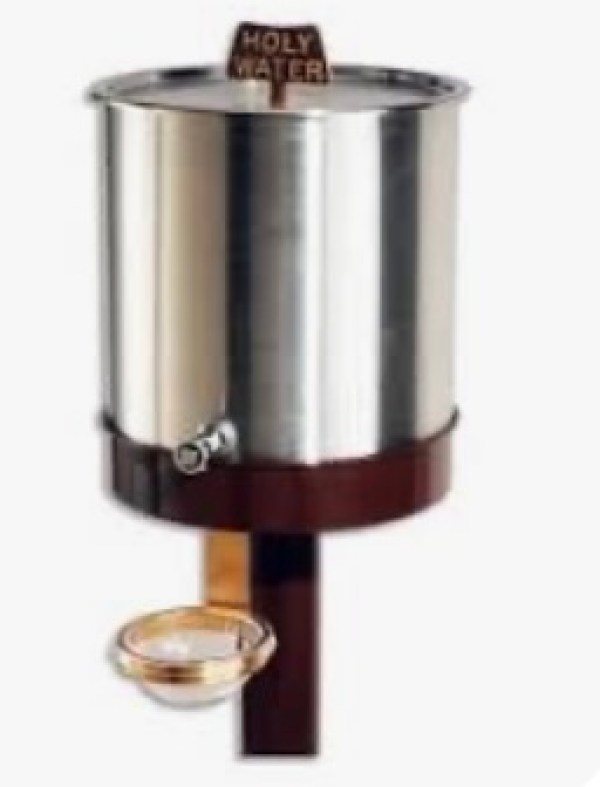
As well, many parishes have a canister with holy water available for the faithful to take home. This might be stationed in a separate room, especially if you have a baptismal chapel. It will likely have a spigot from which you can fill your bottles.
Spiritual symbolism
Sometimes salt is added as a purifier, as in this alternative blessing from the Roman Ritual:
God, source of irresistible might and king of an invincible realm, the ever-glorious conqueror; who restrain the force of the adversary, silencing the uproar of his rage, and valiantly subduing his wickedness; in awe and humility we beg you, Lord, to regard with favor this creature thing of salt and water, to let the light of your kindness shine upon it, and to hallow it with the dew of your mercy; so that wherever it is sprinkled and your holy name is invoked, every assault of the unclean spirit may be baffled, and all dread of the serpent’s venom be cast out. To us who entreat your mercy grant that the Holy Spirit may be with us wherever we may be, through Christ our Lord.
Both blessings recall the inherent symbolism of water and how it is used as a cleansing agent.
Holy water is both a conduit for God's grace, and a reminder of our Baptism, calling to mind how God washes us clean, and brings us closer to him.

No comments:
Post a Comment
Comments are subject to deletion if they are not germane. I have no problem with a bit of colourful language, but blasphemy or depraved profanity will not be allowed. Attacks on the Catholic Faith will not be tolerated. Comments will be deleted that are republican (Yanks! Note the lower case 'r'!), attacks on the legitimacy of Pope Leo XIV as the Vicar of Christ, the legitimacy of the House of Windsor or of the claims of the Elder Line of the House of France, or attacks on the legitimacy of any of the currently ruling Houses of Europe.