
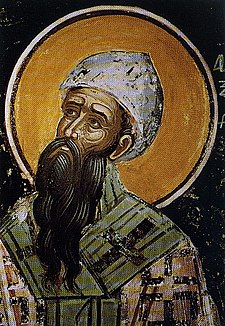
As Patriarch of Jerusalem, Saint Cyril zealously fought against the heresies of Arius and Macedonius. In so doing, he aroused the animosity of the Arian bishops, who sought to have him deposed and banished from Jerusalem.
There was a miraculous portent in 351 at Jerusalem: at the third hour of the day on the Feast of Pentecost, the Holy Cross appeared in the heavens, shining with radiant light. It stretched from Golgotha above the Mount of Olives. Saint Cyril reported this portent to the Arian emperor Constantius (351-363), hoping to convert him to Catholicism.
The heretic Acacius, deposed by the Council of Sardica, was formerly the Metropolitan of Caesarea, and he collaborated with the emperor to have Saint Cyril removed. An intense famine struck Jerusalem, and Saint Cyril expended all his wealth in charity. But since the famine did not abate, the saint pawned church utensils, and used the money to buy wheat for the starving. The saint’s enemies spread a scandalous rumour that they had seen a woman in the city dancing around in clerical garb. Taking advantage of this rumour, the heretics forcibly expelled the saint.
The saint found shelter with Bishop Silvanus in Tarsus. After this, a local Council was held at Seleucia, at which there were about 150 bishops, and among them Saint Cyril. The heretical Metropolitan Acacius did not want to allow him to take a seat, but the Council would not consent to this. Acacius stormed out of the Council, and before the emperor and the Arian patriarch Eudoxius, he denounced both the Council and Saint Cyril. The emperor had the saint imprisoned.
When the emperor Julian the Apostate (361-363) ascended the throne he repealed all the anti-Catholic decrees of Constantius, seemingly out of piety. Saint Cyril returned to his own flock. But after a certain while, when Julian had become secure upon the throne, he openly apostatised and renounced Christ. He permitted the Jews to start rebuilding the Temple of Jerusalem that had been destroyed by the Romans, and he even provided them part of the funds for the building from the state treasury.
Saint Cyril predicted that the words of the Saviour about the destruction of the Temple down to its very stones (Luke. 21:6) would undoubtedly transpire, and the blasphemous intent of Julian would come to naught. Soon there was such a powerful earthquake, that even the solidly set foundation of the ancient Temple of Solomon shifted in its place, and what had been rebuilt fell down and shattered into dust. When the Jews resumed construction, fire came down from the heavens and destroyed the tools of the workmen. Great terror seized everyone. On the following night, the Sign of the Cross appeared on the clothing of the Jews, which they could not remove by any means.
After this heavenly confirmation of Saint Cyril’s prediction, they banished him again, and the bishop’s throne was occupied by Saint Cyriacus. But Saint Cyriacus soon suffered a martyr’s death (October 28).
After the emperor Julian perished in 363, Saint Cyril returned to his See, but during the reign of the emperor Valens (364-378) he was exiled for a third time. It was only under the holy emperor Saint Theodosius the Great (379-395) that he finally returned to his archpastoral activity. In 381 Saint Cyril participated in the Second Ecumenical Council, which condemned the heresy of Macedonius and affirmed the Nicea-Constantinople Symbol of Faith (Creed).
Saint Cyril’s works include twenty-three Instructions (Eighteen are Catechetical, intended for those preparing for Baptism, and five are for the newly-baptized) and two discourses on Gospel themes: “On the Paralytic,” and “Concerning the Transformation of Water into Wine at Cana.”
At the heart of the Catechetical Instructions is a detailed explanation of the Symbol of Faith. The saint suggests that a Christian should inscribe the Symbol of Faith upon “the tablets of the heart.”
“The articles of the Faith,” Saint Cyril teaches, “were not written through human cleverness, but they contain everything that is most important in all the Scriptures, in a single teaching of faith. Just as the mustard seed contains all its plethora of branches within its small kernel, so also does the Faith in its several declarations combine all the pious teachings of the Old and the New Testaments.”
Saint Cyril, a great ascetic and a champion of the Catholic Faith, died in the year 386.
Troparion — Tone 8
You were seen in Zion clothed in a robe of godliness / as an illustrious pillar of the Apostles’ faith. / You became an heir to their grace, / setting forth their pious doctrines / and dispensing their talents of wisdom. / O Cyril, our Father and hierarch, pray for us.
Kontakion — Tone 1
With your lips, O wise Cyril, / and through divine inspiration / you enlightened your people / to the worship of the one Trinity, / undivided in essence, yet divided in Hypostases. / Wherefore rejoicing, we celebrate your all-holy memory, / offering you as our intercessor before God.
ST. CYRIL was raised by God to defend the faith of the Incarnation of his Son, “of which mystery he is styled the doctor, as St. Austin is of that grace,” says Thomassin. He studied under his uncle Theophilus, and testifies 1 that he made it his rule never to advance any doctrine which he had not learned from the ancient Fathers. His books against Julian the Apostate show that he had read the profane writers. He often says himself that he neglected human eloquence: and it is to be wished that he had wrote in a clearer style, and with greater purity of the Greek tongue. Upon the death of Theophilus, in 412, he was raised by the people to the patriarchal dignity. He began to exert his authority by causing the churches of the Novatians in the city to be shut up, and their sacred vessels and ornaments to be seized; an action censured by Socrates, a favourer of those heretics; but we do not know the reasons and authority upon which he proceeded. He next drove the Jews out of the city, who were very numerous, and enjoyed great privileges there from the time of Alexander the Great. Seditions and several acts of violence committed by them excited him to this, which grievously offended Orestes the governor, but was approved by the emperor Theodosius: and the Jews never returned. St. Cyril sent to conjure the governor by the holy gospels that he would consent to a reconciliation, and that he would join in sincere friendship with him: but his offers were rejected. This unhappy disagreement produced pernicious effects. Hypatia, a pagan lady, kept a public school of philosophy in the city. Her reputation for learning was so great, that disciples flocked to her from all parts. Among these was the great Synesius, who afterwards submitted his works to her censure. She was consulted by philosophers of the first rank on the most intricate points of learning, and of the Platonic philosophy in particular, in which she was remarkably well versed. 2 She was much respected and consulted by the governor, and often visited him. The mob, which was no where more unruly or more fond of riots and tumults than in that populous city, the second in the world for extent, upon a suspicion that she incensed the governor against their bishop, seditiously rose, pulled her out of her chariot, cut and mangled her flesh, and tore her body in pieces in the streets, in 415, to the great grief and scandal of all good men, especially of the pious bishop. 3 He had imbibed certain prejudices from his uncle against the great St. Chrysostom: but was prevailed on by St. Isidore of Pelusium and others to insert his name in the Dyptics of his church, in 419: after which, pope Zozimus, sent him letters of communion. 4 1
Nestorius, a monk and priest of Antioch, was made bishop of Constantinople in 428. The retiredness and severity of his life, joined with a hypocritical exterior of virtue, a superficial learning, and a fluency of words, gained him some reputation in the world. But being full of self-conceit, he neglected the study of the Fathers, was a man of weak judgment, extremely vain, violent, and obstinate. This is the character he bears in the history of those times, and which is given him by Socrates, and also by Theodoret, whom he had formerly imposed upon by his hypocrisy. Marius Mercator informs us that he was no sooner placed in the episcopal chair, but he began to persecute with great fury, the Arians, Macedonians, Manichees, and Quartodecimans, whom he banished out of his diocess. But though he taught original sin, he is said to have denied the necessity of grace; on which account he received to his communion Celestius and Julian, who had been condemned by the popes Innocent and Zozimus, and banished out of the West by the emperor Honorius, for Pelagianism. Theodosius obliged them to leave Constantinople, notwithstanding the protection of the bishop. Nestorius and his mercenary priests broached also new errors from the pulpit, teaching two distinct persons in Christ, that of God, and that of man, only joined by a moral union, by which he said the Godhead dwelt in the humanity merely as in its temple. Hence he denied the Incarnation, or that God was made man; and said the Blessed Virgin ought not to be styled the mother of God, but of the man who was Christ, whose humanity was only the temple of the divinity, not a nature hypostatically assumed by the divine Person; though at length convicted by the voice of antiquity, he allowed her the title of mother of God, but continued to deny the mystery. The people were shocked at these novelties, and the priests, St. Proclus, Eusebius, afterwards bishop of Dorylæum, and others, separated themselves from his communion, after having attempted in vain to reclaim him by remonstrances. His homilies, wherever they appeared, gave great offence, and excited every where clamours against the errors and blasphemies they contained. St. Cyril having read them, sent him a mild expostulation on the subject, but was answered with haughtiness and contempt, Pope Celestine, being applied to by both parties, examined his doctrine in a council at Rome: condemned it, and pronounced a sentence of excommunication and deposition against the author, unless within ten days after notification of the sentence, he publicly condemned and retracted it, appointing St. Cyril as his vicegerent in this affair, to see that the sentence was put in execution. 5 Our saint, together with his third and last summons, sent Nestorius twelve propositions with anathemas, hence called anathematisms, to be signed by him as proof of his orthodoxy, but the heresiarch appeared more obstinate than ever. This occasioned the calling of the third general council opened at Ephesus, in 431, by two hundred bishops, with St. Cyril at their head, as pope Celestine’s legate and representative. 6 Nestorius, though in the town, and thrice cited, refused to appear. His heretical sermons were read, and depositions received against him, after which his doctrine was condemned, and the sentence of excommunication and deposition was pronounced against him and notified to the emperor. 2
Six days after, John, patriarch of Antioch, arrived at Ephesus with forty-one oriental bishops; who secretly favouring the person, but not the errors, of Nestorius, of which they deemed him innocent, had advanced but slowly on their journey to the place. Instead of associating with the council, they assembled by themselves, and presumed to excommunicate St. Cyril and his adherents. Both sides had recourse to the emperor for redress, by whose order, soon after, St. Cyril and Nestorius were both arrested and confined, but our saint the worst treated of the two. Nay, through his antagonist’s greater interest at court, he was upon the point of being banished, when three legates from Pope Celestine, Arcadius and Projectus, bishops, and Philip, a priest, arrived at Ephesus, which gave a new turn to affairs in our saint’s favour. The three new legates having considered what had been done under St. Cyril, the condemnation of Nestorius was confirmed, the saint’s conduct approved, and the sentence pronounced against him declared null and invalid. Thus, matters being cleared up, he was enlarged with honour. The Orientals, indeed, continued their schism till 433, when they made their peace with St. Cyril, condemned Nestorius, and gave a clear and orthodox exposition of their faith. That heresiarch, being banished from his see, retired to his monastery in Antioch. John, though formerly his friend, yet finding him very perverse and obstinate in his heresy, and attempting to pervert others, entreated the emperor Theodosius to remove him. He was therefore banished to Oasis, in the deserts of Upper Egypt, on the borders of Libya, in 431, and died miserably and impenitent in his exile. His sect remains to this day very numerous in the East. 7 St. Cyril triumphed over this heresiarch by his meekness, intrepidity, and courage; thanking God for his sufferings, and professing himself ready to spill his blood with joy for the gospel. 8 He arrived at Alexandria on the 30th of October, 431, and spent the remainder of his days in maintaining the faith of the church in its purity, in promoting peace and union among the faithful, and the zealous labours of his pastoral charge, till his glorious death in 444, on the 28th of June, that is, the 3rd of the Egyptian month Epiphi, as the Alexandrians, the Copts, and the Ethiopians unanimously affirm, who by abridging his name call him Kerlos, and gave him the title of Doctor of the world. The Greeks keep the 18th of January in his honour; and have a second commemoration of him again on the 9th of June. 9 The Roman Martyrology mentions him on this day. Pope Celestine styles him, “The generous defender of the church and faith, the Catholic doctor, and an apostolical man.” 10 3
The extraordinary devotion of this holy doctor towards the holy sacrament appears from the zeal with which he frequently inculcates the glorious effects which it produces in the soul of him who worthily receives it, especially in healing all his spiritual disorders, strengthening him against temptations, subduing the passions, giving life, and making us one with Christ by the most sacred union, not only in spirit, but also with his humanity. 11 Hence this father says that by the holy communion we are made concorporeal with Christ. The eminent dignity and privileges of the ever glorious Virgin Mary were likewise a favourite subject on which he often dwells. In his tenth homily, 12 after having often repeated her title of Mother of God, he thus salutes her: “Hail, O Mary, mother of God, rich treasure of the world, 13 inextinguishable lamp, crown of virginity, sceptre of the true doctrine, temple which cannot fall, the residence of him whom no place can contain, Mother and Virgin, by whom He is who cometh Blessed in the name of the Lord. Hail Mary, who in your virgin womb contained Him who is immense and incomprehensible: You, through whom the whole blessed Trinity is glorified and adored, through whom the precious cross is honoured and venerated over the whole world, through whom heaven exults, the angels and archangels rejoice, the devils are banished, the tempter is disarmed, the creature that was fallen is restored to heaven, and comes to the knowledge of the truth, through whom holy baptism is instituted, through whom is given the oil of exultation, through whom churches are founded over the whole earth, through whom nations are brought to penance. And what need of more words? Through whom the only begotten Son of God has shone the light to those who sat in darkness and in the shade of death, &c. What man can celebrate the most praiseworthy Mary according to her dignity?” 4
Note 1. Ep. 56. and 35. apud Lupum. [back]
Note 2. Synesius, ep. 153. [back]
Note 3. Vie d’Hypacie par l’abbé Goujet. Mémoires de Litérature, T. 5.
It is very unjust in some moderns to charge him as conscious of so horrible a crime, which shocks human nature. Great persons are never to be condemned without proofs which amount to conviction. The silence of Orestes, and the historian Socrates, both his declared enemies, suffices to acquit him. [back]
Note 4. We have nothing further of the life of this father, until the year 428, when his zeal was first exerted in defence of the faith against Nestorianism: we shall introduce this period of his labours, with some account of the author of this heresy. [back]
Note 5. Conc. T. 3. p. 343. Liberat. in Breviar. c. 4. [back]
Note 6. St. Leo, Ep. 72. c. 3. Conc. T. 3. p. 656. 980. [back]
Note 7. They have a liturgy under the name of Nestorius, and two others which they pretend to be still more ancient. See Renaudot, liturg. orient. T. 2. and Le Brun, liturg. T. 3. The former contains a clear profession of transubstantiation and the sacrifice of the mass. [back]
Note 8. Ep. ad Theopomp. T. 3. Conc. p. 771. [back]
Note 9. Smith on the present state of the Greek church, p. 13. Thomassin Tr. des Fêtes, l. 1. ch. 7. [back]
Note 10. Conc. T. 3. p. 1077. [back]
Note 11. L. 4. contra Nestor. T. 6. parte 1. p. 110. l. 7. de adoratione in spiritu et verit. T. 1. p. 231. l. 10. in Joan. T. 4. c. 13. [back]
Note 12. T. 5. parte 2. p. 380. Item Conc. T. 3. p. 583. [back]
Note 13. [Greek]. The rich furniture of the world. [back]

It was right that the Church should honor, during these days devoted to the instruction of catechumens, the Pontiff whose very name suggests the zeal and knowledge which pastors ought to show in preparing candidates for baptism. He has long had a place in the Martyrology of the Western Church, but today, in addition to expressing our gratitude for what he did fifteen hundred years ago, we ask him for aid, which is as necessary now as it was in the first ages of Christianity. It is true that baptism is now administered to infants. The gift of faith then infused puts man in possession of all truth before his intelligence has ever met with falsehood. But it too often happens in our days that children are deprived of the protection their weakness really needs. Modern society has denied Jesus Christ, and strives by the hypocritical neutrality of its laws to stifle the divine seed in the baptized soul before it can grow and bear fruit. Baptism, however, has its rights with regard to society as well as with regard to the individual, and our best way of honoring St. Cyril is to remind ourselves on his feast that this first Sacrament has just claims in respect of the education due to the baptized.
For fifteen centuries the western nations, whose social fabric rested on the solid rock of the faith of Rome, have enjoyed a happy ignorance of the difficulties experienced by a soul in rising out of the abyss of error into the pure light of the truth. Our fathers, like ourselves, were baptized at their entrance into this world. They had, moreover, an advantage which we have not, for, in their day, the civil power joined with the Church to protect that plenitude of truth which was the greatest treasure of men, and the safeguard of the world. The protection of individuals is a duty binding upon all princes and rulers, whatever be their title, and this duty is greater in proportion to the interests to be safeguarded. But this protection gives greater glory to the power which exercises it when it is extended to the lowly and weak. The law of man never appears more majestic than when standing beside a little child—a new-born babe or a defenseless orphan—to protect its name, its life or its inheritance. A newly baptized child possesses advantages greater than all those given by noble birth, money, or the richest natural gifts. He has a divine life within him; he is the equal of the angels in virtue of his name of Christian; his inheritance is that plenitude of truth of which we spoke above—God Himself, possessed by faith here below until the beatific vision opens out the possession of eternal love. What greatness there is in a little child! But what a responsibility for the world! If God does not wait for the age of reason before bestowing His gifts, this sublime haste is due to the impatience of His love, but at the same time He counts upon men to reveal in due time their dignity to these children of heaven, to form them to the duties incumbent on them, and to educate them in a way befitting their divine lineage. The education of a king’s son corresponds to the dignity of his birth, and those who have the honor of being his tutors never forget that he is a prince. Instructions, common to all, are presented to him in a way which harmonizes with his exalted destiny, and everything is directed to rendering him capable of wearing his crown with glory. Does the education of a child of God need less care? It is right that his teachers should forget his birth and his destiny?
It is true that the Church alone can explain to us the ineffable origin of the sons of God. She alone knows how to use the elements of human knowledge for the supreme end which dominates the life of a Christian. The natural conclusion is that the Church is by right the first and principal teacher of the nations. When she founds schools, she is on her own ground in all branches of knowledge, and a mission to teach from her is of more value than any diploma. Further, with regard to diplomas, which she herself has not conferred, these official commissions to teach draw their legal value, in the eyes of Christians, from her approval, and they are always by right subject to her supervision. She is the mother of the baptized, and even when a mother does not teach her own children, she has the right to supervise their education.
But the Church is not only the Mother of the Faithful, she is the Bride of the Son of God and the guardian of His sacraments. It is her duty to see that the Precious Blood has not been shed in vain. Our Lord has entrusted these seven fountains to the care of the ministers of His Church, and they must not be opened except when there is good reason to hope that the sacramental grace will be well used. Baptism especially, which raises man out of his own nothingness to a supernatural nobility, must be safeguarded in its administration with a prudence and watchfulness corresponding to the sublime and ineffaceable character which it confers. A baptized Christian who, through his own or others’ fault, is ignorant of his rights and duties, is like a descendant of a noble race who, knowing nothing of his family traditions, is despises by his kinsmen and drags out an aimless existence in a station of life below that to which by birth he is entitled.
The Church is no less vigilant today than she was in the time of Cyril. She has never admitted—she cannot admit—anyone to the sacred font without requiring from him a guarantee of sufficient instruction. An adult must give proof of his knowledge before he receives the Sacrament, and if the Church consents to receive an infant into the Christian family, it is because she considers that the Christian faith of those who present him to her and of the society in which they live will assure to him an education conformable to the supernatural life which is about to be given him.
Thus the baptism of infants could not become a general custom until the reign of Jesus Christ was firmly established upon earth. We must not be surprised to find that, as the conversion of the nations was gradually completed, the Church found herself alone in the work of education. The barren classes of grammarians, philosophers, and rhetoricians, who taught everything but the one thing necessary—the end for which man was created—were deserted for the episcopal and monastic schools, where the science of salvation held the first place, radiating its light upon all other branches of knowledge. Knowledge, thus made Christian, gave birth to the Universities, and produced a fruitful union of the sciences which, until then, had been quite unconnected, if not opposed to one another. The Universities were unknown before the establishment of Christianity, for it alone could solve the problem of this union, which is the essence of University life, and hence they remain the inalienable domain of the Church. The State, which today is pagan once more, may deny to the Mother of the nations and claim for itself the right to give the name of University to its higher schools, but peoples which have lost their Christianity can never have the right to found nor the power to maintain those glorious institutions in the true spirit of the name they bear. A state without faith cannot maintain any union among the sciences but that of Babel. This is already evident. The monument of a pride which rises against God and His Church will only serve to bring back that terrible confusion of tongues from which the Church had snatched the pagan peoples. Any thief or robber can assume the titles of the victim he has robbed, but his inability to display the qualities which these titles suppose in their bearer only serves to show more clearly that a theft has been committed.
Are we, then, to deny to a state which is pagan or, as they say nowadays, neutral, the right to educate the infidels which it has produced after its own image? No, the protection which is the right and duty of the Church extends only to the baptized. Moreover, if the Church finds one day that the state of society is no longer a sufficient guarantee for baptism, she will return to the discipline of the early ages, when the grace of this initial Sacrament was not granted indiscriminately to all, but only to those adults who had shown themselves to be worthy of it, or to infants whose families could give an assurance on which she could rely. The nations will then be once more divided into two classes—on the one side the Children of God, living His life and heirs of His Kingship; on the other those men who have basely preferred to remain the slaves of the King, although by His Incarnation He has made His palace among the sons of Adam and desires to number them among His children. An education which is common and neutral will then appear more impossible than ever. A training designed for the servants of the palace can never be suitable for the princes of the blood royal.
Are we drawing near to those times when men whom circumstances have unfortunately excluded from baptism at their entrance into this world will have to gain for themselves the privilege of admission into the Christian family? God alone knows, but more than one sign seems to point to it. It is possible that the institution of today’s feast is designed by divine Providence to correspond with the new situation which will then be created for the Church. A week ago we paid our homage to St. Gregory the Great, the Doctor of the Christian people; three days earlier our Christian students were honoring St. Thomas Aquinas, the Doctor of the Schools; why do we celebrate today, after fifteen centuries, the Doctor of the Catechumens, a class which has now disappeared, if not because the Church sees that St. Cyril of Jerusalem is called to render her new services by his immortal Catechetical Instructions? Even now many wandering Christians have no greater obstacle in the way of their return to God than an ignorance as desperate as, and more profound than, that of the Jews and pagans in the time of Cyril.
The lessons for the feast of this holy Doctor give a splendid account of his life and work.
Cyril of Jerusalem was given to the study of the Holy Scriptures from childhood, and made such progress that he became an eminent champion of the orthodox faith. He embraced the monastic institute and bound himself to perpetual chastity and austerity of life. He was ordained priest by St. Maximus, Patriarch of Jerusalem, and undertook the work of preaching to the faithful and instructing the catechumens, in which he won the praise of all. He was the author of those truly wonderful Catechetical Instructions, which embrace clearly and fully all the teaching of the Church, and contain an excellent defense of each of the dogmas of religion against the enemies of the faith. His treatment of these subjects is so distinct and clear that he refutes not only the heresies of his own time, but also, by a kind of foreknowledge, as it were, those which were to arise later. Thus he maintains the Real Presence of the Body and Blood of Christ in the adorable sacrament of the Altar. On the death of St. Maximus, the bishops of the province chose Cyril in his place.
As Bishop he endured, like blessed Athanasius, his contemporary, many wrongs and sufferings for the sake of the faith at the hands of the Arians. They could not bear his strenuous opposition to their heresy, and thus assailed him with calumnies, deposed him in a pseudo-council and drove him from his see. To escape their rage, he fled to Tarsus in Cilicia and, as long as Constantius lived, he bore the hardships of exile. On the death of Constantius and the accession of Julian the Apostate, Cyril was able to return to Jerusalem, where he set himself with burning zeal to deliver his flock from false doctrines and from sin. He was driven into exile a second time, under the Emperor Valens, but when peace was restored to the Church by Theodosius the Great, and the cruelty and insolence of the Arians were restrained, he was received with honor by the Emperor, as a valiant soldier of Christ, and restored to his see. With what earnestness and holiness he fulfilled the duties of his exalted office was proved by the flourishing state of the Church at Jerusalem, as described by St. Basil, who spent some time there on a pilgrimage to the holy places.
Tradition states that God rendered the holiness of this venerable Patriarch illustrious by signs from heaven, among which is numbered the apparition of a cross, brighter than the sun, which was seen at the beginning of his Patriarchate. Not only Cyril himself, but pagans and Christians alike were witnesses of this marvel, which Cyril, after having given thanks to God in church, announced by letter to Constantius. A thing no less wonderful came to pass when the Jews were commanded by the impious Emperor Julian to restore the Temple which had been destroyed by Titus. An earthquake arose and great balls of fire broke out of the earth and consumed the work, so that Julian and the Jews were struck with terror and gave up their plan. This had been clearly foretold by Cyril. A little while before his death, he was present at the Œcumenical Council at Constantinople, where the heresies of Macedonius and Arius were condemned. After his return to Jerusalem, he died a holy death in the sixty-ninth year of his age and thirty-fifth of his episcopate. Pope Leo XIII ordered that his office and mass should be said throughout the Universal Church.
Thou wert a true child of the light, O Cyril. Thou didst give thy heart to Holy Wisdom, while yet a child, and she set thee up as a lighthouse at the entrance of the harbor to be the guide of unfortunate souls tossing on the sea of error. The Church confided to thee the mission of preparing for baptism those happy multitudes whom her recent victory had won for her from all ranks of society, and this mission was to be accomplished in a century rich in holy doctors and in the region consecrated by the mysteries of our redemption. Thou wast nourished by Holy Scriptures and the teaching of the Mother of all mankind, and thy words flowed pure and abundant as water from a spring. History tells us that the many duties of thy holy ministry would not permit thee to devote thyself exclusively to the Catechumens, and thus thou wert led to improvise those admirable instructions wherein the science of salvation is set forth with such clearness. The soundness of thy doctrine and the completeness of thy exposition have never been surpassed. In thy eyes, O holy Pontiff, this science of salvation was the knowledge of God and of His Son Jesus Christ, contained in the creed of Holy Church. Preparation for baptism, for life, for the love of God, was the acquisition of this knowledge, so deep, so far-reaching and so necessary. It was to be acquired, not by the impression of a vain sentimentality, but by the reception of the word of God in the right spirit, and by constant meditation, so that the soul comes to be firmly established in the fullness of truth, in moral rectitude, and in hatred of evil.
Thou wast sure of thy hearers and didst not fear to unveil before their eyes the arguments and abominable devices of their secret enemies. There are times and circumstances, only to be judged by the shepherds of the flock, when it is necessary to disregard the revulsion of feeling caused by such revelations in order to denounce the danger and warn the sheep against intellectual or moral scandals. Thus, O Cyril, thy invectives pursued Manicheism to its most secret haunts. Thou didst see in this heresy the principal agent of that mystery of iniquity which pursues its path of darkness and destruction throughout the ages, until it shall bring the world to decay. In these times the Manichee triumphs openly. The societies founded by him have gained power. The secret of the Lodges still hides from the uninitiated the sacrilegious symbols and dogmas brought once from Persia, but the prince of this world has cleverly united all social forces in the hands of this ally. The first use he makes of his power is to attack the Church out of hatred for Christ. He assails her fruitfulness by denying her the right to teach which she has received from her divine Head. The children, whom she has brought forth and who are hers in virtue of their baptism, are snatched from her by main force, and she is forbidden to preside over their education. She calls thee to her aid, O Cyril, in these unhappy times; do not disappoint her expectations. Thou didst understand so well the claims of the sacrament of regeneration. Protect the baptism of so many innocent souls in whom men seek to stifle the divine germ. Strengthen and rekindle the faith of Christian parents and teach them that if it is their duty to defend their children from death at the risk of their own bodies, they must remember that the souls of these little ones are still more precious. It has greatly consoled us to see how many have understood this and, faithful to the dictates of their conscience, have suffered violence rather than yield to the regulations of a pagan state. Bless them, O Cyril, and increase their number. Bless also, strengthen and multiply those faithful souls who devote themselves to the instruction of poor children whose spiritual interests are betrayed by the secular power. There is no mission today more urgent than that of catechists, and none, surely, dearer to thy heart.
Holy Church has just related to us the apparition of the holy Cross, which marked the beginning of thy episcopate, and similar marvels have been witnessed in our own times. But the apparition in thy day announced a triumph—the triumph thou didst foresee when St. Helena discovered the tree of our redemption, the triumph which, at the time of thy death, had been confirmed by the fulfillment of the prophecies concerning the Jewish Temple. Can it be that our times are to witness only defeat and ruin? We have confidence in thy aid, O holy Pontiff. We remember that the triumph which thou didst witness was brought by the sufferings of the whole Church, in which thou thyself didst share by thrice-repeated deposition and twenty years of exile. The Cross, whose great anniversary is now approaching, is not conquered, but triumphs in the sufferings of the faithful and their patient endurance. It will appear once more, as a sign of eternal victory, over the ruins of the world on the Day of Judgment.

No comments:
Post a Comment
Comments are subject to deletion if they are not germane. I have no problem with a bit of colourful language, but blasphemy or depraved profanity will not be allowed. Attacks on the Catholic Faith will not be tolerated. Comments will be deleted that are republican (Yanks! Note the lower case 'r'!), attacks on the legitimacy of Pope Leo XIV as the Vicar of Christ, the legitimacy of the House of Windsor or of the claims of the Elder Line of the House of France, or attacks on the legitimacy of any of the currently ruling Houses of Europe.