✠✠✠✠✠

The Sunday after the Sunday of the Publican and the Pharisee is the Sunday of the Prodigal Son. This parable of God’s forgiveness calls us to “come to ourselves” as did the prodigal son, to see ourselves as being “in a far country” far from the Father’s house, and to make the journey of return to God. We are given every assurance by the Master that our heavenly Father will receive us with joy and gladness. We must only “arise and go,” confessing our self-inflicted and sinful separation from that “home” where we truly belong (Luke 15:11-24).
After the Polyeleion at Matins, we first hear the Lenten hymn “By the Waters of Babylon.” It will be sung for the next two Sundays before Lent begins, and it serves to reinforce the theme of exile in today’s Gospel.
Starting tomorrow, the weekday readings summarize the events of Holy Week. On Monday we read Saint Mark's account of the Entry into Jerusalem. On Tuesday we read how Judas went to the chief priests and offered to betray the Lord. On the night before His death Christ tells His disciples that one of them will betray Him. He also predicts that they will desert Him and that Peter will deny Him three times. On Wednesday the Gospel describes how Judas betrayed the Savior with a kiss. Thursday's Gospel tells how Jesus was questioned by Pilate. On Friday we read the narrative of Christ's crucifixion and death.
Kontakion — Tone 3
I have recklessly forgotten Your glory, O Father; / and among sinners I have scattered the riches which You had given me. / Therefore, I cry to You like the Prodigal: / “I have sinned before You, O compassionate Father; / receive me a penitent and make me as one of Your hired servants.”
✠✠✠✠✠

The second day of the Afterfeast of the Meeting of the Lord falls on February 4.
Troparion — Tone 1
Rejoice, O Virgin Theotokos, full of grace! / From you shone the Sun of Righteousness, Christ our God. / Enlightening those who sat in darkness! / Rejoice, and be glad, O righteous elder; / you accepted in your arms the Redeemer of our souls, / Who grants us the Resurrection.
Troparion — Tone 1
Rejoice, O Virgin Theotokos, full of grace! / From you shone the Sun of Righteousness, Christ our God. / Enlightening those who sat in darkness! / Rejoice, and be glad, O righteous elder; / you accepted in your arms the Redeemer of our souls, / Who grants us the Resurrection.
Kontakion — Tone 1
By Your nativity, You did sanctify the Virgin’s womb, / and did bless Simeon’s hands, O Christ God. / Now You have come and saved us through love. / Grant peace to all Orthodox Christians, O only Lover of man!
✠✠✠✠✠
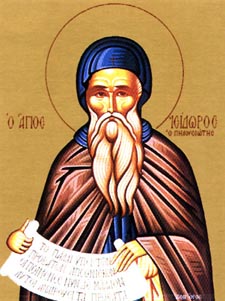
Saint Isidore of Pelusium lived during the fourth-fifth centuries. He was a native of Alexandria and was raised among pious Christians. He was a relative of Theophilus, Archbishop of Alexandria, and of his successor, Saint Cyril (January 18). While still a youth he quit the world and withdrew to Egypt to Mount Pelusium, which became the site of his monastic efforts.
Saint Isidore’s spiritual wisdom and strict asceticism, combined with his broad learning and innate knowledge of the human soul, enabled him to win the respect and love of his fellow monks in a short time. They chose him as their head and had him ordained a priest (the earliest sources for his life, however, say nothing of him being an igumen).
Following the example of Saint John Chrysostom, whom he had managed to see and hear during a trip to Constantinople, Saint Isidore devoted himself primarily to Christian preaching, that “practical wisdom” which, in his own words, is both “the foundation of the edifice and the edifice itself”, while logic is “its embellishment, and contemplation its crown”.
He was a teacher and willingly provided counsel for anyone who turned to him for spiritual encouragement, whether it was a simple man, a dignitary, a bishop, the Patriarch of Alexandria, or even the emperor. He left behind about 10,000 letters, of which 2,090 have survived. A large portion of these letters reveal profound theological thought and contain morally edifying interpretations of Holy Scripture. Photius calls Isidore a model of priestly and ascetical life, and also a master of style.
Saint Isidore’s love for Saint John Chrysostom resulted in his support of Saint John when he was persecuted by the empress Eudoxia and Archbishop Theophilus. After the death of Saint John, Saint Isidore persuaded Theophilus’ successor Saint Cyril to inscribe the name of Saint John Chrysostom into the Church diptychs as a confessor. Through the initiative of Saint Isidore, the Third Ecumenical Council was convened at Ephesus (431), at which the false teaching of Nestorius concerning the person of Jesus Christ was condemned.
Saint Isidore lived into old age and died around the year 436. The Church historian Evagrius (sixth century) writes of Saint Isidore, “his life seemed to everyone the life of an angel upon the earth.” Another historian, Nikēphóros Callistus (ninth century), praises Saint Isidore thus: “He was a vital and inspired pillar of monastic rules and divine vision, and as such he presented a very lofty image of most fervent example and spiritual teaching.”
Troparion — Tone 4
O God of our Fathers, / take not away Your mercy from us / but ever act towards us according to Your kindness, / and by the prayers of Your Saints / guide our lives in peace.
Troparion — Tone 8
The image of God was truly preserved in you, O Father, / for you took up the Cross and followed Christ. / By so doing you taught us to disregard the flesh for it passes away / but to care instead for the soul, since it is immortal. / Therefore your spirit, venerable Isidore, rejoices with the angels.
Kontakion — Tone 4
Finding you to be another morning star, O glorious One, / the Church is illumined by the brilliance of your words. / She cries out to you: “Rejoice, all-blessed and divinely-wise Isidore.”

No comments:
Post a Comment
Comments are subject to deletion if they are not germane. I have no problem with a bit of colourful language, but blasphemy or depraved profanity will not be allowed. Attacks on the Catholic Faith will not be tolerated. Comments will be deleted that are republican (Yanks! Note the lower case 'r'!), attacks on the legitimacy of Pope Leo XIV as the Vicar of Christ, the legitimacy of the House of Windsor or of the claims of the Elder Line of the House of France, or attacks on the legitimacy of any of the currently ruling Houses of Europe.