05 September 2026

Collect of St Alto of Altomünster, Abbot & Confessor ~ Indulgenced on the Saint's Feast Day (See Note)

According to the Apostolic Penitentiary, a partial indulgence is granted to those who, on the feast of any Saint, recite in his honour the oration of the Missal or any other approved by legitimate Authority.


V.
 O Lord, hear my prayer.
R. And let my cry come unto thee.
Let us pray.
O God, who by the preaching of Thy blessed servant Alto Thou didst cause the light of the Gospel to shine in Bavaria: Grant, we beseech Thee, that, having his life and labours in remembrance, we may show our thankfulness to Thee by following the example of his zeal and patience
Through Jesus Christ, Thy Son our Lord, Who liveth and reigneth with Thee, in the unity of the Holy Ghost, God, world without end.
R. Amen. 

Nota bene ~ St Alto is not celebrated on the Universal Calendar, but according to the Martyrology, today is his Feast Day. The Collect is taken from the Common of Confessors.

Collect of St Laurence Justinian, Bishop & Confessor ~ Indulgenced on the Saint's Feast

According to the Apostolic Penitentiary, a partial indulgence is granted to those who, on the feast of any Saint, recite in his honour the oration of the Missal or any other approved by legitimate Authority.


V. 
O Lord, hear my prayer.
R. And let my cry come unto thee.
Let us pray.
Grant, we beseech thee, almighty God, that the venerable feast of Laurence thy blessed Confessor and Bishop may increase our devotion and promote our salvation.
Through Jesus Christ, Thy Son our Lord, Who liveth and reigneth with Thee, in the unity of the Holy Ghost, God, world without end.
R. Amen.  

04 September 2026

Was Gloria Steinem a CIA Agent Working To Overthrow the Family?

Sister Lucia said“The final battle between the Lord and the reign of Satan will be about marriage and the family.” Steinem went to meet her master in hell on Wednesday unless she repented. 


From LifeSiteNews

By LifeSiteNews Staff

Top abortion activist and feminist Gloria Steinem admitted that she once worked for the CIA and defended the agency as ‘liberal, nonviolent, and honorable.’

Top feminist Gloria Steinem who died this week at age 92 may have been very different from her carefully cultivated public persona.  

While she earned her reputation as the unrivaled leader of the feminist and pro-abortion movements, the connections that lay behind her public career perhaps tell a more complex tale.  

There is no question that Steinem was once employed by the Central Intelligence Agency (CIA). She herself divulged her association with the spy agency in her 2015 memoir.  

“She knew she was working for the CIA and said so herself,” LifeSite CEO John-Henry Westen noted in a video on Friday, adding that she defended her work with the CIA by saying, “In my experience, the agency was completely different from its image. It was liberal, nonviolent, and honorable.”

Podcast host Alex Jones suggested that rather than being a casual “operative” working to send young non-communist Americans to overseas youth festivals during the late 1950s through the early 1960s, Steinem remained a “deep, high-level CIA” asset whose mission was to break up the family, to turn women against men, and to train women to be “mind-controlled slaves of the state.”

Perhaps the most startling assertion from Jones about Steinem is that she worked under Paul Ehrlich, the infamous mastermind of the global depopulation movement.  

According to Jones, under Ehrlich’s direction, she helped promote the notion that the Federal Communications Commission (FCC) should direct television content creators to portray large families in a negative light. Beyond that, Ehrlich and Steinem wanted the government to legislate family size and punish those who have too many kids.

“She was a CIA agent, funded by the Rockefeller Foundation, under Paul Ehrlich as her director at the CIA, to destroy the family, and to turn women against men,” said Jones. 

She was “a monster” Jones declared, “with a PR firm – the CIA – behind her to do all this.” By linking Steinem to Ehrlich, Jones has accused her of playing a role in the collapse of western civilization.

Wendell Berry’s “The Need to Be Whole”

Isn't "to be whole" what we are all striving for, both as individuals and as societies? Mr Salyer discusses Wendell Berry's concept of "wholeness".

From The Imaginative Conservative

By Jerry Salyer, MA

More than ever, America is split between populist nationalism and left-wing internationalism, with little room in either ideology for anything like Wendell Berry’s vision of local patriotic devotion. Whatever we make of his ruminations, with respect to this subject it is obviously the culture which has changed over the past few years, not him.

The Need to be Whole: Patriotism and the History of Prejudice, by Wendell Berry (528 pages, Shoemaker + Company, 2022)
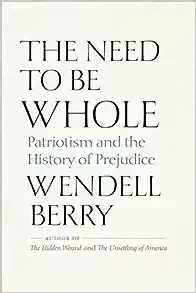
Word is going around that Wendell Berry’s The Need to Be Whole: Patriotism and the History of Prejudice has caused something of a scandal. And we can easily understand the dismay: In his latest study of land, culture, and society, Mr. Berry not only argues against pulling down Confederate monuments, but even suggests that some of the Confederates had redeeming qualities. This is hardly a fashionable thesis in the Year of Our Lord 2023, nor is it what we would expect from a writer who received the National Humanities Medal from Barack Obama.

Then again, nobody should have been too surprised by Mr. Berry’s latest remarks. Left-leaning or no, the man has always been idiosyncratic, and has always admitted that his agrarian philosophy owes much to the politically-incorrect Vanderbilt Agrarians of the 1930’s. As Mr. Berry saw fit during his 2012 Jefferson Lecture to quote the poet Allen Tate—author of Stonewall Jackson: The Good Soldier and poems like “Ode To the Confederate Dead”—it should come as no surprise that he disagrees with those who would have Tate “canceled.”

For that matter, when we turn back to Mr. Berry’s 2007 Sewanee Review essay “The Civil War and the American Imagination,” we find him frankly observing that the Civil War “was contested so fiercely and so long by the Confederacy undoubtedly because of a truth that our federal government has never learned: people generally don’t like to be invaded.” Even though “union and emancipation were moral purposes,” he continues, we must ask “if only to keep the question open, what we gained, as a people, by the North’s expensive victory.” What follows then is Mr. Berry’s dissident accounting of the war:

My own impression is that the net gain was more modest and more questionable than is customarily said. The Northern victory did preserve the Union. But, despite our nationalist “mystique,” our federation of states is a practical condition maintained only by the willing consent of the states and the people. And secession, today, is still not a dead issue … The other large Northern objective—the emancipation of the slaves—also was achieved. But this too appears in retrospect to be an achievement painfully limited. It does not seem unreasonable to say that emancipation was achieved and, almost by the same stroke, botched … My own guess is that, after the decision was taken to make slavery an issue of war, emancipation was inevitably botched.

Mr. Berry implicitly called into question the assumption that the history of race relations in America can be reduced to enlightened Northern whites, victimized blacks, and evil Southerners. At the very least, we may ask whether people seriously interested in racial harmony and brotherhood would really have pursued these aims via John Brown’s terrorist raid, much less through a fratricidal war of attrition, which inevitably entailed bitterness and resentment.

As an example of what he rejects about the conventional view of the Civil War, Mr. Berry pointed specifically to the “Battle Hymn of the Republic,” and what he describes as its “perfectly insane” lyrics. For Mr. Berry, the hymn encapsulates “a truly terrifying simple-mindedness in which we can still identify Christ with military power and conflate the American way of life with the will of God. I have made clear, I hope, my failure to perceive the glory of the coming of the Lord in the Civil War and its effects.… The Civil War was our first great industrial war, which was good for business, like every war since.”

So whatever we make of Mr. Berry’s recent remarks, we must concede that he hardly sprang them upon us out of the blue. True, The Need to Be Whole marks the first time he has publicly defended Confederate monuments; then again, it is only relatively recently that statues of Southern icons have been widely vandalized, pushed over by mobs, or demolished. Where the conservative establishment is content to ignore or perhaps even celebrate the destruction of the Reconciliation Monument in Arlington National Cemetery, Mr. Berry believes that extravagant expressions of hatred toward anyone—including dead Confederates—reveals a disastrous failure of imagination:

We know that in the early years of the last century Confederate soldiers were still living who cherished their memories of friends killed in the war. Widows and children of fallen Confederate soldiers were still living, and they remembered their husbands and fathers with love. I think it is a mistake to discount out of hand the involvement of those monuments with friendship, love, personal loyalty, and lasting grief. It is simply wrong to withhold all sympathy from those feelings, no matter one’s disagreement with those who felt them … I know that whatever ideology those monuments were said then, or said now, to stand for, for many who saw them half a century after Appomattox they stood for the dead. I know that their grief can be imagined. But I know also that many of us now would refuse outright to imagine, and so far to grant, the humanity and suffering of an ‘enemy,’ and to me this is the most troubling revelation of the movement against  monuments. It is also frightening, for such a principled numbness foretells only more killing.

Mr. Berry then goes on to contrast the implacable hostility of the movement against the monuments with the climactic scene in Homer’s Iliad, wherein Achilles and Priam together mourn their respective losses from the Trojan War. For Mr. Berry, the painful irony is that ancient pagans were more capable of sympathizing with and respecting their enemies than are a great many modern Christians.

All that would be controversial enough. But Mr. Berry goes further, speaking up for Confederate officers like John Hunt Morgan, John C. Breckinridge, and above all for Lee. In Mr. Berry’s estimation, the last named officer exemplifies virtues 21st-Century America desperately needs. “I see Robert E. Lee’s choice of his native place and his people as commendable,” Mr. Berry insists, “and in the long run indispensable.” In stark contrast to the archetypal rootless man of our time, Lee “affirmed, obeyed, and suffered the need to defend his homeland and his people.” To highlight his point, Berry declines to call Lee “a tragic hero because, instead of a ‘tragic flaw’ in the classical sense of that term, the source of his tragedy, his local loyalty, was not to him and his people a flaw.”
Correct or not, these judgments help us understand how and why the movement against Confederate monuments has become so powerful so quickly. To be sure, it is partly because Americans have become more sensitive than ever—some might even say Pharisaical—regarding questions of equality, slavery, and racism. Yet the sudden determination to topple memorials in the South has at least as much to do with the evaporation of “local loyalty,” especially among our elite classes. “In order to go with your people,” explains Mr. Berry, “it is necessary to have a people with whom you identify and to whom you feel that you belong. To have a people in this sense you must have a place in which you and they have lived together for generations, and to which you mutually feel that you belong.” How many Americans are so situated? With extended and even nuclear families broken up, and Americans having long since grown accustomed to bouncing from one state and region to another, homeland no longer remains as a meaningful category of the consciousness. Hence it is unsurprising that so few Americans today are capable of sympathizing with the Confederate soldier, whose foremost justification was that he was fighting for his home and region.

More than ever, America is split between populist nationalism and left-wing internationalism, with little room in either ideology for anything like Mr. Berry’s vision of local patriotic devotion. Whatever we make of his ruminations, with respect to this subject it is obviously the culture which has changed over the past few years, not Wendell Berry. Whether loyalty to one’s native place and people is good or bad, as an ideal it is surely nothing new—especially not for the agrarian poet from Henry County.

__________

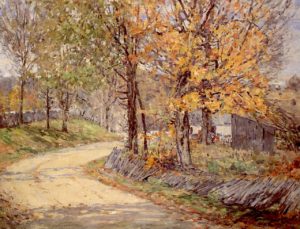
The featured image is “Autumn Roadside, Kentucky (1903), by William Forsyth, and is in the public domain, courtesy of Wikimedia Commons.

Bishop Challoner's Meditations ~ September 5th

ON HUNGERING AND THIRSTING AFTER JUSTICE

Consider first, the words of the fourth beatitude: 'Blessed are they that hunger and thirst after justice, for they shall have their fill.' O happy hunger and thirst, which brings the soul to the possession of all true justice, virtue, and perfection, and to a blessed union with the very fountain of justice, which is God himself! Reflect, my soul, how the desire to be good is indeed the beginning of all good; the desire of wisdom, according to the Scripture, is the beginning of wisdom; the desire of the love of God, is the beginning of the love of God; and so of all other virtues. But then this desire must not be a half desire, like that of the sluggard, or whom the wise man says, that 'he willeth and he willeth not,' Prov. xiii. 4; but a full and earnest desire. And when this desire is strong and perseverant, when it grows to vehement hunger and thirst after divine love and after all true justice and Christian perfection, it then sets the soul upon seeking diligently, praying heartily, knocking earnestly, at the gate of divine mercy, and employing all possible means to procure the satisfying of this hunger and thirst; and thus it easily overcomes all obstacles, and never leaves off its pursuit till it has obtained what it so earnestly seeks and desires. O happy souls that hunger and thirst in this manner!

Consider 2ndly, more in particular, what it is we are to hunger and thirst after, in order to be entitled to this beatitude. The justice of God in ourselves; the justice of God in our neighbours; the justice of God in himself. We hunger and thirst after the justice of God in ourselves when we earnestly seek and desire that we may, by the grace of God, fulfil all justice; that we may acquit ourselves of every branch of our duty; and that the love of God may take full possession of our souls, both for time and eternity. We hunger and thirst after the justice of God in our neighbours when we earnestly desire, and, as much as lies in us, seek and procure that all others may know, love, and serve God, and be eternally his. We hunger and thirst after the justice of God, in himself, when we are in love with his own infinite goodness, as it is in itself; with the beauty of his divine attributes, with his greater glory in all things; and with the perfect accomplishment of his holy will. Such was the hunger and thirst after justice that our Lord himself had here upon earth, who says of himself, St. John iv. 34, 'My meat is to do the will of him that sent me.' My soul, have we any share in this blessed hunger and thirst? Or do we not rather loathe this heavenly food, and only hunger after the fleshpots of Egypt, and thirst for muddy waters, drawn out of broken cisterns. which can never satisfy us? 

Consider 3rdly, the reward here promised to them that hunger and thirst after justice: 'they shall have their fill,' saith the Lord; their fill here of divine grace, of true devotion, of heavenly charity, of all Christian virtues, of a store of good works, and the fruits of the Holy Ghost; in a word, of that justice which they hunger and thirst after: and hereafter they shall be still more happily filled with the beatific vision and the eternal enjoyment of God himself, the only true and sovereign good, which alone can satisfy the heart of man - according to that of the psalmist, Ps. xvi. 15, 'I shall be satisfied when thy glory shall appear.' Here they shall be filled with the grace of God, raining down upon them from the great ocean above: hereafter they shall be drowned in that immense ocean of the deity, where they shall be brimful of God for all eternity.

Conclude to direct thy appetite towards 'the good things of the Lord, in the land of the living;' and in the mean time towards the fulfilling of all his justice. But O! take care not to be depraved with the false sweet of worldly, sensual, and carnal pleasures! These will take away from thee all relish for the things of God; they will never fill thee or satisfy thee themselves; nor suffer thee to taste, either in time or eternity, how sweet is the Lord.

5 September, Antonio, Cardinal Bacci: Meditations For Each Day


I Am Not Able
1. Often, when the violence of our passions threatens to overcome all our powers of resistance, we are tempted to say: “Lord, I am not able; I cannot go any further. Why are You not helping me? Why have you abandoned me?” This is a trick of the devil to make us give up the fight, to make us believe that God has deserted us and that we must inevitably give in to temptation.
This is the last stratagem of the devil when he sees that he cannot persuade us in any other manner. But the Lord addresses to us the reproof which he addressed to St. Peter who, while walking on the water, doubted for an instant, and then felt himself going under. “O thou of little faith, why didst thou doubt?” (Mt. 14:31) In such a situation, we must strengthen our faith, our love, and our dedication to Jesus Christ. Then the Lord will extend His helping hand to us as He did to Peter. He will give us the spiritual tranquility which only grace and Christian fortitude can offer.
Let us recall how this has happened in the temptations of our past life. When we were strong and generous with Jesus, we implored His help with faith and perseverance and emerged victorious from the fray. Then we experienced the heavenly joy which only God can give. Why can we not always do the same? We must never say: “I am not able!” We are poor and weak, but with the grace of God we can overcome all obstacles. As St. Paul says, “I can do all things in him who strengthens me.” (Phil. 4:13)
2. Whenever we feel called upon to make some sacrifice for Jesus or to form some good resolution, how often do we cry: “I am not able!” It may be a question of praying more fervently, of performing some mortification, or of helping our neighbour spiritually or materially. Or perhaps it is a matter of saying a few words of apology or of encouragement to our neighbour, whom we have previously treated with coldness and selfishness. Or it may be something entirely more generous which is demanded; it may be that God is inviting us to renounce ourselves completely and to dedicate ourselves to Him. Naturally this requires sacrifice, and great generosity of heart. But we say to Jesus when He calls us: “I cannot, it is too difficult!” And yet the Lord says: “You shall make and keep yourselves holy, because I am holy.” (Lev. 11:44; 19:2) “You therefore, are to be perfect, even as your heavenly Father is perfect.” (Mt. 5:48) We must not refuse God, Who became man for us and shed His blood for our redemption.
3. When the crosses sent to us by God have seemed too heavy, we have often uttered these words of refusal in a mood of weariness or even in a spirit of revolt. If only we had taken our sorrow to the foot of the Crucifix! Then we should not have had the audacity to have spoken these selfish and unchristian words.
We would have remembered that Jesus, the innocent Lamb, suffered for love of us, and we could not then have told Him that our cross was too heavy. We would have embraced it with resignation and walked towards Heaven in the footsteps of Christ.

Eastern Rite ~ Feasts of 5 September AM 7534

Today is the Feast of the Holy Prophet Zachary and the Righteous Elizabeth, Parents of John the Baptist.
✠✠✠✠✠


The Holy Prophet Zachariah and the Righteous Elizabeth were the parents of the holy Prophet, Forerunner and Baptist of the Lord, John. They were descended from the lineage of Aaron: Saint Zachariah, son of Barach, was a priest in the Jerusalem Temple, and Saint Elizabeth was the sister of Saint Anna, the mother of the Most Holy Theotokos. The righteous spouses, “walking in all the commandments of the Lord” (Luke 1:6), suffered barrenness, which in those times was considered a punishment from God.

Once, during his turn of priestly service in the Temple, Saint Zachariah was told by an angel that his aged wife would bear him a son, who “will be great in the sight of the Lord” (Luke 1:15) and “will go before Him in the spirit and power of Elias” (Luke 1:17).

Zachariah doubted that this prediction would come true, and for his weakness of faith, he was punished by becoming mute. When Elizabeth gave birth to a son, through the inspiration of the Holy Spirit she announced that his name was John, although no one in their family had this name.

They asked Zachariah and he also wrote the name John down on a tablet. Immediately the gift of speech returned to him, and inspired by the Holy Spirit, he began to prophesy about his son as the Forerunner of the Lord.

When King Herod heard from the Magi about the birth of the Messiah, he decided to kill all the infants up to two years old at Bethlehem and the surrounding area, hoping that the newborn Messiah would be among them.

Herod knew about John’s unusual birth and he wanted to kill him, fearing that he was the foretold King of the Jews. But Elizabeth hid herself and the infant in the hills. The murderers searched everywhere for John. Elizabeth, when she saw her pursuers, began to implore God for their safety, and immediately the hill opened up and concealed her and the infant from their pursuers.

In these tragic days, Saint Zachariah was taking his turn at the services in the Temple. Soldiers sent by Herod tried in vain to learn from him the whereabouts of his son. Then, by command of Herod, they murdered this holy prophet, having stabbed him between the temple and the altar (MT 23: 35). Elizabeth died forty days after her husband, and Saint John, preserved by the Lord, dwelt in the wilderness until the day of his appearance to the nation of Israel.

On the Greek calendar, Saints Zachariah and Elizabeth are also commemorated on June 24, the Feast of the Nativity of Saint John the Baptist.

Troparion — Tone 2

Celebrating the memory of the Righteous Zachariah and Elizabeth, O Lord, / together with them we pray to You: "Save our souls."

Troparion — Tone 4

Robed in the vestments of the priesthood, / according to the Law of God you offered whole-burnt offerings in a sacred manner, wise Zachariah. / You became a luminary and a seer of the mysteries, / bearing within yourself the signs of grace, all-wise one. / Slain by the sword in the temple of God, O prophet of Christ, / intercede together with the Forerunner / that our souls may be saved.

Kontakion — Tone 3

Today the prophet Zachariah, priest of the Most High / and parent of the Forerunner, / has prepared a banquet to his memory to nourish the faithful, / mixing the drink of righteousness. / Therefore we praise him as a divine initiate of the grace of God.

Byzantine Saints: Holy Prophet Zachariah & Righteous Elizabeth

IN LUMINE FIDEI: 5 SEPTEMBER – SAINT LAWRENCE JUSTINIAN (Bishop and Confessor)


IN LUMINE FIDEI: 5 SEPTEMBER – SAINT LAWRENCE JUSTINIAN (Bishop and Confessor): Laurence was born at Venice of the illustrious family of the Justiniani, and while still a child was remarkable for the seriousness of ...

5 September, The Chesterton Calendar

SEPTEMBER 5th

Our modern mystics make a mistake when they wear long hair or loose ties to attract the spirits. The elves and the old gods when they revisit the earth really go straight for a dull top-hat. For it means simplicity, which the gods love.

'Charles Dickens.'

5 September, The Holy Rule of St Benedict, Patriarch of Western Monasticism


PROLOGUE OF OUR MOST HOLY FATHER SAINT BENEDICT TO HIS RULE

5 Jan. 6 May. 5 Sept.

Hence also the Lord saith in the Gospel: “He that heareth these words of Mine, and doeth them, is like a wise man who built his house upon a rock: the floods came, the winds blew, and beat upon that house, and it fell not, because it was founded upon a rock.” And the Lord in fulfilment of these His words is waiting daily for us to respond by our deeds to His holy admonitions. Therefore are the days of our life lengthened for the amendment of our evil ways, as saith the Apostle: “Knowest thou not that the patience of God is leading thee to repentance?” For the merciful Lord saith: “I will not the death of a sinner, but that he should be converted and live.”

6 September, The Roman Martyrology


O
ctávo Idus Septémbris Luna vicésima quarta. Anno Dómini 2026
September 6th 2026, the 24th day of the Moon, is commemorated
The Prophet Zachariah, who returned home from Chaldea as an old man, and is buried beside the prophet Haggai.
Upon the same day, were born into the better life: At the Dardanelles, holy Onesiphorus, a disciple of the Apostles, of whom holy Paul maketh mention in writing unto Timothy. By command of the Proconsul Hadrian, holy Onesiphorus and Porphyry were heavily beaten, and drawn by wild horses, and so gave up their souls to God.
At Alexandria, the holy martyrs the Priest Faustus, Macarius, and ten Companions, who finished their testimony for Christ's name's sake, under the Emperor Decius and the President Valerius, by being beheaded.
In Cappadocia, the holy martyrs the Deacon Cottidus, Eugenius, and their Companions.
In Africa, the holy Bishops Donatian, Prassidius, Mansuetus, German, and Fusculus, who in the persecution under the Vandals were, by command of the Arian King Hunneric, because of their assertion of the Catholic truth, heavily beaten with cudgels, and banished. Among them was also a Bishop named Laetus, a man of great activity and learning, who, after suffering a long and foul imprisonment, was burnt.
At Verona, (in the fifth century,) the holy Confessor Petronius, Bishop (of that see.) At Rome, the holy Abbot Eleutherius, the servant of God, of whom holy Pope Gregory writeth, that by his prayer and tears he raised a man from the dead.
℣. And elsewhere many other holy martyrs, confessors, and holy virgins.
℟. Thanks be to God.

Meme of the Moment

Today is his Feast Day.

Traditional Catholic Evening Prayers in English | September


Traditional Catholic evening devotional prayers to close your day with your mind, heart, tongue, and soul on our Lord! The month of September is dedicated to the Seven Sorrows of Our Lady. Begin and end each day with prayer. This video is a compilation of many traditional evening prayers Catholics say, and should not be considered a replacement for those who have an obligation to pray the Divine Office evening prayers.

Compline

From St Thomas Aquinas Seminary. You may follow the Office at Divinum Officium.

Byzantine Saints: Martyr Hermione, Daughter of Saint Philip the Deacon

St Rosalia, Virgin: Butler's Lives of the Saints

Stations of the Cross According to St Francis of Assisi


From the Apostolic Penitentiary:

A plenary indulgence is granted to those who piously make the Way of the Cross. The gaining of the indulgence is regulated by the following rules:

1. Must be done before stations of the cross legitimately erected.

2. 14 stations are required. Although it is customary for the icons to represent pictures or images, 14 simple crosses will suffice.

3. The common practice consists of fourteen pious readings to which some vocal prayers are added.. However, nothing more is required than a pious meditation on the Passion and Death of the Lord, which need not be a particular consideration of the individual mysteries of the stations.

4. A movement from one station to the next is required. But if the stations are made publicly and it is not possible for everyone taking part to go from station to station, it suffices if at least the one conducting the exercise goes from station to station, the others remaining in their places.

5. Those who are "impeded" can gain the same indulgence if they spend at least one half and hour in pious reading and meditation on the Passion and Death of our Lord Jesus Christ.

Vespers of Friday in Pentecostide

From the Canons Regular of the New Jerusalem. You may follow the Office at Divinum Officium.

Summa Contra Gentiles, Book II: LXXIV Avicenna: Intelligible Forms Not Preserved in Possible Intellect

From Contemplating History

Saint Thomas Aquinas (1225 – 7 March 1274), was a Doctor of the Church, Philosopher, Theologian, Jurist, Dominican Friar, and Priest. Known as Doctor Angelicus "Angelic Doctor," and the Doctor Communis "Universal Doctor" his writings serve as a defense and proof of the validity of Christ's authority over all. The Summa contra Gentiles (also known as Liber de veritate catholicae fidei contra errores infidelium, "Book on the truth of the Catholic faith against the errors of the unbelievers"). The Summa contra Gentiles consists of four books. The structure of Saint Thomas's work is designed to proceed from general philosophical arguments for monotheism, to which Muslims and Jews are likely to consent even within their own respective religious traditions, before progressing to the discussion of specifically Christian doctrine.

Book II is dedicated to the Creation (in other words, the physical universe, everything which exists). Whether you are a history enthusiast, a student of religion, or simply curious about the impact of the Roman Catholic Church on the world, this playlist is designed to provide an informative and engaging journey through its captivating past. Subscribe to the Contemplating History channel for more educational content and immerse yourself in the rich tapestry of history.

David Chalmers, PhD - Virtual Immortality

From Closer to Truth, a secular source.


Virtual immortality is the theory that when the fullness of our mental selves can be uploaded with first-person perfection to non-biological media, then when our mortal bodies die our mental selves will live on. But the complexity of the science is vast. And what about the nature of consciousness?

David Chalmers is an Australian philosopher and cognitive scientist, specialising in philosophy of mind and philosophy of language.

The Holy Rosary

Friday, the Sorrowful Mysteries, in Latin with Cardinal Burke.

Face of Anne of Cleves | Story Behind the Painting | Hans Holbein the Younger

From History Calling


Did Hans Holbein the Younger TRICK HENRY VIII by making Anne of Cleves look more beautiful than she really was? That is the charge often levelled at the famed Tudor painter in light of the fact that Henry sent for Anne to become his fourth wife after viewing Holbein’s efforts, only to discover upon meeting the lady that he disliked her so much that he dumped her six months later and had the union annulled, causing a major Tudor scandal. Is it fair to blame Holbein for this marital disaster though and what do we know about how, when and why the portrait was created? In this six wives documentary from History Calling, I share the story behind the painting of this portrait of a Tudor Queen and look at how great of an impact it had on the King’s decision to marry Anne. We’ll also look at what happened to the painting after the marriage of Henry VIII and Anne of Cleves broke down and how this famous work of art ended up in the Louvre in Paris. We’ll consider too how likely it is that this is a true representation of the face of Anne of Cleves and at whether Henry was angry at Holbein for the painting, or if he blamed his dislike of Anne on factors other than her looks. It is rare for a painting to have such a prominent place in the history of Tudor England, but this image has achieved just that and it changed the course of the life of Anne of Cleves forever. The podcast episode and documentary I discussed in this video were ‘Anne of Cleves’ (part of the Not Just the Tudors podcast series by Suzannah Lipscomb) and ‘Becoming Anne Boleyn’, also hosted by Suzannah Lipscomb

The Origins and Prevalence of Habitable Worlds Karin Öberg, PhD (Harvard University)

From The Society of Catholic Scientists 

Australia’s Unique Devotion to Our Lady of the Southern Cross

There is a reason the Southern Cross figures prominently on the flags of both Australia and New Zealand, not that it's for a religious reason.


From Aleteia

By Philip Kosloski

In the Southern Hemisphere, the Southern Cross has been a guide to sailors for thousands of years and Our Lady continues to guide souls to her Son.

In an age without smartphones and GPS systems, sailors had to look to the starry night sky for guidance on how to reach their final destination.

This was the case in both the Northern and Southern Hemispheres, with each region having its own unique stars to guide voyagers to a safe haven.

For those who traveled in the Southern Hemisphere, the Southern Cross played a pivotal role, as it is clearly visible and helped sailors correct their course. Also known as Crux (Latin for cross) it is among the most easily distinguished of the constellations.

It became such an essential part of travel that both Australia and New Zealand decided to incorporate the Southern Cross into their national flags.

In the Catholic world, it should come as no surprise that there quickly developed a variety of devotions connected to this symbolic constellation in Australia, as there is an ancient tradition that connects Mary to the title "Star of the Sea."

Our Lady of the Southern Cross

The Hebrew form of Mary is miryam and some biblical scholars have seen in it the Hebrew words mar (bitter) and yam (sea). This first meaning can refer to Mary's bitter suffering at the cross and her many tears of sorrow.

Another interpretation of the word mar renders Mary's name to mean "drop of the sea" and St. Jerome rendered it in Latin as stilla mariswhich was later changed to stella (star) marisThis accounts for a popular title for Mary as "Star of the Sea." Calling Mary stella maris referred to Mary's ability to guide sinners along the right path to the Eternal Shores of Heaven.

St. Thomas Aquinas confirms this symbolism, "Mary means Star of the Sea, for as mariners are guided to port by the ocean star, so Christians attain to glory through Mary's maternal intercession."

In the Diocese of Toowoomba in South West Queensland, Australia, there was no record of a Diocesesan patron saint. After much consultation, they decided to officially honor Mary under the title, "Our Lady of the Southern Cross," as they explain on their website:

The choice was overwhelmingly in favour of Mary of the Southern Cross. After seeking approval, on November 14, 1998, the Holy Father issued a Bull formally recognizing the title of the Blessed Virgin Mary under the title of Our Lady of the Southern Cross.

The first celebration of the Feast of Mary of the Southern Cross, as the Diocese has chosen to refer to it, took place on September 1, 1999. A day of solemnity across the Diocese.

The day was chosen for a variety of reasons, including the fact that eight days later the Church celebrates the feast of the Nativity of the Virgin Mary on September 8.

A light in the darkness

Furthermore, when establishing an Anglican Ordinariate for Australia, it was similarly given the patronage of, "Our Lady of the Southern Cross." A local artist even wrote a new icon for Our Lady of the Southern Cross, which is rich in symbolism.

St. John Paul II similarly invoked Mary as "Star of the Sea" when addressing the Church in Oceania, praying:

O Stella Maris, light of every ocean
and mistress of the deep,
guide the peoples of Oceania
across all dark and stormy seas,
that they may reach the haven of peace and light
prepared in him who calmed the sea.

Viewing Mary as a "star" is an ancient devotion that continues to have relevance for Catholics living in both the Northern and Southern Hemispheres. She remains a bright beacon of hope for all of us, leading us to her Son, Jesus, and his holy Cross.


Jesuit Goes Viral for Saying He Hates the Traditional Mass

Some Very Dark Accusations Are Coming to Light About Pope Leo in Peru


Leo is, at the very least, accused of protecting a monster priest, and people are starting to scrutinise Prevost's relationship with a priest who is literally half his age.

You Wont Believe What This Monk Did in 1010!

From Modern History TV


Jason Kingsley, OBE,the Modern Knight, discusses two fragmentary records of medieval flying machines actually being tested out. What happened? Eilmer of Malmesbury: The Medieval Monk Who Tried to Fly.

No AI, AI free, human made, no gen AI. Everything in this video is filmed, tested, and experienced in real conditions. No AI-generated content. Did a medieval monk really attempt human flight nearly a thousand years ago? In this video, we uncover the fascinating story of Eilmer of Malmesbury, the 11th-century English monk who strapped wings to his arms and launched himself from the tower of Malmesbury Abbey around the year 1010.
Eilmer’s daring glider attempt and what inspired him? Medieval sources. What do the records say?
The context of early flight experiments. Was Eilmer ahead of his time?
Fact vs. legend. How much truth is in this story? Eilmer’s flight may not have been a complete success, but his ambition echoes through history as one of the earliest pioneers of aviation.

Traditional Catholic Morning Prayers in English | September


Traditional Catholic morning prayers to help start your day in a holy way! The month of September is dedicated to the Seven Sorrows of Our Lady. I hope these prayers increase your devotion to the Blessed Virgin Mary this month, to share in her sorrows and to and draw you closer to her Divine Son, Jesus Christ. Begin each day with morning prayer! This video is a compilation of many traditional evening prayers Catholics say, and should not be considered a replacement for those who have an obligation to pray the Divine Office evening prayers.

Former Protestant Pastor Returns to Catholic Faith

From Ascension Presents


Jeff Cavins shares his emotional journey of growing up Catholic, leaving the Catholic Church, becoming a protestant pastor, and finding his way back to Catholicism. His journey is a reminder that no matter your past, God is always calling you back to Himself and His Church. To learn more about Jeff Cavins, visit: https://ascensionpress.com/pages/pers...