There were three post-Tridentine figured who inspired Pope John XXIII. https://meaningofcath.substack.com/p/...
17 June 2026
Octave of the Sacred Heart, Vatican II-Trent Saint, Deposed Pope and More
From The Meaning of Catholic
There were three post-Tridentine figured who inspired Pope John XXIII. https://meaningofcath.substack.com/p/...
There were three post-Tridentine figured who inspired Pope John XXIII. https://meaningofcath.substack.com/p/...

The Challenge of the Eucharistic Heart of Jesus
A very short-lived Feast, the Eucharistic Heart of Jesus, was an early casualty of Bugnini's hatchet job on the Liturgy, though the Redemptorists still keep it.

From One Peter Five

From One Peter Five
By Charles Coulombe, STM, KCSS
Many sovereigns did do it.
I – Europe
Sweet Heart, Lovable Heart,
wounded by love for us,
faint with love for us,
make Thyself favorable to me.
Heart of Jesus, sweeter than honey,
Heart, purer than the pure sun,
tabernacle of the Word of God,
compendium of the riches of God.
You are a harbor to the shipwrecked world,
a secure place for the faithful,
an asylum for guilty minds,
a retreat for pious hearts.
The Feast of the Eucharistic Heart of Jesus was both an early casualty of liturgical unrest, and – as far as the Universal Church goes – a singularly short-lived one. It is, however, still observed by the Redemptorists, whose Irish Province offer this admirable introduction to the feast: “On 9 November 1921, Pope Benedict XV instituted the feast of the Eucharistic Heart of Jesus to be celebrated on the Thursday within the Octave of the Sacred Heart with a Proper Mass and Office. The feast continues to be celebrated in some places and by some communities, notably by the Redemptorists who maintain it in their Proper Calendar.” Thus this feast will fall this week on Thursday. In instituting the feast, Pope Benedict XV wrote:
The chief reason of this feast is to commemorate the love of Our Lord Jesus Christ in the mystery of the Eucharist. By this means the Church wishes more and more to excite the faithful to approach this sacred mystery with confidence, and to inflame their hearts with that divine charity which consumed the Sacred Heart of Jesus when in His infinite love He instituted the Most Holy Eucharist, wherein the Divine Heart guards and loves them by living with them, as they live and abide in Him. For in the sacrament of the Holy Eucharist He offers and gives Himself to us as victim, companion, nourishment, viaticum, and pledge of our future glory.
Despite both its novelty and short lifespan the feast goes to the very heart (literally) of Catholic life and history. To understand this, it is first important to remember that every element of Sacramental and devotional life in the Catholic Church is bound up with every other – honour paid to Our Lady of Knock does not diminish that offered Our Lady of Guadalupe, since it is the same Immaculately Conceived and Gloriously Assumed person who has appeared in both places among many others. Honour paid to her in one place is paid to her in all. Neither is veneration given her taken away from her Divine Son. Her Queenship derives from His Kingship; the devotion due her Immaculate Heart does not take away from that to be given to His Sacred Heart. It works also in reverse; she was the very first Tabernacle to contain His Sacred Body and Precious Blood.
As the name will indicate, the name Eucharistic Heart of Jesus encompasses two foci of worship toward Christ: His Most Blessed Sacrament, and His Most Sacred Heart. But it would be a mistake to think that that linkage is only one hundred and fiveyears old. Indeed, these two devotions, and a great many others – go back to the beginnings of the Church – to the very first Maundy Thursday and Good Friday.
On that Thursday, the Last Supper encompassed a number of key events for the subsequent history of the Church. Our Lord united His Davidic Kingship with the Communio of the Church, as symbolised by the Washing of the Feet; thenceforth, Catholic Monarchs aspired to participate in His Kingship (which is why the Maundy Thursday Footwashing was a regular feature of Imperial and Royal Court Calendars). He also began the Mass with the First Transubstantiation; the vessel in which He made the wine His Precious Blood was ever after identified as the Holy Grail of song and story. He then created the Catholic Priesthood to continue this ever after.
The next day, the creation of the Mass was consummated with His death on the Cross; Christian Chivalry dated its own origins to that Sacrifice, seeing Christ as the first Knight. Our Redemption accomplished, St. Longinus stabbed Our Lord in the side, into His Sacred Heart – from whence poured Blood and Water – seen ever since as symbolic as of the two most essential Sacraments – the Holy Eucharist, which worthily and frequently received over a lifetime makes us ever more a part of Him, and Holy Baptism, which incorporates us into His Mystical Body, and makes it possible to receive His Body and Blood. In all of this we see the close connexion between the Blessed Sacrament and the Sacred Heart. The many early Saints who had visions of drinking from His Side Wound underscore this – as does the first Eucharistic Miracle, at Lanciano, taking place at the Shrine of St. Longinus.
Starting in the 12th century, there began what I like to call the Eucharistic Revolution. It began with Hildebert of Lavardin coining the word “Transubstantiation.” Then began the penning of stories about the Holy Grail; not very reliable as a source of history, they nevertheless incorporate stories of Eucharistic Miracles that would repeatedly occur in real life down to – especially in – our time. During the period they grew in popularity in the 13th century, Transubstantiation was defined as the best way to describe what happens at the Mass, and St. Juliana of Cornillon had her visions which led to the great feast of Corpus Christi. This turn led to the growth of Eucharistic processions, adoration, and much more. But in 1199, Christ appeared to St. Lutgarde of Saint-Trond. This is the first medieval apparition of the Sacred Heart passed down to us through Tradition.
At the same time, devotion grew to Our Lord’s Five Wounds, and their connection to the Eucharist was not unnoticed – after all, it was the same blood that came down daily upon each Altar, was reappearing in miracles (sometimes bleeding from hosts and at others from images of Our Lord), and relics of which were being brought back along a great many others from the Holy Land and Constantinople, thanks to the Crusades. Ss. Gertrude the Great and Mechtilde – both in the Abbey of Helfta, received visions of the Sacred Heart, and St. Bonaventure, and a great many other preached about this Heart and the Blood that flowed from it.
When the Protestant Revolt broke out, the Pilgrims of Grace in England marched against the King’s men under the banner of the Five Wounds. St. Ignatius of Loyola in his Anima Christi Prayer united all elements of devotion to Christ – and St. Peter Canisius spoke frequently of Christ’s Heart and Blood in defence of His Real Presence in the Eucharist; a theme taken up by many Catholic preachers fighting the new heresies.
It was of course in the 17th century that Our Lord appeared to St. Margaret Mary Alacoque with the revelations we know. But the 17th century saw an explosion of such devotion independently. Sr. Marie des Vallees had vision explicitly linking the Sacred Heart to the Eucharist, and the devotion was already in the hearts of Ss. Claude de la Colombiere and St. John Eudes before they became the foremost supporters and propagators of St. Margaret Mary’s work.
Another interesting element of this rising tide was the interest taken in the Sacred Hear by Crowned Heads. Of course, this was not a one-way street. On June 17, 1689, St. Margaret Mary Alacoque received another revelation from Our Lord, which she quoted:
so He wants, it seems, to come with pomp and magnificence into the houses of princes and kings, to be honored as there as He has been outraged, despised and humiliated by His passion; He would receive much pleasure by seeing the great men of the earth lowered and humbled before Him, as He felt the bitterness of being abased by them. And these are the words that I heard on this subject: ‘Make it known to the eldest son of my Sacred Heart, that as his temporal birth was obtained by devotion to the merits of My Holy Childhood, so he will get his birth to eternal glory by the consecration which he will make of himself to my adorable Heart, which means his triumph, and through it, to the great of the earth. I want My Heart to reign in his palace, to be painted on his standard and engraved in his arms, to make him victorious over all his enemies, and by placing at his feet these proud foes, to make him victorious over all enemies of the Holy Church.’
Although neither Louis XIV nor Louis XV complied with this request, others did. Mary of Modena, Queen of the deposed King James II; Queen Henriette Marie of England (widow of the murdered Charles I); Augustus II “the Strong,” Elector of Saxony, King of Poland, and Grand Duke of Lithuania; King Felipe V of Spain; Stanisław Leszczyński, sometime King of Poland and Duke of Lorraine; Augustus III, King of Poland; Marie Leszczynska, Queen of Louis XV of France; Queen Maria I of Portugal; and Maximilian III Joseph, Elector of Bavaria; all became active propagators of the devotion.
When the French Revolution broke out in 1789, and drowned that word in fire and blood, the imprisoned Louis XVI privately consecrated the country to the Sacred Heart and vowed to do so publicly if restored to power. This did not happen, as we know. But from the Vendée to Spain to Tyrol, the Sacred Heart became the symbol of Catholic resistance to the revolution. Afterwards, it was a big part of the Catholic Restoration. On December 22, 1822,
Pope Pius VIII approved the Confraternity of the Holy Hour, founded that same year by Father Debrosse, SJ, in the Jesuit church of Paray-le-Monial, with the approval of Bishop d’Héricourt of Autun. A mental or vocal prayer focused on the agony of Our Lord in the Garden of Olives, the Holy Hour is observed with the aim of appeasing God’s wrath, asking for grace for sinners, and consoling the Heart of Jesus for one hour. Initially, the adoration took place in the chapel of the Jesuit Fathers in Paray, between eleven o’clock and midnight, and was limited to men.
From there it has spread throughout the world, and to both sexes. Here we see an obvious unifying of the two devotions.
Unhappily, the Restoration only lasted fifteen years, before Liberalism renewed its assault. The Sacred Heart and the Blessed Sacrament were the two weapons used against it by its Catholic military and political opponents. The French Legitimists, the Spanish Carlists, the Portuguese Miguelists – all used the Sacred heart as their symbol – as did the Papal Zouaves, those young men from so many countries, who rallied to defend the Pope against his enemies. After he lost in 1870, these last returned home, and became great propagators of the Sacred Heart in their home countries.
Some of these in France created the “National Vow,” which called for the National Consecration of France to the Sacred Heart, and the building of a Basilica in His honour; once accomplished, Perpetual Adoration would be established therein. The first result was the Basilica of the Sacred Heart at Montmartre. Soon, a number of similar buildings were built around Europe and the World. So too did the idea of National Consecrations, which in their fullness would include both the country’s bishops and its Head of State. In the meantime, the 19th century saw a great many religious orders arise, dedicated to either or both Blessed Sacrament and the Sacred Heart.
On May 25, 1899, in the Encyclical Annum Sacrum, Leo XIII ordered the consecration of all Mankind to the Sacred Heart for the following June 11. In Vienna, the entire Habsburg Clan, with one memorable exception, gathered in Vienna at St. Stephen’s Cathedral on the appointed day to make the Consecration in front of the Blessed Sacrament. But the young Archduke Karl – one day to be Emperor and eventually a Blessed of the Church – made it privately at the Chapel of his parents’ home the Villa Wartholz. As with his uncle Franz Ferdinand, he was deeply devoted to the Sacred Heart.
The First World War did at least as much damage to the Catholic World as the French Revolution. This is why Benedict XV made the relationship between the two devotions clear when he established the feast – and why Pius XI made the Octave of the Sacred Heart equal to that of Christmas. In times of difficulty, we should never forget that the Blessed Sacrament and the Sacred Heart – and for that matter, the Precious Blood – are the refuges that will lead us from this embattled vale of tears to Paradise.
St Gregory Barbarigo: Give Thanks for Your Talents
A sermon for today. Please remember to say 3 Hail Marys for the Priest.
St Botulph, Abbot

From Fr Alban Butler's Lives of the Saints:
SS. BOTULPH and ADULPH were two noble English brothers, who opened their eyes to the light of faith in the first dawning of the day of the gospel upon our ancestors. Astonished at the great truths which they had learned, and penetrated with the most profound sentiments which religion inspires, they travelled into the Belgic Gaul, there to find some religious houses and schools of virtue, which were then scarce in England. Such was the progress of these holy men that they soon were judged fit to be themselves masters. Nor was it long before Adulph was advanced to the bishopric of Maestricht, which he administered in so holy a manner, that he is honored in France among the saints on the 17th of June. St. Botulph returned to England to bring to his own country the treasure he had found. Addressing himself to king Ethelmund, he begged some barren spot of ground to found a monastery. The king gave him the wilderness of Ikanho where he built an abbey, and taught the brethren whom he assembled there the rules of Christian perfection, and the institutes of the holy fathers. He was beloved by every one, being humble, mild, and affable. All his discourse was on things which tended to edification, and his example was still far more efficacious to instil the true spirit of every virtue. When he was oppressed with any sickness he never ceased thanking and praising God with holy Job. Thus he persevered to a good old age. He was purified by a long illness before his happy death, which happened in the same year with that of St. Hilda, 655. His monastery having been destroyed by the Danes, his relics were part carried to the monastery of Ely, and part to that of Thorney. St. Edward the Confessor afterwards bestowed some portion of them on his own abbey of Westminster. Few English saints have been more honored by our ancestors. Four parishes in London, and innumerable others throughout the country, bear his name. Botulph’s town, now Boston, in Lincolnshire and Botulph’s bridge, now Bottle-bride, in Huntingdonshire, are so called from him. Leland and Bale will have his monastery of Ikanho to have been in one of those two places; Hickes says at Boston; others think it was towards Sussex; for Ethelmund seems to have been king of the South-Saxons. Thorney abbey was situated in Cambridgeshire, and was one of those whose abbots sat in parliament. It was founded in 972, in honor of St. Mary and St. Botulph. In its church lay interred St. Botulph, St. Athulf, St. Huna, St. Tancred, St. Tothred, St. Hereferth, St. Cissa, St. Bennet, St. Tova, or Towa, to whose memory a fair chapel called Thoueham, half a mile off in the wood, was consecrated. Thorney was anciently called Ancarig, that is, the Isle of Anchorets. Part of the relics of St. Botulph was kept at Medesham, afterwards called Peterburgh. See Dr. Brown Willis, on mitred Abbeys, t. 1, p. 187, and the life of St. Botulph published by Mabillon, Act. Ben. t. 3, p. 1, and by Papebroke, t. 3, Junij, p. 398. The anonymous author of this piece declares he had received some things which he relates from the disciples of the saint who had lived under his direction. There is also in the Cottonian library, n. 111, a MS. life of Saint Botulph compiled by Folcard, first a monk of St. Bertin’s at St. Omer, afterwards made by the conqueror abbot of Thorney in 1068. See also Narratio de Sanctis qui in Anglia quiescunt, translated from the English-Saxon into Latin by Francis Junius, and published by Dr. Hickes, Diss. Epist. pp. 118, 119. Thesauri, t. 1.
St Gregory Barbarigo, Bishop & Confessor

From Catholic Exchange
A diplomat turned bishop, Gregory Barbarigo united intellect with pastoral care. In Bergamo and Padua, he renewed dioceses through education, catechesis, and faithful clergy formation. Accessible and humble, he proved that strong administration and deep holiness can work together to bring lasting spiritual renewal.
St. Gregory Barbarigo was born in 1625 in Venice, Italy, into a noble family. From a young age, he was drawn to public service and the Church. After serving as a diplomat and studying law, he was ordained a priest and quickly became known for his intelligence and pastoral care. Pope Alexander VII appointed him Bishop of Bergamo and later Cardinal and Bishop of Padua. Deeply influenced by the reforms of the Council of Trent, St. Gregory worked tirelessly to implement them by improving seminaries, supporting Catholic education, and personally guiding his priests and people. He founded libraries, expanded schools, and prioritised catechesis, especially among the poor. Known for his humility, accessibility, and administrative excellence, he brought spiritual renewal to every diocese he served. St. Gregory died in 1697 and was canonised in 1960.
Collect of St Botolph of Thorney, Abbot & Confessor ~ Indulgenced on the Saint's Feast (See Note)
According to the Apostolic Penitentiary, a partial indulgence is granted to those who, on the feast of any Saint, recite in his honour the oration of the Missal or any other approved by legitimate Authority.
.jpg)
V. O Lord, hear my prayer.
R. And let my cry come unto thee.
Let us pray.
O God, who by the preaching of Thy blessed servant Botolph Thou didst cause the light of the Gospel to shine in the land of the East Angles: Grant, we beseech Thee, that, having his life and labours in remembrance, we may show our thankfulness to Thee by following the example of his zeal and patience
Let us pray.
O God, who by the preaching of Thy blessed servant Botolph Thou didst cause the light of the Gospel to shine in the land of the East Angles: Grant, we beseech Thee, that, having his life and labours in remembrance, we may show our thankfulness to Thee by following the example of his zeal and patience
Through Jesus Christ, Thy Son our Lord, Who liveth and reigneth with Thee, in the unity of the Holy Ghost, God, world without end.
R. Amen.
Collect of St Gregory Barbarigo, Bishop & Confessor ~ Indulgenced on the Saint's Feast
According to the Apostolic Penitentiary, a partial indulgence is granted to those who, on the feast of any Saint, recite in his honour the oration of the Missal or any other approved by legitimate Authority.

V. O Lord, hear my prayer.
R. And let my cry come unto thee.
Let us pray.
Let us pray.
O God, Who hast willed that Blessed Gregory, Thy Confessor and Bishop, be renowned for the care of his flock and compassion for the poor; favourably grant that we who honour his merits may imitate the example of his charity.
Through Jesus Christ, Thy Son our Lord, Who liveth and reigneth with Thee, in the unity of the Holy Ghost, God, world without end.
R. Amen.
16 June 2026
Honorius I, Vatican II and the SSPX
An interesting essay comparing the literal and metaphorical interpretations of the documents of the Second Vatican Council.
From Rorate Cæli
James Baresel, MA(Phil)
As is well known, Pope Honorius I stated in a letter to Patriarch Sergius of Constantinople that “we confess one will of our Lord Jesus Christ”—despite the Church’s dogmatic teaching that Christ has both a divine will and a human will—and was posthumously anathematized by the Third Council of Constantinople.
What is not generally known, what is, in fact, virtually unknown, is that Pope John IV taught that Christ “never had two contrary wills [his human will being perfectly subordinate to his divine will] …we fittingly say and truthfully confess [in a metaphorical sense] one will” and that, therefore, Honorius’s letter was not intrinsically heretical its precise wording—because it did not state whether “one will” was meant literally or metaphorically.
In other words, the Church condemned Honorius for supporting the Monothelite heresy in practice but also ruled that the letter in which he did so was not technically heretical in principle.
Given that precedent, I have long believed that the Society of Saint Pius X should accept that Vatican II and the Novus Order are capable of orthodox interpretations, including as a matter of probability in the case of non-definitive conciliar teachings.
Moreover, I believe that the SSPX should abandon its insistence upon doctrinal agreement preceding canonical reconciliation in favor of reconciling on the basis of ambiguity, in support of which position I will cite the fact that Saint John Fisher was willing to accept the monarch of England as the “singular protector, supreme lord, and even, so far as the law of Christ allows, supreme head of the English church and clergy”—since nothing was stated about what the law of Christ allowed in that matter.
Having said that, the Society’s public statements, its publications and my own conversations with some of its priests give me reason to believe reconciliation with a substantial proportion of the Society would be possible if Rome were clearly willing to tacitly allow it to treat Vatican II and the Novus Ordo much the way the Church treated Honorius’s letter.
The clearest example of this is the position taken by Bishop Bernard Fellay, then superior general of the SSPX, during discussions with the Ecclesia Commission in 2017.
Archbishop Guido Pozzo, the Commission’s secretary, suggested Vatican II’s statements on religious freedom in Dignitatis Humanae—a major point of contention—could be interpreted “as directives for pastoral action, directions, and suggestions or exhortations of a practical pastoral nature”[1] rather than as doctrine. Bishop Fellay believed the suggestion had potential.
Details could have been worked on the basis of a preparatory schema for Vatican II. Approvingly included as an appendix in Archbishop Marcel Lefebvre’s book They Have Uncrowned Him, it supports extensive religious freedom as a matter of law while maintaining the traditional magisterial teaching that limited restrictions can be placed on false religions under certain circumstances solely to direct people towards truth and away from error. For Rome to merely allow Dignitatis Humanae to be interpreted that way would demonstrate that there is no intention of imposing a break with traditional doctrine.
But in 2017 Cardinal Gerhard Müller, the prefect of the Congregation for the Doctrine of the Faith, rejected Archbishop Pozzo’s suggestion—insisting Dignitatis Humanae be accepted as doctrinal without qualification, failing to make even a perfunctory effort to reconcile it with the magisterial teachings of numerous popes and destroying one of the best chances to reconcile the SSPX.
Today Cardinal Müller has virtually abandoned even a pretense of finding continuity on the question of religious freedom, dismissing the magisterial teachings of numerous “pre-conciliar” popes as “ambiguous” (and by implication more or less irrelevant) while claiming that Vatican II corrected “misunderstandings” (without specifying who was guilty of them) and “rethought and re-examined many decrees”[2] (which sounds suspiciously like “re-interpreted” in violation of their original meaning).
Examples could be multiplied, with Rome’s treatment of the Tridentine Mass at the top of the list.
Little imagination is needed to foresee the consequences if a priestly society or religious order which habitually uses both the traditional Roman rite and the missal of Paul VI—and whose acceptance of the latter therefore cannot be questioned—suddenly started to produce a series of books, articles and lectures arguing that Vatican II and the Novus Ordo are no more than minimally Catholic in the manner of Honorius’s letter.
SSPX insistence upon doctrinal agreement preceding canonical regularization is neither solely the result of its refusal to recognize that the conciliar texts and liturgical reform have that minimum of Catholicity nor a pretext for prolonging its irregular status. It is also a reaction to Rome’s treatment of those traditionalists who—without falling into the errors of the SSPX—call attention to ambiguities of those texts and that missal and to the heterodox intentions of churchmen responsible for them.
[1] https://sspx.org/en/news/key-points-council-negotiable-7494
https://onepeterfive.com/abp-pozzo-on-sspx-disputed-vatican-ii-documents-are-non-doctrinal/?utm_source=chatgpt.com
[2] https://www.herder.de/hk/hefte/archiv/2016/6-2016/barrieren-abbauen-ein-gespraech-mit-dem-praefekten-der-glaubenskongregation-kardinal-gerhard-ludwig-mueller/
Prudence vs Fanaticism: On the American & French Revolutions
I wonder what he would say about the ideologically motivated mess that the American Revolution has become in the 21st century? He would be horrified!
From The Imaginative Conservative
By Russell Kirk
The American and French Revolutions provide a contrast between principle and ideology; between prudence and fanaticism; between prescriptive rights and extravagant ambitions; between historical wisdom and utopianism; between free government and democratic despotism.
 A little book forgotten for a century and a half, Friedrich Gentz’s Origin and Principles of the American Revolution, compared with the Origin and Principles of the French Revolution, has recently been reprinted in the United States. For the revolutions of our own century have given it renewed meaning. In the first year of the nineteenth century John Quincy Adams, only thirty-three years old, was Minister Plenipotentiary of the United States to Prussia. Adams educated himself the whole of his life; and, perfecting his German during his residence at Berlin, he translated from the Berlin Historisches Journal (April and May, 1800) a long article on the French and American Revolutions by Friedrich Gentz, a rising Prussian man of letters, three years older than the precocious Adams. Gentz was the founder, editor, and sole contributor to this remarkable magazine of ideas. These were men of mark: Adams would become President of the United States, and Gentz, with Metternich, the architect of European conservatism. “It cannot but afford a gratification to every American attached to his country,” Adams wrote to Gentz, “to see its revolution so ably vindicated from the imputation of having originated, or been conducted upon the same principles, as that of France.”
Gentz had studied under Kant, but Burke’s Reflections had converted the young man to conservative principles, and, abhorring the theories and consequences of the French Revolution, he had translated the Reflections into German, thus exerting his first influence upon European politics and making his reputation. Like Gentz, the younger Adams had been profoundly influenced by Burke; and though he tried to act the role of arbiter between Burke and Paine, Adams really was persuaded by all Burke’s principal arguments. His Letters of Publicola, published in 1791, had demolished Paine’s Rights of Man and had cudgeled the French revolutionaries, enraging Jefferson. The Americans, young Adams had written, had not fallen into the pit of radical abstract doctrine: “Happy, thrice happy the people of America, whose gentleness of manners and habits of virtue are still sufficient to reconcile the enjoyment of their natural rights with the peace and tranquillity of their country; whose principles of religious liberty did not result from an indiscriminate contempt of all religion whatever, and whose equal representation in their legislative councils was founded upon an equality really existing among them, and not upon the metaphysical speculations of fanciful politicians, vainly contending against the unalterable course of events and the established order of nature.”
Thus Adams was of one mind with Gentz, and saw in Gentz’s essay the most succinct and forceful contrast between the moderate polity of the American colonies, founded upon a respect for prescriptive rights and custom, and the leveling theories of French radicalism. Only the word “Republic” was common to the two new dominations, Adams perceived; and the French Republic already had ceased to contain any element of true representative government. Adams’ translation of Gentz was published anonymously at Philadelphia in the same year, and was not reprinted until 1955. This little book has Adams’ style strongly imprinted upon it in translation; but in thought and structure, Gentz’s writing bears the mark of Burke’s Reflections and Schiller’s Thirty Years’ War—books which, by a curious coincidence, incalculably influenced both Gentz and the present editor in their early years. The folly of true and thoroughgoing revolution—which the American War of Independence was not—was the great theme of Gentz’s thought and action from 1791 until the end of his life. In 1827, defending his career against the strictures of a woman he loved, he summarized with a high sincerity the principles that had moved him:
I made my choice in my twenty-fifth year. Fascinated before that by the new German philosophy and also, no doubt, by some supposedly new disclosures in the field of political science, which in those days, however, was still very unfamiliar to me, I recognized my mission clearly and distinctly with the outbreak of the French Revolution. At first I felt, and later knew, that by virtue of the talents and abilities that nature had reposed in me I had been called as a champion of the established, and a foe to innovations. Neither my station in life, my circumstances and expectations at the time, my manner of living, nor any sort of inborn or acquired prejudice, nor any worldly interest, determined this choice. All my earlier political articles were written at a time when, wholly confined to reading and study, I had not the slightest connection with any important political figure, either within or without the country where I lived. That some of these articles should have made my name familiar in higher circles was only natural.
By the power of his pen, the obscure Gentz rose to be the associate of kings and the designer of the Concert of Europe. In the end, he did not prevail against the titanic powers of revolution, but he chose, like Cato at Utica, to defy destiny for the sake of truth.
I have always been conscious that despite the majesty and power of my superiors, despite all the lonely victories that we achieved, the spirit of the age would prove mightier in the end than we; that thoroughly as I have despised the press for its extravagances, it would not lose its dread ascendancy over all our wisdom; and that guile, no more than force, would be able to stay the great wheel of time, as you have written with equal truth and beauty. But that was no reason for me not to carry out the task faithfully and persistently, once it had fallen to me; only an unworthy soldier deserts his flag when fate seems inimical, and I have enough pride to say to myself in darker moments, Victrix causa this placuit, sed vista Catoni.
Yet the battle is not always to the strong; and as the dead Cato in some sense conquered Caesar, so Gentz’s ideas have had their vindication in the twentieth century. The dominant liberal school of nineteenth-century historians embraced the view that the French Revolution had been a noble and irrevocable stride forward toward a universal domination of peace and enlightenment and brotherhood, and they confounded the American and French revolutions as virtually identical manifestations of the same progressive movement. Even Gladstone, who read Burke through and through, concluded that Burke and his school had been utterly mistaken about the nature of the French Revolution. The Napoleonic interlude, the liberals maintained, had been only a passing reaction against the forces of charity and light which found their expression in French Revolutionary doctrines. It required the catastrophes of the twentieth century, and the grim recurrence of what Professor Talmon calls “totalitarian democracy” and Lord Percy of Newcastle calls “totalist democracy,” to convince the liberal mind that possibly something was wrong with the first principles of the French innovators.
With Burke, and with the Adams Presidents, Gentz perceived that disaster would come inevitably from the fallacies of Turgot and Condorcet and Rousseau and Paine. This little tract contains the essence of Gentz’s whole lifelong argument. The American Revolution, he contends, was—as Burke had said of the Glorious Revolution of 1688—“a revolution not made, but prevented.” The American colonists stood up for their prescriptive rights; their claims and expectations were moderate, and founded upon a true apprehension of human nature and natural rights; their constitutions were conservative. But the French revolutionaries, hoping to make human nature and society afresh, broke with the past, defied history, embraced theoretic dogma, and so fell under the cruel domination of Giant Ideology. Prudence and prescription guided the steps of the Americans, who simply preserved and continued the English tradition of representative government and private rights; fanaticism and vain expectations led the French to their own destruction. Burke, at the beginning of the American Revolution, had declared that the colonists were trying to conserve, not to destroy; they sought to keep liberties gained through historical experience, not to claim fanciful liberties conjured up by closet-philosophers; they were “not only devoted to liberty, but to liberty according to English ideas, and English principles. Abstract liberty like other mere abstractions is not to be found. Liberty inheres in some sensible object.”
Again and again, Gentz touches upon the profound differences between American and French principles which the course of history, since 1776, has now made clear to the scholars of the twentieth century. He contrasts, for instance, the Americans’ sound understanding of natural rights with the French illusion of the abstract “rights of man,” “a sort of magic spell, with which all the ties of nations and of humanity were insensibly dissolved.” This is the French heresy of vox populi, vox Dei, recently analyzed by Lord Percy of Newcastle in his Heresy of Democracy. The pretended right of the “people” to do whatever they liked, Gentz insisted, would swallow up all the ancient and precious and hard-earned rights of groups and individuals. And so it came to pass. The Americans sought security; the French, through their armed doctrine, irresponsible power. “As the American revolution was a defensive revolution, it was of course finished at the moment when it had overcome the attack, by which it had been occasioned. The French revolution, true to the character of a most violent offensive revolution, could not but proceed so long as there remained objects for it to attack and it retained strength for the assault.”
The verdict of the historians, liberal or conservative in their assumptions, now veers round to Gentz’s position. “The Americans of 1776,” Mr. Clinton Rossiter writes, “were among the first men in modern history to defend rather than to seek an open society and constitutional liberty; their political faith, like the appeal to arms it supported, was therefore surprisingly sober… Perhaps the most remarkable characteristic of this political theory was its deep-seated conservatism. However radical the principles of the Revolution may have seemed to the rest of the world, in the minds of the colonists they were thoroughly preservative and respectful of the past…. The political theory of the American Revolution, in contrast to that of the French Revolution, was not a theory designed to make the world over.” Mr. Louis Hartz, though differing from Professor Rossiter in much, concurs here: “Symbols of a world revolution, the Americans were not in truth world revolutionaries…. The past had been good to the Americans and they knew it. Instead of inspiring them to the fury of Bentham and Voltaire, it often produced a mystical sense of Providential guidance akin to that of Maistre.”
With the French the whole attitude toward history, continuity, and the contract of eternal society was ruinously different. “So France, exhausted by fasting under the monarchy,” Paine puts it, “made drunk by the bad drug of the Social Contract, and countless other adulterated or fiery beverages, is suddenly struck with paralysis of the brain; at once she is convulsed in every limb through the incoherent play and contradictory twitchings of her discordent organs. At this time she has traversed the period of joyous madness, and is about to enter upon the period of sombre delirium; behold her capable of daring, suffering, and doing all, capable of incredible exploits and abominable barbarities, the moment her guides, as erratic as herself, indicate an enemy or an obstacle to her fury.” A penetrating modern critic of history and politics, Mr. Daniel Boorstin, in The Genius of American Politics, comes to a conclusion identical with Gentz’s: “The American Revolution was in a very special way conceived as both a vindication of the British past and an affirmation of an American future. The British past was contained in ancient and living institutions rather than in doctrines; and the American future was never to be contained in a theory. The Revolution was thus a prudential decision taken by men of principle rather than the affirmation of a theory.” But the French, as Tocqueville wrote, halfway down the stairs, threw themselves out of the window in order to reach the ground more quickly.
By seeming to tend rather to the regeneration of the human race than to the reform of France alone, it roused passions such as the most violent political revolutions had been incapable of awakening. It inspired proselytism, and gave birth to propagandism; and hence assumed that quasi-religious character which so terrified those who saw it, or, rather, became a sort of new religion, imperfect, it is true, without God, worship, or future life, but still able, like Islamism, to cover the earth with its soldiers, its apostles, and its martyrs.
It is the contrast between principle and ideology that Gentz gives us; between prudence and fanaticism; between prescriptive rights and extravagant ambitions; between historical wisdom and utopianism; between free government and democratic despotism. These confIicting forces are at war in the world still, and the prescriptive authority of English and American politics confronts the leveling frenzy of ideology and the ferocity of the enraptured Jacobin.
__________
This essay was originally published in Contemporary Review (November 1956) and is republished here with gracious permission from The Russell Kirk Center for Cultural Renewal. It first appeared here in March 2017.
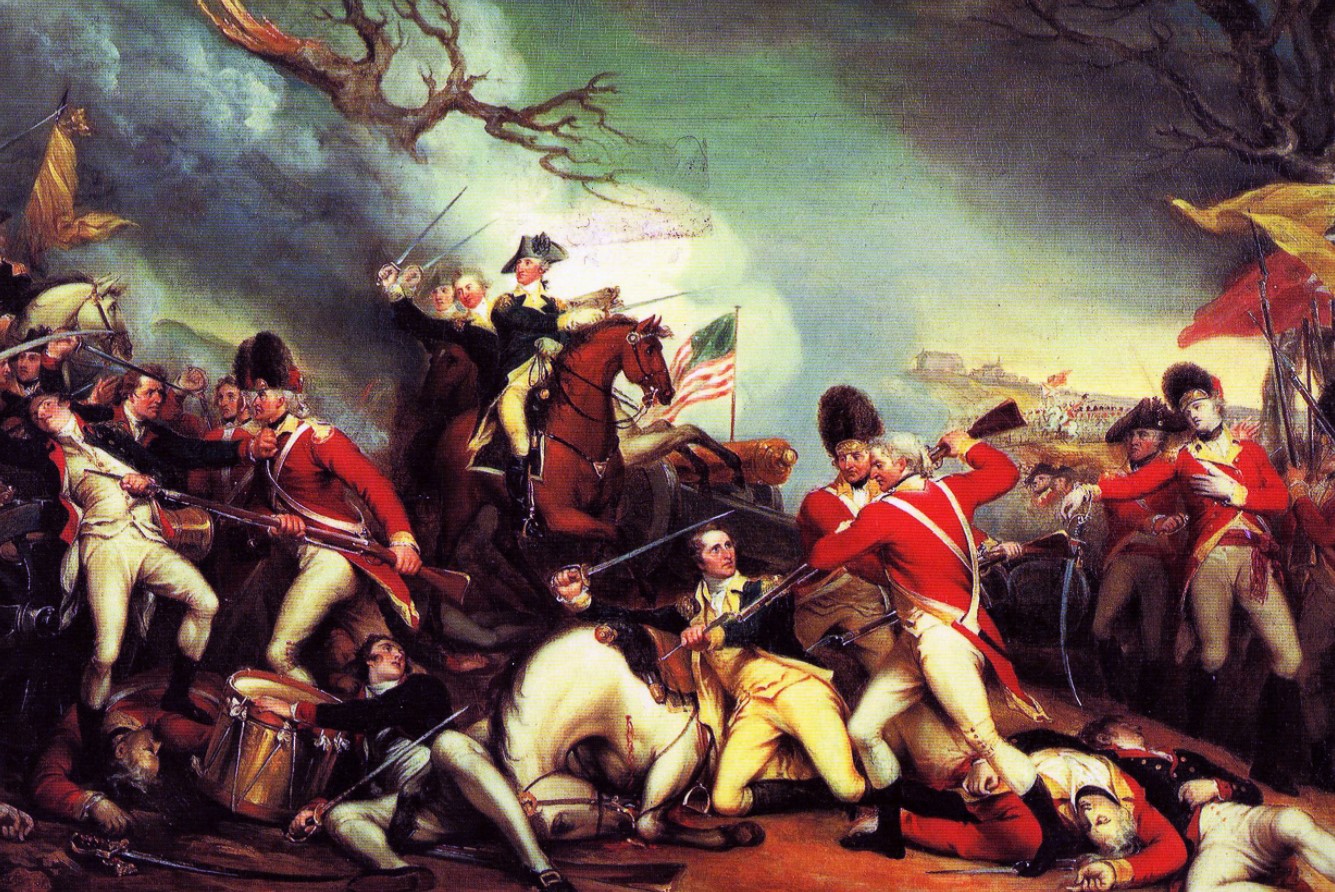
The featured image is “Death Of General Mercer at the Battle of Princeton” by John Trumbull (1756–1843) and is in the public domain, courtesy of Wikimedia Commons.
Bishop Challoner's Meditations ~ 17th June

ON THE BLESSED EUCHARIST AS A SACRIFICE OF THANKSGIVING

Consider first, that we are also indispensably obliged to return due thanks to God for all his bounties, favours, and mercies to us; and that, as these are boundless and infinite, he has a right to call for a return of all the gratitude and love we are capable of; and that nothing less than an infinite thanksgiving can be equivalent to the debt we owe him. But O! how little is all that our store can afford towards discharging so immense a debt! If we should ever offer him our whole being, and this could be a return for the great benefit of our creation, by which he has given us this being, what should we have left to give him, or what return should we be able to make him for our redemption, for our preservation, for our vocation, and for so man others his benefits, and above all for that eternal free love of his for us, which is the source of all these benefits? See then how good our God has been in furnishing us, by the means of the eucharistic sacrifice, with a standing fund to enable us to discharge this infinite debt, and to render him thanksgiving worthy of him.
Consider 2ndly, that as the thank-offerings of the law of nature and of the law of Moses fell infinitely short of answering in a proper and sufficient manner the obligation incumbent on mankind of returning due thanks to God, the Son of God himself became man to make himself our priest and victim, and in that quality to offer up in our behalf a worthy sacrifice of thanksgiving, no less infinite, by reason of the dignity of his person, than those favours and mercies were for which he makes this return of thanks. This sacrifice of thanksgiving he offered once upon the cross, and offers daily in the Eucharist upon a million of altars throughout the world; and in this offering he expects that his whole family of heaven and earth should join with him; that with him and through him they may make a daily return of worthy thanks for all God's blessings bestowed upon both him and them. See, my soul, thou be never wanting in this duty.
Consider 3rdly, what this thanksgiving is, that we are to offer up daily to God in the sacrifice of the blessed Eucharist, a sacrifice which takes its very name from thanksgiving. 1. We are to return thanks to God for his own great glory, manifested in all his works. 2. We are to thank him in particular for the great work of our redemption. 3. We are to offer up to him this sacrifice in thanksgiving for the incarnation and birth of his Son, and for all the blessings bestowed upon him, according to his human nature: for his doctrine and miracles, for his passion and death, for his resurrection and ascension, and for all that power which is given him in heaven and earth. 4. We are likewise to offer up sacrifice in thanksgiving for ourselves, and for the whole church, triumphant, militant, and patient, and for all that mercy, grace, and salvation which has at any time been derived by man form the sovereign source of all good, through Jesus Christ. See, Christians, how much we all, in general, have to thank God for besides the special favours for which each one in particular stands indebted to the divine bounty. But infinite thanks be to his infinite goodness who has provide for us this sacrifice of infinite value, in which we may daily present ourselves before him, in the company of Jesus Christ his Son, and make him a suitable and acceptable offering, through him, for his favours!
Conclude to unite daily thy intentions with those, with which Jesus Christ daily offers this sacrifice upon all the altars throughout his church; the thanksgiving offered by him, and nothing less, will be equal to thy debt.
17 June, Antonio, Cardinal Bacci: Meditations For Each Day

The Feast of Corpus Christi
1. St. Thomas refers to the Blessed Eucharist as the greatest of all Jesus Christ’s miracles.
All the other miracles were accomplished in an instant or, at the most, protracted over a few years, like the raising to life of Lazarus, or the widow’s son at Naim. The Eucharist, on the contrary, is a miracle which continues throughout the centuries and all over the world.
The other miracles, moreover, gave us a part of the power and goodness of Jesus. But the Eucharist gives us Jesus Himself with all His graces and gifts. It was not enough for Our Lord to offer Himself on Calvary as a propitiary host for our sins. It was not enough for Him to shed His precious Blood for our redemption. It was not enough to give us the Church to instruct us and to guide us on the way to Heaven.
He wished to give us Himself in addition. He wished to remain with us as our companion on our mortal pilgrimage and as the spiritual nourishment of our souls.
The power of Jesus is an infinite as His charity. Nevertheless, in the Eucharist this power and charity are, as it were, exhausted. Only the immense love of God could conceive such a miracle.
When we consider this mysterious gift which Jesus has given to each of us, we cannot say that it is too difficult for us to conquer the perverse inclinations of our corrupted nature and that we lack the strength to continue on the way of perfection. Everything is possible with Jesus. “I can do all things in him who strengthens me.” (Phil. 4:13)
Let us go to Jesus and take our nourishment from Him. Then, like St. Paul, we shall be able to do everything in Him Who is our strength and our support. In union with Jesus we shall be able to conquer sin and to become holy.
2. Human words cannot express the beauty and depth of the passage from the Gospel which today’s liturgy of the Holy Mass offers for our meditation. It is the passage in which Jesus promises the institution of the Blessed Eucharist.
“My flesh is food indeed, and my blood is drink indeed. He who eats my flesh, and drinks my blood, abides in me and I in him. As the living Father has sent me, and as I live because of the Father, so he who eats me, he also shall live because of me. This is the bread that has come down from heaven; not as your fathers ate the manna, and died. He who eats this bread shall live forever.” (John 6:56-59)
No human being could have visualised or uttered such words. Only the God-Man could have spoken them.
Even outside the Eucharist God communicates with us, descending with His grace into our souls. We feel that He is present; we experience His supernatural influence and inspiration, His appeals to us to do good. But in the Eucharist we have far more than this. We have the God-Man as the food of our souls, through which we live His own life, so that like St. Paul it is no longer we who live, but Christ who lives in us.
This intimate and mysterious union has been compared with the unfathomable union in which the Son of God lives the life of His heavenly Father, because by means of the Eucharist we should live the supernatural life of Jesus. As a result of this transformation there can be no further place in us for sin, nor for disordered affections and desires, but only for virtue and for God.
3. This is the Feast of Jesus in the Blessed Eucharist. Let us enkindle in ourselves a more intense faith and love; let us adore and love Him on behalf of those who neglect to do so. Let us resolve to live a Eucharistic life.
"I adore You at every moment, O living Bread from Heaven, O most wonderful Sacrament."
Eastern Rite ~ Feasts of 17 May AM 7534
Today is the Feasts of the Holy Martyrs Manuel, Sabel and Ismael and of Our Venerable Father Hypatius, Hegumen of Ruphenia.
The Holy Martyrs Manuel, Sabel and Ismael, brothers by birth, were descended from an illustrious Persian family. Their father was a pagan, but their mother was a Christian, who baptized the children and raised them with firm faith in Christ the Savior.
When they reached adulthood, the brothers entered military service. Speaking on behalf of the Persian emperor Alamundar, they were his emissaries in concluding a peace treaty with the emperor Julian the Apostate (361-363). Julian received them with due honor and showed them his favor. But when the brothers refused to take part in a pagan sacrifice, Julian became angry. He annulled the treaty and incarcerated the ambassadors of a foreign country like common criminals.
At the interrogation he told them that if they scorned the gods he worshipped, it would be impossible to reach any peace or accord between the two sides. The holy brothers answered that they were sent as emissaries of their emperor on matters of state, and not to argue about “gods.” Seeing their firmness of faith, the emperor ordered the brothers to be tortured.
They beat the holy martyrs, then nailed their hands and feet to trees. Later, they drove iron spikes into their heads, and wedged sharp splinters under their fingernails and toenails. During this time of torment the saints glorified God and prayed as if they did not feel the tortures.
Finally, the holy martyrs were beheaded. Julian ordered their bodies to be burned, and suddenly there was an earthquake. The ground opened up and the bodies of the holy martyrs disappeared into the abyss. After two days of fervent prayer by the Christians, the earth returned the bodies of the holy brothers, from which a sweet fragrance issued forth. Many pagans, witnessing the miracle, came to believe in Christ and were baptized.
Christians reverently buried the bodies of the holy martyrs Manuel, Sabel and Ismael in the year 362. Since that time the relics of the holy passion-bearers have been glorified with miracles.
When he heard about the murder of his emissaries, and that Julian was marching against him with a vast army, the Persian emperor Alamundar mustered his army and started off toward the border of his domain. The Persians vanquished the Greeks in a great battle, and Julian the Apostate was killed by the holy Great Martyr Mercurius (November 24).
Thirty years later the pious emperor Theodosius the Great (+ 397) built at Constantinople a church in honor of the holy martyrs, and Saint Germanus, Patriarch of Constantinople (May 12), then still a hieromonk, wrote a Canon in memory and in praise of the holy brothers.
There he herded cattle for a time, and then he lived with a priest who taught him how to chant the Psalms. Soon the chosen one of God was tonsured in one of the monasteries. Struggling against the temptations of the flesh, the holy ascetic spent fifty days in a strict fast. One night, with the blessing of the igumen, he drank some wine and ate some bread in the presence of the brethren, and was healed of his passions.
In search of a new place for ascetic struggles, Saint Hypatius settled with two other monks in the neglected Rufinus monastery near Chalcedon (Asia Minor). The monastery was rebuilt and soon many monks gathered about the holy ascetic, and the monastery began to flourish spiritually once more.
At the age of forty, Saint Hypatius was chosen igumen and he guided the monastery for forty years. Many monks, imitating their guide, attained spiritual perfection. For his strict ascetic life and love for others, Saint Hypatius was granted the gifts of wonderworking and healing by the Lord. Through his holy prayers bread was multiplied at the monastery. Those afflicted with demons, and the blind, the withered and the haemorrhaging, came to the monastery and were healed.
Saint Hypatius reposed in 446, at eighty years of age. On the eve of his death, he predicted misfortunes to come: a devastating hailstorm, an earthquake, and Attila the Hun’s invasion of Thrace.
Troparion — Tone 8
By a flood of tears you made the desert fertile, / and your longing for God brought forth fruits in abundance. / By the radiance of miracles you illumined the whole universe! / O our holy father Hypatius, pray to Christ our God to save our souls!
✠✠✠✠✠

When they reached adulthood, the brothers entered military service. Speaking on behalf of the Persian emperor Alamundar, they were his emissaries in concluding a peace treaty with the emperor Julian the Apostate (361-363). Julian received them with due honor and showed them his favor. But when the brothers refused to take part in a pagan sacrifice, Julian became angry. He annulled the treaty and incarcerated the ambassadors of a foreign country like common criminals.
At the interrogation he told them that if they scorned the gods he worshipped, it would be impossible to reach any peace or accord between the two sides. The holy brothers answered that they were sent as emissaries of their emperor on matters of state, and not to argue about “gods.” Seeing their firmness of faith, the emperor ordered the brothers to be tortured.
They beat the holy martyrs, then nailed their hands and feet to trees. Later, they drove iron spikes into their heads, and wedged sharp splinters under their fingernails and toenails. During this time of torment the saints glorified God and prayed as if they did not feel the tortures.
Finally, the holy martyrs were beheaded. Julian ordered their bodies to be burned, and suddenly there was an earthquake. The ground opened up and the bodies of the holy martyrs disappeared into the abyss. After two days of fervent prayer by the Christians, the earth returned the bodies of the holy brothers, from which a sweet fragrance issued forth. Many pagans, witnessing the miracle, came to believe in Christ and were baptized.
Christians reverently buried the bodies of the holy martyrs Manuel, Sabel and Ismael in the year 362. Since that time the relics of the holy passion-bearers have been glorified with miracles.
When he heard about the murder of his emissaries, and that Julian was marching against him with a vast army, the Persian emperor Alamundar mustered his army and started off toward the border of his domain. The Persians vanquished the Greeks in a great battle, and Julian the Apostate was killed by the holy Great Martyr Mercurius (November 24).
Thirty years later the pious emperor Theodosius the Great (+ 397) built at Constantinople a church in honor of the holy martyrs, and Saint Germanus, Patriarch of Constantinople (May 12), then still a hieromonk, wrote a Canon in memory and in praise of the holy brothers.
✠✠✠✠✠
Saint Hypatius, Igumen of Rufinus in Chalcedon was born in Phrygia (Asia Minor) into the family of a lawyer and he received a fine education. Once, when he was eighteen years old, his father punished him, after which the youth left home and went to Thrace (Balkans).There he herded cattle for a time, and then he lived with a priest who taught him how to chant the Psalms. Soon the chosen one of God was tonsured in one of the monasteries. Struggling against the temptations of the flesh, the holy ascetic spent fifty days in a strict fast. One night, with the blessing of the igumen, he drank some wine and ate some bread in the presence of the brethren, and was healed of his passions.
In search of a new place for ascetic struggles, Saint Hypatius settled with two other monks in the neglected Rufinus monastery near Chalcedon (Asia Minor). The monastery was rebuilt and soon many monks gathered about the holy ascetic, and the monastery began to flourish spiritually once more.
At the age of forty, Saint Hypatius was chosen igumen and he guided the monastery for forty years. Many monks, imitating their guide, attained spiritual perfection. For his strict ascetic life and love for others, Saint Hypatius was granted the gifts of wonderworking and healing by the Lord. Through his holy prayers bread was multiplied at the monastery. Those afflicted with demons, and the blind, the withered and the haemorrhaging, came to the monastery and were healed.
Saint Hypatius reposed in 446, at eighty years of age. On the eve of his death, he predicted misfortunes to come: a devastating hailstorm, an earthquake, and Attila the Hun’s invasion of Thrace.
Troparion — Tone 8
By a flood of tears you made the desert fertile, / and your longing for God brought forth fruits in abundance. / By the radiance of miracles you illumined the whole universe! / O our holy father Hypatius, pray to Christ our God to save our souls!
Subscribe to:
Posts (Atom)