A recipe for today. These "bones" sound delicious! In Spain, they are characteristic of pastry shops for the celebration of All Saints' Day.
From Aleteia
By V.M. Traverso
Spain’s “Huesos del Santo,” or “bones of the Saint,” are a beloved marzipan treat baked to remember those who have passedCatholics usually celebrate All Saints Day by going to church and paying a visit to the cemetery. But to many communities around the Spanish peninsula, this annual ritual is accompanied by another long-established tradition: baking “bones of the saint” cookies.
Known in Spanish as “Huesos del Santo” these bone-shaped treats are made with almonds, sugar and eggs and filled with egg yolk custard. Their origin goes back to at least the 17th century: they are mentioned in a 1611 cookbook by Spanish writer and chef Francisco Martínez Motiño.
According to tradition, it was a Benedectine monk who first introduced these log-shaped sweets to encourage the shift away from borderline pagan customs, towards Christian celebrations of All Saints Day.
Believers were encouraged to bake “huesos del Santo” and share them with their community as part of the annual All Saints Day ritual, the treats acting as a culinary reminder of saintly relics. Over the course of the centuries, these “bones” become associated with All Souls day, too.
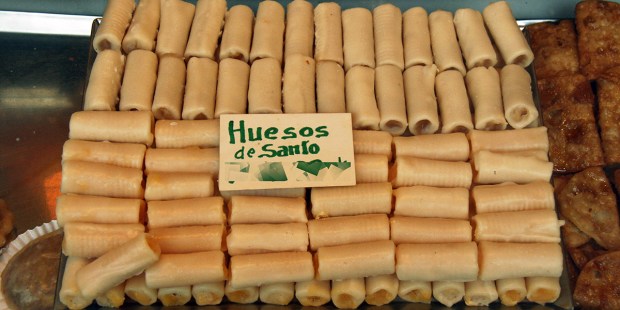
As explained by Juan Manuel Albelda, the owner of Toledo’s 250-year-old marzipan company Obrador San Telésforo, eating these bone-shaped cookies during All Saints Day and All Souls Day is a way to remember those who have passed.
“They serve as a way to respect those who have died and to show that we haven’t forgotten them,”Albelda explained in an interview with Atlas Obscura.
And indeed, for the past 250 years, these bone-shaped treats, baked at home or in pastry shops, have accompanied Spanish Catholics in their celebration of All Saints Day, from going to church to visiting the cemetery. The tradition has even crossed borders and became popular outside of Spain: it is believed that the Mexican tradition of “pan de los muertos” evolved from “huesos del Santo” cookies brought to the New World by the Spanish.
In recent times, the centuries-old recipe of “huesos del santo” has been expanded to include new versions filled with coffee-cream, vanilla or chocolate. But according to Albelda, it is the original version, made of a hard marzipan shell and a soft egg-yolk interior, that still proves the most popular nearly 500 years after it was first invented.
To bake “Huesos del Santo” at home, follow this recipe:
Ingredients
Marzipan:
4 cups almond flour
2 ½ cups powdered sugar
½ cup water
1 tablespoon honey (optional)
1 teaspoon lemon zest
Yolk cream filling:
4 egg yolks
½ cup sugar
¼–⅓ cup water
Preparation
First, make the marzipan, mixing almond flour, sugar, zest, and honey. Add hot water gradually and knead into a smooth dough. Chill 1–2 hours. Then, make the filling. Boil sugar and water into syrup. Slowly pour into beaten yolks while whisking. Cook over low heat until thick. Cool. Go back to the marzipan and cut it into “bones.” Roll marzipan to 1/8-inch thick.
Cut strips, wrap around a thin rod (2-inch), and seal. Let dry a few hours.
To finish, pipe yolk cream into each “bone.”


No comments:
Post a Comment
Comments are subject to deletion if they are not germane. I have no problem with a bit of colourful language, but blasphemy or depraved profanity will not be allowed. Attacks on the Catholic Faith will not be tolerated. Comments will be deleted that are republican (Yanks! Note the lower case 'r'!), attacks on the legitimacy of Pope Leo XIV as the Vicar of Christ, the legitimacy of the House of Windsor or of the claims of the Elder Line of the House of France, or attacks on the legitimacy of any of the currently ruling Houses of Europe.