Earlier in the month, I shared a video, "The Latin Mass Is Not Going Away... and Here’s Why, With Dr Peter Kwasniewski" from Pints With Aquinas. Here is Dr Kwasnieski's "resource list" to go with the video.
From Tradition and Sanity
By Peter Kwasniewski, PhD
Matt Fradd released to the public the 3-hour-and-45-minute conversation he and I had in his studio a couple of weeks ago — quite a vigorous exchange about the liturgy, tradition, the reform, Vatican II, and much else besides. I encourage you to watch it.
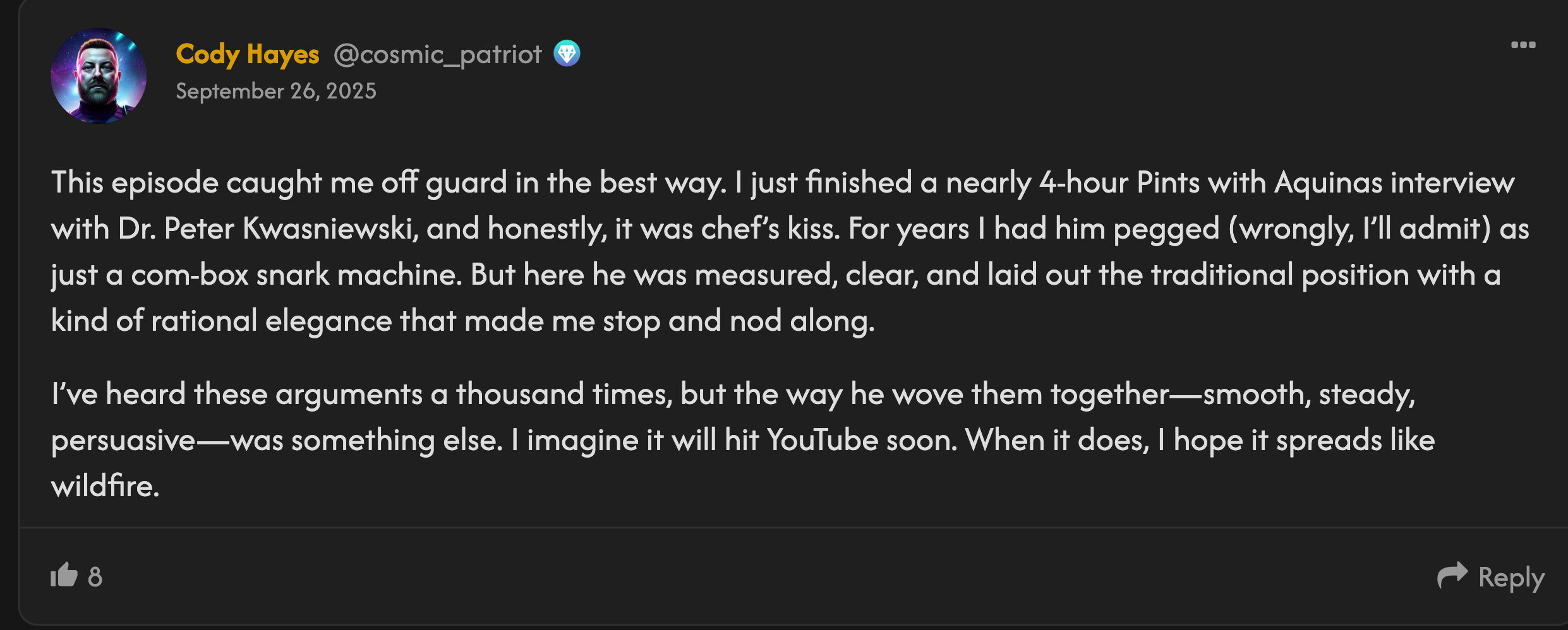
Early reactions have been over-the-top positive. Here’s one fellow’s reaction:
Laus Deo et Mariae!
Because we touch on so many controversial issues, and there’s only so much one can say on the spur of the moment, I decided to make available a list of further content you can read or listen to concerning various points raised. The time-stamps to the PWA episode are given below in bold. If no author is mentioned, the item is by me.
Resource List
Pints with Aquinas interview with Dr. Peter Kwasniewski (10/1/25)
7:40
24:50
Anna Elissa, Mantilla: The Veil of the Bride of Christ [book]
“The Theology Behind Women Wearing Veils in Church” [article]
31:16 & 3:27:00
“Why It Is Better Not to Understand Everything Immediately: The Wisdom of the Traditional Liturgy” [lecture]
33:30
Michael Davies, Liturgical Revolution trilogy [books]
48:47
49:35
Dom Prosper Guéranger, Liturgical Institutions [book]
53:09
“The Continual Spectre of False Antiquarianism” [article]
“False Antiquarianism and Liturgical Reform” [article]
56:45
57:00
Yves Chiron, Annibale Bugnini: Reformer of the Liturgy [book]
Yves Chiron, Paul VI: The Divided Pope [book]
Yves Chiron, Between Rome and Rebellion: A History of Catholic Traditionalism with Special Attention to France [book]
59:59
1:09:12
The exact quotation from Martin Mosebach’s book The Heresy of Formlessness, pp. 14-15:
Kneeling was medieval, they said. The early Christians prayed standing. Standing signifies the resurrected Christ, they said; it is the most appropriate attitude for a Christian. The early Christians are also supposed to have received Communion in their hands. What is irreverent about the faithful making their hands into “throne” for the Host? I grant that the people who tell me such things are absolutely serious about it all. But it becomes very clear that pastors of souls are incredibly remote from the world in these matters; academic arguments are completely useless in questions of liturgy. These scholars are always concerned only about the historical side of the substance of faith and of the forms of devotion. If, however, we think correctly and historically, we should realize that what is an expression of veneration in one period can be an expression of blasphemy in another. If people who have been kneeling for a thousand years suddenly get to their feet, they do not think, “We’re doing this like the early Christians, who stood for the Consecration”; they are not aware of returning to some particularly authentic form of worship. They simply get up, brush the dust from their trouser-legs and say to themselves: “So it wasn’t such a serious business after all.” Everything that takes place in celebrations of this kind implies the same thing: “It wasn’t all that serious after all.”
1:08:16
1:09:48
1:13:24
1:15:37
“Defense of the TLM’s ‘Sacerdotalism’” [lecture]
1:15:58
1:18:10
“‘From the East to the West’: A Defense of Ad Orientem Worship” [lecture]
“Mass ‘Facing the People’ as Counter-Catechesis and Irreligion” [article]
“The Normativity of Ad Orientem Worship According to the Ordinary Form’s Rubrics” [article]
“Seeking the Origins of ‘Versus Populum’ in the United States” [article]
1:19:29
1:26:38 & 3:16:32
1:29:58
1:50:46
Lauren Pristas, The Collects of the Roman Missals: A Comparative Study of the Sundays in Proper Seasons before and after the Second Vatican Council [book]
Lauren Pristas, “The Orations of the Vatican II Missal: Policies for Revision” [article]
1:50:55
Matthew Hazell, “‘All the Elements of the Roman Rite’? Mythbusting, Part II” [article]
1:53:41
“Sacrosanctum Concilium: The Ultimate Trojan Horse” [article], which was developed into a fuller case as chapter 1 of Close the Workshop [book]
1:54:09
“The Lie That Was Told to Over 2,000 Council Fathers at Vatican II” [article]
“What They Requested, What They Expected, and What Happened: Council Fathers on the Latin Roman Canon” [article]
“The Council Fathers in Support of Latin: Correcting a Narrative Bias” [article]
1:54:31
“Against Vernacular Readings in the Traditional Mass” [article]
“In Defense of Preserving Readings in Latin” [article]
1:56:08
“Indeterminacy and Optionitis” [article]
Chapters 4 & 7 of Close the Workshop [book]
1:57:40
“Why the ‘Reform of the Reform’ Is Doomed” [article]
Phillip Campbell, “Reform of the Reform: Liturgical Russian Roulette” [article]
“The ‘Latin Novus Ordo’ Is Not the Solution” [article]
1:57:58
“The Liturgical Rollercoaster and the Temptation of Tinkeritis,” chapter 12 of Close the Workshop [book]
2:02:54
2:07:30
Guéranger, Liturgical Institutions, 59–61; 72–74 [book]
2:10:40
Hazell, “Paul VI Against the Council: The Censorship of the Psalms in the Divine Office” [article]
Felix Just, “Psalms and Verses Omitted from the Four-Week Psalter” [article]
“The Omission of ‘Difficult’ Psalms and the Spreading-Thin of the Psalter” [article]
2:10:46
Guéranger, Liturgical Institutions, 85 [book]
The Once and Future Roman Rite: Returning to the Traditional Latin Liturgy after Seventy Years of Exile, 202–3 [book]
2:13:29
Chiron, Annibale Bugnini: Reformer of the Liturgy, 37–39 [book]
2:20:01
“The Pope’s Boundedness to Tradition as a Legislative Limit: Replying to Ultramontanist Apologetics” [lecture]
“Papal Authority over Liturgy: A Dialogue” [article]
“The Primacy of Tradition and Obedience to the Truth” [lecture]
Bound by Truth: Authority, Obedience, Tradition, and the Common Good [book]
True Obedience in the Church: A Guide to Discernment in Challenging Times [book]
2:23:27
“Are Traditionalists Guilty of ‘Private Judgment’ Over the Popes?” [article]
“Conundrums About Interpretation: What Is a Catholic to Do?” [article]
2:25:18
Alcuin Reid, ed., A Bitter Trial: Evelyn Waugh and John Carmel Cardinal Heenan on the Liturgical Changes [book]
2:33:00
2:34:59
“The Horns of the Death Penalty Dilemma” [article]
“What Good is a Changing Catechism? Revisiting the Purpose and Limits of a Book” [lecture]
2:39:28
“In the Midst of Crisis, Be Driven by Faith, Not by Fear” [article]
“To a Friend, on Persevering in a Most Unholy and Unchristian Age” [article]
“A Reply to the Discouraged Seminarian: There Are 6,000 Reasons to Remain Catholic” [article]
2:46:00
“Beyond ‘Smells and Bells’: Why We Need the Objective Content of the Usus Antiquior” [lecture]
“The Reign of Novelty and the Sins of the Times: Why the Novus Ordo Is Solely Modern in Content” [lecture]
2:46:50
2:49:04
“Can a Bishop Restrict a ‘Private Mass’ in the Usus Antiquior to a Priest and a Server?” [article]
“Does a Priest Need Permission to Offer the Traditional Latin Mass?” [article]
2:55:42
“The Long Shadow of Neoscholastic Reductionism” [article]
2:59:05
See Congregation for Divine Worship and the Discipline of the sacraments, Redemptionis Sacramentum no. 11
Pontifical Council for Culture and Pontifical Council for Interreligious Dialogue, Jesus Christ the Bearer of the Water of Life: A Christian Reflection on the “New Age”:
This study invites readers to take account of the way that New Age religiosity addresses the spiritual hunger of contemporary men and women. It should be recognized that the attraction that New Age religiosity has for some Christians may be due in part to the lack of serious attention in their own communities for themes which are actually part of the Catholic synthesis such as the importance of man’ spiritual dimension and its integration with the whole of life, the search for life’s meaning, the link between human beings and the rest of creation, the desire for personal and social transformation, and the rejection of a rationalistic and materialistic view of humanity.... The unstructured or chaotic life of alternative communities of the 1970s has given way to a search for discipline and structures, which are clearly key elements in the immensely popular “mystical” movements. New Age is attractive mainly because so much of what it offers meets hungers often left unsatisfied by the established institutions.
3:23:52
“Not Just More Scripture, But Different Scripture—Comparing the Old and New Lectionaries” [article]
“The Omission that Haunts the Church—1 Corinthians 11:27-29” [article]
3:36:06
Joseph Shaw, “St Pius V and the Mass” [article]
3:42:24
John Henry Newman, “Thoughts Respectfully Addressed to the Clergy on Alterations in the Liturgy” [article]
3:43:51
3:44:31
3:45:43
Fr. Javier Olivera Ravasi, The Cristero Counterrevolution and the Battle for the Soul of Mexico [book]
3:47:17
Erratum
At one point, speaking rapidly, I said “Pius XI’s encyclical Mediator Dei.” Of course, the author of it was Pius XII — something I knew, as can be seen from countless articles of mine online that refer to the correct author. Everyone’s bound to make a verbal slip somewhere in a 4-hour conversation! If I find any more, I’ll put them here.
Charges
There is a type of Catholic out there who will quickly (and very often without even having watched the podcast) race to his chair and pepper various comboxes with accusations that I am a “heretic,” a “schismatic,” or even a “sedevacantist” (and accuse Matt Fradd for having “given me a platform”).
Such charges would be laughable if they were not false and sinfully slanderous.
I have written extensively against sedevacantism, and hold no truck with it. For example, see volume 1 of my The Road from Hyperpapalism to Catholicism.
I hold no heretical views whatsoever; I don’t even dip my big toe in the shallowest pond of error. I can make this claim confidently on the twin basis of Ludwig Ott’s Fundamentals of Catholic Dogma, which furnishes a detailed overview of the Church’s dogmatic teaching, and Alfonso de Castro’s 1,067-page tome Against All Heresies, which spells out every imaginable (and sometimes unimaginable) heresy ever identified and condemned — not to mention the sensus fidei honed over decades of study of St. Thomas Aquinas, the Church’s Common Doctor, about whom I have written two scholarly monographs (this one and this one).
Yes, I hold some minority views (e.g., the non-infallibility of canonizations), but these are allowed to be held and debated by Catholic theologians, as the Church’s Magisterium has issued no definitive judgment in their regard.
Lastly, those who are going to bandy about the grave charge of “schism” should take five minutes to acquire an understanding of what schism actually is and entails. I recommend reading Phillip Campbell’s article “Stop Using This Word [viz., ‘schism’] So Recklessly.”
Ah, the internet, where intelligent discourse sometimes flourishes… and sometimes goes to die!

No comments:
Post a Comment
Comments are subject to deletion if they are not germane. I have no problem with a bit of colourful language, but blasphemy or depraved profanity will not be allowed. Attacks on the Catholic Faith will not be tolerated. Comments will be deleted that are republican (Yanks! Note the lower case 'r'!), attacks on the legitimacy of Pope Leo XIV as the Vicar of Christ, the legitimacy of the House of Windsor or of the claims of the Elder Line of the House of France, or attacks on the legitimacy of any of the currently ruling Houses of Europe.