As a former Orthodox, it is not "bitterness" they feel towards the Catholic Church. It is HATRED, deep in their DNA. When I swam the Tiber, most of my Orthodox "friends" refused to speak to me.
From The Imaginative Conservative
By Joseph Pearce
The bitterness that many Orthodox Christians feel towards the Catholic Church is rooted in a historical perception of past grievances which Catholic Christians don’t share and don’t understand. For this reason alone, Catholics will benefit from reading Dmitri Solzhenitsyn’s book, which surveys the history of the relations between the two churches.
Reuniting Rome with the Orthodox: How the Great Schism Unfolded and Might Yet Be Healed, by Dmitri Solzhenitsyn (272 pages, Creed & Culture, 2026)
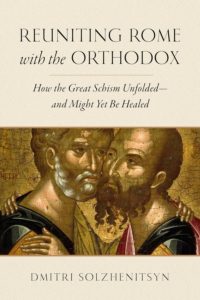 It is almost a thousand years since the Great Schism, which divided the Orthodox Christians in the east from the Catholic Christians in the west. This division is heartbreaking for many Christians on both sides of the divide because it signifies the broken heart of the Church herself. It is, therefore, refreshing to see a new work by a young Orthodox author which seeks to suggest ways of healing the heartbreak.
Reuniting Rome with the Orthodox: How the Great Schism Unfolded and Might Yet Be Healed is written by Dmitri Solzhenitsyn, grandson of Aleksandr Solzhenitsyn, the great Russian author and winner of the Nobel Prize for Literature.
Although conciliatory in tone, as the theme and title of the book would suggest, Mr. Solzhenitsyn sees the events leading up to the Schism and the history since the Schism from an Orthodox perspective. This is understandable and perhaps unavoidable but it will raise the eyebrows and possibly even the ire of some Catholic readers.
And yet such misgivings should not detract from the noble cause which Mr. Solzhenitsyn is advocating, nor should it deter Catholics from reading his book. Indeed the nobility of the cause for which Mr. Solzhenitsyn is fighting is made apparent in the opening paragraph of the opening chapter:
Christ sent the Holy Spirit to the apostles on Pentecost to establish “one, holy, catholic and apostolic church.” Today, the Roman Catholic Church and the Eastern Orthodox Churches both profess their identity with Christ’s Church; yet, lacking communion, they are no longer “one” with each other. Somewhere along the way, our Churches have squandered the ties that once bound them together in Christ’s body.
Mr. Solzhenitsyn describes his book as “the result of a personal quest to understand the origins of the Great Schism… as well as the obstacles that continue to hinder the Churches’ reunification”. As an Orthodox Christian, he confesses “a bittersweet sense of kinship” with the Catholic Church “akin to the memory of a long-lost brother”.
As a Catholic Christian, the present author can confess a similar sense of kinship with his Eastern Orthodox brethren, though perhaps not the same bittersweetness. The bitterness that many Orthodox Christians feel towards the Catholic Church is rooted in a historical perception of past grievances which Catholic Christians don’t share and don’t understand. For this reason alone, Catholics will benefit from reading Mr. Solzhenitsyn’s book, which surveys the history of the relations between the two churches. A Catholic historian would dissent perhaps with the way that aspects of this history are presented but there’s no denying that Mr. Solzhenitsyn has tried very diligently to be balanced and unbiased in his approach. His goal is the reasoned reconciliation of the two sides, not the dredging up of old grudges.
The problem is that the knowledge of history will not be enough in itself to bring the two parties together because the wounds are not merely historical but theological. The three theological bones of contention remain unresolved: the primacy of the See of Peter, the filioque clause in the Creed, and the use of leavened or unleavened bread in the liturgy.
Apart from these three theological elephants in the room, which stand in the way of reunion, there are also contemporary problems which need to be resolved in both the Orthodox and Catholic Churches. In the East, the divisions and tensions between the Patriarchates of Constantinople and Moscow need to be resolved prior to any realistic hopes of reunion with Rome. In the West, the divisions and tensions between orthodoxy and modernism need to be resolved through the triumph of the former over the latter. This need for Catholics “to get their house in order” is stressed in the Afterword to Mr. Solzhenitsyn’s book, written by the great English Dominican, Fr. Aidan Nicholls: “It will require a return to the dogmatic, moral, and liturgical settlement achieved by Popes John Paul II and Benedict XVI in the wake of the Second Vatican Council. That remains, currently, an open issue–not to say an open wound.”
Aside from the messiness of ecclesial politics, in both the past and the present, and the theological thorns of division which continue to wound the Mystical Body of Christ, perhaps a modicum of comfort and hope can be offered by the retelling of a well-known legend about St. Augustine.
While Augustine was working on De Trinitate, his great work on the Trinity, he saw a boy on the beach trying to pour the whole of the sea into a hole in the sand using a seashell. When the great Doctor of the Church explained to the boy that it was impossible to get the great sea into the little hole, the child replied that it was not so difficult as trying to get the great and eternal mystery of the Trinity into the human mind.
Surely this same principle can be applied to the filioque clause in the Creed. Theologians on both the Orthodox and Catholic side of the divide quote passages from Scripture to “prove” that the Holy Spirit proceeds either from the Father and the Son, or from the Father alone. Irrespective of theological “proofs”, the whole question is philosophically incomprehensible to the human mind. Surely this is a case of trying to get the ocean into a bucket!
As a Catholic who has no difficulty accepting the filioque, the present author sees no reason why the Orthodox Creed, which omits it, should thereby be considered invalid or heretical. On this issue, at least, both sides need to embrace the mystery and accept its mastery over our understanding.
And while we’re on the subject of mystery, we need to remember that the Church is both the Mystical Body of Christ and the Bride of Christ. She is always “one flesh” in this mystical marriage. There is no division in the Church when she is understood in her mystical fullness. The Church Triumphant has already won the victory. There is no division among the saints in heaven. The only divisions among the members of the Church are to be found in the Church Militant, the temporal Church in this vale of tears and this land of exile, which fights in enemy territory. The scars that the Church Militant wears are war wounds; they are the crowns of thorns worn by those who are crucified with Christ. With this mystery in mind, we need not worry unduly about divisions among the members of the Church on this side of the grave because we know that there are no divisions on the other side of the grave. We need to pray for unity, praise the Lord and keep our eyes on heaven. Perhaps we might even dare to hope that the great man, Aleksandr Solzhenitsyn, the author’s grandfather, is praying for such unity from his own place of reward in the Church Triumphant.
On this note, we’ll return to, and end with, the final words of Aidan Nicholls in his Afterword to Reuniting Rome with the Orthodox: “Dmitri Solzhenitsyn’s book looks ahead to a time when conditions are ripe. That time, as far as we can tell, is not now. But perhaps, by God’s grace, this book will help hasten its coming.”
No comments:
Post a Comment
Comments are subject to deletion if they are not germane. I have no problem with a bit of colourful language, but blasphemy or depraved profanity will not be allowed. Attacks on the Catholic Faith will not be tolerated. Comments will be deleted that are republican (Yanks! Note the lower case 'r'!), attacks on the legitimacy of Pope Leo XIV as the Vicar of Christ, the legitimacy of the House of Windsor or of the claims of the Elder Line of the House of France, or attacks on the legitimacy of any of the currently ruling Houses of Europe.