"As a professor of history .... I encountered the consequences of reading—and increasingly, the consequences of not reading—every day."
From The Imaginative Conservative
By Mark Malvasi
My greatest concern as a teacher for more than thirty years was my students’ inability or unwillingness to read. I repeatedly tried, and repeatedly failed, to persuade them that when they read, they were not merely absorbing information, but were also, and more importantly, rehearsing acts of imagination.
I.
 “Bisogna saper leggere,” Jakob Burckhardt told his students. “You must know how to read.” Burckhardt did not, of course, mean that his students must become literate. Rather, he meant that they needed to cultivate the habit of attention, for the ability to read was essential to understanding history, literature, culture, society, and ultimately the self. As a professor of history for more than thirty years, I encountered the consequences of reading—and increasingly, the consequences of not reading—every day.
How well I recall the moment when I first understood what I read without having someone explain it to me. I can only describe it as vertiginous. The world turned upside down, and yet everything made more sense than ever before. The sensation of vertigo is more precise, and more important, than it might at first appear. I had not simply understood something I read; I had discovered a truth that I have never forgotten: Language can be inhabited. Although it was not clear to me at the time, I ceased to regard words as labels attached to things and began to experience them as a medium in which thought itself unfolds. I had realized that reading no longer involved the mere retrieval of information, but as Burckhardt instructed his students, I discovered it was a way of paying attention.
In the May of 2026, I retired from teaching for the second, and the last, time. I will spare readers the details of my abrupt retirement in 2024 or the reasons I briefly returned to teaching in 2026. Suffice it to say that I quit, and that I was hesitant to return, because, among other things, I feared I could no longer teach serious courses. In this case, my prescience required no special gift. Leaving aside the widespread use of artificial intelligence that compromises the integrity of every writing assignment, my greatest concern was the students’ inability or unwillingness to read.[i] The effect was obvious and immediate. Their vocabulary diminished. Their knowledge of history weakened. Their writing, notwithstanding the intrusion of AI, deteriorated. The erosion of those abilities is real and enduring. But there is an even deeper loss: the gradual disappearance of attention and interiority.
Minds have become superficial and puerile, their mental furnishings cheap, inferior, and often garish. More troubling, such minds betray an arrogant self-satisfaction at their ignorance, which they often display as a badge of honor. These are commonplace, pedestrian minds, emotionally stunted and intellectually vulgar, not only incapable but also unwilling to think, that is to reason from what they know to what they do not. If I understood my students at all—and I was often as baffled by them as they must have been by me—they assumed that learning should be easy and that knowledge should be cheaply had. Knowledge had joined the ranks of other disposable commodities, to be discarded as soon as they completed their assignments and no longer needed it. What they had learned, if I may be permitted the term, held no value beyond its immediate utility. Reading, for many, was a burdensome way to acquire knowledge. Some students went so far to complain that, by requiring them to read so much, I was withholding from them information vital to their success in the course. It would have been simpler for me to tell them what they needed to know instead of compelling them to discover it for themselves in the pages of books and essays.
Sustained reading demands the entrance into, and the reconstruction of, another consciousness. I repeatedly tried, and repeatedly failed, to persuade my students that when they read, they were not merely absorbing information, nor should that exercise have been their main objective. They were also, and more important, rehearsing acts of imagination. They were learning to sustain ambiguity, to defer judgment, to entertain ideas and possibilities that had not previously occurred to them. It was difficult work, I assured them, but it was also profoundly rewarding and profoundly human. If people ceased to read, I promised, they would become less practiced at inhabiting complexity. They would know less about the world and themselves.
In addition, reading cultivates habits of mind on which every democratic society depends. These include patience, the capacity to reason, the willingness to revise beliefs and understanding in the face of new evidence, a tolerance for ambiguity, uncertainty and disagreement, the recognition that another mind may be richer and more complex than first impressions suggest. Such habits are not literary or scholarly virtues alone. They are civic virtues as well. A people that does not or cannot read struggles to think–at least to think seriously and deeply. I do not mean that everyone must become a scholar or a critic. I do mean that the mental habits careful reading fosters have consequences extending far beyond the classroom.
At the same time, it is easy, especially for those of us who love books, to conclude that our society is simply becoming less intelligent. Mounting evidence indicates that it may be true, but the conclusion is too facile and, perhaps, not quite accurate. To be sure, what we might call the economy of attention has changed. Although few of my students showed any evidence of even glancing at the assigned readings for the courses I taught, it occurred to me that they were, in fact, reading all day every day. They received, read, and responded to myriad texts and notifications, not just from friends and family but many of them from the college administration. As numerous scholars and journalists have pointed out, it is not the quantity but the quality of reading that has diminished. Most contemporary reading is optimized for efficiency and summary. My students implicitly asked: “What is the point of a book or essay?” “What do I need to know about it?” “How is this information of immediate relevance to my needs?” Serious literary and scholarly writing poses alternate, if not opposite, questions. Such writing asks readers to contemplate what it means to be human. What if there were no immediate use to a piece of writing? Does it still have value? What if it requires readers to think and reflect rather than to act, to pause and attend rather than to consume? Those experiences are increasingly unfamiliar, and I will venture, now almost nonexistent for many, perhaps most, members of my students’ generation. On the contrary, their approach to language is utilitarian and instrumentalist. They want to know what they need to do to complete an assignment. “What answers do I seek?” students ask. They do not understand, or at least they resist, my telling them that the answers come from them, not from me, and that they must formulate their responses based in part on what they read.
It is not that persons will stop appreciating Dante, Shakespeare, Goethe, or Austen, that they will cease to understand Plato, Aquinas, Tocqueville, or Weil. It is that they will no longer recognize that language, and the written word in particular, requires something of them, and that they cannot remain passive in their encounters with it. If nothing else, every important text asks readers to become someone different by the time they have finished reading than they were when they began. This commitment is, in my mind, a moral, or at the very least, an ethical responsibility. We are losing that expectation. As a result, language itself has begun to stultify and flatten. Abbreviations and shorthand are replacing words and sentences. And words themselves are becoming instruments of transaction rather than discovery. Public discourse is correspondingly trivial, insipid, and vulgar. We speak and write in slogans because slogans demand little of the speaker, the writer, the listener, or the reader. Slogans simply reality, offering easy solutions to complex problems. As such, they not only cloud judgment, but they also make thinking nearly impossible. Whether in commerce, politics, or education, superficiality is the point; ignorance, perhaps stupidity, is the result.
There is, I hasten to add, a vast difference between the spoken and the written word. The relation of one to the other is far more complicated than we might initially suspect. Although both speaking and writing are forms of expression, the spoken word has an immediacy that the written word lacks. As a result, speech is more ephemeral than writing. The connection between reading and writing is even more complex. As Adolf Hitler understood better, or at least earlier than most of his contemporaries, speech commanded the masses and animated their emotions while simultaneously decreasing, if not eliminating, their capacity for reason and judgment. Writing—and reading—are of a different order. Although writing may have an emotional component, the written word elicits not an immediate response, but invites thoughtful readers to pause, reflect, analyze, and evaluate—in a word, to think. I have not put the matter to the test, but I suspect that mature men and women have an easier time remembering what they read than what they hear.
I have no wish to dismiss oratory, the quality of which has also deteriorated. An accomplished speech, a brilliant lecture can stir the imagination and inspire the mind. We can only approximate the excitement that hearing The Iliad, The Odyssey, or Beowulf must have generated. The southern poet Donald Davidson believed that poetry should be recited and never read; a poem, he thought, died on the page. But as I once wrote of my paternal grandfather: “When a man dies who does not know how to write, his past dies with him, all the people he knew, a lifetime of experiences and memories, his whole world.” [ii] Spoken words disappear as soon as they are uttered. Speakers repeat themselves to aid memory. They do not edit as writers do. If they make a mistake, even if they contradict themselves, they go on, confident that their audience will not recall their words in detail sufficient to challenge them. It ought to come as no surprise that Hitler preferred dictation to composition.
Despite the publication of serious books and essays about serious subjects that appeal to serious readers, in all likelihood, present trends will continue and accelerate. Reading will become less common. There may come a time, if it has not already arrived, when the ability to read attentively will be similar to the ability to play a musical instrument well. Such abilities will not be universal, or even widespread, but will be deeply valued among those who cultivate them. At the same time, rarity is not extinction. For one who remains ever hopeful, but almost never optimistic, that concession is as far as I am willing to go. Witnessing the decline of my students during more than thirty years of teaching has left me both angry and sad, if for no other reason than I saw more clearly than they did what they stood to lose. They denied themselves an experience that altered my life and that I hoped would alter theirs. It is not what made me a professor, a historian, and eventually a writer. But it did change my angle of vision. It transformed the way I perceived the world. Most of my students missed an opportunity that may not come again and that may, in fact, already be beyond recovery.
II.
There was once a time when I could not read. I can no longer call it to mind. Nor do I remember the process of learning to read any more than I can imagine not knowing how to do so. The question that most interests me is not what I have learned from decades of reading, not the wealth of information I have accumulated, but how the act of reading changed me, or more accurately, how reading has shaped and reshaped the quality of my mind.
When I started teaching, in addition to wondering whether I would have enough material to fill class time or whether I would have sufficient command of my subject to avoid making a fool of myself and misleading my students, I told myself that I wanted to initiate a small revolution. Over the years, I have tried to explain this aspiration to colleagues. Invariably, they think I meant something political, that I intended to indoctrinate my students in one or another political ideology. Such are the limitations of their perspective. What I did propose was to create opportunities for students to see the world differently, to begin to view the world from a slightly different angle of vision. The rest was up to them. Since for most of my career as I taught history, I insisted that my students approach the past with an open mind, that they try to see the past for what it was before they began to impose categories on it or make judgments about it. I suggested that they at least pause long enough to consider that the past was very different for the people who lived through it than it is for those of us who study it from a distance.
In this effort, I did enjoy a small measure of success. More than once, a few students told me that my courses were the first they had ever taken in which historical figures seemed like real people and not merely the sum of their deeds and accomplishments. The revolution I sought was not in what students believed but in how they thought.
Most teaching is organized around the transfer of information. I know something. I teach it to you. Now you know it too. In addition, modern educators speak almost exclusively in the language of outcomes. Administrators and teachers routinely emphasize learning objectives, assessment metrics, disciplinary competencies—in a word, deliverables that they can qualify. I suppose this approach to teaching and learning has some merit, although I would do away with it completely if I could. The transformation I have been describing is resistant to such measurement. How can we assess whether a student has become more patient with ambiguity? How can we quantify a newly awakened capacity to imagine another person’s interior life? How do we add up the recognition that ideas, beliefs, and values—including our own—are historically contingent? The most important achievements of education are among the least calculable, which makes them easy to ignore or neglect.
I was not primarily trying to transmit historical knowledge. I was, instead, seeking to instill a habit of mind. I wanted students to abandon the reflex to categorize, to judge, to reduce, to simplify long enough to encounter another people and another world on their own terms. It is an ethic of attention before judgment. That was not an exercise in indoctrination but the opposite. It was an invitation to intellectual humility and moral restraint.
Permit me to be clear. I was not trying to engineer a particular outcome. I did not encourage my students to adopt a political ideology or extol one religious creed over another. I was not trying to take individuals and make them identical. Conformity is anathema to me. It has no place in my life and thus no place in my teaching or scholarship. In addition, conformity is easy. I ever and always reminded my students to think for themselves. I ask only that they examine and explain their reasons for making certain commitments and reaching certain conclusions. I liken my approach to gardening. A gardener cannot command the seeds to germinate. He can only prepare the soil, provide water and light, remove obstacles, and wait. Whether growth occurs depends partly on the seeds themselves. Teachers are often judged as though they were manufacturers. Students are the products whom they fashion and complete. Human beings may be nurtured and cultivated, like the seeds that a gardener buries in the soil. But human beings cannot, and should not, be mass produced according to an established process to fit a conventional design. Some lessons, and I prefer to think the most important ones, take a long time to flower.
It is in equal measure ironic and disheartening that in their diatribes about education, neither liberal nor conservative politicians have faced—or dare to face—the real crisis of education: the dissolution of learning. No people has ever placed greater faith in education than Americans. Their naïve conviction that education automatically improves the character arises, I suppose, from the dogmatic American belief in the perfectibility of man and society. Schools undertook not only to educate but also to civilize. They taught etiquette, morality, and citizenship as well as reading and writing, science, arithmetic, geography, and history. They enabled students to learn how to dance, how to cook, how to play a sport, and how to drive a car as well as how to add, subtract, multiply, and divide or to identify the parts of speech. Unlike their English counterparts, who hated the wretched Dickensian prisons to which they had been condemned, Americans loved their schools and often their teachers. They exhibited school pride and school spirit. Even after graduation, they gathered periodically with former classmates to reminisce about the blissful times they had shared. Yet, their wonderful memories notwithstanding, few could recall what they learned in school. When queried, many could not remember having learned anything at all.
This deficit certainly prevailed among the students whom I taught. It was, as I have suggested, in part a consequence of their inability to concentrate. Their severely limited attention spans, I suspect, were the result at once of the complexity and superficiality of modern life. They were (and are) over-stimulated, anxious, and undisciplined. Some could not even sit still and had permission to walk around during class or to leave the classroom as they wished. Their minds drifted from one unconnected impression to another and back again. To the extent that they thought at all, their thinking was episodic and fragmented; ideas, developments, and events existed in isolation and were thereby rendered meaningless. Their minds were cluttered and so their efforts at communication, whether in speech or in writing, were often hurried and incoherent. With rare exceptions, during the last decade or so of my career, tortured and unreadable prose became the norm among my students and, if nothing else, revealed the noisy tumult of their lives. They seem never to have enjoyed a moment of quiet repose or contemplation, or to have understood the blessings that such moments afford.
This bewilderment, of which my students were as much the victims as the architects, is a symptom of a deep psychological and spiritual mutation. To put the matter starkly: watching television, surfing the Web, scrolling through TikTok videos, and text messaging require less intellectual engagement than reading a poem, an essay, or a book. (The same may be said about listening to a piece of serious music or watching a sophisticated film.) During my career, the vocabulary of the students whom I taught became woefully stunted and inadequate. Nothing made me feel my age more than their unfamiliarity with, their indifference to, and their disengagement from words.
The devolution from literacy to illiteracy to what Rose Horowitch now calls “post-literacy,” combined with the inability to concentrate and pay attention, calls for a revolution in teaching, although not of the sort I hoped to launch. Instruction will—must of necessity—now become more visual than verbal. Lectures must be delivered only in a brief compass, if they are delivered at all and not replaced by PowerPoint presentations. Discussions must be cursory and trifling, assignments simple and basic. I was not and am not the man for the job.
My students increasingly reminded me of the Eloi in H.G. Wells’s novel The Time Machine. Delicate and peaceful, the Eloi enjoy idyllic lives in the year 802,701 A.D. They do no work and yet have all they need. They are perpetual children, innocent, carefree, and irresponsible. Except that they lack a child’s curiosity and a child’s sense of wonder. The Eloi are passive, inert, lazy, and stupid. The Morlocks, brutish creatures who inhabit the underworld, living beneath the surface of the earth, work to provide the Eloi with food and clothing. They are fattening them like cattle for the slaughter. The Morlocks nightly hunt, kill, and eat the Eloi.
For the moment I will leave aside Wells’s concerns about class privilege and exploitation to make what I consider a more important point. I wanted to feel compassion for my students, especially on the days when I returned assignments to which I had given poor grades. But I was more often overwhelmed by anger at the thought of those men and women who for centuries had risked and sacrificed to build a civilization only to witness their efforts miscarry and end in the ruin of neglect, ignorance, and complacency. Critics may argue that I was too hard on the young, that I demanded too much from those who were not yet mature enough to accept the burdens that I imposed upon them. I fear, by contrast, that intellectual immaturity has become a permanent condition. Like the Eloi, my students did not wish to grow up and did not believe that they must. Refusing to put aside their childish fancies, they resented anyone who threatened to disrupt their untroubled existence. I know it was not their fault; they had experienced no other reality and thus never had a chance. But I also know that they left themselves exposed and vulnerable to the present-day Morlocks who lurk in the dark corners of our world.
III.
My lingering hope as a teacher, however fleeting it became toward the end of my tenure, was that I could not know the results of my efforts, could not know what I have set in motion, could not know which students, in the years to come, would find value in what I taught. Anyone who plants a seed must retain some hope in the future. I tried to acquaint my students with words, books, and ideas. I tried to guide them in their quest for meaning. I tried to show them how to read. I tried to discuss ideas with them, and to persuade them that thinking, although hard work, was indispensable and ultimately gratifying. I can only hope that my influence will radiate outward in ways that I cannot anticipate and may never witness. That I will likely never know the consequences of my actions helps me to resist despair. The future of reading, and of learning in general, will not be secured by grand gestures and elaborate campaigns. It will depend on innumerable acts of quiet transmission—from parents, teachers, librarians, booksellers, friends, and writers who, one reader at a time, will awaken that same vertiginous moment that I earlier described: the instant when language ceases to be ink on a page and becomes a way of seeing and a way of knowing. That moment, if it comes, is impossible to forget. It changes everything.
A lifetime of reading has enabled me to acquire more than a storehouse of information and knowledge. I have also developed a habit of mind that resists premature abstraction, that distrusts superficial certainty, and that allows persons and things both to remain and to reveal themselves before asking what they mean, or before imposing a meaning on them. As a teacher, as a historian, and as a writer the underlying question has always been the same: How do we preserve the reality and the integrity of another existence without reducing it to our own purposes?
Both the act of reading and the struggle to understand what I read has taught me patience. I do not expect certainty before acting. I do expect responsibility afterward. I review the best evidence I have, fully aware that I might be proven wrong by future disclosures. I act, and then I see. In this way, I hope to avoid two opposite errors. The first is the illusion that I can gather enough information to eliminate uncertainty. The second is the romantic notion that I must trust my instincts and act without deliberation. I try, on the contrary, to make the best judgment possible given the evidence at my disposal and to remain open to revision when new evidence appears, or, perhaps more to the point, when I reconsider what I thought I knew and understood. A great many persons are willing to make hard decisions. Fewer are willing to revisit the assumptions behind those decisions without feeling that revision is an admission of failure, as was often the case with my students. But revision is not failure. Revision separates the essential from the accidental. It is thus among the defining characteristics of intelligence.
Some may ascribe my temperament to an abundance of caution, even to intellectual and moral cowardice. I demur. Nothing could be further from the truth. Caution and cowardice frequently imply avoidance. A person refuses to act because he cannot guarantee the outcome in advance, and because he fears the consequences of a mistaken judgment. I am willing to live with, and to act from, uncertainty and to accept error. I refuse to mistake confidence for knowledge. Historians may be especially prone to recognizing this distinction because history is replete with contingent moments. The men and women who made decisions at particular times did not know what we know. They acted with incomplete information. I tried to impress upon my students that among a historian’s principal responsibilities is to reconstruct that uncertainty rather than to judge the past as if the outcome had been as obvious or inevitable as it seems to us.
In my teaching and my writing, I begin with the conviction that the world has already accumulated meanings before we arrive to define, analyze, and interpret them. The objects of daily life and the actions of human beings carry their own significance and their own history. Human beings do not manufacture reality. We encounter it. We try to perceive and record it with a modicum of accuracy. If we are fortunate, we give back something clearer than what we received. The task of a historian is thus not to impose meaning but to discover what has been there all along, patiently waiting.
My instructions to students were always to pause, think, reflect, wait, see. Attend with care even to small to details that might otherwise disappear. Make the best judgment based on the evidence available. Decide. Act. Remain teachable. For a person who remains teachable is never finished. The world, intractable as it is, continues to correct and refine them. As I repeated to my students until they were probably tired of hearing it, the danger for a thoughtful person is not that they will make mistakes; everyone does. The danger is that their accumulated experience will harden into certainty. Experience should deepen perception rather than foreclose it. I advised them not to accept even a compelling idea or argument–mine included–without first examining the origins and the consequences. They should be neither dismissive nor reverential toward the past. Rather, they would do well to preserve the tension, to ask questions and to question answers.
Were I to distill my teaching into two words they would be: Pay attention. That impulse is fundamentally life-affirming. It does not seek to escape the world. It seeks deeper participation in, and deeper understanding of, it. I grew up in a tough, little mill town in the Ohio Rust Belt where horizons were narrow and opportunities few. I tried to model for my students a different moral vision, exemplifying the conviction that a life is not only something we possess but something we owe—to others, to the future, and perhaps even to the possibilities within ourselves that have not yet had the chance to emerge. In The Brothers Karamazov, Dostoyevsky returns often to the idea that persons must ultimately answer to the conscience they carry within themselves. The difficulty is that conscience does not always make life easier, does not always relieve suffering or offer a respite from grief. Sometimes yielding to conscience requires the surrender of what we most desire. Read, pay attention, and learn.
That observation returns us at last to the question of declining literacy. Where will it leave our society when fewer persons know how or care to read? In all candor, I do not know. In a recent issue of The Atlantic, Rose Horowitch speculated that “the generation growing up with their brains hooked on endless video feeds” might develop “some kind of novel, as-yet-undetectable cognitive brilliance.” But at the moment, Horowitch conceded, “the decline in reading seems to be ushering in a less rational, analytical, and sophisticated mode of thinking. It’s difficult to see any advantages in that.”[iii] Civilization has long depended on men and women who preserved forms of attention that had gone out of fashion. Sometimes they were monks copying manuscripts. Sometimes they were writers who maintained endangered wisdom. Sometimes they were musicians who kept alive an older tradition. Sometimes they were teachers who showed a classroom full of students that they, too, could enter the world of words, books, and ideas, and could make it their own.
None of these acts may have seemed consequential in the moment. Yet institutions, technology, and wealth alone will not safeguard culture or civilization. They will be saved by habits of attention passed from generation to generation, often one person at a time.
Earlier in this essay, I described my goal as a teacher to foment a small revolution. Perhaps “revolution” was too dramatic a word. As I meander toward a conclusion, I find myself thinking instead of something quieter. A student enters a room looking in one direction, perhaps seeking the answer to a question, perhaps seeking nothing more than for the clock to strike the hour when dismissal is at hand. He occupies a desk. He listens. Perhaps he jots a note or two. When he rises to leave, he sees the world from a slightly different angle, if only by a few degrees. Nothing spectacular or miraculous has taken place. The instructor raised no banners and proclaimed no doctrines. The room itself was unchanged. And yet, because the student altered his angle of vision, he has transformed the larger horizon perhaps without even recognizing what he has done. That kind of teaching rarely makes headlines, not should it. But it may have an effect that lasts a lifetime.
The revolutions that endure are often private. They occur when someone unexpectedly discovers that the world is more complicated and more worthy of patient attention than they had imagined. Once that shift occurs, even, again, if by just a few degrees, there is no turning back. There can be no return to the old way of seeing, the old way of thinking, or the old way of being.
__________
Notes:
[i] The decline in reading is not confined to students. According to a survey conducted by the National Endowment for the Arts, fewer than half of adults in the United States reported reading a book in 2022. Only thirty-eight percent read a novel or a short story. Of the 236,000 respondents to the American Time Use Survey (2023), only sixteen percent of adults read for pleasure. Many, perhaps most, students now arrive in college without the ability to maintain focus, with a low tolerance for sustained mental exertion, and with a limited ability to comprehend what they read, but the abandonment of the written word is far more complicated and widespread.
[ii] Mark G. Malvasi, Merigan: A Novel (Trenton, GA, 2022), 96.
[iii] Rose Horowitch, “The Age of Reading is Over,” The Atlantic (August 2026), 19.
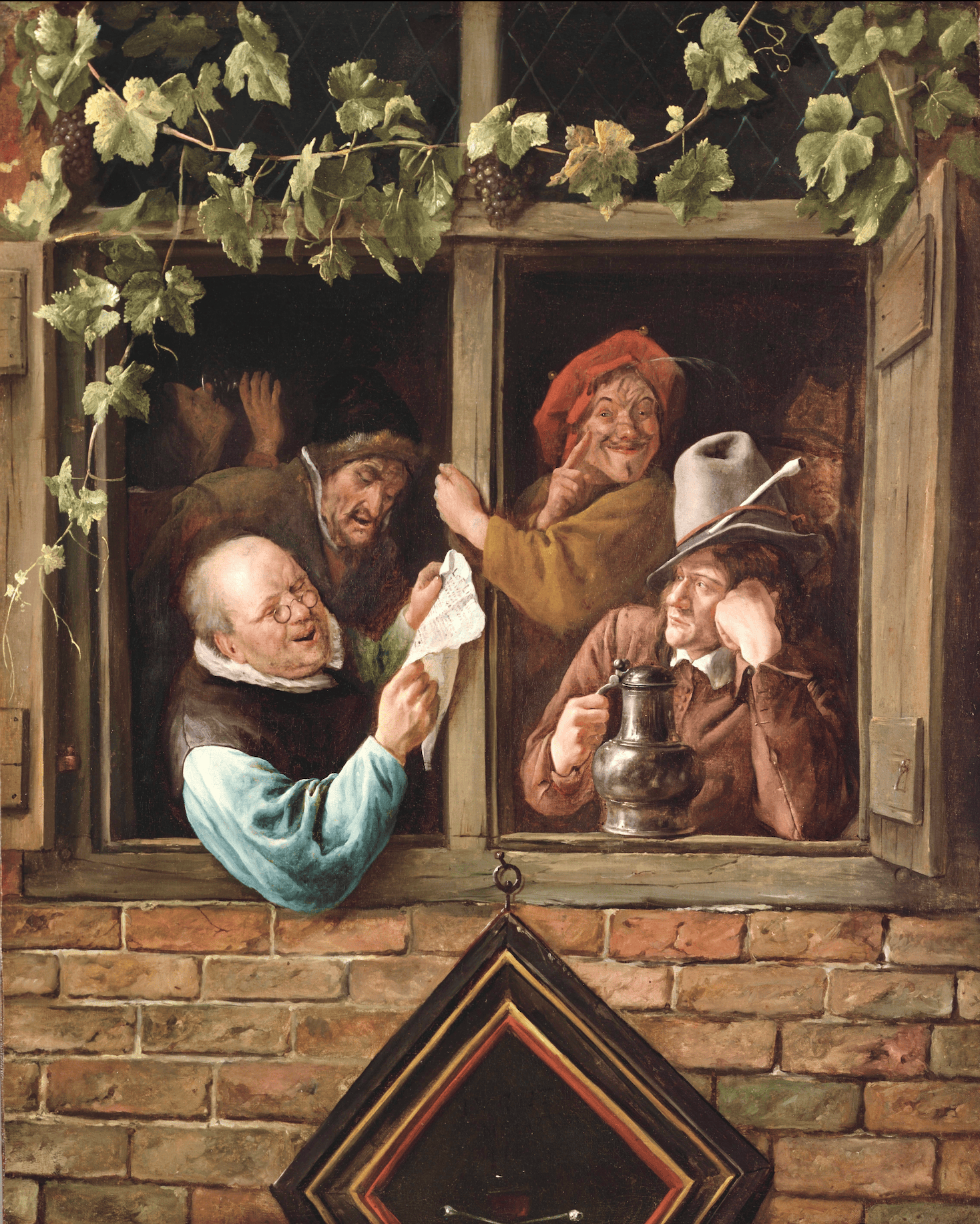
The featured image is “Rhetoricians at a Window” (between 1663 and 1665), by Jan Steen, and is in the public domain, courtesy of Wikimedia Commons.
No comments:
Post a Comment
Comments are subject to deletion if they are not germane. I have no problem with a bit of colourful language, but blasphemy or depraved profanity will not be allowed. Attacks on the Catholic Faith will not be tolerated. Comments will be deleted that are republican (Yanks! Note the lower case 'r'!), attacks on the legitimacy of Pope Leo XIV as the Vicar of Christ, the legitimacy of the House of Windsor or of the claims of the Elder Line of the House of France, or attacks on the legitimacy of any of the currently ruling Houses of Europe.