Since I am in the process of reading The Ballad of the White Horse, about King Alfred, by G. K. Chesterton, this essay is very apropos.
From The Imaginative Conservative
By Scott Crider, PhD
Here are the ten qualities to notice about the next poem you read.
 By “poem,” I mean lyric poem, the shortest, most concentrated form of the poetic activity of representing human action in order to understand that action and, therefore, ourselves, one of the most delightful ways of fulfilling the Apollonian dictate, “Know thyself.” With “how,” I note that, although a lyric poem has propositions within, it cannot be reduced to them unless we take into account their matter and form.
This is already getting rather abstract, so allow me to offer you a poem for us to discuss, “You Must Sing,” one of my favorites, an American sonnet from Li-Young Lee’s The City in Which I Love You (BOA Editions, Ltd., 1990). Read the poem aloud slowly to yourself:
He sings in his father’s arms, sings his father
to sleep, all the while seeing how on that face
grown suddenly strange, wasting to shadow,
time moves. Stern time. Sweet time. Because his father
asked, he sings; because they are wholly lost.
How else in immaculate noon, will each find
each, who are so close now? So close and lost.
His voice stands at windows, runs everywhere.
Was death giant? O, how will he find his
father? They are so close. Was death a guest?
By which door did it come? All the day’s doors
are closed. He must go out of these hours, that house,
the enfolding limbs, go burdened to learn:
you must sing to be found; when found you must sing.
Lovely and moving, no? I will work through the poem, focusing not only on what it says, but also on how, then try to understand why the “how” matters in the poem and in poetry generally.
The American sonnet is a fourteen-line poem whose line is not strictly iambic pentameter, and which has no rhyme scheme to speak of. How do we know it’s a sonnet at all? Well, it has fourteen lines, but the American form is highly aware of all the features of the Italian and English form—stanzas, for example. Stanza is Italian for little room: a stanza is a verse paragraph.
Let’s take our poem’s first stanza, even if those are a little hard to see because Lee likes to enjamb lines from one to the next, letting one line roll over into another, and he does so here during transitions from one stanza to another, as we will see in the first stanza:
He sings in his father’s arms, sings his father
to sleep, all the while seeing how on that face
grown suddenly strange, wasting to shadow,
time moves. Stern time. Sweet time.
Our poet is telling a story about what we might call, “the hospice moment,” when we attend to a dying parent. The visit to the underworld to visit a beloved is a mythic action: Orpheus seeking Eurydice or Aeneas, Anchises. There are epic, mythic allusions here to express the land between the living and dead during a passing. We don’t know if Lee is telling the story of another, or of himself, distanced through the third-person singular of “he.” Be that as it may, “He sings in his father’s arms, singing his father / to sleep ….” The singing may be literal, or it may be figurative; i.e., he may actually be singing, or it may be that singing is a metaphor for the activity of attending. Before assuming that Lee’s poem is in free verse altogether, it is worth pointing out that the first line has five stresses before the enjambed line carries over to the next: “He sings in his father’s arms, sings his father / to sleep ….” I note five stresses in each line without this being in any way the famous iambic pentameter of the English sonnet.
Though lyric poetry is not reducible to story, there is a narrative of “the hospice moment” here, though many of its exact features are ambiguous. The son watches his dying father as he sings to him, “seeing how on that face / grown suddenly strange, wasting to shadow, / time moves. Stern time. Sweet time.” Lee throws the prepositional phrase—“on that face grown suddenly strange, wasting to shadow”—before the time moving. Unusual word order is a common feature of lyric poetry. Why? Notice that here we begin with the mortal face, then rise to the abstraction of time and reflections upon it: “time moves. Stern time. Sweet time.” “Time” is repeated here in fascinating ways: the line so far opens and closes with time; the last two sentences each end with time, repetition that provides the rhythm that establish a theme, the variation of which is supplied by the paradox of the two adjectives for time: stern and sweet. Time is “stern,” one assumes, since its laws—one of which is that everyone dies—are not to be persuaded away; it is “sweet” because it makes possible such moments between those who love each other during the moment of losing each other.
As noted, the last part of the first stanza is enjambed to the next:
Because his father
asked, he sings; because they are wholly lost.
How else in immaculate noon, will each find
each, who are so close now? So close and lost.
His voice stands at windows, runs everywhere.
He sings “[b]ecause his father / asked,” but if, at first, you think he is only being dutiful in singing, we get a second reason: “because they are wholly lost.” The repetition of the subordinate conjunction “because” provides rhythm; the grammar of dependent-independent-dependent clause gives the sentence a framed pattern. We get a metaphor for the moment: the son and father are “lost,” to each other since one is going where the other cannot follow, and both together since neither has had this experience before—not only lost, but “wholly lost.” No part of the experience is identifiable. And the poet comments upon what is transpiring with a rhetorical question: “How else in immaculate noon, will each find each, who are so close now?” How else, one assumes, but by singing and being sung to. Whether the time indicated—“immaculate noon”—is literal or figurative, it is paradoxical: “immaculate noon.” As a student pointed out to me in a recent class discussion, noon is the time with the least shadow, the time furthest from darkness. So, during their visit to the underworld of shades, there is a pure experience of lighted clarity of outline and identity during this moment of intimacy, “each finding each,” the each-ness making them distinct, the frame repetition unifying them. Yet the intimacy does not negate the disorientation: “So close and lost.” The stanza’s final line is ambiguous: “His voice stands at windows, runs everywhere.” Whose voice? It seems to be the son’s since he is the one singing. It could be the father’s since he is the one leaving. Lee keeps the ambiguity.
But it could be anticipatory of the next stanza since a third character has arrived, death:
Was death giant? O, how will he find his
father? They are so close. Was death a guest?
By which door did it come? All the day’s doors
are closed.
The stanza’s four questions—the tone here is interrogative—are not rhetorical ones. The first—“Was death giant?”—and the second—“Was death a guest?”—catch death’s paradoxical character: “giant” because outsized and frightening; a “guest” because, once it is truly time for the beloved to go, one’s acceptance takes the form of an invitation. Not that such acceptance makes it easy, so the disorienting pain of the interrogative exclamation—“O, how will he find his / father?”—remains, as does the mystery of death, as the son judges immaterial things by the material—“By which door did it come?”—only to be stymied by doing so: “All the day’s doors are closed.” (One must pronounce those “d’s” to voice the poem.) The poem appears to be closing on confusion.
Yet it ends on clarity, an actual moral:
He must go out of these hours, that house,
the enfolding limbs, go burdened to learn:
you must sing to be found; when found you must sing.
By creating a three-line conclusion with a one-line moral, Lee ensures that this American sonnet will not be thought English: it leans away on either side of a couplet. Its “he” is less ambiguous than that one above. It might be his father, but I think it is the son, pointing toward the living member’s new life after the death of the father, beyond the hospice moment, but informed by it, after leaving the time, space, and embrace of that moment, into an ethic that he is “burdened to learn.” Orpheus knew he had failed Eurydice; Aeneas feared failing Anchises’ mandate. What he is burdened to learn is this: “you must sing to be found; when found you must sing.” The shift in person is startling: not a third-person “he,” but a second person “you.” The son is being addressed directly by the experience. And the lesson is double. First, it the imperative to sing in order to be found, one presumes by the lost beloved; second it is the imperative to sing once found thus. This is the mandate to lament and to celebrate, and there is here something of the David psalmist’s range of register. The ABBA framing of the actions—“song,” “found,” “found,” “sing”—reveals both the similarities and differences of the two registers as the son is addressed.
And as is the poet and the reader. That “you” is difficult not to feel directed both to the poet, the poem itself a living out of the mandate, and the poem’s readers who, either as poets themselves or simply poetic people reading poetry, must sing and find, find and sing.
Such singing and finding, finding and singing will require both attending to the loss of one’s own beloveds, and noting the qualities of song I have tried to highlight without excessive technicalities in order to encourage you to read more poetry. Here are the ten qualities to notice about the next poem you read:
- What are its audible stresses and sound effects;
- what is literal and what, figurative;
- what unusual features of diction are there;
- what words or phrases get repeated and how;
- what other literature does the poem allude to, and why;
- what grammatical features stand out as significant;
- what ambiguities remain, and why;
- what is the poem’s structural form, and why;
- what questions of life does it answer, and what does it not; and
- how does the poem remark upon its own activity?
There are other questions to ask, but addressing these as you sing to find and find to sing will, I hope, help you gather a number of other poems which can become, in Kenneth Burke’s phrase, “equipment for living.”
__________
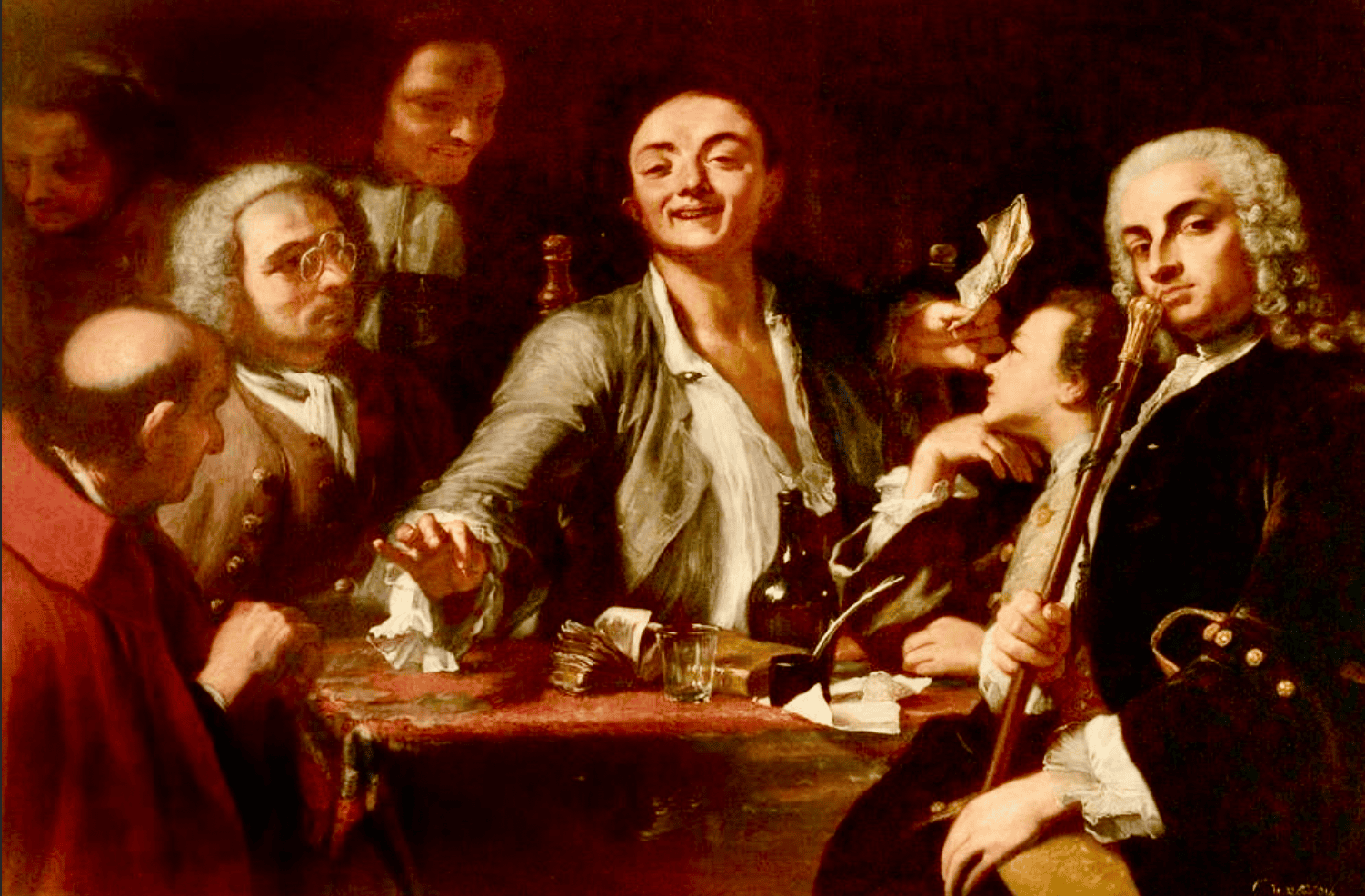
The featured image is “The Poet” (circa ), by Giuseppe Bonito, and is in the public domain, courtesy of Wikimedia Commons.
No comments:
Post a Comment
Comments are subject to deletion if they are not germane. I have no problem with a bit of colourful language, but blasphemy or depraved profanity will not be allowed. Attacks on the Catholic Faith will not be tolerated. Comments will be deleted that are republican (Yanks! Note the lower case 'r'!), attacks on the legitimacy of Pope Leo XIV as the Vicar of Christ, the legitimacy of the House of Windsor or of the claims of the Elder Line of the House of France, or attacks on the legitimacy of any of the currently ruling Houses of Europe.