I wish I could, indeed, spend an evening with Dr Johnson! He was a solid Tory, defining Whig as "The name of a faction" and a Tory as "One who adheres to the ancient constitution of the state, and the apostolical hierarchy of the church of England, opposed to a Whig."
From The Imaginative Conservative
By Joseph Pearce
Turning the pages of a volume of essays by Samuel Johnson, I felt at once that I had discovered a new friend, who shared with his admirer G.K. Chesterton the ability to make us see the everyday things of life with a new sense of wonder.
 The inimitable Dr. Johnson was just a famous name to me until I read the equally inimitable G.K. Chesterton. In discovering Chesterton’s admiration for Dr. Johnson, I discovered ipso facto someone worth admiring. If Chesterton liked Samuel Johnson, clearly I should like him too. Any friend of Chesterton’s was a friend of mine.
As I sought to illustrate in last week’s essay on Chesterton and Dr. Johnson, the former considered the latter a “great religious genius”, who “judged all things with a gigantic and detached good sense”. Clearly Dr. Johnson was someone whom I should know better. And yet he remained a stranger to me. Worse, my failure to read him constituted a veritable sin of omission. It is true that I own Boswell’s famous Life of Samuel Johnson in a handsome hardback edition, but I had only very occasionally dipped into its pages. I also own Johnson’s Rasselas, in a splendid 1819 edition, in full red Morocco and with an elaborate gilt, which has its place of honour in the antiquarian corner of my library, snuggling up to a four-volume Lives of the Saints, published in 1729. There it sat for years, untouched and largely unheeded, until I took it from the shelf at the end of 2024 and finally read it, to my great delight. I know the date because I listed it amongst “the best books I read in 2024” for an end-of-the-year feature in Catholic World Report. Having finally read it, I can fully appreciate and agree with Chesterton’s description of it as a “philosophical satire on philosophy” and his opinion that its author was “a philosopher mocking philosophers”.
Having had my appetite whetted by the brilliance of Rasselas, it surprises me that I would neglect Dr. Johnson for a further two years. Haunted by Chesterton’s praise for his “titanic intellectual power of logic” and his “love of humility, humanity, and of good and simple things”, I plucked another Johnson volume from the shelf. This was a volume of his selected essays, edited by W. J. Bate and published by Yale University Press in 1968.
Making myself comfortable in my favourite armchair, I settled down for an enjoyable evening with Dr. Johnson. Turning the pages, I felt at once that I had discovered a new friend, who shared with Chesterton the ability to make us see the everyday things of life with a new sense of wonder. Take, for instance, his description of the importance of the first discovery of glass:
Who… would have imagined, that in this shapeless lump lay concealed so many conveniencies of life, as would in time constitute a great part of the happiness of the world? Yet by some such fortuitous liquefaction was mankind taught to procure a body at once in a high degree solid and transparent, which might admit the light of the sun, and exclude the violence of the wind; which might extend the sight of the philosopher to new ranges of existence… and, what is yet of more importance, might supply the decays of nature, and succour old age with subsidiary sight…. Thus was the first artificer in glass… facilitating and prolonging the enjoyment of light, enlarging the avenues of science, and conferring the highest and most lasting pleasure; he was enabling the student to contemplate nature, and the beauty to behold herself.
As I read those words, I enjoyed the same sense of surprise at the glories of the commonplace as I had experienced when I had first read Chesterton’s words about the human eye. “Give me miraculous eyes to see my eyes,” Chesterton wrote. “Those rolling mirrors made alive in me, terrible crystals more incredible, than all the things they see.”
Today, as I write these words, I am using those “rolling mirrors made alive in me” to see the words I’m writing through the glasses perched on my nose and through the glass of the computer screen. Should I look up from the screen, I can see the meadow through the glass of the casement and, beyond the meadow, the towering trees surmounted by a clear early September sky. Echoing the words and wisdom of Dr. Johnson and G.K. Chesterton, I should not merely give thanks to God for the meadow and the trees and the sky but for the eyes and the eyeglasses and the windows.
__________
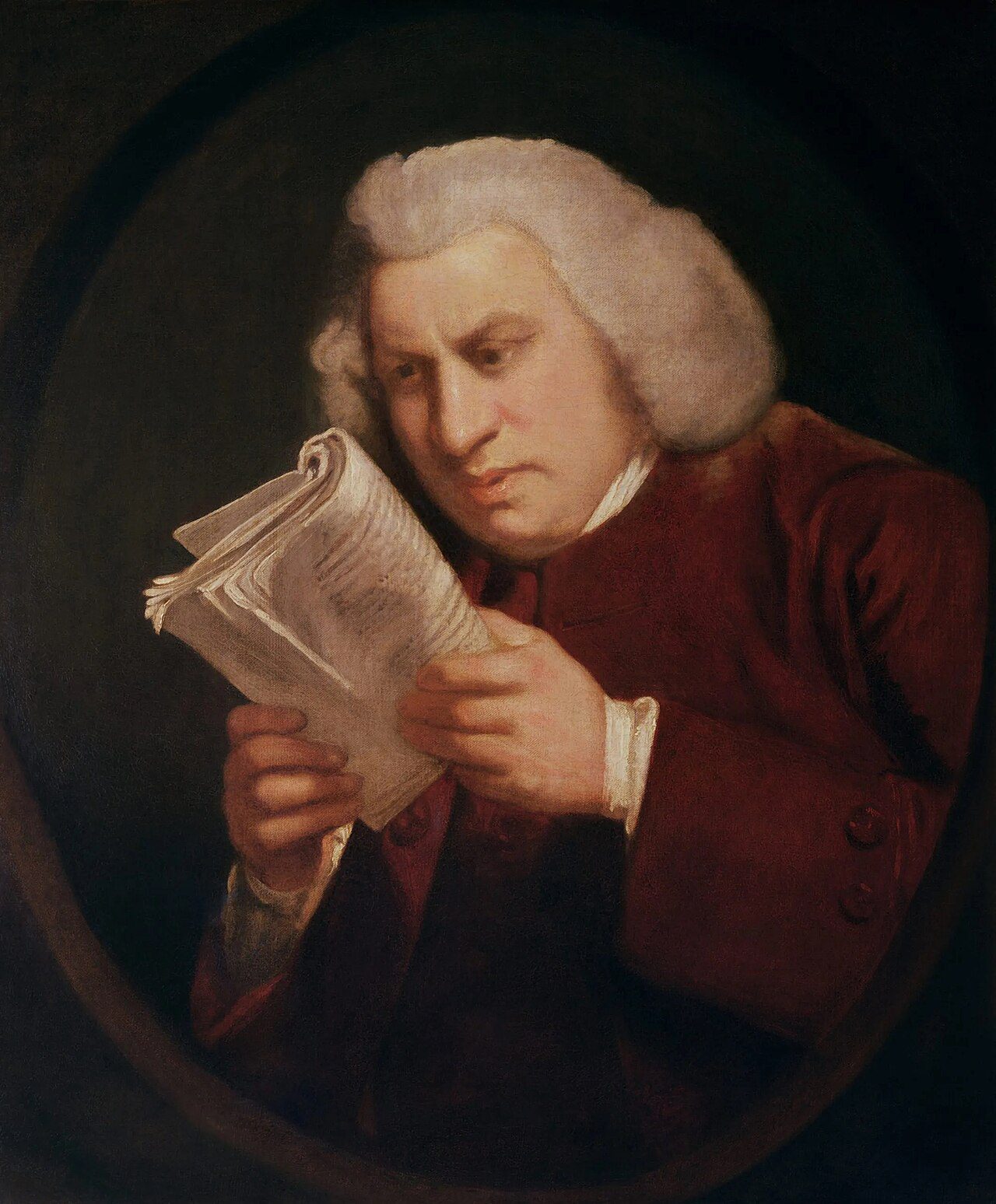
The featured image is a portrait of Samuel Johnson (“Blinking Sam”), painted by Joshua Reynolds in 1775, and is in the public domain, courtesy of Wikipedia.
No comments:
Post a Comment
Comments are subject to deletion if they are not germane. I have no problem with a bit of colourful language, but blasphemy or depraved profanity will not be allowed. Attacks on the Catholic Faith will not be tolerated. Comments will be deleted that are republican (Yanks! Note the lower case 'r'!), attacks on the legitimacy of Pope Leo XIV as the Vicar of Christ, the legitimacy of the House of Windsor or of the claims of the Elder Line of the House of France, or attacks on the legitimacy of any of the currently ruling Houses of Europe.