Barfield originated the idea of chronological snobbery, an argument that the thinking, art, or science of an earlier time is inherently inferior to that of the present.
From The Imaginative Conservative
By Fr Dwight Longenecker
At the heart of Owen Barfield’s thought is the concept of participation—the psychic unity between the perceiving self and the external phenomena it encounters. While Barfield’s theories are fascinating, he seems perhaps too pessimistic about humanity’s loss of vision.
 Owen Barfield was sometimes called “the silent Inkling.” C.S. Lewis called him “the wisest and best of my unofficial teachers.” Both having survived the Great War, Barfield and Lewis became friends at Oxford, and their friendship continued the rest of their lives.
After Oxford, through the 1920s, Barfield tried to make his way as a writer, producing The Silver Trumpet (a children’s fantasy), A History in English Words (exploring the history of Western civilization through changing word meanings), and Poetic Diction: A Study in Meaning. But finding the financial rewards of writing too challenging, he re-trained in law and joined his father’s law firm in London.
Barfield continued his friendship with Lewis and Tolkien, and his work on the development of language, consciousness, and the imagination influenced their own thought and creativity.
In his 1957 book Saving the Appearances: A Study in Idolatry, Barfield flexed his fascination with language, perception, and philosophy to explore how we relate to the world we perceive.
At the heart of Barfield’s thought is the concept of participation—the psychic unity between the perceiving self and the external phenomena it encounters.
Barfield begins his explanation by proposing that what we experience as reality is a system of collective representations—that we form through an interaction of our consciousness with the external phenomena. This “figuration” is an active, largely unconscious activity that produces the world as we know it.
Underlying this primitive activity by which our ancestors made make sense of their perceptions is a deeper and more intimate bond. In earlier stages of human history, this bond was experienced consciously and immediately. Barfield terms this state “original participation”. For primitive humans, he speculates, phenomena were never mere “things” standing over against the detached observer, instead the sky, the tree, the animal, the mountain or the storm carried an interior life contiguous with the perceiver’s own.
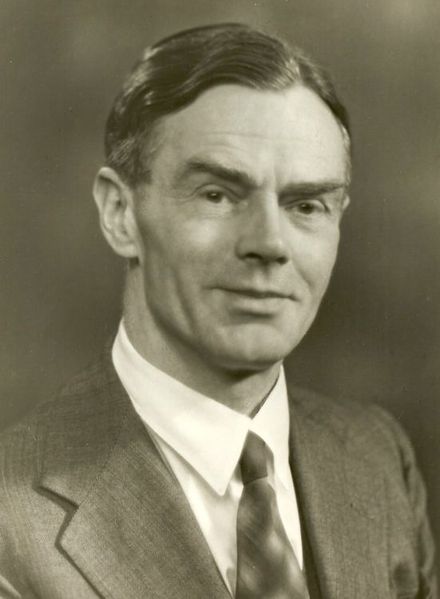
Owen Barfield
Barfield criticizes the early anthropologists who explained animism as primitive man perceiving awesome external phenomena and assigning supernatural powers to them. Instead, Barfield proposed, their apprehension of the gods or spirits of nature was an expression of their direct unitive experience with nature. Subject and object were not defined in a binary way nor did they approach reality with logic and rationality. Instead it was all one. They were an organic part of the natural order and experienced the “inside” of things personally and psychically.
Barfield speculated that over eons this original participation gradually dwindled from conscious awareness. Two historical forces accelerated the withdrawal. The first was the Hebrew rejection of graven images, and the insistence that the natural world is distinct from the transcendent creator. By forbidding the identification of God with any created form, Judaism not only killed pagan animism and polytheism but also began the long process of stripping the appearances of their interior spirit.
The second, Barfield proposed, was the scientific revolution. By systematically stripping phenomena of their essences, and qualitative meanings in favor of quantitative, mechanical explanations, modern science completed the evisceration of the appearances. I would add that between these two forces was the influence of nominalism, which also stripped the natural world of the underlying Platonic forms leaving the material appearances no more than a collection of names.
Consequently, as moderns, we experience ourselves as detached onlookers confronting a random and meaningless collection of objects. What Barfield called “Alpha-thinking”—the habit of thinking about the appearances as separate things—dominates, while the personal, unitive participation fades away.
Thus, as observers we are alienated from the material world. Without participation—that intimate, unitive relationship— nature becomes a resource to be exploited, and human beings lose the sense that they share an interior kinship with the cosmos, and eventually they lose not only their relationship with nature, but also with one another and with the divine. Accordingly, every man is an island.
Barfield does not advocate some sort of artificial attempt to “get back to the garden.” He acknowledges that the development of individual self-consciousness and scientific knowledge was a necessary stage in the evolution of the human spirit.
Instead, he anticipates a final participation, in which the human imagination consciously re-enters the continuing development of consciousness. However, instead of meaning being received passively from outside; it is actively bestowed—the imagination enlivening the images rather than being enlivened by them. Assuming an evolutionary model, Barfield’s thought (heavily influenced by Rudolph Steiner’s anthroposophism) echoes the “omega point” proposed by the Jesuit philosopher and anthropologist Teilhard de Chardin.
If you have followed this dense discussion so far, one is left with the question, “So how shall we then live?” Barfield’s basic observation that we live in a modern, de-mystified world is indisputable, but what to do about it? To put it simply, how might we enter into that final participation in which we engage with the deeper meaning of the world and thus move beyond mundane materialism?
While Barfield’s theories are fascinating, he seems perhaps too pessimistic about humanity’s loss of vision. In every age culture and religion there has always been a strand of mysticism that leads to a unitive, immersive experience. The holy men and women, the poets and artists have always retained that inner insight—the ability to look into everything rather than to look through everything. They have always seen “eternity in a grain of sand” and proclaimed that “the world is charged with the grandeur of God.”
The contemplative and meditative traditions have urged practitioners to a consciousness that is focused and simple, and the three classic steps of Catholic spirituality move the soul from purgation, through illumination, to a unitive state.
So, in the arts and in the traditions of spirituality, humanity has retained and nurtured that one-ness: that immersion in a deeper reality.
Furthermore, it occurs to me that it is in the beauty of traditional liturgy that ordinary people may participate in eternal truth, beauty, and goodness in a more intimate and personal way.
As such I am reminded of the famous lines from Sacrosanctum Concilium, the second Vatican Council’s Constitution on Sacred Worship:
Mother Church earnestly desires that all the faithful should be led to that full, conscious, and active participation in liturgical celebrations which is demanded by the very nature of the liturgy. Such participation by the Christian people as ‘a chosen race, a royal priesthood, a holy nation, a redeemed people’ (1 Pet. 2:9; cf. 2:4-5), is their right and duty by reason of their baptism.
Barfield called for a development in human consciousness that renewed humanity’s intimate engagement with the eternal within and through the material world. I suggest that it is already there and has been all along. Through the arts and particularly in the liturgy and sacramental life, we apprehend beauty and thus ritually, intimately, and profoundly connect with the unseen realm, and so are inducted into an anticipatory participation here and now that looks forward to that final participation which is the consummation of all things.
__________
Fr Longenecker’s latest book Bloodshed and Blessing: Stories of Ancient Altars to the Catholic Mass is published by Sophia Institute Press.
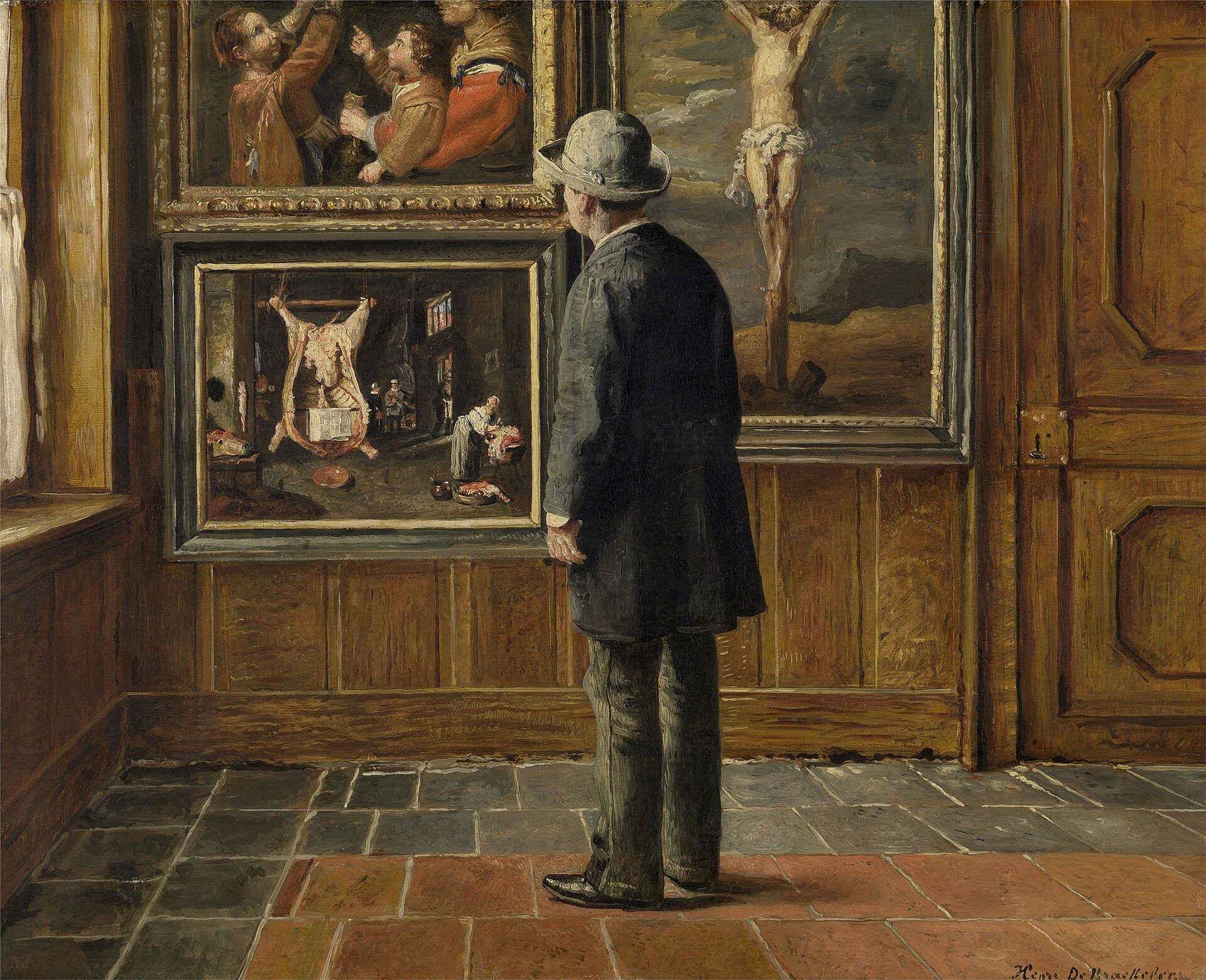
The featured image is “The Art Lover” (circa 1884), by Henri de Braekeleer, and is in the public domain, courtesy of Wikimedia Commons. The photograph of Own Barfield was taken in 1937 and is in the public domain, courtesy of Wikimedia Commons.
No comments:
Post a Comment
Comments are subject to deletion if they are not germane. I have no problem with a bit of colourful language, but blasphemy or depraved profanity will not be allowed. Attacks on the Catholic Faith will not be tolerated. Comments will be deleted that are republican (Yanks! Note the lower case 'r'!), attacks on the legitimacy of Pope Leo XIV as the Vicar of Christ, the legitimacy of the House of Windsor or of the claims of the Elder Line of the House of France, or attacks on the legitimacy of any of the currently ruling Houses of Europe.