The Major Oak of Sherwood Forest has died. Mr Pearce compares it to Treebeard in the LoTR, whose death would signal the deth of Middle Earth.
From The Imaginative Conservative
The Major Oak, like Robin Hood and Maid Marian, has died. Its death is felt even more deeply because of what it signifies. Its death seems to signify the death of England itself.
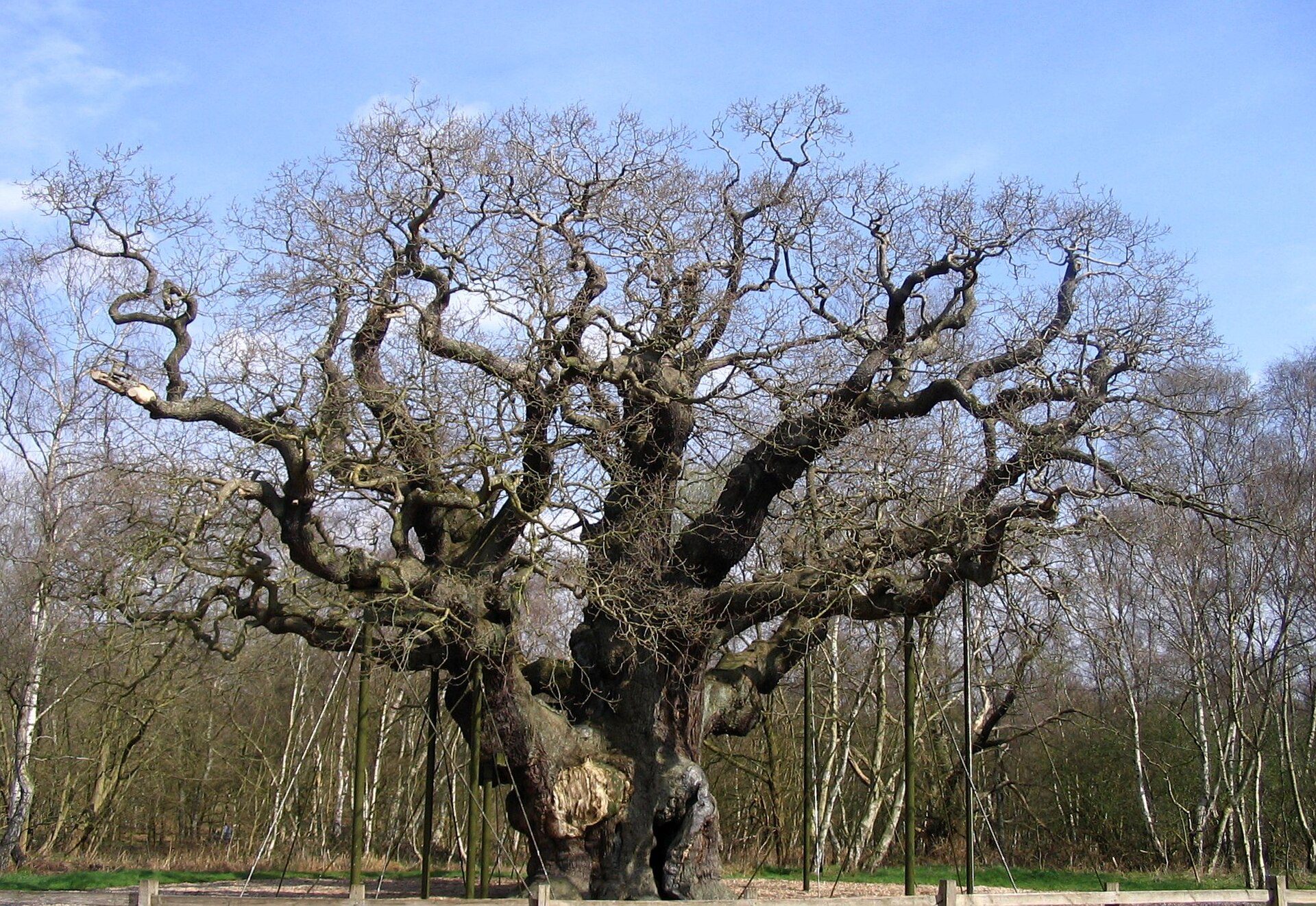 Imagine for a moment that you are in Middle-earth. Imagine what you would think or feel were you to be told that Treebeard had died. If you are a lover of The Lord of the Rings you would feel a deep sense that something seemingly immortal and immutable had ceased to be. Something akin to this was what I felt when I heard the news that the Major Oak of Sherwood Forest had died.
The Major Oak, set in the midst of the forest in which Robin Hood and his Merry Men made their home, was at least 800 years old and was probably more than a thousand years old. Some even say that it was up to 1,500 years old. If it could speak, it could tell stories of days of yore, including stories of Robin Hood, Maid Marian, Friar Tuck and the wicked Sheriff of Nottingham, all of whom may have passed under its watchful shade. Or, perhaps, even if the Merry Men were mere phantoms, mere figments of the folkloric imagination, it could tell stories of the real Merrie England, of the England of the Faith, the England of monasteries and monks, of wandering friars and wandering minstrels, of ploughmen and peasants, of country fairs and Christian festivals. It had seen it all, and had seen it all pass away. And now it has itself passed away. This summer it has produced no leaves and was pronounced dead in June.
In lamenting the Major Oak’s passing, I am haunted by the words I wrote about Michael Kurek’s Third Symphony, otherwise known as the English Symphony, the fourth movement of which is titled “The Major Oak of Sherwood Forest”. In a review of that symphony for this illustrious journal, I perceived this movement as a meditation on time and timelessness: “This famous tree… might have sheltered Robin Hood and his Merry Men from the elements or it might have hidden them from the Sheriff of Nottingham and his wicked minions. It might have witnessed young Robin making merry with Maid Marion in the springtime of its life and theirs. Robin Hood and his Merry Men passed away but the tree remained. Merry England passed away but the tree remained. The old oak has seen decades pass like a mere daze of days and centuries slip away, one after another, either into the future or into the past, for who can say in which direction time slips?”
But now the tree has also slipped away. It has not remained. The Major Oak, like Robin Hood and Maid Marian, has died. It is dead.
Its death is felt even more deeply because of what it signifies. It was not merely a tree; it was also a living metaphor for England herself. Its death seems to signify the death of England itself. This mystical metaphorical life was venerated by Michael Kurek in his desire to “personify” the Major Oak of Sherwood Forest in a manner that reminds us of Tolkien’s Ents. The old tree represents the presence of an ancient wisdom, which is timeless. It has no more need to be hasty than have Tolkien’s Ents because it has seen countless fads and fashions come and go. Mighty rulers wax and wane. Dynasties disintegrate and disappear. Only the permanent things remain.
But the tree has failed. It is also disintegrating. It will disappear. It will not remain. It is not permanent.
Is this not a cause for desolation, or despondency, or even for despair? If even the permanent things are not permanent, where might we find any source of life or hope?
The answer, of course, lies in the one Permanent Thing in which any other things might find true permanence. For God, there is no past and there is no future. For God everything is Present. This is the deeper meaning of Divine omnipresence; not that God is present everywhere, though He is, but that everything is present to God. For God, therefore, we cannot say that history was but only that history is. It is always present to Him. It is this ever-present history which is truly permanent and cannot pass away. All of life, including the life of the Major Oak and the life of England, is present to God in the eternal Now.
Those who happen to be wandering around today on the geographical stage on which the drama of England is being performed are sharing that stage simultaneously with all Englishmen in all ages. Most people walking around on that stage today might have no idea of what England is, or of who they are, but England is not dependent on them. Insofar as contemporary Englishmen have lost sight of the truth to which True England owes its allegiance, they have lost their place in the cosmological passion play in which True England plays its part. They have answered Hamlet’s conundrum of “to be or not to be” by choosing not to be. Like the souls in C.S. Lewis’ Great Divorce, they are pathetic and relatively insubstantial shadows. They are certainly less real as Englishmen than Alfred the Great, Bede the Venerable, St. Edward the Confessor, Chaucer, St Thomas More, the hundreds of English Martyrs, Shakespeare, Newman, Chesterton or Tolkien. They are even less real than legendary figures like King Arthur or Robin Hood. All these people are England, now and always.
Seeing England and the Major Oak of Sherwood Forest through the omnipresent perspective of the Triune splendor of the Good, the True and the Beautiful, we know that they can never die, not because they linger like fading coals in the memory of mortal men, but because they exist as beautiful flowers in the Gardens of Eternity.
No comments:
Post a Comment
Comments are subject to deletion if they are not germane. I have no problem with a bit of colourful language, but blasphemy or depraved profanity will not be allowed. Attacks on the Catholic Faith will not be tolerated. Comments will be deleted that are republican (Yanks! Note the lower case 'r'!), attacks on the legitimacy of Pope Leo XIV as the Vicar of Christ, the legitimacy of the House of Windsor or of the claims of the Elder Line of the House of France, or attacks on the legitimacy of any of the currently ruling Houses of Europe.