I majored in Soviet history at university, and I'm an Eastern Rite Catholic. I know what happens to Catholics in Russian-controlled territory
From Crisis
By Mariia Smyrnova, PhD
Since 2022, the religious landscape of the Donbas region has been deliberately reshaped to align with the political objectives of the Kremlin.
February 24, 2026, marked four years since the start of Russia’s full-scale invasion of Ukraine. According to the latest analysis, peace negotiations have reached a deadlock, and one of the reasons is the issue of 10 percent of the territories in Donbas, which Ukraine does not intend to give away. As a native of Donbas, I will attempt to lift the veil on how church life in the Donetsk region has changed under occupation, how the Orthodox Church has become the main instrument for war sacralization, and why Donbas parents should think twice before sending their children to Sunday school.
The End of Religious Pluralism
Having endured the Holodomors, deportations, firing-squad executions, persecution, atheist propaganda, and grueling labor in mines and industrial enterprises during the Soviet era, the people of Donbas became, to some extent, pragmatic nihilists. This helps explain why religiosity in the region has been the lowest in Ukraine—below 50 percent, compared to a national average of around 70 percent and about 90 percent in Galicia.
After the proclamation of Ukraine’s independence, religious pluralism was an organic phenomenon in Donbas, where about 80 ethnic groups lived. Overall, until 2022,1,879 religious organizations were registered in Donetsk Oblast, including 23 religious centers, 13 monasteries, 1 Lavra, and 11 theological educational institutions. In addition to the Orthodox, Catholic, Muslim, and Jewish communities traditionally present in the region, there was a Buddhist monastery in Olhynka, Protestant seminaries in Donetsk, religious communities of Jehovah’s Witnesses, the Society for Krishna Consciousness, yoga groups, followers of the Slavic native faith, and others. Amid this diversity, mutual respect arose naturally, though it was once shamefully marred in 1999 when supporters of the Moscow Patriarchate attacked Patriarch Filaret in Mariupol, pelting him with eggs, breaking his staff, and striking him on the head.
From 2014 to 2021, part of Donbas became occupied, which led to certain changes in the religious landscape of the region. The Adventist seminary students were told to leave Donetsk, and the Kyiv Patriarchate had to relocate to Mariupol. Despite rallies against “sects,” the Ukrainian Greek Catholic Church managed to register its community in 2019, and there was some, even though limited, activity by Protestant churches (Evangelical Christians—Baptists, Pentecostals). However, the fact that some communities obtained “registration” did not guarantee the absence of persecution against other communities of the same denomination.
Since 2022, the religious landscape of the Donetsk region has been deliberately reshaped to align with the political objectives of the Kremlin. According to the Institute for Religious Freedom, almost all churches not affiliated with the Moscow Patriarchate in the occupied territory have been deprived of the right to conduct religious services. Separate permissions were granted to so-called “traditional” Russian Federation denominations. Ukrainian evangelical churches, branded by Russian propaganda as “American agents,” or “extremists,” were particularly affected by persecution by the occupying authorities. Priests of the Orthodox Church of Ukraine (OCU) and the Ukrainian Greek Catholic Church (UGCC) who were unable to leave faced a grim fate: torture, threats, beatings, and murder; in a few fortunate cases, deportation.
Having endured the Holodomors, deportations, firing-squad executions, persecution, atheist propaganda, and grueling labor in mines and industrial enterprises during the Soviet era, the people of Donbas became pragmatic nihilists.Loyal Shepherds
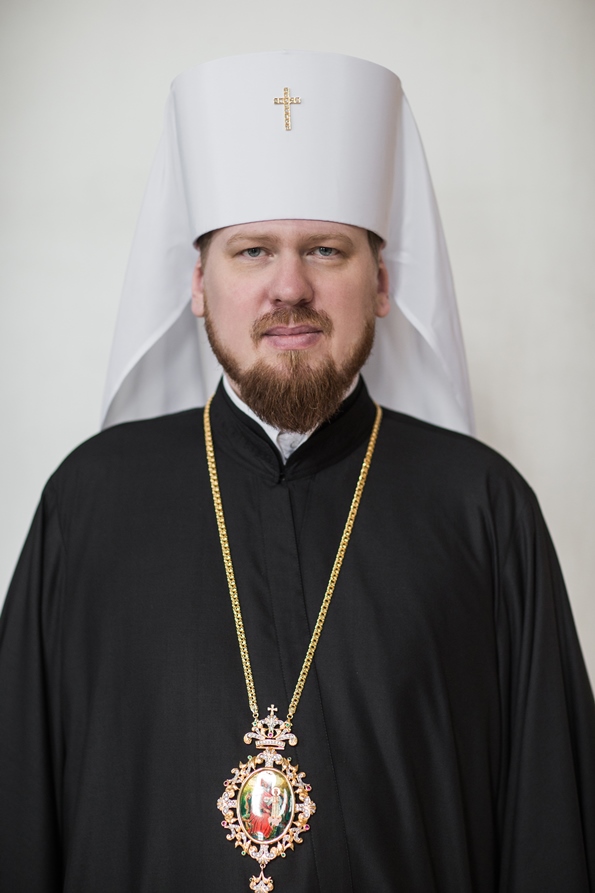
In 2024, the Synod of the Russian Orthodox Church decided to relieve Metropolitan Hilarion of his duties as head of the Donetsk Eparchy and to retire him. The Metropolitan has Western Ukrainian roots and served in the eparchy for nearly 30 years. Instead, Metropolitan Vladimir, who was previously serving in Vladivostok, was assigned to the Donetsk and Mariupol diocese. Being ordained by Patriarch Kirill and rising quickly through the church ranks shows that the Donbas mission is a high-priority mission for the Russian Orthodox Church. The removal of Metropolitan Hilarion is explained by, among other reasons, his relatively low involvement in encouraging the population to participate in military activities and the limited engagement of local clergy in patriotic events.
The main website covering church activities, Donbas Orthodox, switched its hosting from Ukrainian to Russian with the arrival of Metropolitan Vladimir. Under Metropolitan Hilarion, until December 2023, the website mostly featured news of a liturgical nature and occasional political meetings; whereas, since 2024, there has been an overwhelming number of photo reports from every parish, with a strong emphasis on the heroes of the “special military operation,” traditional values, youth education, politics, and patriotism.
Many new priests, politicians, and volunteers also arrived from the Russian Federation, who are shaping new realities in which the church is closely linked to the war.
Human Capital for National Goals
In Donbas, people are being pushed to serve the state: through the army, labor, volunteering, donations, school programs, or bearing and raising children to become future patriots. Hence the emphasis on traditional values, large families, and the upbringing of young soldiers. Recruitment of believers is carried out through sermons, memorial services for fallen “liberators,” participation in Sunday schools where children write letters of gratitude to Russian soldiers for “liberation,” or church-patriotic literature where Slavs are shown as one nation. One more direction is an active recruitment of mercy sisters who are taking care of wounded people. Perhaps these activities seem insufficient, which is why one can observe the introduction of military elements into any social event, even Christmas concerts.
Not to fall behind, there is the notorious youth groupYunarmia—which already has 1.3 million members and indoctrinates children in occupied Ukraine to prepare them for military service, with members as young as 8; so the church is also contributing to the “upbringing” of youth. Meetings are held between priests and Nakhimov cadets, Yunarmia members visit churches, the clergy hold discussions about the feats of heroes, and clergy are present at the oath-taking ceremonies to show that the pledge of loyalty to the Motherland is also a pledge to God.
As for Sunday schools, the emphasis on militarization is far from universal, of course. In the Donetsk region, there are still some priests who fulfill the reporting requirements for conducting discussions with schoolchildren but choose church-neutral topics, such as holidays or morality, thereby largely avoiding any involvement in political activities. However, complete neutrality is impossible to maintain, just to take prayers for “Holy Rus” and victory as an example. Additionally, the system of pilgrimage trips to Russia’s holy sites has become particularly developed, where traditional and patriotic themes naturally also arise.
The Cult of Donbas Saints: Mythmaking and the Rewriting of History
In September 2025, the Orthodox TV channel Spas announced a fundraising campaign for a four-part film titled “Saints of Novorossiya and Donbas,” aimed at promoting spiritual unity between Russia and the occupied Ukrainian territories.
One central figure is St. Ignatius of Mariupol, presented as a historic protector of local Christians, though aspects of his biography are selectively emphasized to align with modern political messaging. During the resettlement of peoples under Catherine II in the 18th century, he led the relocation of the Greeks from Crimea to the Azov steppes. This is taught as if the empress cared about the Orthodox peoples; and parallels are often drawn with the present day. However, the aim lied in weakening the Crimean Khanate by removing one of its main categories of taxpayers, the Greeks, and it corresponded to Russia’s principal strategic objective at that time:advancing toward the conquest of Constantinople. In reality, this forced resettlement was a tragedy, with one in four Greeks dying from disease, cold, and hunger.
Another influential figure is Donbas elder Zosima Sokur, whose alleged prophecies about war and Russia’s spiritual triumph have been quoted by major state outlets and even mentioned to President Vladimir Putin. Philip of Luhansk’s hagiography is also slightly modified, silencing that he was against Bolsheviks and supported the catacomb church. Widely circulated quotations attributed to St. Jonah of Odessa about Ukraine cannot be verified as authentic; however, he is associated with extreme monarchist beliefs and some controversial practices.
More recent candidates for sainthood include priests who died in the Ukraine war, like Mikhail Vasilyev, who was posthumously named a Hero of Russia, and others portrayed as martyrs despite inconsistencies in their stories.
This trend can be compared to an earlier politically-charged “pantheon” of saints, such as the elevation of Luka Krymsky after Crimea’s annexation or Alexander Nevsky’s popularity. The “Donbas saints” project serves political goals: reinforcing the concept of a unified “Holy Rus,” leaving little room for purely spiritual concerns.
In occupied Donbas, the transformation of religious life is systemic. The erosion of religious pluralism, the replacement of local church leadership with loyal hierarchs, the militarization of sermons and Sunday schools, and the construction of “Donbas saints” all point in one direction: war is no longer presented as tragedy but as destiny and a sacred mission. In this framework, loyalty to the state merges with loyalty to God, and disagreement means spiritual betrayal. It becomes too difficult to separate prayer from propaganda and martyrdom from mythmaking. “God as a weapon” is not a metaphor in occupied Donbas; it is a governing principle and a sad reality.
Pictured: His Eminence, Vladimir, Russian Orthodox Metropolitan of Donetsk and Mariupol
No comments:
Post a Comment
Comments are subject to deletion if they are not germane. I have no problem with a bit of colourful language, but blasphemy or depraved profanity will not be allowed. Attacks on the Catholic Faith will not be tolerated. Comments will be deleted that are republican (Yanks! Note the lower case 'r'!), attacks on the legitimacy of Pope Leo XIV as the Vicar of Christ, the legitimacy of the House of Windsor or of the claims of the Elder Line of the House of France, or attacks on the legitimacy of any of the currently ruling Houses of Europe.