Do we need God to be good? No, but it is much easier with His help. St Paul says in Romans 2:15 that the law is written in the hearts of men.
From One Peter Five
By Mike Schramm
Do We Need God to be Good or Not?
Often when we speak with non-Christians, an objection is raised concerning the morality – good or bad – of non-Christians. Some point out examples of non-Christian heroes who had obvious virtue – like Gandhi, for instance – and contrast them with everyday Christians who act like pagans. Let us leave aside that this claim often acts as a red herring that neither proves nor disproves anything about God’s existence and engage with it using one of the Church’s great, most under-appreciated ethical minds of the last century.
Dietrich von Hildebrand was a philosopher and Catholic convert who not only engaged with the ethical and moral questions of his day privately with his mind, but publicly with his pen at his life’s own risk from the Nazis. He was a thinker who saw no need to separate the head and the heart when it came to ethics. He also believed that the line between the natural and supernatural was not as thick as his increasingly technocratic world was trying to establish.
The question of the possible morality of those with God’s revelation can be traced in various paths to the New Testament itself. There is the classic verse from Romans 2:15 about the law written on one’s heart. One could cite the words of Jesus about those who are not explicitly “with us” but more importantly “not against us” in Mark 9:40. The Church rightly distinguishes between the four natural, cardinal virtues from the three theological virtues, only the latter of which cannot be obtained without God. Von Hildebrand, being a product of the realistic branch of the school of phenomenology, would have focused as much on the individual capacity for the virtue as the virtue itself. This is the real focus of our question. In one of von Hildebrand’s fundamental texts, his Ethics, this Trad Godfather treats on the philosophical distinctions between Christian saints and non-Christians who are great and virtuous, but not truly holy.
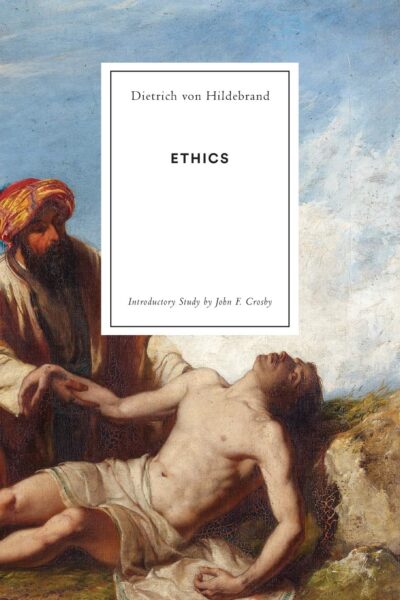
Following Hildebrand, the first point to address must be the inverse premises assumed by either answer to the question. If one says “yes,” that one does need God to be good, one is defining God as something intrinsically connected to moral goodness. If one says “no,” one is defining “God” as something, at best, arbitrarily connected to moral goodness or not connected at all. There are other steps and foundational principles to account for in both of these assumptions, and a treatment of the classical theistic understanding for God is always helpful. Plato saw the divine in the Form of the Good. Aristotle considered the good life as that which contemplated divine wisdom. St. Augustine and St. Thomas Aquinas of course recognized the relationship between God and goodness, primarily in the Good Shepherd they both followed.
The metaphysical foundation connecting God and goodness was not von Hildebrand’s main focus and so not the concern of this article. Suffice it to say he briefly mentions that he does believe in an intrinsic connection, following the classical theistic model as well as that of the Catholic Church, when saying “if there were no God, all moral values, the moral law itself, would be deprived of their indispensable metaphysical basis.”[1] However, as mentioned he wants to tackle the more personalistic dimension, so he goes beyond this and highlights four specific areas where “Christian Morality,” so-called, an understanding of ethics informed by an awareness of God, is distinct and necessary from natural morality.
Taking into account the already established fact of natural virtues and that grace builds upon nature (which implies that there is at least the seed of something in the person apart from explicit revelation in God), von Hildebrand makes four distinctions between the natural and Christian ethos. The first is the preeminence of humility in Christianity. This virtue is primary because it “pervades every other virtue” that follows, allowing them to “unfold in their full beauty.”[2] The necessity and exaltation of humility introduced by Christ cannot be discounted when considering a system of virtue. This was not assumed by Plato or Aristotle and so clearly delineated Christ’s view from his predecessors.
The second distinction von Hildebrand notes is what he calls the “interpretation of attitudes” between two, seemingly contradictory, virtues.[3] He calls these a “unity of opposites” and far from cancelling each other, create “something completely new and incomparably higher” in the saint because “they also contain all moral values present in the two perfections which can be found separately in the pagan.”[4] It is the tension of the paradox, the Catholic both/and that makes this reality possible. Because all virtues emanate from one Source, they cannot contradict but complement each other.
The third “mark” von Hildebrand sees is that, while humility may be the foundation of Christian ethics, “charity is its very core.”[5] Von Hildebrand contrasts the witness of Socrates, whose core admirably was justice, to that of St. Stephen and St. Francis, both of whom emulated charity in the mercy that fulfills even justice.[6] This could only derive from an understanding of God Who did not just love or command others to love, but is Love Itself as 1 John 4:8 says.
The fourth point relates back to the first metaphysical principle established in God’s relationship to goodness. Von Hildebrand states that “all virtues and moral attitudes,” according to Christian morality, “originate in a response to God.”[7] Even an unconscious participation in moral goodness (which is what all the virtues are), is a response to the Source of those virtues, the Source of that goodness, which (or Whom if you are comfortable) classical theists also just happen to recognize as God. To participate in goodness, whether one acknowledges it or not, is to participate in the Goodness from Whom it emanates.
I will avoid giving the frustrating non-answer of “yes, and no” to the question from this article’s heading. I will say, and I think the great Dietrich von Hildebrand would approve of this paraphrased summary of his chapter, that nuance cannot be avoided. While one objectively does need God to be good simply because goodness, by definition, cannot be separated from what God is, one need not necessarily be conscious of this relationship in order to participate in that goodness. However, there are clear, necessary and transformative elements to the distinctly Christian morality that cannot be neglected. While these distinctions could perhaps have been delayed in a pre-Christian world until the advent of Christ, to ignore them in a post-Christian world would result in what von Hildebrand calls a vision “perverted and deprived of all true moral value.”[8] If St. Paul in 1 Corinthians 3:2 compared his early catechesis to mother’s milk and later teaching to solid food, then let us not become malnourished by rejecting what has been given in our 2,000-year, grace-filled Tradition.
[1] Dietrich von Hildebrand, Christian Ethics (Franciscan Herald Press, 1972), 457. Editor’s note: this older edition that the author quotes is the same text now re-edited and printed by the Hildebrand Project.
[2] Ibid. 461.
[3] Ibid. 462.
[4] Ibid.
[5] Ibid.
[6] Ibid.
[7] Ibid., 463.
[8] Ibid., 459.
No comments:
Post a Comment
Comments are subject to deletion if they are not germane. I have no problem with a bit of colourful language, but blasphemy or depraved profanity will not be allowed. Attacks on the Catholic Faith will not be tolerated. Comments will be deleted that are republican (Yanks! Note the lower case 'r'!), attacks on the legitimacy of Pope Leo XIV as the Vicar of Christ, the legitimacy of the House of Windsor or of the claims of the Elder Line of the House of France, or attacks on the legitimacy of any of the currently ruling Houses of Europe.