Mr Coulombe looks at Europe and its future in light of the Empire of Charlemagne, whose Feast as a Blessed was today. He is celebrated in Aachen, his capital.
From the Sacred Heart of Jesus
By Charles Coulombe, KCSS, STM
2.JPG)
Nevertheless, I am indeed a European. The fact is that, save for some Indian blood (visible in my Coulombe cousins, though not in myself), my ancestry hails from the mother continent. Mixed — French, Austrian, English, Russian, Scots, Irish, and various others — to be sure, but nevertheless all European.
None of the languages I speak, however poorly — Canadian French, Yankee English, a fractured Viennese, and Los Angeles Mexican street Spanish — can be considered indigenous to the Americas, and as a result, all of the arts to enjoyed in the languages I understand have European origins — from Shakespeare to Piaf.
In the State of California, where I reside, although the laws covering land, water, and minerals point up our origins as a colony of His Most Catholic Majesty of Spain, the rest of our governance, with its panoply of governor, legislature, judiciary, counties, sheriffs, mayors, coroners and on and on, show the English origins of the better part of our law and institutions.
Above all, I belong to a religion centered in Rome, whose current head said shortly after his accession, “all Catholics are in some way Romans.” It is unlikely that he was referring either to Rome, New York, or Rome, Texas.
Of course, I am not alone in this position. It is true of the larger proportion of my fellow Americans ethnically, and virtually all of us culturally. It is especially true of the Blacks in this country, who have no real, identifiable, ties to Africa (despite all the hype), except mere genetics. If anything, they are, save the Indians, the most completely American cultural element in the population. But that too makes them Europeans.
The truth is, pace the Anti-Colonial League, that we are the most successful of colonies, having succeeded so tremendously that we have dominated all our former metropoles, and their neighbours. Moreover, most of us have forgotten our origins, and unconsciously think of ourselves as autogenetic.
But on a deeper level still, we know that it is not true. Old Europe still keeps a hold on our imaginations, no matter how much we may try to deny it. Moreover, the fact remains that none of us without tribal ancestry can stand on a bit of land in this country and say, “my people were here a thousand years ago.” The equally unconscious ability of Europeans to do precisely that (and of those few Americans who visit to do likewise) quietly influences the relationship between the two sides of the Atlantic — Canadians, of course, are somewhat more aware of their origins, which gives them a separate mental universe entirely.
From Christendom Our Fathers Came, from Abendland …

For my own part, a large segment of my work as a writer has been to imply the truth: that we Americans are Europeans separated by time and space from our origins. But as with any colonial, it is not the Europe of Tony Blair, Bertie Ahern, Jacques Chirac, and rest of the “generation of ‘68” gone to seed that I have in mind.
There is a reason why the 17th and 18th centuries can still be heard in the French, English, and Spanish spoken in various remote spots in the Americas. It is because we were settled by a different Europe.
The continent that produced our ancestors was the Europe of Dryden, Cervantes, and Moliere — the realm of chivalry and guilds, shrines and legends, for all that (in the northern half, anyway) this was collapsing at a more or less speedy rate. In a word, it was from Christendom that our fathers came, from Abendland.
Echoes of this can be found in the more profound religiosity that characterizes most of the Western Hemisphere — even if much of that religiosity is Calvinism or sects still more bizarre.
It has only been since the ‘60s that our elites have become more or less atheistic, and determined to impose their creeds upon the rest of us (a phenomenon to which neither Quebec or Latin America have been immune, although in the latter case it is still somewhat moderated).
In any case, the malaise that has infected Europe since 1789, and has become more or less triumphant since 1945 and especially 1968, has not gone nearly as far here.
In Europe herself, by way of contrast, American religious attitudes are well-nigh incomprehensible; public displays of religious ceremonial are quite common in Europe (although her current leaders do try to suppress or limit them when possible) to a degree unheard of in the United States; yet the personal faith that is a sine qua non in a politician here is considered rather strange on the other side of the ocean. Marriage and birth statistics reveal that such personal faith is also increasingly rare among the European citizenry at large (a lack, however, noticeably absent in her growing Muslim population).
The altar was one of the two foundations upon which Europe rested: the other was the throne. Of course, since 1776, we have done our best on this side of the water to minimise its contributions to our nationhood; Latin Americans have been doing so since the 1820s, and Canadian politicians and media folk got into the act in the 1960s.
Yet, as earlier mentioned, all of our institutions come to us from Europe — but from a Royal Europe. The same anti-monarchical slant infected Europe in 1789, and received heavy boosts in 1918 and 1945. But European republics still house the dreary old politicians they call presidents in the royal palaces, surround them with more or less cut-rate royal pageantry (guards, households, and orders of knighthood), and pretend that somehow the whole charade has something to with “rule by the people” — as though the general mass of the people were able to live as well as the politicians that batten off them! Much the same is true in Latin America, where current chiefs of state continue to use many of the appurtenances of the long-vanished viceroys.
For all of the differences between old Europe and her children, however, there can be no doubt that, despite the end of colonialism and the attempts at self-assertion of local politicians in such nations as Australia, Europe really extends from San Francisco to Valdivostok, and from North Cape to Cape Town and Buenos Aires.
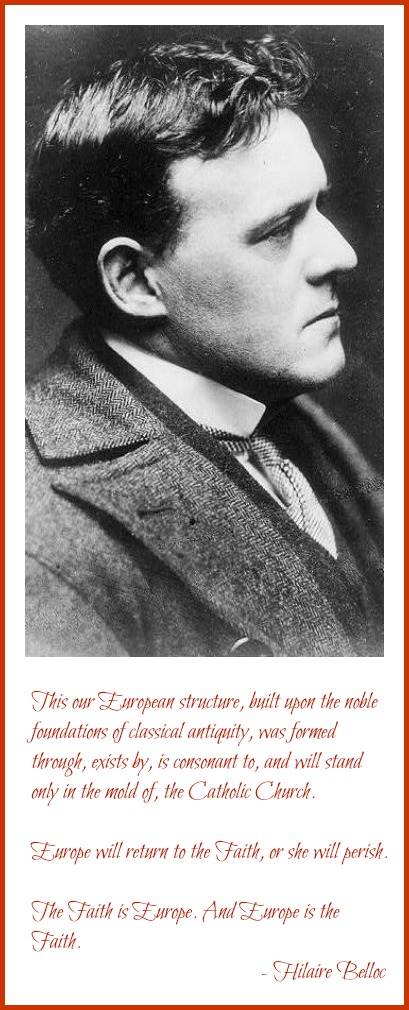
Like it or not, we are stuck with each other. But culturally and religiously, the health of the periphery still depends upon that of the Mother Continent. Europe’s health, over here, is frequently spoken of in terms of the European Union. But just what is that Union, and how true is it to the European soul, of which Hilaire Belloc once famously remarked that, “the Faith is Europe, and Europe is the Faith!”
One must say, given the disastrous course of European history in the 20th century, that the origins of the EU were promising enough. Solid Christians like Jean Monnet, Paul-Henri Spaak, Robert Schuman, Konrad Adenauer, and Alcide de Gasperi hoped to pull out of the ruins of their countries a new Europe — rooted deeply in the religion and best traditions of her past, but freed of the national hatreds and social conflicts that had spilled so much of the best of her blood from 1914 to 1945.
It was a noble dream, reflected in such efforts as the Karlspreis, the annual award by the city fathers of Aachen, Charlemagne’s Aix-la-Chapelle, to the individual who, in their opinion, had best demonstrated the “European idea” that year.
In time, the ACP (Atlantic-Caribbean-Pacific) scheme was intended to allow the former imperial masters to aid their one-time colonies in a way consonant with those nations’ self-respect. Moreover, European unity would allow Europe to play an effective role in world affairs, independent of both the United States and the Soviet Union. Yet at the same time, the principle of “subsidiarity” would allow towns, counties, and provinces (or their local equivalent) far more freedom to run their own affairs. Successive Popes seconded this goal — and came to prefer it to the older vision enunciated by such as Salazar, Franco, and any number of Latin American rulers.
Alas, the reality was to be far different from what either Pontiffs or founding politicians had hoped. For what we are faced with in the European Union of 2006 is quite another thing, entirely. Far from the sort of Europe envisaged by the Founders, the EU is, to begin with, ever more anti-Christian, as the abortive Constitution’s preamble and the Buttiglione case point up.
Non-marital unions, contraception, abortion, euthanasia — anything calculated to worsen Europe’s already plummeting demographics — are encouraged at every turn by the EU. Instead of subsidiarity, local farmers, artisans, and regular folk throughout the Union find themselves ever more strangled by the Brussels bureaucracy — what seems to be emerging is a personally oppressive superstate upon a foundation of equally annoying national bureaucracies.
Perhaps making up for this has been the EU’s ineffectiveness in foreign affairs: the ACP idea is being abandoned, having done little to ameliorate Third World poverty and less to address bad governance there. Bosnia and Kossovo pointed up the New Europe’s inability to address even nearby conflicts effectively. Needless to say, the U.S. took little notice of Europe when dealing with Iraq — alas, perhaps, to no one’s ultimate advantage. The only thing more pitiful than the awarding of the Karlspreis to Tony Blair in 1999 was Bill Clinton’s reception of it the following year.
As a result, despite the best efforts of a well-healed PR machine, and the views of most European political parties, the EU has yet to win the affection of the common man in Europe. Instead, most folk respond with derision. Yet despite polls and plebiscites, the thing appears to be on its way to commanding ever-greater power over a supine continent. Since the 1980s, a common explanation was to blame the next country over for the EU. British blamed the French, Frenchmen blamed the Germans, Germans blamed the Italians, and so forth. In recent years, this sort of round robin of finger-pointing has subsided.
The Elites of Europe
That is probably just as well. Because the plain truth is that the EU’s failings are not to be laid at the door of any single nationality.
Rather, responsibility for them rests communally with the greater part of the dominant elites in each country of Europe, with such as the earlier cited Blair and Ahern, Belgium’s Guy Verhofstadt, Spain’s Jose Luis Rodriguez Zapatero (he masculinised it from “Zapatera;” in light of his support of homosexual marriage, he need not have bothered), and the now cashiered French and German premiers Jospin and Schroeder.
What all of these worthies and their numerous hangers-on, concubines, and flunkies in government, the judiciary, and media have in common is a shared vision.
Products of the 1960s, they simply hate their respective countries, at least as they inherited them.
Naturally, this hatred does not extend to the organs of power, ultimately the gift in most European countries of Bonaparte and such unconscious successors as Bismarck and Cavour, but rather is aimed at the countries themselves — at whatever gave each their own identity.
In all cases, this includes not merely Christianity, but its affect on society and culture; on traditional mores in the family and in the arts.
To make all things anew after their own image was their desire in the 60s, and it remains so today.
Yet each of these nations is a building block in what had been the very real but difficult to define entity called “Europe,” nee Christendom.
Just as, in their hands, their respective countries have begun to morph into something very different to what they had been, so too with the European Union. Nothing is sacred to these folk! Hunting and the House of Lords must go in Great Britain, indissoluble marriage in Ireland, school crucifixes in Belgium and Spain, and strange and unusual means of producing goods in every rural hamlet on the continent, and smoking everywhere (were public health really a concern, these mandarins might turn their attention to limiting such things as the behaviours which spread AIDS).
Behind these lie greater alterations — the self-same all-important demography-busting marriage, life, and family issues earlier referred to.
Is There a Viable Alternative to the EU?

Disastrous as these measure would doubtless be in the long-run, their practical harm is multiplied by the fact that they are all the rulers of Europe have to throw back at militant Islam — managing at once to convince the Muslims of their own moral supremacy, and to limit the ability of Europe to resist. The problem is that the EU has been recast in the leadership’s own image.
All of which having been said, we need to look and see if there is a viable alternative to what is on offer. I once told a German friend of mine (as it happened, in Aachen, outside of Charlemagne’s resting place in the cathedral there), that I was not “opposed to the union of Europe, but to this union of Europe!” He responded, “no, Charles, you are really opposed to the union of this Europe.”
He was right, but is there another Europe to choose? Indeed there is. The noted French Royalist, Charles Maurras, coined the notion of France being divided into two: the pays reel, the real France, Catholic and Royalist; and the pays legal, the legal France, anti-clerical and republican.
Georges Bernanos wrote of life in the former France in his brilliant work Nous Autres Francais — “We Other French.” Perhaps inspired by Bernanos, Phillippe de Villiers called his quondam organisation Nous Autres Europeens. It is the “Other Europe,” the Europe that drew its origin from Rome and Jerusalem that we must look at, rather than the one that is rooted in Brussels (much as I personally love that pleasant city!).
Two centuries ago, faced with the similar problem posed by the new Europe then a-borning, Romantic writer Friederich von Hardenberg (better known as Novalis) penned his best known essay, Christendom or Europe? Its opening paragraph was a battle cry, a challenge thrown down to everything that had happened to Europe since the Reformation:
There once were beautiful, splendid times when Europe was a Christian land, when one Christendom dwelt in this continent, shaped by human hand; one great common interest bound together the most distant provinces of this broad religious empire. Although he did not have extensive secular possessions, one supreme ruler guided and united the great political powers. A numerous guild which everyone could join ranked immediately below the ruler and carried out his wishes, eagerly striving to secure his beneficent might. Each member of this society was honoured on all sides, and whenever the common people sought from him consolation or help, protection or advice, being glad in exchange to provide richly for his diverse needs, each also found protection, esteem, and a hearing from the more mighty ones, while all cared for these chosen men, who were armed with wondrous powers like children of heaven, and whose presence and favour spread many blessings. Childlike trust bound people to their pronouncements. How cheerfully each could accomplish his earthly tasks, since by virtue of these holy people a safe future was prepared for him, and every false step was forgiven by them, and every discoloured mark in his life wiped away and made clear. They were the experienced helmsmen on the great unknown sea, under whose protection all storms could be made light of, and one could be truly confident of a safe arrival and landing on a shore that was truly a fatherland.
This was high-flown Romanticism, to be sure, but not without some basis in historical fact, unlike the visions of the ruling revolutionaries of his day—or ours, for that matter. Certainly Novalis had uncovered the ideal of Medieval society in this passage, if not always its reality. One shudders to think of what the idealism of our current masters, with its glorification of perversion, conformity, and death, would look like, if reduced to writing.
At any rate, the Medieval Christendom of which Novalis wrote so glowingly was not, like modern Europe, a patchwork of more or less stable nation-states, but rather a crazy quilt of minor fiefdoms, principalities, duchies, free cities, ecclesiastical lordships, and strange local groupings not easily described (like the first three forest cantons of Switzerland or Holstein’s Dithmarschen). These in turn were grouped together, for the most part, into various kingdoms — although some of the lesser entities split their allegiance between two or more kings. The monarchs of these countries were sometimes elected, but usually hereditary.
But they were not heads of state in the modern understanding of the term, because the countries they presided over were not states, as we know them now. Lacking secret police or internal revenue services, they had none of the appurtenances of governance we would recognise. Indeed, to our eyes, these countries would have been mere bundles of anarchy.
This is because our ancestors lived in a very different mental universe to ours. Allegiance meant much more than merely being draughted or taxed. Although the King may not have had the ability through his guards to impose his will much beyond his palaces, his subjects loyally upheld the local equivalent of “the King’s Peace.” Did a desperado “play the robber on the King’s Highway?” The neighbours would send up the hue and cry, hunt him down, and kill him in the name of the King — and the consider the “King’s Peace” restored. The nation, to our way of thinking, was a mutually imagined illusion.
But it was certainly real to them, in the sense of Platonic realism. Key to understanding how the mediæval kingdom worked is to realise the difference between power and authority: the former is the ability to make things happen, the latter the right to say how that power should be used.
In Medieval times, power was diffuse, the lords, churchmen, commoners, guilds and so on all claiming their share. Authority however was in the hands of the King. A good King was like an orchestra leader. But under a bad King, (apart from annoyances meted out to his immediate companions) the result was not dictatorship in the modern fashion, but anarchy. When such times occurred, locals would often group together to “keep the peace,” forming a confraternity for that purpose. These bodies often served as local police and militia — such as the famous Santa Hermandades of Spain.
As a side note, it is fair to say that Her Majesty Queen Elizabeth II probably has little more power than did her pre-Tudor ancestors (as much the founders of the modern state as anyone — like Louis XIV — else). But because, in our day, power is concentrated in the hands of the elite, while authority is scattered amongst a more or less oblivious electorate, her position looks much less impressive. Such is the modern state.
Binding all of these kingdoms and so on together were several institutions, first of which was the Church, with her several networks of dioceses and religious orders; she in turn gave her blessing to the complementary circuits of guilds and universities. Some of the same benediction touched Chivalry, the “corporation,” as it were of knighthood; this would come in time to include the great military orders, who partook of both the Church and Chivalry.
The Holy Empire
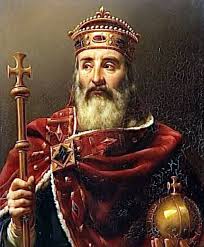
But in, with, and under all of these was the idea of the “Holy Empire,” Roman in the West, Byzantine in the East. We really need to take a close and somewhat detailed look at this Imperial idea, because it provides the great alternative to the notion of the European Union.
Despite many future conflicts between the Imperial and Papal powers, there was an underlying unity between the two which was unbreakable. This is admirably summed up by James, Viscount Bryce, in The Holy Roman Empire (pp.102-105):
The realistic philosophy, and the needs of a time when the only notion of civil or religious order was submission to authority, required the World State to be a monarchy: tradition, as well as the continued existence of a part of the ancient institutions, gave the monarch the name of Roman Emperor.
A king could not be universal sovereign, for there were many kings: the Emperor must be universal, for there had never been but one Emperor; he had in older and brighter days been the actual lord of the civilised world; the seat of his power was placed beside that of the spiritual autocrat of Christendom.
His functions will be seen most clearly if we deduce them from the leading principle of mediaeval mythology, the exact correspondence of earth and heaven.
As God, in the midst of the celestial hierarchy, rules blessed spirits in Paradise, so the Pope, His vicar; raised above priests, bishops, metropolitans, reigns over the souls of mortal men below.
But as God is Lord of earth as well as heaven, so must he (the Imperator coelestis) be represented by a second earthly viceroy, the Emperor (Imperator terrenus), whose authority shall be of and for this present life.
And as in this present world the soul cannot act save through the body, while yet the body is no more than an instrument and means for the soul’s manifestation, so there must be a rule and care of men ‘s bodies as well as their souls, yet subordinated always to the well-being of that element which is the purer and more enduring.
It is under the emblem of soul and body that the relation of the papal and imperial power is presented to us through out the Middle Ages. The Pope, as God’s vicar in matters spiritual, is to lead men to eternal life; the Emperor; as vicar in matters temporal, must so control them in their dealings with one another that they are able to pursue undisturbed the spiritual life, and thereby attain the same supreme and common end of everlasting happiness.
In view of this object his chief duty is to maintain peace in the world, while towards the Church his position is that of Advocate or Patron, a title borrowed from the practice adopted by churches and monasteries choosing some powerful baron to protect their lands and lead their tenants in war.
The functions of Advocacy are twofold: at home to make the Christian people obedient to the priesthood, and to execute priestly decrees upon heretics and sinners; abroad to propagate the faith among the heathen, not sparing to use carnal weapons. Thus does the Emperor answer in every point to his antitype the Pope, his power being yet of a lower rank created on the analogy of the papal…
Thus the Holy Roman Church and the Holy Roman Empire are one and the same thing seen from different sides; and Catholicism, the principle of the universal Christian society, is also Romanism…
Of course Voltaire, that great pioneer of the modern mindset, gibed that the HRE was “neither Holy, nor Roman, nor an Empire,” nor had been for many years.
Indeed, that was what any modern would see. But for most of its history, as an overarching framework of Christendom, it was at least as real to its denizens as “France,” “Germany,” or “Poland.”
As with Chivalry, any given guild, the “republic of letters” of the universities, or the Church herself, the Empire was as real as its subjects conceived it to be — no matter how much they might fight over or even against it.
Proof of this contention may be found in the work of Dom Prosper Gueranger, O.S.B., who, as both a 19th century Frenchman (and restorer of the Benedictines in that country as well as of Gregorian Chant throughout the Church), and, as an Ultramontane (he was instrumental in bringing about the 1870 definition of Papal Infallibility) may not be accused of partiality in this matter.
At the time of his writing, most commentators in English favoured the Medieval Emperors against the Popes because of their partiality toward Prussia and the nascent German Empire of Bismarck. This makes Dom Gueranger’s description of the imperial coronation in his entry for St. Leo III in his magisterial The Liturgical Year all the more telling:
Space fails us, or gladly would we here describe in detail the gorgeous liturgical function used during the middle-ages, in the ordination of an emperor. The Ordo Romanus, wherein these rites are handed down to us, is full of the richest teachings clearly revealing the whole thought of the Church.
The future lieutenant of Christ, kissing the feet of the Vicar of the Man-God, first made his profession in due form: he “guaranteed, promised, and swore fidelity to God and blessed Peter pledging himself on the holy Gospels, for the rest of his life to protect and defend, according to his skill and ability, without fraud or ill intent, the Roman Church and her ruler in all necessities or interests affecting the same.”
Then followed the solemn examination of the faith and morals of the elect, almost word for word the same as that marked in the Pontifical at the consecration of a bishop. Not until the Church had thus taken sureties regarding him who was to become in her eyes, as it were, an extern bishop, was she content to proceed to the imperial ordination.
While the apostolic suzerain, the Pope, was being vested in pontifical attire for the celebration of the sacred Mysteries, two cardinals clad the emperor elect in amice and alb; then they presented him to the Pontiff, who made him a clerk, and conceded to him, for the ceremony of his coronation, the use of the tunic, dalmatic, and cope, together with the pontifical shoes and the mitre.
The anointing of the prince was reserved to the Cardinal Bishop of Ostia, the official consecrator of popes and emperors. But the Vicar of Jesus Christ himself gave to the new emperor the infrangible seal of his faith, namely the ring; the sword, representing that of the Lord of armies, the most potent One, chanted in the Psalm; the globe and sceptre, images of the universal empire and of the inflexible justice of the King of kings; lastly, the crown, a sign of the glory reserved in endless ages as a reward for his fidelity, by this same Lord Jesus Christ, whose figure he had just been made. The giving of these august symbols took place during the holy Sacrifice.
At the Offertory, the emperor laid aside the cope and the ensigns of his new dignity; then, clad simply in the dalmatic, he approached the altar and there fulfilled, at the Pontiff’s side, the office of subdeacon, the servitor, as it were, of holy Church and the official representative of the Christian people. Later on, even the stole was given him: as recently as 1530, Charles V on the day of his coronation, assisted Clement VII in quality of deacon, presenting to the Pope the paten and the Host, and offering the chalice together with him.
The Imperial office was considered as sacred with Charlemagne and his successors as ever had been under Constantine, Theodosius, or Justinian. The Emperor was enrolled as a canon of St. John Lateran, and the church at Aix-la-Chapelle. He was considered to have some power over the weather by the people — in German today, fine sunny weather is still called Kaiserswetter.
Hence, as Dom Gueranger further tells us, this ceremony for the seventh lesson of Christmas Matins (dealing with the order of Caesar Augustus for the census which brought Mary and Joseph to Bethlehem) at St. Peter‘s:
This seventh Lesson, according to the Ceremonial of the Roman Church, is to be sung by the Emperor, if he happen to be in Rome at the time; and this is done in order to honour the Imperial power, whose decrees were the occasion of Mary and Joseph going to Bethlehem, and so fulfilling the designs of God, which he had revealed to the ancient Prophets. The Emperor is led to the Pope, in the same manner as the Knight who had to sing the fifth lesson; he puts on the Cope; two Cardinal-Deacons gird him with the sword, and go with him to the Ambo. The Lesson being concluded, the Emperor again goes before the Pope, and kisses his foot, as being the Vicar of the Christ whom he has just announced.
This ceremony was observed in 1468, by the Emperor Frederic III, before the then Pope, Paul II. This was echoed by the prayers of the Roman Missal, until 1955. Among the “Occasional Prayers, “ (sets of collects, secrets, and post-communions for various intentions, to be said by the priest after finishing the propers), we find the following, “For the Emperor:”
COLLECT O God, the Protector of all Kingdoms and in particular of the Christian Empire, grant to Thy servant our Emperor N. always to work wisely for the triumph of Thy power, that being s prince in virtue of Thy institution he may always continue mighty by virtue of Thy grace. Through Our Lord. SECRET Accept, O Lord, the prayers and offerings of Thy Church for the safety of Thy suppliant servant, and work prodigies habitual to Thine arm for the protection of nations faithful to Thee: that, the enemies of peace having been overcome, Christian peace may allow of Thy being served in security. Through Our Lord.
POSTCOMMUNION O God, Who hast prepared the Roman Empire to serve for the preaching of the Gospel of the Eternal King: present Thy servant our Emperor N. with heavenly weapons, that the peace of the Churches may not be disturbed by the storms of war. Through Our Lord.
Nor was this the only liturgical treatment the Emperor received. Twice a year, all Catholics came into contact with the Imperial idea. Among the Good Friday Collects was inserted the following:
Let us pray also for our most Christian Emperor N., that Our God and Lord may, for our perpetual peace, subject all barbarous nations to him. Let us pray. Let us kneel down. R. Arise. O Almighty and Eternal God, in Whose hands are the powers of all men and the rights of all Kingdoms; graciously look down upon the Roman Empire, that the nations that confide in their fierceness may be repressed by the power of Thy right hand. Through Our Lord. R. Amen. Then again, on Holy Saturday, during the Exsultet, the prayer blessing the Paschal Candle, the priest would chant:
Regard also our most devout Emperor N., and since Thou knowest, O God, the desires of his heart, grant by the ineffable grace of Thy goodness and mercy, that he may enjoy with all his people the tranquillity of perpetual peace and heavenly victory.

The Empire in the East fell to the Turks in 1453, after which the Russian Tsars claimed that post for themselves. The last Holy Roman Emperor abdicated in 1806, and this is generally accepted as the end of the Institution, although legal experts always point out that the abdication of a sovereign does not dissolve his throne.
This last Emperor had, two years earlier, declared himself Emperor of Austria. That line continued until 1918, when Bl. Charles I (of Austria—he would have been Charles VIII of the Holy Roman Empire), whose cause for sainthood is now complete, was forced off the throne at the behest of Woodrow Wilson.
It is rather ironic that the line begun with one Charles I, who is a Blessed, should have ended with another Charles I. The year before, Nicholas II abdicated the Russian throne. No longer does any government claim connexion with Constantine.
No comments:
Post a Comment
Comments are subject to deletion if they are not germane. I have no problem with a bit of colourful language, but blasphemy or depraved profanity will not be allowed. Attacks on the Catholic Faith will not be tolerated. Comments will be deleted that are republican (Yanks! Note the lower case 'r'!), attacks on the legitimacy of Pope Leo XIV as the Vicar of Christ, the legitimacy of the House of Windsor or of the claims of the Elder Line of the House of France, or attacks on the legitimacy of any of the currently ruling Houses of Europe.