When it was first published, The Camp of the Saints was considered racist propaganda. Now, it can be seen as a prophecy of the future of Europe.

From The European Conservative
By Rod Dreher
A prophetic French novel once dismissed as racist now reads like a blueprint for Western self-destruction.
Each day brings ever more jaw-dropping news from Great Britain, otherwise known as Starmerstan.
The government cannot gain control of the migrant boats ferrying invaders daily like a dinghy armada. A thousand years ago and more, when Viking longboats carried ferocious Scandinavian war bands across the waters to conquer the British Isles, the natives had no difficulty seeing what was happening and doing what they could to defend themselves.
Today, though, the new invaders come without weapons, knowing with certainty that the mush-brained Brahmins of Britain’s ruling class will not only fail to resist them, but will put them up in fancy hotels, give them smartphones, put them on the dole, and extend benefits to these illegal entrants that would have been unimaginable to previous generations of Britons. Has there ever been a nation in history that offered such succor to its would-be colonizers?
Meanwhile, David Betz, a war studies expert at King’s College London, turns up everywhere these days—most recently in this chilling interview with The European Conservative’s Harrison Pitt—warning that the United Kingdom, as well as most other western European countries, are a tinder box waiting to explode. Daniel Hannan, a conservative peer in the House of Lords, characterized the godawful mess like this in a recent Telegraph column:
Fixing immigration policy will require intelligence, delicacy and patience. A government truly determined to stop the boats and to deport illegal entrants will need to derogate, at least in part, from numerous international treaties – not just the ECHR, but all those cited by pro-immigration judges, including the Refugee Convention and possibly the UN Convention on the Rights of the Child. It will need to scrap a mass of domestic laws, including the Human Rights Act and the Equality Act. It will need to override the current system of judicial review and create a mechanism to remove partisan judges.
All of this was foreseen over fifty years ago in a French novel so controversial that few respectable people today will dare to admit they have read it: The Camp of the Saints, by Jean Raspail. The 1973 book is so dangerous, in the judgment of ruling class censors, that it is difficult to find the English version, translated by Norman Shapiro and published in 1975. Fortunately, Vauban Books, a small American publisher, will in mid-September release a superior new translation by Ethan Rundell. It can now be pre-ordered in the UK here and in the United States here.
The plot of The Camp of the Saints follows a million-strong migrant flotilla setting sail from India and, after being rejected by Egypt and South Africa, ultimately heading for a defenseless France. The true villains are not the migrants but the European elite, who welcome the invasion as a form of moral atonement for their wealth and whiteness.
In Raspail’s narrative, the migrants overrun France, and indeed the West, and unwilling to assimilate, bring its civilization to an end. You can see why the book was so controversial, though as Raspail points out in an introduction to a later edition, he received encouraging letters from top French politicians, including François Mitterrand, the Socialist leader who was at the time president of the Republic. They knew his dark vision was accurate. In a time when the British government has made criticizing migrants a potential crime under the Online Safety Act, it is impossible to imagine that European leaders will welcome this new version of The Camp of the Saints.
I first read it in 2015, living in America and watching masses of migrants flood out of the Middle East and into Europe. The words of then-chancellor of Germany, Angela Merkel—“Wir schaffen das!” (“We can manage this!”)—with which she declared her country’s borders open to over one million migrants, could have come straight from the pages of Raspail.
Back then, a report in The New York Times summed up the mood of Europe:
“I don’t think this wave can stop,” said Sonja Licht of the International Center for Democratic Transition. “It can maybe from time to time be somewhat less intensive, we simply have to prepare. The global north must be prepared that the global south is on the move, the entire global south. This is not just a problem for Europe but for the whole world.”
Meanwhile, leftist politicians like Joschka Fischer, a Greens party member who once served as foreign minister, denounced the “xenophobia” and “open racism” of Europeans who did not look forward to being overwhelmed by the tsunami of foreigners.
It’s all there, in Raspail, in 1973.
When I first read it, I expected it to be nothing more than a racist conspiracy, but I felt compelled to see for myself as Europe faced a real-time migration crisis. While the book’s portrayal of migrants is deeply troubling, I couldn’t ignore its unsettling insight: that Europe’s elites disguise civilizational surrender as humanitarian virtue.
Revisiting the book a decade later, having spent the past four years living in Europe, I think the book is not as bad as I once judged it. Perhaps this is because Ethan Rundell’s translation is more felicitous than the previous translator’s. But it is also the case that having lived in Europe, and seen what mass migration has done to this continent, and worse, having witnessed the lengths to which the ruling classes in European countries and in Brussels will go to punish Europeans who object to their colonization—it all makes me far more sympathetic to Raspail’s unsparing vision.
The new edition includes an insightful essay by American scholar Nathan Pinkoski, who argues that The Camp of the Saints is not about race but about Western self-hatred and cultural collapse. Raspail’s true offense, Pinkoski says, was to question whether indigenous Europeans had the same right to cultural survival that the Left defends for non-Western peoples. The novel, he contends, should be read as a thought experiment exploring the consequences of Europe’s growing desire for civilizational self-erasure.
Since The Camp of the Saints was published, France’s migrant-background population has more than doubled to an estimated 24 percent, with projections suggesting they will form the majority by 2080–2090. In Britain, the non-Western migrant background population has grown from 4.4 percent in 1973 to around 20 percent today, with native Britons expected to become a minority by the novel’s centenary.
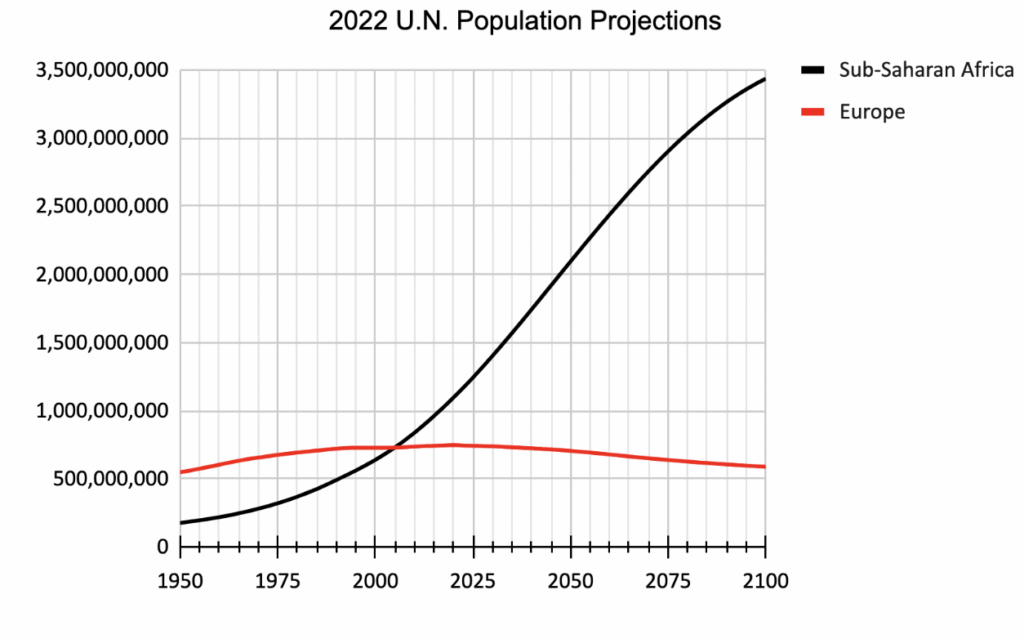
Not everybody is fooled, though. Last weekend, in his annual Tusványos address, Hungarian prime minister Viktor Orbán predicted that a Europe weakened by mass migration will not be able to muster the will to resist the coming waves from Africa, whose population is exploding. The American social critic Steve Sailer has dubbed this image, based on United Nations data, “the most important graph in the world”:
Fifty-two years after its publication, the time has finally come for The Camp of the Saints to find a wide readership—if it can somehow evade the censors, and overcome the tiresome smear that it is nothing but far-right drivel.
Europe is not quite over—but we can see its demise sailing over the horizon. What was in 1973 dystopian speculative fiction is today the stuff of daily headlines. The race wars of Raspail’s 52-year-old novel are now on the verge of breaking out, according to Prof. Betz—and, as he ominously told The European Conservative, the army will not be able to save Britain from what’s coming.
Once again, The Camp of the Saints is not really about migrants; it’s about us, and whether we peoples of the West, long paralyzed by the sentimental humanitarianism and civilizational self-hatred of a spiritually corrupt elite, still have the power to rewrite this tragic story.
No comments:
Post a Comment
Comments are subject to deletion if they are not germane. I have no problem with a bit of colourful language, but blasphemy or depraved profanity will not be allowed. Attacks on the Catholic Faith will not be tolerated. Comments will be deleted that are republican (Yanks! Note the lower case 'r'!), attacks on the legitimacy of Pope Leo XIV as the Vicar of Christ, the legitimacy of the House of Windsor or of the claims of the Elder Line of the House of France, or attacks on the legitimacy of any of the currently ruling Houses of Europe.