
Saint Peter Nolasco was born at the end of the twelfth century in either Languedoc, France, or Barcelona, Spain. At that time, the Moors still held much of Spain, and in sudden raids from the sea they carried off thousands of Christians, holding them as slaves in Granada and in their citadels along the African coast. Peter Nolasco, a merchant by profession, became aware of the plight of these Christian captives on his frequent business trips. He was obsessed with the thought of their suffering, and when, after the death of his father, he received a small inheritance, Peter proceeded to spend it freely in ransoming the Christian slaves. Because of these ventures Peter soon became penniless. He was on the point of despair when he had a vision of the Virgin and heard these words: "Find me men like yourself, an army of brave, generous, unselfish men, and send them into these lands where the children of the faith are suffering." Peter went at once to Saint Raymond of Pennafort, his spiritual director, who used his influence to get approbation and support for the new community. On August 10, 1218, Peter and two companions were received as the first members of the Order of the Blessed Virgin Mary of Mercy, dedicated to the ransom of Christian captives.
The Order spread rapidly. The founder required of himself and his followers a special vow in addition to the usual three--to devote their "whole substance and very liberty to the ransoming of slaves," even to the point of acting as hostages in order to free others. Peter and his comrades traveled throughout Christian Spain, recruiting new members and collecting funds to ransom the captives. Then they began negotiations with the slave-owners. They penetrated Andalusia, crossed the sea to Tunis and Morocco, and brought home cargo after cargo of Christians. Although Peter, as General of the Order, was occupied with its organization and administration, he made two trips to Africa where, besides liberating captives, he converted many Moors. He died after a long illness in 1256, and was canonized by Pope Urban VIII in 1628.
According to records, the Order of the Blessed Virgin Mary for the Ransom of Captives accomplished approximately 70,000 rescues--some 2,700 during the founder's lifetime. Originally the Order was a military order; the members were knights. In 1318 Pope John XXII decreed that the leader of the order should be a priest, an action that caused lay knights to leave the Mercedarians and join a military order of Our Lady of Montesa. The Mercedarians subsequently became a mendicant order. Mercedarians accompanied Columbus to America and founded monasteries in Latin America. They also established themselves in Africa, Italy, France, and Ireland. The anti-clerical mood of the nineteenth century came close to extinguishing the Mercedarians. In 1880, however, their constitution was revised and their apostolate included educational, charitable, and social work, activities which the Mercedarians continued to pursue in the twentieth century.
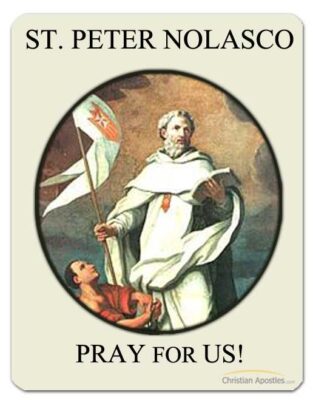
[Roman Martyrology. Authority: life by Franciscus Zumel.]
Peter Nolasco sprang from one of the first families of Languedoc. He was born in the year 1189, in the village of Mas des Saintes Pucelles. His pious parents took pains to give him a good education, and to cultivate the germs of virtue which appeared early in his soul. They saw with gladness his compassion for the poor, and his love of prayer. The child was wont to distribute his pocket-money in alms, and he went regularly to the matin office sung shortly after midnight. When he was aged 15, he lost his father, who left him heir to a large estate, but he remained with his mother, a pious woman, who laboured to strengthen and confirm in him those graces which grew and expanded daily. Being solicited to marry, he remained some little while in hesitation, but at last, rising one night he cast himself before his crucifix in prayer, and remained till day broke in the east, imploring God's guidance, and then feeling a clear call, he resolved to devote his patrimony to the honour and glory of God, and himself to celibacy. He followed Simon de Montfort, in the crusade against the Albigenses, an heretical, or rather heathen sect, holding two Gods, one good, the other evil, and who had devastated Navarre, burning churches and massacring priests and monks. The crusade was conducted with too much of worldly ambition, and without that compassionate love which should seek to win by gentleness rather than force by the sword. But the cruel massacres which took place were not the work of the crusaders, but of a mixed multitude of camp-followers, who obeyed no officers but such as they chose to appoint, as appears from the contemporary accounts of that war. However, Peter Nolasco was in no way responsible for the barbarities which sullied this terrible war. In the battle of Muset, the King of Aragon, who headed the Albigenses, was killed, and his son, aged six, fell into the hands of Simon de Montfort, who appointed Peter Nolasco, then aged twenty-five, to be his tutor, and sent both together into Spain. In the court of the King of Barcelona, where the Kings of Aragon resided, Peter led the life of a recluse. The Moors at that time were possessed of a considerable portion of Spain, and great numbers of Christians groaned under their tyranny in miserable slavery both there and in Africa. Whenever Peter saw a Christian slave, he was moved with sorrow; and he resolved to devote his life to the redemption of captives. He endeavoured to found a religious order for a constant supply of men and means whereby to carry on so charitable an undertaking. This design met with great obstacles in the execution; but the Blessed Virgin appearing to the [Pg 472]king, S. Raymund of Pennaforte, and S. Peter Nolasco, the same night, in visions, encouraged the prosecution of this charitable scheme.
In the year 1223 S. Peter took the vows before the Bishop of Barcelona, and he became first general of the new order, which was entitled "the Order of Our Lady of Mercy for the redemption of captives." It was confirmed by Pope Gregory IX. in 1225. The habit is white, with a white scapular, and the arms of Aragon were worn on the breast, by desire of the king.
S. Peter, after his religious profession, renounced all his business at court, and no entreaties of the king could prevail on him to appear there again, except once, when called to reconcile two powerful nobles, who by their dissension had kindled a civil war.
He made several journeys along the coasts, and to Algiers to purchase captives; on one of these expeditions he underwent imprisonment for the faith. He died on Christmas day, 1286. Almost his last words were those of the Psalmist, which summed up the efforts of his life, "The Lord hath sent redemption unto His people; He hath commanded His covenant for ever."
No comments:
Post a Comment
Comments are subject to deletion if they are not germane. I have no problem with a bit of colourful language, but blasphemy or depraved profanity will not be allowed. Attacks on the Catholic Faith will not be tolerated. Comments will be deleted that are republican (Yanks! Note the lower case 'r'!), attacks on the legitimacy of Pope Leo XIV as the Vicar of Christ, the legitimacy of the House of Windsor or of the claims of the Elder Line of the House of France, or attacks on the legitimacy of any of the currently ruling Houses of Europe.