✠✠✠✠✠

Great and Holy Saturday is the day on which Christ reposed in the tomb. The Church calls this day the Blessed Sabbath.
“The great Moses mystically foreshadowed this day when he said:
God blessed the seventh day.
This is the blessed Sabbath
This is the day of rest,
on which the only-begotten Son of God rested from all His works....”
(Vesperal Liturgy of Holy Saturday)
By using this title the Church links Holy Saturday with the creative act of God. In the initial account of creation, as found in the Book of Genesis, God made man in His own image and likeness. To be truly himself, man was to live in constant communion with the source and dynamic power of that image: God. Man fell from God. Now Christ, the Son of God through whom all things were created, has come to restore man to communion with God. He thereby completes creation. All things are again as they should be. His mission is consummated. On the Blessed Sabbath, He rests from all His works.
THE TRANSITION
Holy Saturday is a neglected day in parish life. Few people attend the Services. Popular piety usually reduces Holy Week to one day—Holy Friday. This day is quickly replaced by another—Easter Sunday. Christ is dead and then suddenly alive. Great sorrow is suddenly replaced by great joy. In such a scheme Holy Saturday is lost.
In the understanding of the Church, sorrow is not replaced by joy; it is transformed into joy. This distinction indicates that it is precisely within death that Christ continues to effect triumph.
TRAMPLING DOWN DEATH BY DEATH
We sing that Christ is “...trampling down death by death” in the Troparion of Easter. This phrase gives great meaning to Holy Saturday. Christ’s repose in the tomb is an “active” repose. He comes in search of His fallen friend, Adam, who represents all men. Not finding him on earth, he descends to the realm of death, known as Hades in the Old Testament. There He finds him and brings him life once again. This is the victory: the dead are given life. The tomb is no longer a forsaken, lifeless place. By His death Christ tramples down death by death.
THE ICON OF THE DESCENT INTO HADES
The traditional icon used by the Church on the feast of Easter is an icon of Holy Saturday: the descent of Christ into Hades. It is a painting of theology, for no one has ever seen this event. It depicts Christ, radiant in hues of white and blue, standing on the shattered gates of Hades. With arms outstretched He is joining hands with Adam and all the other Old Testament righteous whom He has found there. He leads them from the kingdom of death. By His death He tramples death.
“Today Hades cries out groaning:
I should not have accepted the Man born of Mary.
He came and destroyed my power.
He shattered the gates of brass.
As God, He raised the souls I had held captive.
Glory to Thy cross and resurrection, O Lord!”
(Vesperal Liturgy of Holy Saturday)
THE VESPERAL LITURGY
The Vespers of Holy Saturday inaugurates the Paschal celebration, for the liturgical cycle of the day always begins in the evening. In the past, this service constituted the first part of the great Paschal vigil during which the catechumens were baptized in the “baptisterion” and led in procession back into the church for participation in their first Divine Liturgy, the Paschal Eucharist. Later, with the number of catechumens increasing, the first baptismal part of the Paschal celebration was disconnected from the liturgy of the Paschal night and formed our pre-paschal service: Vespers and the Liturgy of Saint Basil the Great which follows it. It still keeps the marks of the early celebration of Pascha as a baptismal feast and that of Baptism as the Paschal sacrament (death and resurrection with Jesus Christ—Romans 6).
On “Lord I Call” the Saturday Resurrectional stichiras of Tone 1 are sung, followed by the special stichiras of Holy Saturday, which stress the death of Christ as a descent into Hades, the region of death, for its destruction. But the pivotal point of the service occurs after the Entrance, when fifteen lessons from the Old Testament are read, all centered on the promise of the Resurrection, all glorifying the ultimate Victory of God, prophesied in the victorious Song of Moses after the crossing of the Red Sea (“Let us sing to the Lord, for gloriously has He been glorified”), the salvation of Jonah, and that of the three youths in the furnace.
Then the epistle is read, the same epistle that is still read at Baptism (Romans 6:3-11), in which Christ’s death and resurrection become the source of the death in us of the “old man,” the resurrection of the new, whose life is in the Risen Lord. During the special verses sung after the epistle, “Arise, O God, and judge the earth,” the dark lenten vestments are put aside and the clergy vest in the bright white ones, so that when the celebrant appears with the Gospel the light of Resurrection is truly made visible in us, the “Rejoice” with which the Risen Christ greeted the women at the grave is experienced as being directed at us.
The Liturgy of Saint Basil continues in this white and joyful light, revealing the Tomb of Christ as the Life-giving Tomb, introducing us into the ultimate reality of Christ’s Resurrection, communicating His life to us, the children of fallen Adam.
One can and must say that of all services of the Church that are inspiring, meaningful, and revealing, this one: the Vespers and Liturgy of Saint Basil the Great and Holy Saturday is truly the liturgical climax of the Church. If one opens one’s heart and mind to it and accepts its meaning and its light, the very truth of our Holy Faith is given by it, the taste and the joy of that new life which shines forth from the grave.
Troparion — Tone 2
When You descended to death, O Life Immortal, / You slew hell with the splendour of Your Godhead, / and when from the depths You raised the dead, / all the Powers of Heaven cried out, / O Giver of Life, Christ our God, glory to You!
Kontakion — Tone 6
He who shut in the depths is beheld dead, / wrapped in fine linen and spices. / The Immortal One is laid in a tomb as a mortal man. / The women have come to anoint Him with myrrh, / weeping bitterly and crying: / “This is the most blessed Sabbath / on which Christ has fallen asleep to rise on the third day!”
✠✠✠✠✠
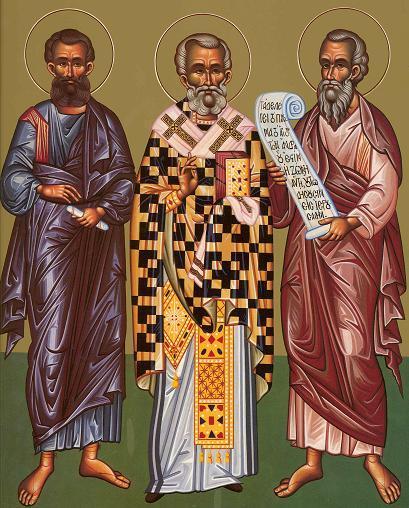
The holy Apostle Herodion was a relative of Saint Paul and his companion on many journeys. When Christianity had spread to the Balkan Peninsula, the Apostles Peter and Paul established Saint Herodion as Bishop of Patara. Saint Herodion zealously preached the Word of God and converted many of the Greek pagans and Jews to Christianity.
Enraged by the preaching of the disciple, the idol-worshippers and Jews with one accord fell upon Saint Herodion, and they began to beat him with sticks and pelt him with stones. One of the mob struck him with a knife, and the saint fell down. But when the murderers were gone, the Lord restored him to health unharmed.
Saint Herodion continued to accompany the Apostle Paul for many years. When the holy Apostle Peter was crucified (✠ c. 67), Saint Herodion and Saint Olympos were beheaded by the sword at the same time.
The holy Apostle Agabus was endowed with the gift of prophecy. He predicted (Acts 11:27-28) the famine during the reign of the emperor Claudius (41-52), and foretold the suffering of the Apostle Paul at Jerusalem (Acts 21:11). Saint Agabus preached in many lands, and converted many pagans to Christ.
Saint Rufus, whom the holy Apostle Paul mentions in the Epistle to the Romans (Rom. 16:11-15), was bishop of the Greek city of Thebes. Saint Asyncritus (Rom. 16:14) was bishop in Hyrcania (Asia Minor). Saint Phlegon was bishop in the city of Marathon (Thrace). Saint Hermes was bishop in Dalmatia (there is another Apostle of the Seventy by the name of Hermas, who was bishop in the Thracian city of Philippopolis).
All these disciples for their intrepid service to Christ underwent fierce sufferings and were found worthy of a martyr’s crown.
Troparion — Tone 1
Let us praise in hymns the six-fold choir of Apostles: / Herodion and Agabus, / Rufus, Asyncritus, Phlegon and holy Hermes. / They ever entreat the Trinity for our souls!
Troparion — Tone 3
Holy Apostles / entreat the merciful God / to grant our souls forgiveness of transgressions.
Kontakion — Tone 4
With the light of the Holy Spirit, / you illumine the way of the faithful like stars, O Holy Apostles. / As you gaze on God the Word you repel the darkness of error.
Kontakion — Tone 2
You became the disciples of Christ / And all-holy Apostles, / O glorious Herodion, Agabus and Rufus, / Asyncritus, Phlegon and Hermes. / Ever entreat the Lord / To grant forgiveness of transgressions / To us who sing your praises.
No comments:
Post a Comment
Comments are subject to deletion if they are not germane. I have no problem with a bit of colourful language, but blasphemy or depraved profanity will not be allowed. Attacks on the Catholic Faith will not be tolerated. Comments will be deleted that are republican (Yanks! Note the lower case 'r'!), attacks on the legitimacy of Pope Leo XIV as the Vicar of Christ, the legitimacy of the House of Windsor or of the claims of the Elder Line of the House of France, or attacks on the legitimacy of any of the currently ruling Houses of Europe.